
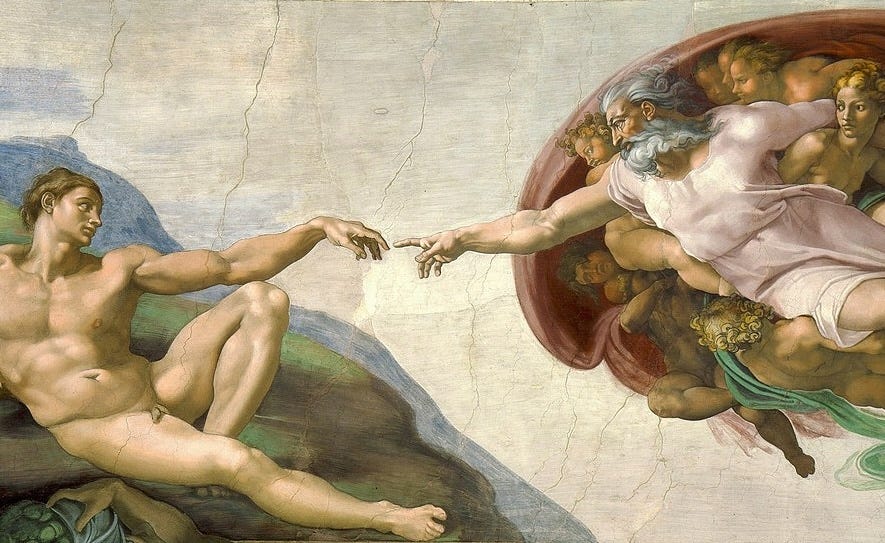
The opening words of the Bible declare that in the beginning God created the heavens and the earth. The next verse talks about a formless void, darkness, and the spirit of God hovering over the deep waters. In the beginning, we might say, there was the potentiality of everything, which at the same time is nothing in particular. At least, not until language calls order out of chaos, with the words, ‘let there be light’. A voice spoke, and what is came to be. The formless chaos is given form. The infinite variety of life emerges from out of the deep waters.
The belief that some form of supernatural agency assembled the world, in six 24-hour days, some 6000 years ago is easy to mock. Look at the geological record. Look at the knowledge we now have about the size and age of the known universe. But this would be to misunderstand the nature and purpose of myth.
A myth is not a fanciful account of history long forgotten, but a narrative of human meaning.
The story of creation recorded in the Book of Genesis tells us that, whatever else it may be, reality is ordered and structured. Something created is something intended, even if for no particular reason, and intention implies some kind of purposive intelligence. When we use the term ‘creation’ to talk about existence, we are saying that what is is meant to be.
We can all presumably agree that we live in a universe that is intelligible to us, that operates according to processes that are discoverable by us, and that these workings can to a large extent be described by what we call mathematics. However, this can lead to divergent conclusions. For some, the magic of mathematics indicates divine order and intelligence in the universe, whilst for others – perhaps in some societies, these days, a majority – a world described by the language of the natural sciences and the grammar of mathematics gives rise to the opposite view, namely that there is no underlying order or intelligence in the universe at all.
I have to say, I’m always puzzled by the uncritical assumption that scientific knowledge necessarily ‘disproves’ the existence of God. And I’m tired of hearing people mindlessly repeat lazy cliches along the line that belief in God is self-evidently irrational. For centuries, scientists saw evidence for God in the laws of nature they discovered. The very fact of the intelligibility of the universe, they thought, corroborated the idea of some sort of over-arching intelligence in which that intelligibility was grounded. In other words, the reason the universe is understandable to us, appears to be ordered, rational, and coded with meaningful information, is that it is imbued with conscious, purposive, intelligence.
And yet…
According to the prevailing orthodoxy of scientific materialism, the basic ’stuff’ of existence, including conscious life itself, is reducible to insentient, lifeless, matter. But this leaves some really big questions unanswered. We cannot account for the emergence of life from inert, non-living, chemicals. And we cannot account for the experience we irrefutably have of conscious awareness. Lacking explanations that fit the paradigm, we simply assume that life inexplicably emerges by chance, an mere accident, and that consciousness, in spite of the incontrovertible facts of personal experience, is merely an illusion arising from otherwise entirely physical brain processes. On this view, the universe is ultimately meaningless and exists for no reason. It is certainly not imbued with purposive intelligence.
That may or may not be true – we could never possibly know one way or the other – but it is a deeply unsatisfactory conclusion to draw. Not least because out of all the possible universes that could exist, one capable of supporting intelligent life is highly improbable. The physical constants, such as gravitational force, have to be just exactly so for life even to be possible. The likelihood of order arising by accident in the mere 14 billion years of the existence of the universe so far is inconceivably small. Pure chance can’t be ruled out – it’s improbable not impossible – but it hardly seems to be the more likely explanation. We have no plausible account of how life can emerge from non-living matter. Indeed, it seems about as likely as a radio being able to enjoy the music it plays. So, the notion that life, the universe, and everything – including the fact that we can even think about any of this in the first place – is simply the consequence of random chance would arguably require a far greater leap of faith than the proposition that things are the way they are because they’re meant to be.
Whether by accident or design there is something rather than nothing. Moreover, the ‘something’ in question is actually this, and not something else, even though statistically it would seem far more probable that what is could so easily have been what isn’t. Surely, therefore, the most economical explanation is that reality was intended to be this way simply because, if left to chance, it is so much more likely that it would have been some other way. Yes, you can say it’s just chance and therefore doesn’t mean anything at all – there is no reason for what is to be what it is – but is that really more rational?
Creation thus refers not so much to the idea of a super-powerful entity, outside time and space, somehow assembling the universe like Lego. Rather, it is simply a way of saying that existence exists for a reason. What is is what is because it’s meant to be. It is somehow deliberate. Moreover, the fact that the universe is intelligible implies that existence is undergirded by intelligence. This intuition runs through the literature of ancient wisdom traditions, including the Bible, in which intelligence is described as ‘the cause of all things and the ‘fashioner of what exists’ (Wisdom 8.5-6). Finally, it seems reasonable to conclude that we can plausibly account for these observations by positing consciousness, rather than matter, as the fundamental substrate of existence. The simplicity of this move solves a number of otherwise intractable problems. Whilst it is impossible to account for the emergence of life and consciousness from inanimate matter, it is surprisingly easy to explain both consciousness and matter if, in fact, consciousness is an irreducible property of existence itself. So, when we ask how did conscious life emerge from inert matter, we are asking the wrong question. It didn’t. Consciousness comes first.
The primacy of consciousness is also reflected in the opening words of John’s Gospel, which deliberately echo the first verse of the Book of Genesis. In the beginning was the Word. The ‘Word’ denotes language and rationality, which in turn implies the facility to know, to have intelligence and, therefore, consciousness. This beginning is not an event in history a long, long time ago but, rather, a way of signifying our most basic foundational assumption, the ultimate starting point of everything. To say ‘in the beginning was the Word’, therefore, is to say that consciousness is the bottom line, the basic fact of reality. It is both the beginning and the end, alpha and omega. Moreover, what is can only be. Consciousness cannot not exist, darkness cannot overcome it – as the Prologue to John’s Gospel continues – because darkness is not a thing, but rather the word we use to describe the absence of light.
In the beginning was the Word. How, or why we do not know. Reality is just what is. But it is made intelligible, to us, by language. Why is there something rather than nothing? Why does life exist? What is consciousness? How has it come to be? Why are we even able to ask these questions in the first place? These are not questions to which we do not yet have answers, but questions which by their nature cannot be answered. This is the purpose of faith, which is not the opposite of reason, but its foundational axiom. Faith is a choice we make in the face of what cannot be known. Everything we think we know is based, ultimately, on assumptions that are accepted in the absence of proof. Something must be assumed as a starting point and, to some extent, that is an arbitrary choice. Why this starting point and not that one?
Because it is the most elegant and economical way of making sense of everything else.
Whether or not we believe existence exists for a reason is among the most fundamental choices we make as human beings. If it doesn’t, then nothing has any meaning at all. The existence of the universe is a matter of pure chance, the appearance of laws of nature just that – an appearance – and the fact that any of it is intelligible to us an insignificant coincidence. This is the dividing line between faith and unbelief. It is the basic assumption that determines everything that follows. That is our choice. To see the world as ‘creation’ is to see it as existing for a reason, rather than by accident. It is to see it as a manifestation of agency, will and intelligence, an energy, if you like, that we often describe in terms of love.
The creation story then goes one step further, declaring that human beings are made in the image and likeness of God. This is to say that the deepest truth of what we are is somehow related to that which is ultimately real and true. God is the name we give to that which both transcends the self, and in which the self inheres; a reality that is intimately familiar and yet utterly strange. This is why we do not need to go off looking for God on great ‘spiritual journeys’, because God is, paradoxically, what is most human about us. Yet, at the same time, what we are is defined by what we are not. We are but an image, a likeness, neither exactly the same nor completely different. This highlights the theme of alienation – from that which is ultimately real and true – that characterises the experience of being human. We are not present. We are not here. We are not... Our essential non-being is mirrored in the example of Christ, who ‘though he was in the form of God (...) emptied himself (...) being born in human likeness’ (Philippians 2.6-7). The archetypal Christian virtue is selflessness; the nature of Christ is, literally, a state of non-self.
The doctrine of the Incarnation states that Jesus is both fully human and fully divine. This is one of the most scandalous claims in history, as offensive to the religious sensibilities of the ancient world as it is to the cultured elites of today. How can that be possible? Why there? Why then? Every time and every place, to us, is arbitrary. Hence, we ask, why Bethlehem? Why would the saviour of the world be born in some dismal corner of an insignificant province of the Empire? By contrast, every time and every place is the same to God. So, he answers, ‘why not?’
The meaning of Christmas is this: the only place we can know God is here; the only time we can know God is now.
No posts
Comments
Nothing yet. Say the first thing.
Sign in to join the conversation.