
Navigate to other related articles:
(new) Listening to children’s spiritual expression
Introducing the landmark study: Faith in the Nexus
Animating children’s voices: bring faith talk alive for adults and children at school and at home.
Nexus Research in Church Toddler Groups
Transforming Research into Practice
Academic Articles
How Faith in the Nexus research captured children’s spiritual oracy, advanced theory, and informed education and church policy and practice
Bowie, R.A., Pittaway, A., Casson, A. et al. How Faith in the Nexus research captured children’s spiritual oracy, advanced theory, and informed education and church policy and practice. j. relig. educ. (2026). https://doi.org/10.1007/s40839-026-00298-3
Religious Education in Catholic and Church of England schools has often emphasised top-down transmission of tradition and spiritual practice. While this may remain important, Pope Francis’ Global Compact on Education (2019) calls for attentive listening to children. Young people are co-agents in their own formation. This paper draws primarily on findings from the Faith in the Nexus research, which explored children’s own accounts of prayer, reflection, and spiritual flourishing in primary schools. It argues that children are active initiators of spiritual meaning-making and that listening to their voices provides fresh insights for schools, families, and churches. These findings suggest a need to rebalance practice towards a dialogic model of spiritual education, affirming children’s capacity for spiritual oracy and contributing to wider interdisciplinary debates on spirituality, wellbeing, and inclusion.
Casson, A., Woolley, M., Hulbert, S., & Bowie, R. A. (2023). Prioritising a Sense of Belonging Within the Rural Nexus: An Empirical Study of Five Rural Church Primary Schools. Rural Theology, 21(2), 95–108. https://doi.org/10.1080/14704994.2023.2249659
The rural church primary school exists in a nexus of connections between school, home, and the institutional Church (parochial, diocesan, and national). This article applies Walker’s model of belonging to God through church to the sense of belonging expressed by families whose children attend a rural Church of England primary school. The data drawn from the Faith in the Nexus project undertaken at Canterbury Christ Church University, consists of 24 semi-structured focus group interviews, and 8 individual interviews with school and church leaders from parents, school staff, clergy, and governors across five rural Church of England primary schools. The findings highlight how rural church school families develop and sustain a sense of belonging through events, people, place, and activities. The discussion considers the value of Walker’s model of belonging, the fragility of the rural nexus and a need to acknowledge the relational nature of belonginess expressed by parents and pupils.
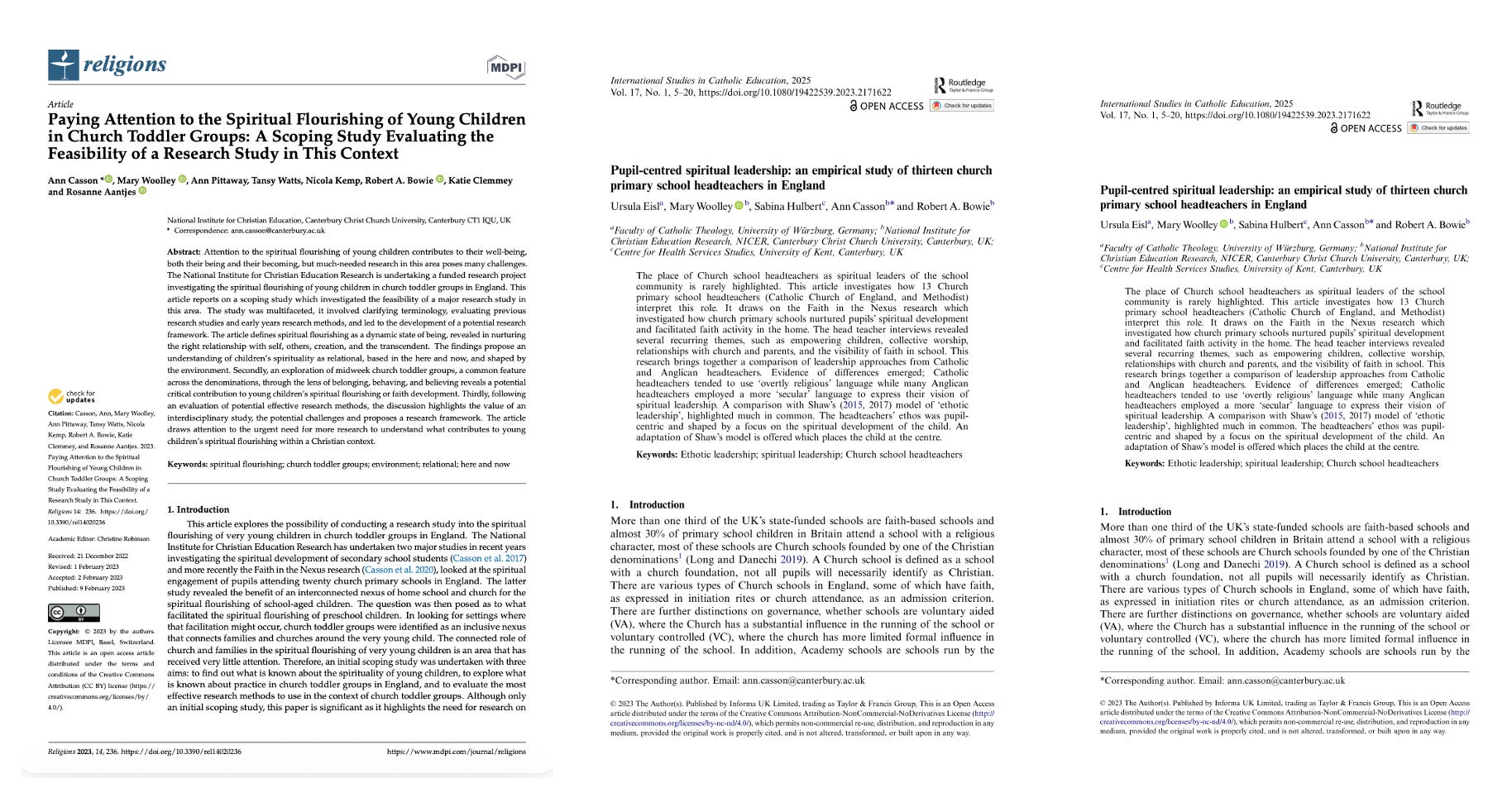
Eisl, U., Woolley, M., Hulbert, S., Casson, A., & Bowie, R. A. (2025). Pupil-centred spiritual leadership: an empirical study of thirteen church primary school headteachers in England. International Studies in Catholic Education, 17(1), 5–20. https://doi.org/10.1080/19422539.2023.2171622
The place of Church school headteachers as spiritual leaders of the school community is rarely highlighted. This article investigates how 13 Church primary school headteachers (Catholic Church of England, and Methodist) interpret this role. It draws on the Faith in the Nexus research which investigated how church primary schools nurtured pupils’ spiritual development and facilitated faith activity in the home. The head teacher interviews revealed several recurring themes, such as empowering children, collective worship, relationships with church and parents, and the visibility of faith in school. This research brings together a comparison of leadership approaches from Catholic and Anglican headteachers.
Casson, A.; Woolley, M.; Pittaway, A.; Watts, T.; Kemp, N.; Bowie, R.A.; Clemmey, K.; Aantjes, R. Paying Attention to the Spiritual Flourishing of Young Children in Church Toddler Groups: A Scoping Study Evaluating the Feasibility of a Research Study in This Context. Religions 2023, 14, 236. https://doi.org/10.3390/rel14020236
Attention to the spiritual flourishing of young children contributes to their well-being, both their being and their becoming, but much-needed research in this area poses many challenges. The National Institute for Christian Education Research is undertaking a funded research project investigating the spiritual flourishing of young children in church toddler groups in England. This article reports on a scoping study which investigated the feasibility of a major research study in this area. The study was multifaceted, it involved clarifying terminology, evaluating previous research studies and early years research methods, and led to the development of a potential research framework. The article defines spiritual flourishing as a dynamic state of being, revealed in nurturing the right relationship with self, others, creation, and the transcendent.
Comments
Nothing yet. Say the first thing.
Sign in to join the conversation.