
There’s a lot of noise about elections and prediction markets as we near midterm elections. But there’s one specific angle I wonder about a lot.
In 2024, Republicans liked to point out how great prediction markets were, including making Donald Trump a favorite on his way to a convincing victory in the presidential race.
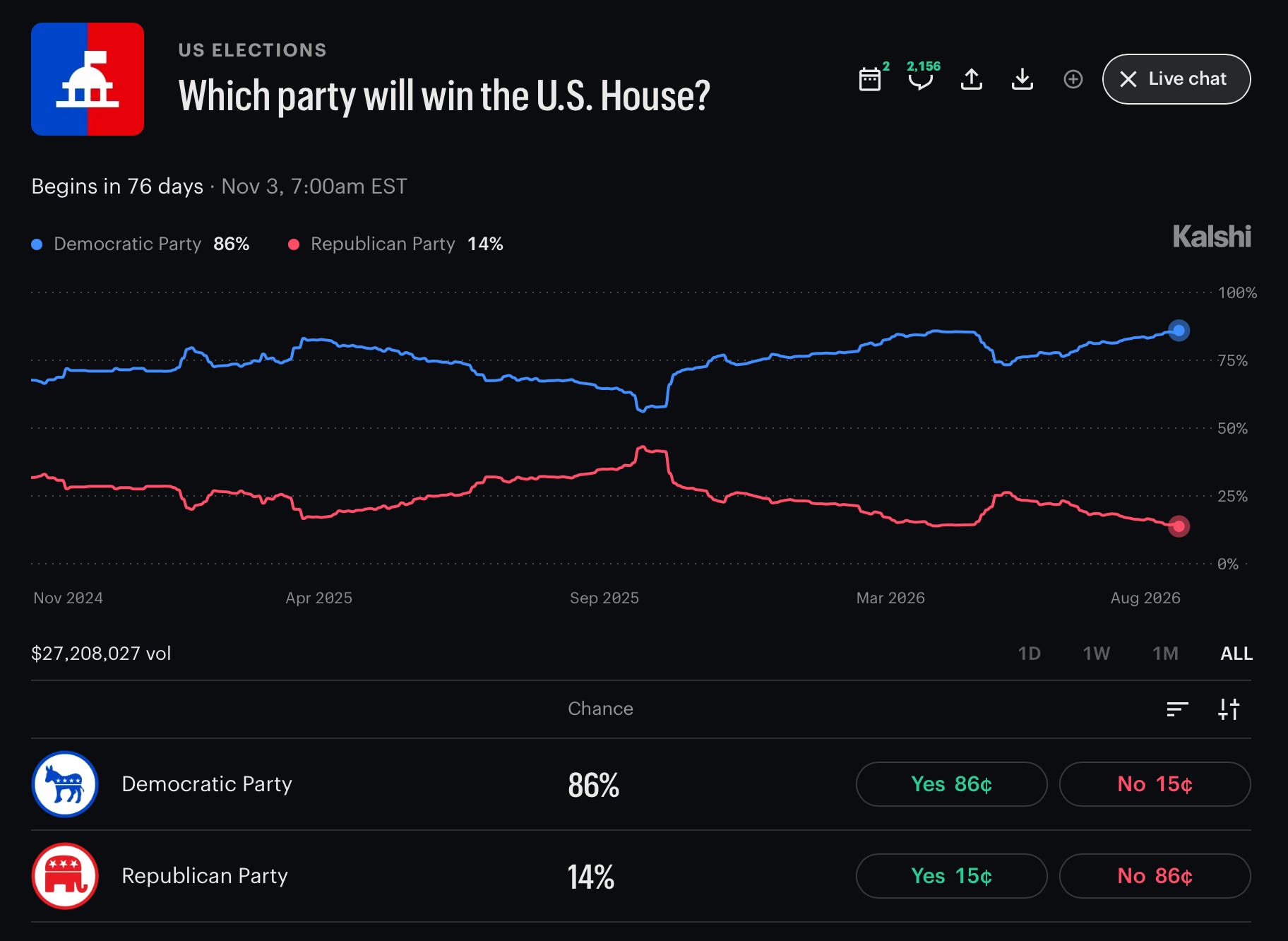
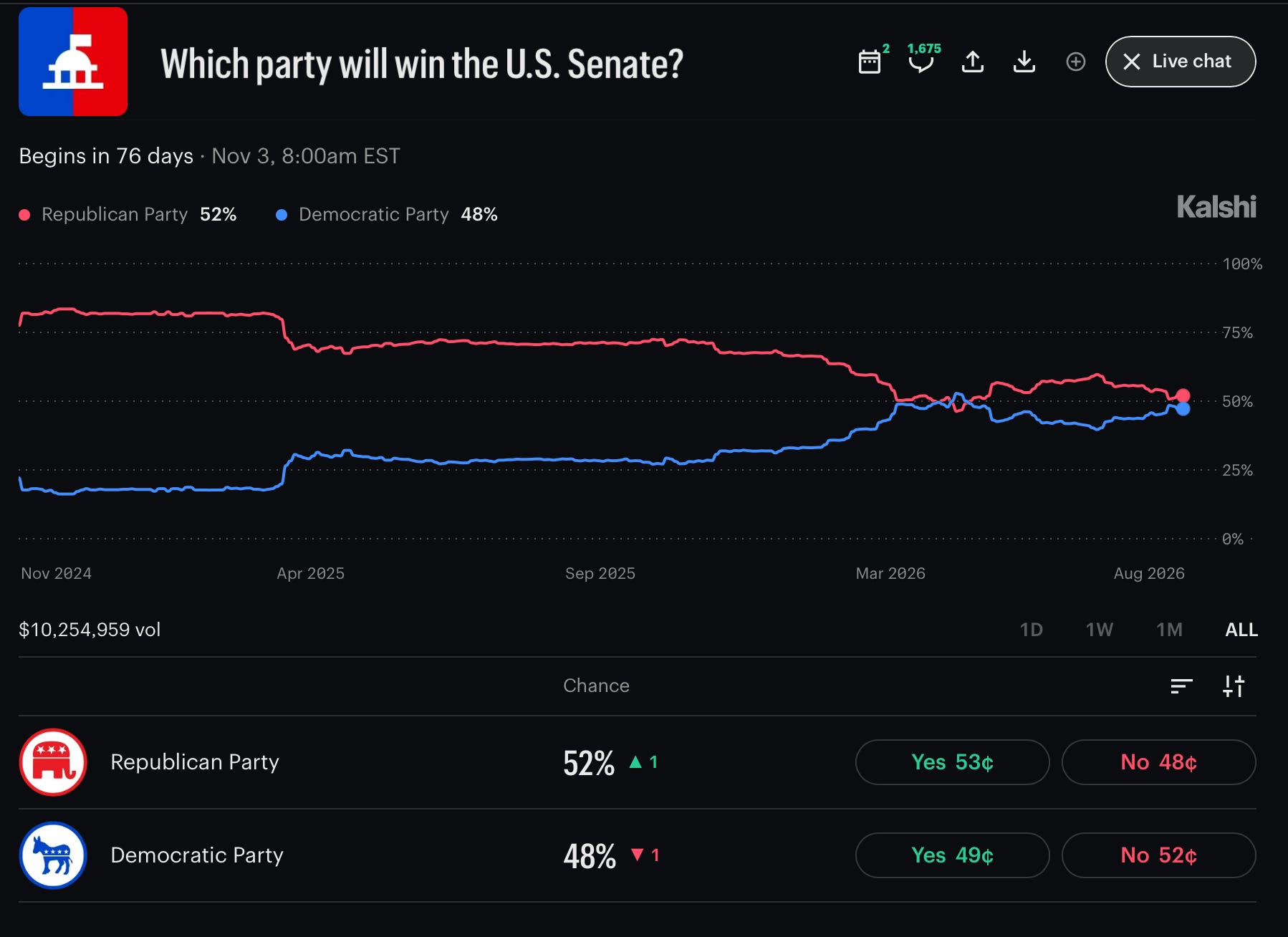
In 2026, prediction markets like Democrats’ chances more than they do Republicans’. I’ll use Kalshi odds, but the story is the same across prediction markets:
Democrats are a sizable favorite to take control of the House:
Control of the Senate is about a coin flip:
Which leads me to this:
Republicans very much liked prediction markets when they told a narrative that fit their worldview and validated their victories. How much will Republicans like prediction markets if they show their side losing?
Honestly, the narrative for prediction markets on the Republican side of the aisle could be kind of fraught from a comms standpoint:
If Republicans continue to be underdogs in the House, will they start telling us not to listen to prediction markets?
If Republicans buck the odds and win the House as underdogs, will they tell us that prediction markets are “fake news,” just like they have done for polls in the past?
We’re in uncharted territory here. Yes, we’ve had betting on elections before. But we’ve never had election markets at the scale we will have this year, and never with prediction markets as much a part of the national consciousness as they are now.
Anyway, I think it’s an interesting dynamic. Prediction markets have in some ways been a darling of Republicans coming out of 2024. “They tell us the truth” was the message after Trump won. If Republicans aren’t portrayed as winning, will they sing a different tune?
Of course, we still have months until the actual election. A lot of things can happen, we’ll get more polling data, etc. These odds will also most certainly change.
But prediction markets telling a story of Republicans not being the favorites will be one of several interesting dynamics leading up to November.
A quick look at what matters most in prediction markets.
Cantor Lets Hedge Funds Place Big Bets on Kalshi’s Prediction Markets (Wall Street Journal): “Cantor’s some 3,000 institutional clients, which range from family offices to hedge funds, will have full access to Kalshi’s suite of events-based, yes-or-no contracts such as those tied to weather, commodities and corporate results.”
Press release here notes that Susquehanna will provide pricing and liquidity.
“We believe the next area of material growth for prediction markets will be large institutional risk transfer,” said Joe Grubb, Head of Business Development at Susquehanna Predictions. “We are able to price and execute custom, tailored contracts for institutional counterparties desiring to hedge both general market and bespoke industry risk currently unserved by traditional insurance markets. Our ability to do so quickly and at scale will provide a valuable solution to this unmet market demand.”
More color from CNBC: “The global investment firm will serve as a broker, meaning it will organize the block trades on Kalshi’s event contracts for its clients. Block trades are large, privately negotiated transactions that are typically executed outside of a public market to avoid price volatility, and are a feature of trading by large Wall Street firms.”
“Wednesday’s announcement marks the latest move by Kalshi to appeal to Wall Street. The company has increasingly focused on professional investors even as retail traders up until now have driven its rise, primarily trading on the platform’s sports-related event contracts.”
CNBC also reported this week that Kalshi filed to list perpetual futures contracts tied to financial indices, spreading another tendril of diversification out into the institutional realm.
This follows yesterday’s news that Cartesian Digital was also adding prediction markets to its institutional trading services, though Kalshi did not feature in that announcement by name.
It also seems related to last week’s announcement that Kalshi had begun distributing its live order book over a dedicated fiber network on the DoubleZero protocol, an institutional data feed aimed at the biggest trading desks.
ICYMI: Tech Times’ dive on the data pipeline is fantastic.
The New York Times previewed this in some depth back in June: “Small businesses, including a New York City beer bar and a specialist sports insurer, have already used Kalshi for hedging their business risks. But the platform has spent months hiring trading specialists and working with financial firms to lay the groundwork for institutions to do that, too.”
🔍 There’s a lot to ponder here, both in terms of product and in the context of the emerging legal headwinds at the state level. Kalshi is trying very, very hard to position itself as a legitimate financial entity rather than a dressed-up sportsbook, and it is now making the sorts of maneuvers that legitimately help its case. This institutional build-out also acts as a practical hedge against any ongoing complications for the sports/novelty component of its operation.
The White House bailed on prediction markets for its Wednesday gathering, but the industry is still set to feature in Thursday’s inaugural meeting of the CFTC’s Innovation Advisory Committee.
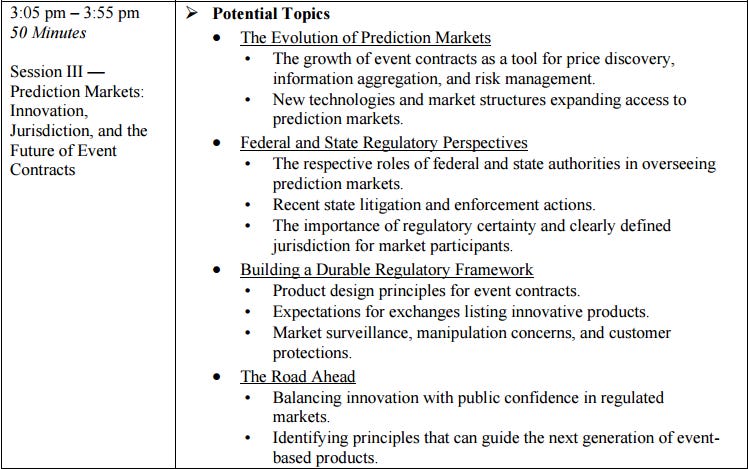
Opening remarks start at 1:00 pm Eastern, and prediction markets occupy the meeting’s final session from 3:05-3:55.
Here’s the agenda:
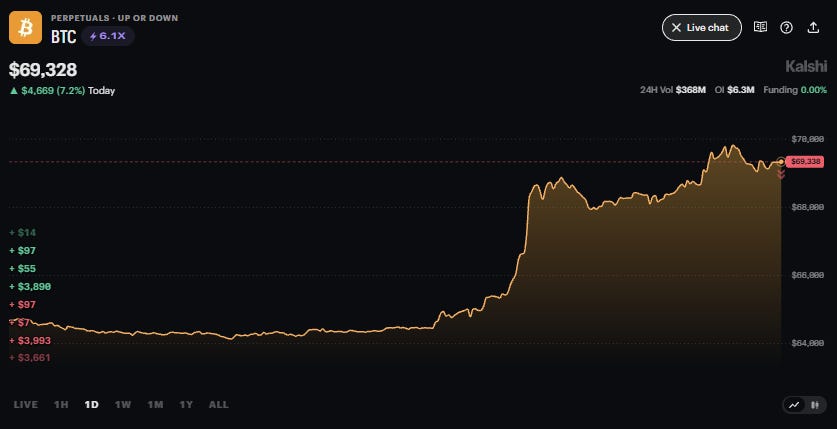
BTC markets, including the up/down perpetual which has generated 24h trading volume of around $400 million.
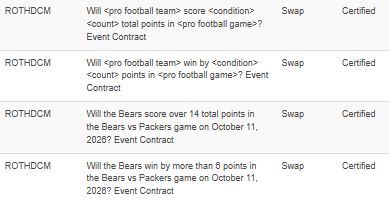
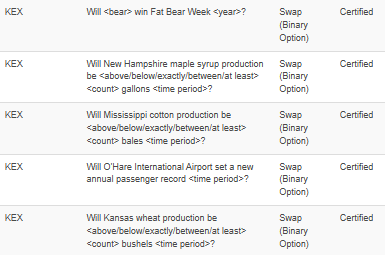
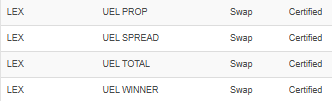
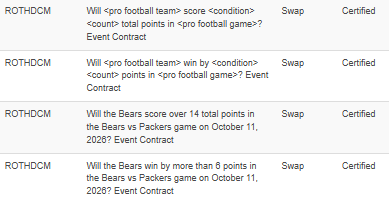
New self-certifications listed with the Commodity Futures Trading Commission:
Kalshi: State-specific commodity production, O’Hare passenger counts, and… Fat Bear Week? Don’t worry, I looked it up for you. Fat Bear Week is (obviously) an annual contest hosted by the Katmai National Park & Preserve to highlight the impressive fatness of bears preparing for winter hibernation.

Novig: More soccer, just like yesterday.

Rothera: NFL spreads and totals, both generic and specific.
Gemini: Two sister markets for the US Open Women’s Championship.

“The dream of creating an honest consensus now works as a kind of acid, a solvent dismantling the capacity for coordination. What we’re left with is a system for producing conflict, a machine for generating chaos.”
— Finn Brunton, for Harper’s (more below in the roundup)
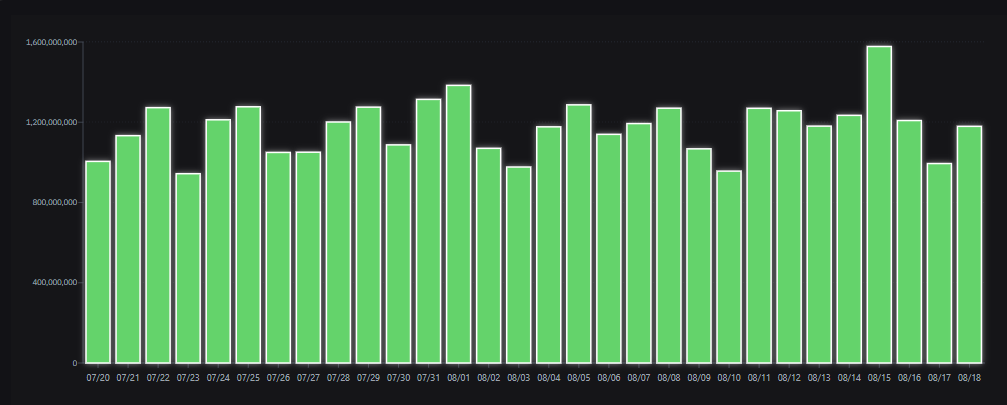
Kalshi volume: $1.18 billion
Sports + parlays: 76.5% of volume
Crypto markets: 17.9% of volume
Trend line from TickerTracker:
Volume on other platforms:
Polymarket US: $106 million
Rothera: $14.9 million
Underdog: $12.6 million
ProphetX: $4.45 million
DKeX: $557,181

You can’t pause current events when your payments can’t keep up. With every failed deposit or lengthy withdrawal process, customers lose trust in your brand. And when money doesn’t move fast enough, your liquidity suffers. PayNearMe’s PayXMTM platform is purpose-built for Payment Experience Management, giving you the fast, familiar payment options your customers want while streamlining back-end operations for your team. Get real-time payments for real-time events—from one simple integration.
Everything else important that happened in or was written about prediction markets:
How prediction markets became the center of a fake California poll scandal (SFGATE): “At least three “polls” were published last Thursday by a group called Median Strategies and circulated around California, Nevada and Wisconsin. The California poll claimed that Los Angeles Mayor Karen Bass was 12 points ahead of opponent Nithya Raman.”
“Representatives for Median Strategies told the LA Times on Monday that the entire project was a “social experiment.” The group took down its website and posted a statement late Monday warning that its data ‘should not be cited or treated as genuine polling data.’”
“Two political polling experts told SFGATE that the fake poll could have been an attempt to sway betting markets, which allow people to gamble on political races.”
🔍 The original story did seem somehow incomplete when it initially broke, and of course prediction markets would pop up as a suspect. Whether or not the sources in this story are onto something sinister here, it does underscore the many ways a market like this could be manipulated and the countless attack surfaces available to bad actors.
Bill To Ban Wildfire Prediction Markets Filed In Congress (InGame): “The bill itself casts a wide net by effectively banning all contracts tied to anything involving a wildfire, including when one starts, where it happens, how long it lasts, how big it gets, how fast it spreads, and when it gets contained. Contracts involving evacuations, injuries, deaths, or property damage would also be banned.”
“This may be a solution in search of a problem, as it would appear no prediction markets are actually offering contracts on wildfires. The last time this happened appears to be back in January of 2025, when Polymarket offered contracts on the containment of the Palisades fire in California.”
Two pieces of international bad news for Polymarket from NEXTPredict:
South Korea to block Polymarket over illegal gambling claims: “South Korea has decided to move forward with a plan to block access to Polymarket after arguing the crypto-based prediction market provided an illegal gambling environment for domestic users.”
Denmark blocks Polymarket in sweep of unlicensed gambling sites: “Denmark has blocked access to prediction markets operator Polymarket after a court upheld the gambling regulator’s request to restrict 98 unlicensed gambling websites.”
“Taxation and Economic Growth Minister Jakob Engel-Schmidt singled out Polymarket in a statement. He said the service lets users wager and speculate on war and other grave events. The minister condemned the treatment of deaths, bereavement and conflicts as tradeable propositions. He said companies seeking Danish customers must comply with Danish rules.”
CFTC Requests Comment on the Listing of Compute Derivatives Contracts (press release): The Commodity Futures Trading Commission today issued a request for comment to better inform its understanding and oversight of derivatives markets in compute.
This request seeks comment on the size, liquidity, and other considerations with respect to compute cash markets, market oversight and manipulation concerns, customer protection, and perpetual compute futures. The request also welcomes comment on all aspects of the compute markets.
"America cannot win the AI race without a robust derivatives market for compute,” Chairman Michael S. Selig said. “Just as American markets helped establish the gold standard for trading the commodities that powered the industrial economy, we will do the same for the commodity that will power the intelligence economy. This request for comment is the first step toward establishing clear rules of the road for American compute markets.”
Heat Being Turned Up On Prediction Markets, Policy Analyst Says (InGame): “The recent flurry of Commodity Futures Trading Commission (CFTC) missives around sports prediction markets ‘is a feeble attempt to shore up an area that they are sorely losing in court,’ Better Markets COO and Policy Director Amanda Fischer said Wednesday.”
Chairman Selig mentions prediction markets in remarks at White House meeting (CFTC): “We’ve also protected federally regulated prediction markets from rogue state attorneys general like Letitia James who seek to nullify federal law and push these financial markets offshore – to unregulated and foreign venues.”
Kalshi’s head of crypto on why prediction markets are going mainstream (CoinDesk): “John Wang, head of crypto at Kalshi, joins Sam just days after the company hit a $40 billion valuation and one year into John's tenure, which has seen prediction markets go from niche internet community to mainstream financial instrument. They cover the World Cup trading frenzy, why crypto is now the second largest market on the platform, and how Kalshi built the first CFTC-regulated perp exchange in the US from the ground up, doing $1 billion in its first week and $5 billion in its first month.”

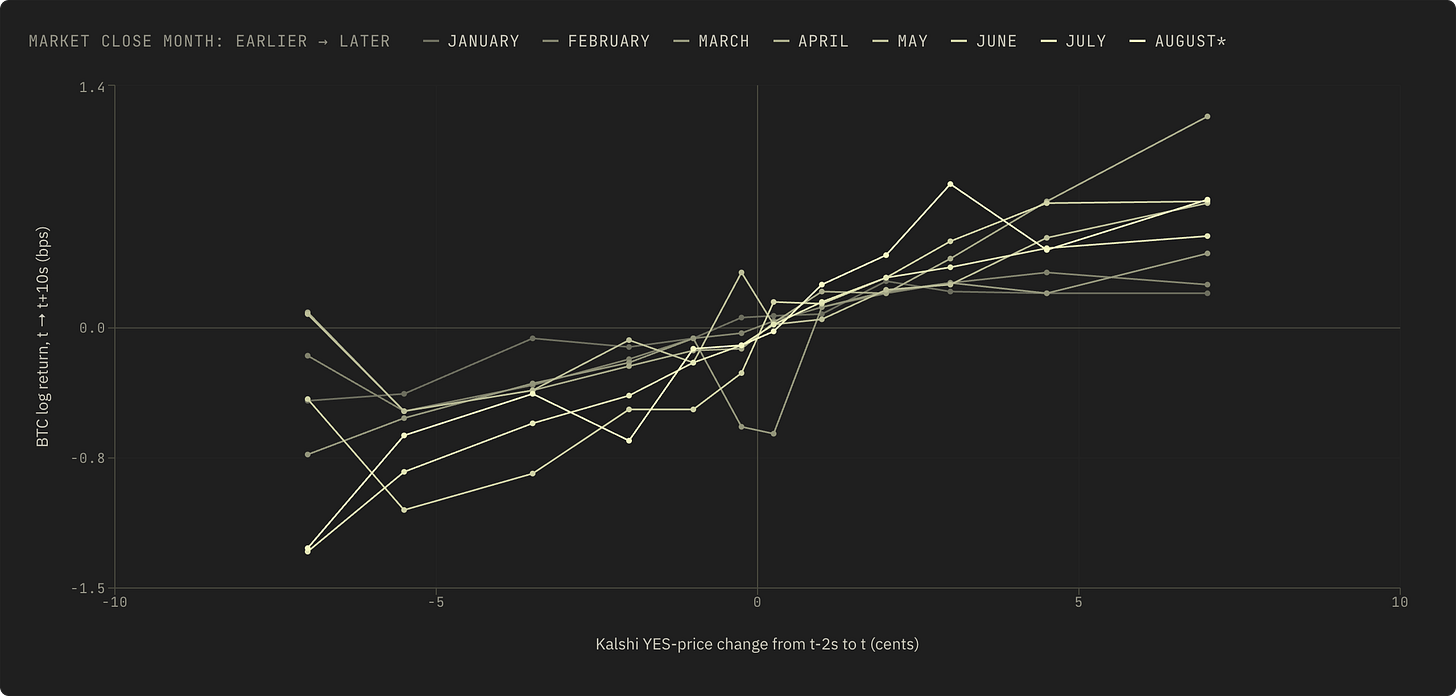
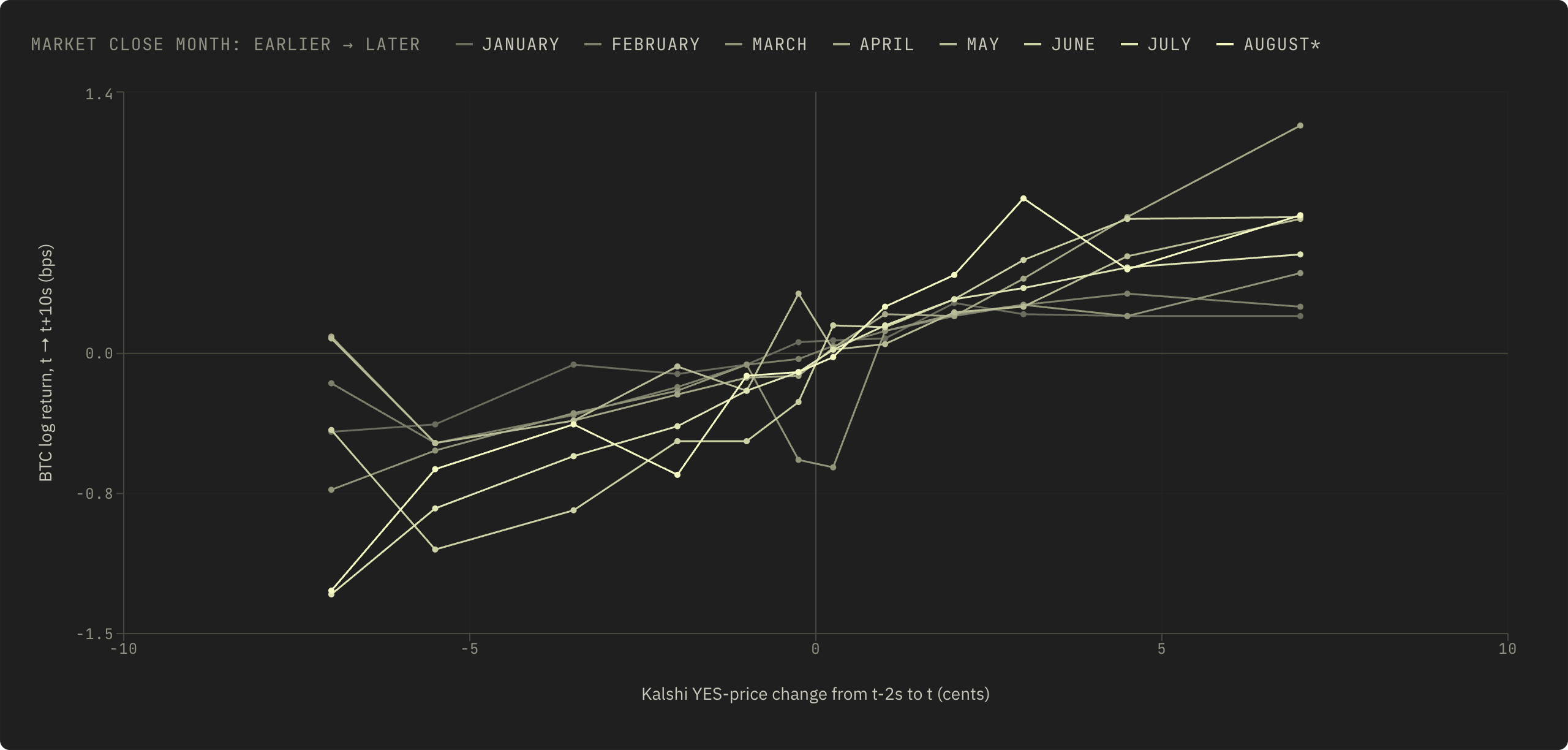
Kalshi’s 15-Minute Markets Now Drive Bitcoin Price Discovery (Synth Data): “Conventional wisdom suggests that Kalshi’s 15-minute BTC markets should follow Binance. Binance moves first, algorithms observe the new spot price, and Kalshi traders reprice the probability that BTC finishes above or below the market threshold.”
“However analysis from the Synth Research team shows that this relationship is changing. Kalshi prices are increasingly predicting subsequent moves in Binance BTC, with the strength of that predictive relationship growing materially throughout 2026.”

Arnold Bernault@ahitposter
my quants have just discovered that there is a strong predictive relationship between the amount of people entering a bank with guns and the amount of money withdrawn from the bank shortly after

Synthdata @SynthdataCo
1/ Synth's HFT team has found that @Kalshi’s 15-min BTC market is beginning to predict subsequent BTC moves on @binance and all other CEXs. And strength of this predictive relationship has grown materially throughout 2026 (see image). @Kalshi is becoming the venue for BTC
6:22 AM · Aug 19, 2026 · 4.44K Views
6 Replies · 2 Reposts · 88 Likes

Kalshi is about to shoot themselves in the foot (@LeoAdberg on X/Twitter): “TLDR: Kalshi Combos were the best way to onboard new market makers to provide liquidity, but in a blind greed they're about to go institutional-only”
“Later today, Kalshi is planning to roll out a maker fee on all combo markets that is double any existing maker fee on other markets! I believe they've planned this without thinking about any downstream effects beyond 1.5x'ing the fees they collect on the biggest single category of trade.”

Leo Adberg@LeoAdberg
https://t.co/Og3y4a3lMv
4:15 AM · Aug 19, 2026 · 49.1K Views
34 Replies · 9 Reposts · 196 Likes
The Chaos Machine — Prediction markets and the triumph of crypto-anarchy (Harper’s): “The rise of prediction markets is the story of two men—contemporaries and occasional correspondents—with shared interests and profoundly different visions. One wanted to build a machine to encourage a collective understanding of reality; the other a machine to dissolve trust. One envisioned a tool for effective governance; the other a weapon against it. The strange tragedy of prediction markets is that they are widely thought to facilitate the former vision but are better understood as succeeding at the latter. Analyzing the stories of these two men will help us understand not only how we got here but what the future of prediction markets holds for us—and how much worse things could become.”
From Substack:
Kalshi-Catalist Live Streaming Deal Announced, Then Pulled (Legal Sports Report): “Earlier on Tuesday morning, Catalist Sports and Kalshi had signed a multi-year agreement, which included live streaming and official data rights. However, later in the morning, the announcement was pulled from Catalist Sports’ site.”
“The partnership between Kalshi and Catalist Sports would have included tennis and soccer streaming.”
Half of Americans say they are gambling, but rate is declining (SBC Americas): “Gambling for money online was the only category that posted an increase since the last poll in 2016, up by one single percentage point. Back then, legal and regulated options for gambling online were more scarce than they are today, and the Professional and Amateur Sports Protection Act (PASPA) was still two years away from being repealed.”
“The prediction markets section was limited to wagering on “a future non-athletic event,” meaning that it does not account for the vast majority of trading volume on Kalshi and other sports-focused prediction market platforms.”
The Legal War Over Prediction Markets Is Getting Crazier (The New Republic): “Last month I wrote about the tug-of-war between the Trump administration and the states over prediction markets. Kalshi, one of the largest U.S. prediction market companies, had just won a favorable ruling from a federal court in Minnesota with the help of a key federal financial regulator. Since then, things have escalated dramatically for the prediction market industry on multiple fronts.”
Kalshi Hires Oregon Lobbyists and Gives Rayfield $12,500 (Willamette Week): “Ascendent New York City-based prediction market Kalshi has hired a pair of experienced Oregon lobbyists and made a $12,500 campaign contribution to Attorney General Dan Rayfield.”
“In his first term as Oregon AG, Rayfield has emerged as one of the most prolific filers of litigation against the second Trump administration. Last June, he signed Oregon on to a multistate effort to oppose Kalshi before the 9th U.S. Circuit Court of Appeals.”
A niche academic team at quant hedge fund AQR is researching prediction markets (eFinancialCareers): “AQR Capital Management, the hedge fund of Cliff Asness, was seen hiring an experienced prediction markets quant on a salary of up to $260k earlier this year. Now it's hiring interns in the space as well, but the team they're joining has been around for a while.”
“AQR has put out a listing for a '2027 quantitative prediction markets summer analyst' based in its Greenwich, Connecticut headquarters. AQR said in the listing that it's interested in event contracts for finance, crypto, sports, politics, and culture. The intern will be tasked with ‘seek[ing] out reliable prediction markets trading strategies’"
Prediction Markets and Regulation by Non-Enforcement (The CLS Blue Sky Blog): “Justice delayed is justice denied, even if the Commissions do eventually sort prediction products into their appropriate categories. In the meantime, market expectations get established and trading occurs outside the congressionally designated regulatory environment. The Commissions’ approach to startup prediction markets is protective, and the partiality in the application of law is troubling. It can also contribute to socially corrosive narratives.”
No posts
Comments
Nothing yet. Say the first thing.
Sign in to join the conversation.