
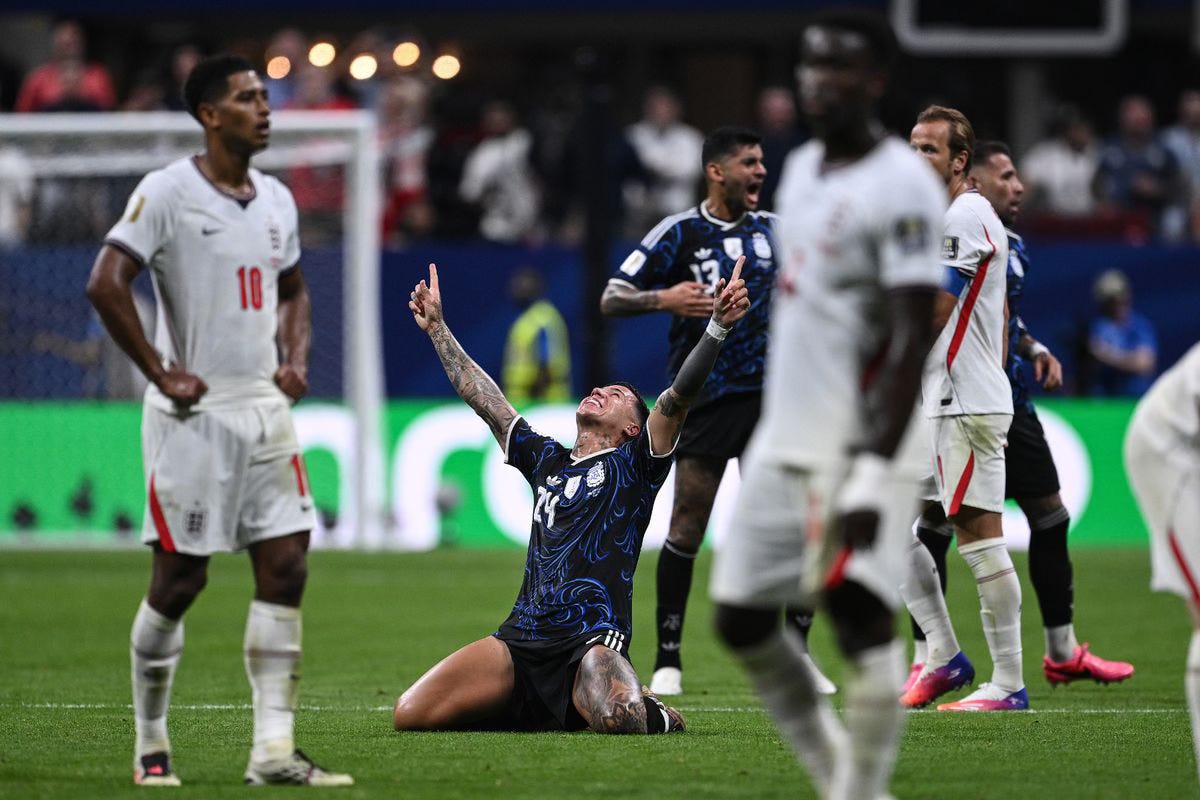
England were supposed to win but they didn’t.
My youngest child, aged 4
It is important not to get carried away with sporting analogies. But sometimes a sporting event semiotically captures an important truth. This happened a week last Wednesday, when England, in somehow contriving to lose their World Cup semi-final against Argentina, produced a perfect metaphor for a generalised failing in the country at large.
England should have won: they had fought their way on top with sheer physicality and speed in the first half, and at 60 minutes in, a goal to the good, they were perfectly positioned to begin to turn the screw. But it slowly became evident they just weren’t willing to take the steps necessary to make it happen. They saw victory within their grasp, and they pulled back their hands. They had their opponents and arch-rivals on the ropes, and chose not to deliver the knock-out liver shot. They had their enemy by the throat and relaxed their grip. They suddenly sat back, retreated within their shell, and invited pressure. And in the end, their shell cracked.
It took an Irish journalist to describe best the inexplicable way England had capitulated from a dominant position. Speaking shortly after the game and given only brief moments to summarise, David Sneyd remarked on what England had lacked. A great team, as he put it:
get into that position in the game, and they understand that their rivals are…almost on their knees, and you kill them.
The violent language is appropriate. Knock-out football at a professional level is not a matter of life and death, but it is in the same category as a knife fight in the sense that the point is to win. Winning is the reason you are involved in the first place; you’re not there to have fun. So go ahead and win. The other side wants to kill you, so you’d better kill them first. When you get the chance to stick the knife in, you do it. When you’re 1-0 up and in a strong position you use that strong position to score again. You finish the job. England didn’t want to finish the job. They didn’t have the ruthlessness - the killer instinct - to do it.
This is a familiar failing of English national sporting teams (don’t get me started on the subject of cricket) in recent decades; they get into positions of dominance against a rival - and foreign readers should be in no doubt that Argentina are a genuinely hated rival - and then almost seem to prefer to lose. It is not, I think, that they are inhibited by a fear of success; they are not chokers. It is not that they are incapable of squeezing out that last millilitre of courage and grit it would take to get over the line. It is that they’re too nice. There’s a reticence to go for the jugular and finish off an opponent for good. That’s okay against markedly inferior opposition. But against the big boys - when it’s kill or be killed - it leads only to humiliation in defeat.
In this case the picture was complicated by the fact that the root of the capitulation were the inexplicably uber-defensive substitutions the coach made, which could only ever have produced the effect of turning the English penalty area into the footballing equivalent of the Alamo. But, to repeat, at the level of metaphor what transpired was an almost perfect summation of the collective neurosis that lies at the heart of the nation in 2026: we are a nation that almost seems to prefer failing on the grounds that it is nicer than doing what is required to succeed.
When reflecting on our current malaise - the fact that we can’t take the tough decisions necessary to deport foreign sex offenders and drug-dealers; that we don’t have the wherewithal to stop dinghies full of young men from dangerous, misogynistic societies entering the country and give them free room and board when they get here; that we see welfare and handouts as the solution to every societal ill; that we think it appropriate that criminals, already lightly sentenced, need only serve a third of their allotted terms; that we allow soldiers to be prosecuted for killing our enemies; that we spend twice as much money on debt interest as we do on defence; that we see nothing wrong with civil servants phoning in their jobs, in every sense, at mass scale; that the public sphere is becoming noticeably grubbier, noisier and ruder because of a loss of societal discipline - it is hard not to see the metaphorical significance of what happened the other night. Our boys were too nice. They weren’t ruthless enough. They were a soft touch. They lost. And that is of a piece with what is happening in the nation at large.
Sometimes a football match is just a football match. But events are imbued with symbolic meaning that can tell us a great deal more about the world and our place in it than might appear at face value. We, inescapably, read meaning into them. And it is, sometimes, in the reading of meaning itself that the truth appears. The truth is our national football team revealed themselves, when it mattered, to be a soft touch. And that’s the truth of things, revealed in the reading of what happened that Wednesday night. As a nation, we’re too nice. We aren’t ruthless enough. We’re a soft touch. And we lose.
No posts
Comments
Nothing yet. Say the first thing.
Sign in to join the conversation.