
For if we could suppose a great Multitude of men to consent in the observation of Justice, and other Lawes of Nature, without a common Power to keep them all in awe; we might as well suppose all Man-kind to do the same; and then there neither would be nor need to be any Civill Government, or Common-wealth at all; because there would be Peace without subjection.
Thomas Hobbes
The greatest trick the devil ever pulled was convincing the world the Leviathan exists. Margaret Thatcher famously proclaimed there to be ‘no such thing’ as society (although her remarks, as ever, were taken dramatically out of context); what we now need is a Prime Minister willing to make the case there is no such thing as the State, either. There are just people, making decisions. There is no independent, abstract Hobbesian ‘artificial man’ who makes them for us.
We are in other words blind to libertarianism’s most important insight, unutterable by most political libertarians because it cuts in all directions: there is no State, only people making decisions, and almost all of those people are going to be incompetent, venal, or both. As Proudhon famously said all those years ago, it is not the act of governing itself which is necessarily the problem. The real problem is that government is being performed ‘by creatures who have neither the right nor the wisdom nor the virtue to do so’.
Nowhere is this more evident than in the realm of taxation. It is not the State that taxes you. It is dreadful people like Rachel Reeves - or, now we have a new government, John Healey. Whenever a Chancellor increases a tax, the correct question to ask is not, ‘What will the effect be on the economy?’ but rather, ‘Who in their right mind would give Rachel Reeves or John Healey 20% of their income to spend on their behalf?’ The answer is: nobody. And yet because a phantasm which we call ‘the State’ acts as an intermediary, we think it the most natural and normal thing in the world to do so.
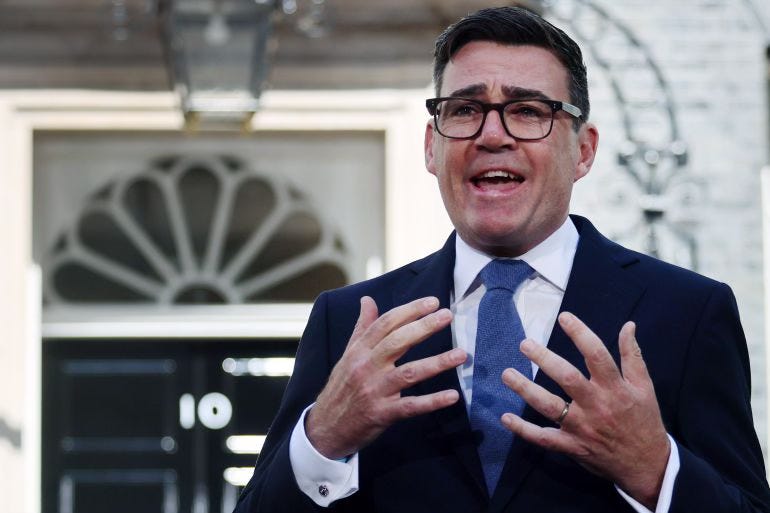
I was pondering this today when I read an article in the Telegraph on the subject of yet another mooted tax hike here in the Yookay: a ‘death tax’ of 10% which Andrew Burnham, the new PM, has hinted will be applied to all inheritances in order to fund what is misleadingly called ‘social care’ - i.e. care of those unable to look after themselves. Yes, that’s right: you can grow up in a council house, fight your way into modest property ownership by doing all the right things, struggle to make ends meet for your entire life, pay whatever taxes you are required, but it still won’t be enough. The phantasm of the State will still want its cut of what you hope to pass on to your children. Consider yourself lucky: it could be 20%. It could be 50%. It could be all of it.
But it isn’t the State which makes the decision, of course. It is a real person. It is ‘Andy’, the nice Miscellaneous Northern Bloke, the wool from St Helens, the fellow who got a 2:1 from Cambridge and supports Everton, who does so. He will be advised in making the decision by other people, of course, and it will technically be his Chancellor who issues the orders. But ultimately the process will be no different to what happens at the AGM of your local crown bowling club on a Wednesday night in early October. A group of ordinary men and women sitting down to make some decisions. It’s just that in one scenario their conversation will take place in a room with a nice carpet in Westminster, accompanied by a few posh baguettes and poké bowls brought in by a flunky from the local Pret, while in the other it will be chintz, bad combovers and digestive biscuits. And in one the participants will be participating in the grand outrage of deciding what they are going to do with your property, while in the other they will merely be discussing what to do about the foxes that keep crapping on the lawns.
This brings us back to the subject of political modernity as such. The modern state can be thought of as a long, drawn-out elaboration of two, let’s call them depersonalising, ideas: first, that it is ultimately the quality of things like laws and institutions which determine how well government performs, and second, that there is such a thing as historical progress which is not particularly reliant on the personal qualities of those in charge, but is actualised through mysterious ‘systems’, ‘structures’ and ‘forces’, not to mention the ‘popular will’. The former of these is more closely associated with liberalism; the latter with fascism and Marxism. But the important break here is really between Machiavelli and Hobbes, writing something a little over a century apart.
Comments
Nothing yet. Say the first thing.
Sign in to join the conversation.