

I’ve been sitting with the title of this issue for a while now. Not in a passive, Pinterest-quote kind of way but in a way that feels like it’s asking something of me. Demanding, actually.
Because inherited trauma is subtle. It doesn’t always arrive loudly or obviously. It slips into your thinking. It shapes what you believe is possible. It quietly edits your sense of self until you start mistaking limitation for truth.
I see it most clearly when I think about my mother. A woman who is, in every measurable way, extraordinary. Intelligent. Resilient. Deeply capable. And yet, somewhere along the way, she was taught to see herself as half of what she is. Not fully worthy. Not fully able. Not quite someone who could create an expansive, beautiful life on her own terms.
And that belief did not start with her.
It was handed down. Layered through culture, through expectation, through what it means to be a first generation immigrant South Asian woman navigating a world that rarely reflects your full value back to you. Women of colour feel this in their bones, each race to a varying degree. The quiet messaging that you are too much and not enough at the same time. That your power should be softened, diluted…made more palatable.
And if you’re not careful, you inherit that without question because you do so subconsciously. You wear it like it’s yours. It’s normal and yet, it isn’t.
The part no one talks about.
Here’s the uncomfortable truth. Awareness does not equal immunity.
I can see the pattern. I can name it. I can coach other people through it with clarity and conviction. I can hold space for transformation, for expansion, for bold, unapologetic self-belief.
And yet, there are still moments where I don’t quite believe it about myself.
Moments where I hear people say things like, “You could go viral. Your work has that level of integrity and impact,” and instead of fully receiving it, something in me hesitates.
Not loudly. Not dramatically. But just enough to make me stop rather than start. Just enough to keep me playing slightly smaller than I know I’m capable of. Hell, to even write this newsletter took me two weeks (note the lack of an issue last week).
And this is where the real self-work begins. It’s one thing to intellectually understand your worth. It’s another thing entirely to embody it.
To trust it when no one is clapping.
To act from it before there’s evidence.
To stop waiting for external confirmation to validate what you already know, deep down, is true.
The tension we live in.
This is the space so many of us occupy. We are deeply aware. Self-reflective. Doing the work. Healing. Growing. Expanding. And all the while we still carry echoes of old beliefs. And this is not because we’re failing but because unlearning is layered.
You don’t just wake up one day and shed years or sometimes generations, of conditioning. You meet it in real time. In your decisions. In your visibility. In how you speak about yourself when no one is watching.
I know how alive I feel when I’m fully in my work. When I’m creating, guiding, holding space and challenging perspectives. There is no doubt there. No hesitation. Just clarity, energy and alignment. And yet outside of those moments, there are still parts of me that question whether I should get to fully take up that space. Whether people would want to hear me and let me guide them - despite the evidence I have that in fact, they do.
But that is the inherited voice. And I am slowly but surely learning not to obey it.
This is where it changes.
Breaking a cycle is not a dramatic, one-time decision. It’s a series of small and often invisible choices. It’s choosing to believe something new before it feels comfortable. It’s choosing to act from your full value even when a part of you wants to shrink. It’s choosing not to pass the same narrative down, whether that’s to your children, your clients, or even just the next version of yourself.
Because here’s what I know for certain.
My mum’s story is not my destiny. Her limitations, learned through no fault of her own, do not get to define the ceiling of my life.
And if you feel like you’re in a similar boat, and that you are inheriting things from someone close to you, the same is true for you.
Practical ways to break the pattern.
This is where we move from awareness into action. Not perfect action, just honest and intentional shifts.
Name the inherited belief.
Ask yourself: what belief about myself did I learn, not choose?
Write it down exactly as it shows up.
For example:
“I’m not someone who can be highly visible.”
“I need to stay humble, not stand out.”
“I shouldn’t want more.”
Seeing it clearly is the first step to challenging it.
Separate truth from familiarity.
Just because something feels true does not mean it is.
Ask: is this actually true, or is it just familiar?
Familiar beliefs feel safe because they are known. Not because they are accurate.
Act from the version of you that already knows.
There is a part of you that already understands your value.
Ask: if I fully believed in my worth, what would I do next?
Then do that. Even if it feels uncomfortable. Especially if it feels uncomfortable.
Let evidence catch up later.
We often wait for proof before we believe in ourselves.
Flip it.
Decide first. Act from that decision. Let the evidence follow.
Interrupt the shrinking.
Notice when you downplay yourself. When you soften your achievements. When you hesitate to be seen.
Pause.
Ask: what would it look like to stay fully in my power right now?
Then choose that instead.
Take this offline.
Real transformation happens in conversation. Not just with others, but with yourself.
Here are three questions to open a meaningful conversation about the topic of this newsletter - be brave and find someone close to begin a dialogue with:
What belief about myself have I been carrying that no longer serves who I am becoming?
Where in my life am I still playing smaller than I know I’m capable of?
What would change if I trusted my value before anyone else confirmed it?
Final thoughts.
You are not responsible for what you inherited. But you are responsible for what you continue. There is something deeply powerful about being the one who decides, quietly but firmly, that it ends here.
Not perfectly. Not all at once. But intentionally. Because you were never meant to be half of anything.
About the author
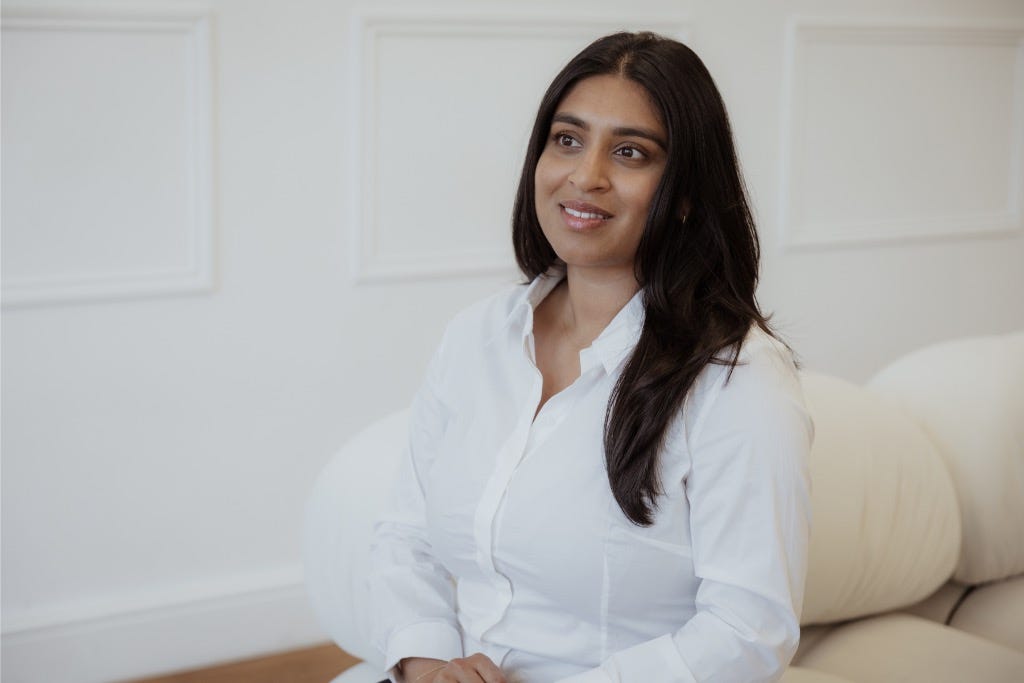
Roxanna Sarkar-Patel is a lawyer and mindset and self-alignment coach. Through her work at @newperspectives.coaching, she supports people in returning to their foundations, mastering their inner world, and building lives that feel both successful and true. Her work is grounded, reflective, and centred on bridging the gap between self and life.
Comments
Nothing yet. Say the first thing.
Sign in to join the conversation.