
I’ve been looking at secondhand wedding dresses lately. I am engaged with a vague timeline of a future wedding - but I know this dress decision will take a lot of time so I am getting a head start.
Why secondhand? I just don’t think it’s worth £5k to look like literally every other modern bride. I want to be timeless, but unique - and there is sooooo much supply.
So now I scroll scroll scroll - Vinted, eBay, Vestiaire - and I’ve noticed something about my reaction to the different listings.
When I see a vintage Vera Wang or a Monique Lhuillier from the early 2000’s, for example, I feel a rush. Genuine excitement. A classic designer at a fraction of the price - I can sense the pride I would feel wearing this.
When I see a beautiful dress with no label, or a brand that no longer exists, I feel something almost as good. An insane ball gown from the 1930’s? Intrigue. Mystery. True exclusivity - not only can no one else buy it, it can’t even be named.
But when I see a contemporary designer from 5 years ago - I feel nothing. Say, a Pronovias gown or a rehearsal dress from Self-Portrait. In the brand-new context I would be excited about these dresses, but in a secondhand context? They haven’t earned their stripes yet.
Why is this reflection odd to me? Because objectively the no-brand dress could be “worse” than the Self-Portrait one. In it’s modern context it could have been massively uncool or unstylish, but the mystique and anonymity it holds now makes it way cooler. The opportunity that lies in not having a brand is basically limitless.
Which brought me back to a similar feeing I had when I started upcycling my own clothes.
When you buy something with a brand you’re not just buying the garment, you’re buying the brand. You are inserting yourself into the world the brand has established. It’s a signal - a pre-packaged story that other people can read without you having to explain anything.
Vera Wang means something. It means bridal heritage, a particular era of glamour, it means true luxury designer. You don’t have to explain any of that. The label explains it for you.
This is why some brands command such a premium. It’s not irrational, it’s actually deeply efficient. In a world of infinite choice and imperfect information, a trusted brand collapses all that complexity into a single legible signal.
But what about on the other side, when what a brand communicates is net-negative?
Here’s what I’ve come to realize: brand power isn’t linear. It doesn’t go from weak brand at the bottom to strong brand at the top. It’s more like a valley with a long tail.
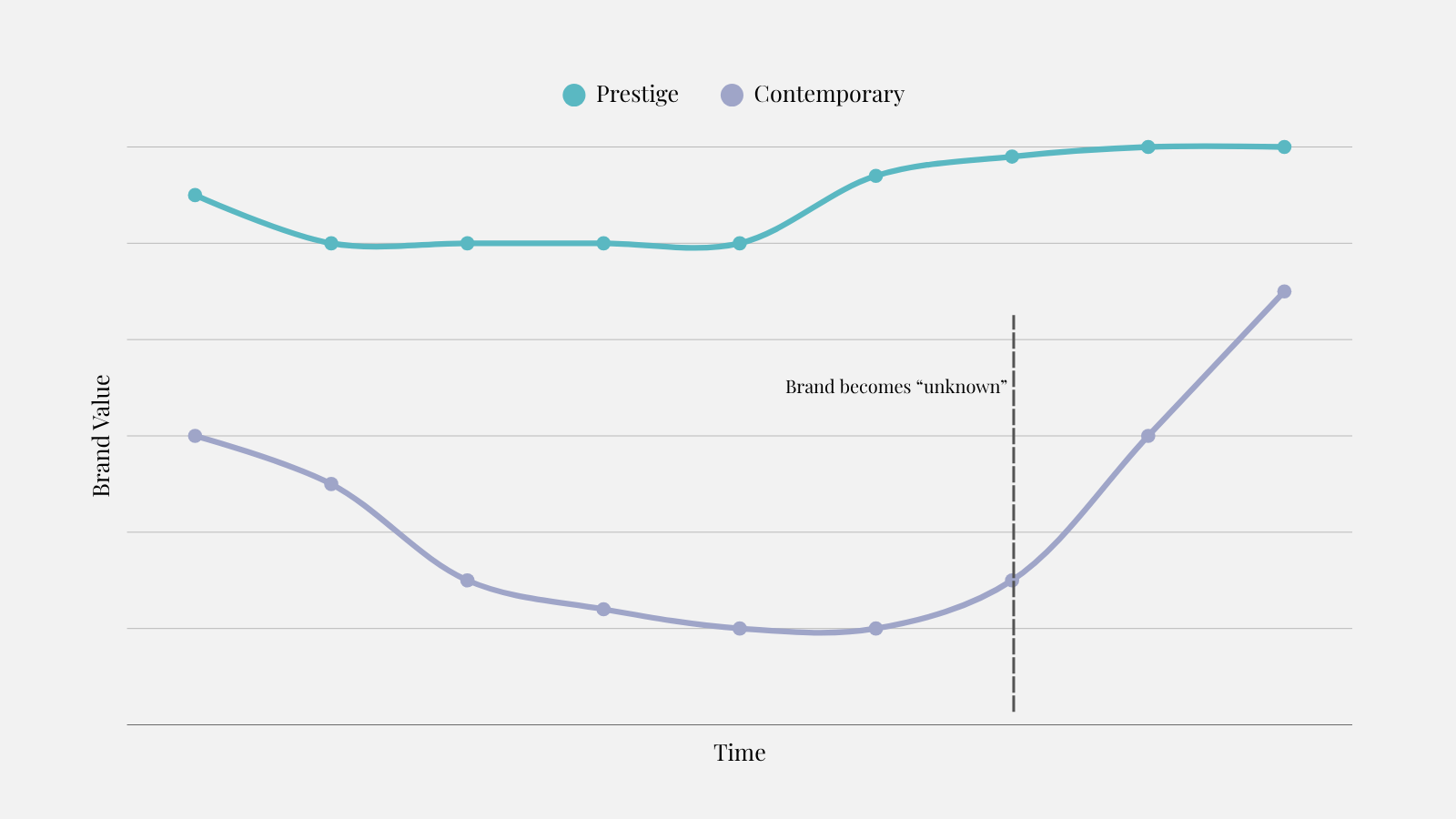
Prestige brands, Vera Wang, Dior, the ones that have earned their mythology, barely dip. They hold their value, then climb. Time is on their side.
Contemporary brands have a harder journey. New, they’re exciting. But secondhand? They slowly decline season after seasons. Too recent to be vintage and not prestigious enough to be covetable.
But here’s the interesting part: given enough time, something shifts. The brand fades from cultural memory. What it stood for, what season it was, who wore it - is either very vague or totally forgotten. And in that forgetting, it quietly becomes something more interesting: unknown. Anonymous. Full of possibility.
In other words, obscurity is the destination either way. The no-brand dress just skipped the awkward middle part.
The no-brand/unknown-brand wins over the average brand because mystery beats mediocrity every time. We project onto things without labels. We fill in the gaps with our imagination, and our imagination is usually more interesting than reality.
When I started my upcycling journey I was so curious about sewing. My first reaction was: nobody sews anymore.
And then I started actually looking. I was very wrong.
Mimi G has built an enormous platform around sewing.
Professor Pincushion has over a 500k YouTube subscribers.
Evelyn Wood has a full on virtual sewing school.
There are dozens of websites, magazines with millions of monthly viewers. This is not a small space.
There is an entire ecosystems here - communities of women making extraordinary things, sharing techniques, building skills that most of the fashion industry has long since outsourced.
Even here on Substack there are dozens of major writers focused on sewing and knitting, some of my favorites are:
The sewing internet is massive. Yet it seems almost invisible to mainstream fashion culture.
Which raises the question: if making your own clothes is this widespread, why doesn’t it have cultural cachet?
Part of it is aesthetic. So much of sewing is focused on the garment technique and construction (duh!). But that means the content looks more like a craft project than a fashion moment. It stays within the algorithms of people actively looking to sew; it’s hard to compete for general “style” attention against our trend-led fashion influencers.
Part of it is historical coding. Making your own clothes used to mean you couldn’t afford to buy them. That association runs deep, even when the reality has completely changed - today making your own clothes is an act of skill, patience and creativity.
And part of it is the label. When you make something yourself, there’s no label to help people shortcut associations. There is no signal to do the work for you. You have to explain it, and most social contexts don’t leave room for that explanation.
Something shifted around 2020. Thrift flipping started going viral on TikTok - taking secondhand pieces and reconstructing them into something new. Cutting up, resewing, combining, transforming.
It is sewing. But it doesn’t look like sewing. It looks cool as hell, and the transitions are addicting to watch.
The aesthetic is chaotic and intentional at the same time. Anti-polish. Anti-brand. The point isn’t to make something that looks like it came from a store, it is to make something that couldn’t have come from a store. The no-brand isn’t a limitation, it’s the whole point.
Gen Z didn’t revive sewing by showing the practicality of making your own clothing. They leaned into the uniqueness and one-of-a-kind nature of it. Sprinkle on the sustainability aspect, and it’s a generational phenomenon.
The no-brand brand can be the most powerful signal in the room, or the most invisible. The difference is context and intention.
For my vintage wedding dress, no brand is the flex. The mystery does the work. Your imagination fills the gap and what you project is almost always more interesting than what the label would have told you anyway.
For the home sewer, no brand is the problem. The skill is real, the garment is real, but without a legible signal there’s nothing for culture to grab onto. The craft is invisible precisely because it can't be named.
Thrift flipping solved this almost accidentally. By making the no-brand chaotic and visible, the mash-up of denim patches, the before and after, the transformation on camera. It gave the label-less garment a story people could actually see. The process became the brand.
Which is maybe the real lesson. No brand isn’t inherently powerful or powerless. It’s a blank space. What matters is whether you give people something to project onto it - mystery, transformation, skill, rebellion.
Leave it empty and it disappears. Fill it with something real and it will beat the average label every time.
Comments
Nothing yet. Say the first thing.
Sign in to join the conversation.