
We are already halfway through summer. Somehow its going SO fast!
But there is still plenty of summer beauty left to enjoy.
I found the cutest little tool to help us make the most of every sunny day we have left. Let’s make the second half of summer 2026 the best part yet.
I recently came across the most beautiful illustrations from Jenna O'Brien, the creator behind @feelingmagazine. Her illustratios are so fun, pretty and just give you that boost of dopamine. I swear they sparkled something open in my brain.
One of the illustrations specifically reeled me in. They gave me the feeling where a simple idea suddenly makes ordinary life feel a little more colorful, a tiny more intentional, and a lot more fun.
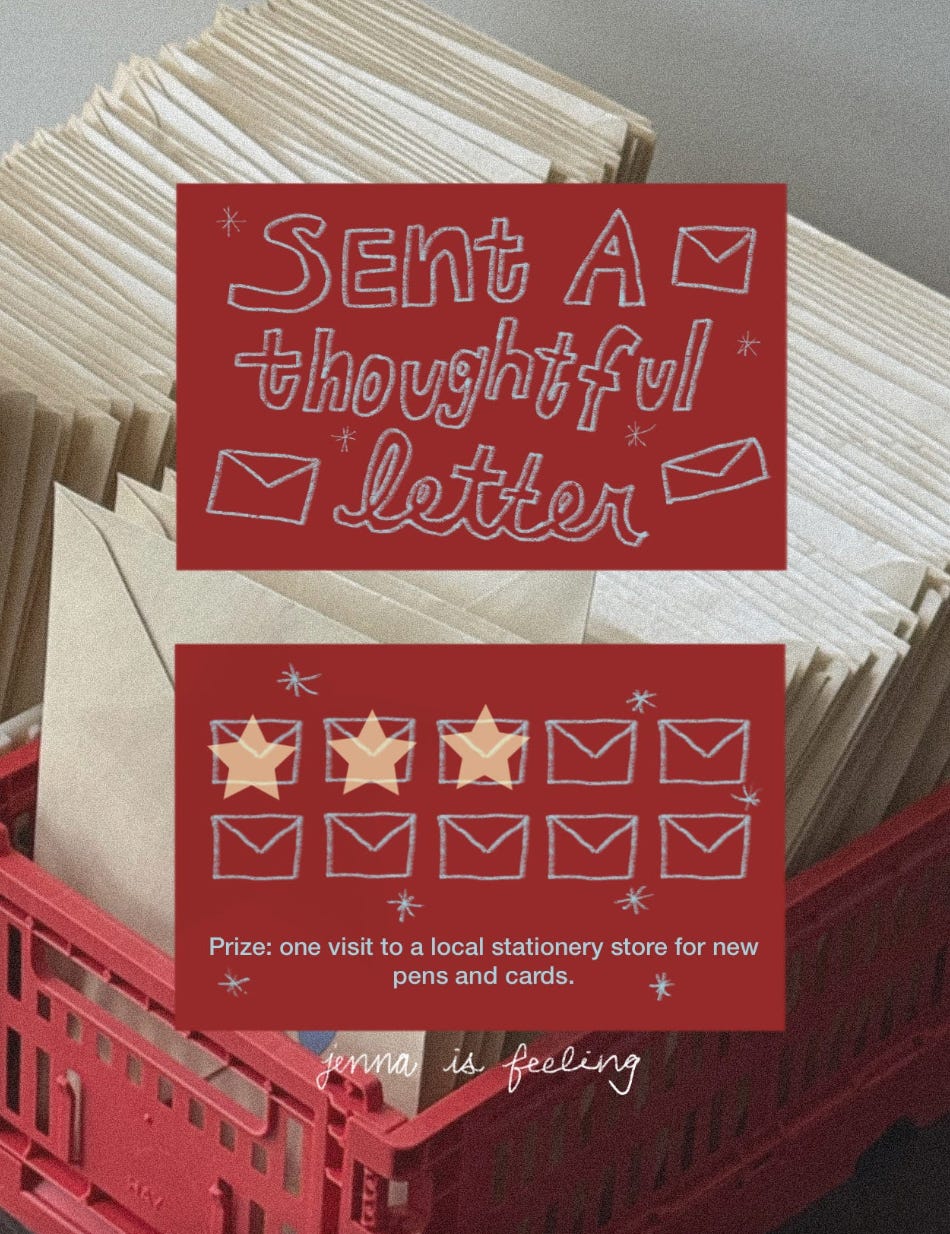
She created summer punch cards.
I asked her for permission if I can share them here <3.
It was written in light blue on a red background, with ten little drawn envelopes underneath that you could cross out each time you sent a letter. And at the bottom, it said:
Prize: 1 trip to the local stationery store for more pens and stationery paper.
What a lovely prize. And what a lovely way to earn it. You do something thoughtful, you make someone feel loved, you slow down enough to write a real letter, and your reward is more paper and pens so you can do it again.
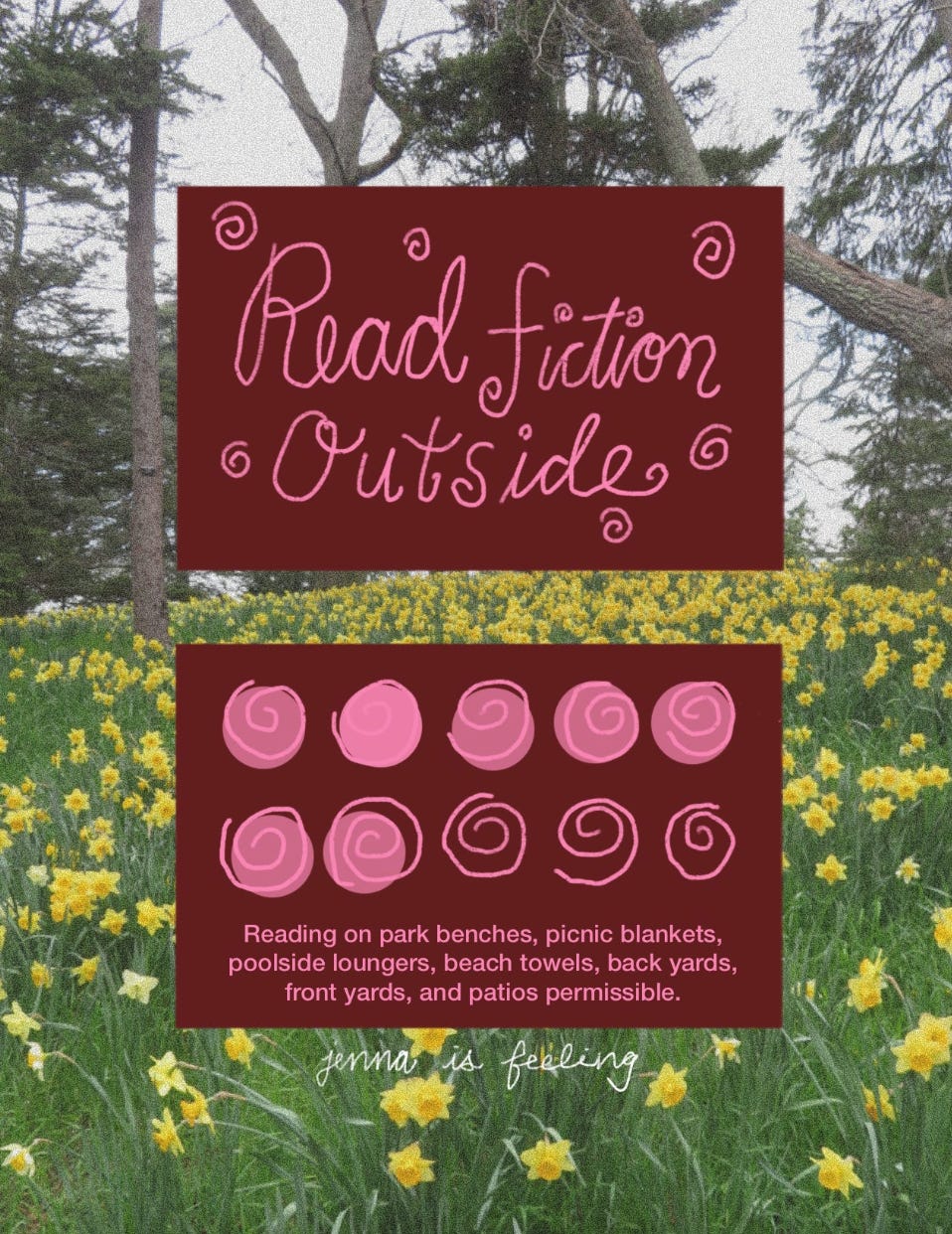
Hot pink writing on a deep Bordeaux background. Ten little swirly circles to stamp or cross out. And underneath, it said:
Reading on park benches, picnic blankets, poolside loungers, beach towels, backyards, front yards, and patios permissible.
So so cute!
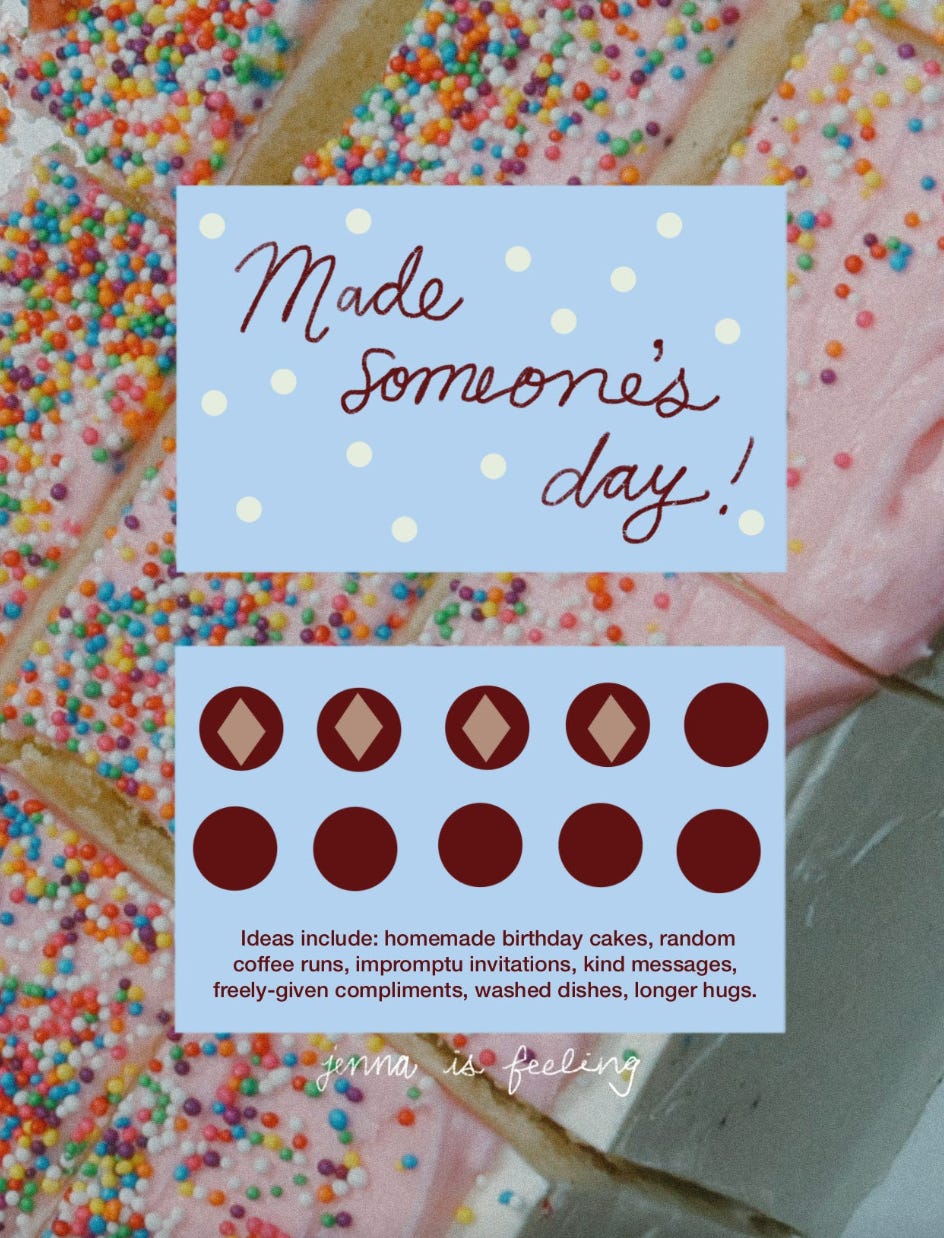
Underneath the ten circles, it listed ideas: homemade birthday cakes, random coffee runs, impromptu invitations, kind messages, freely given compliments, washed dishes, longer hugs.
YESSS please!
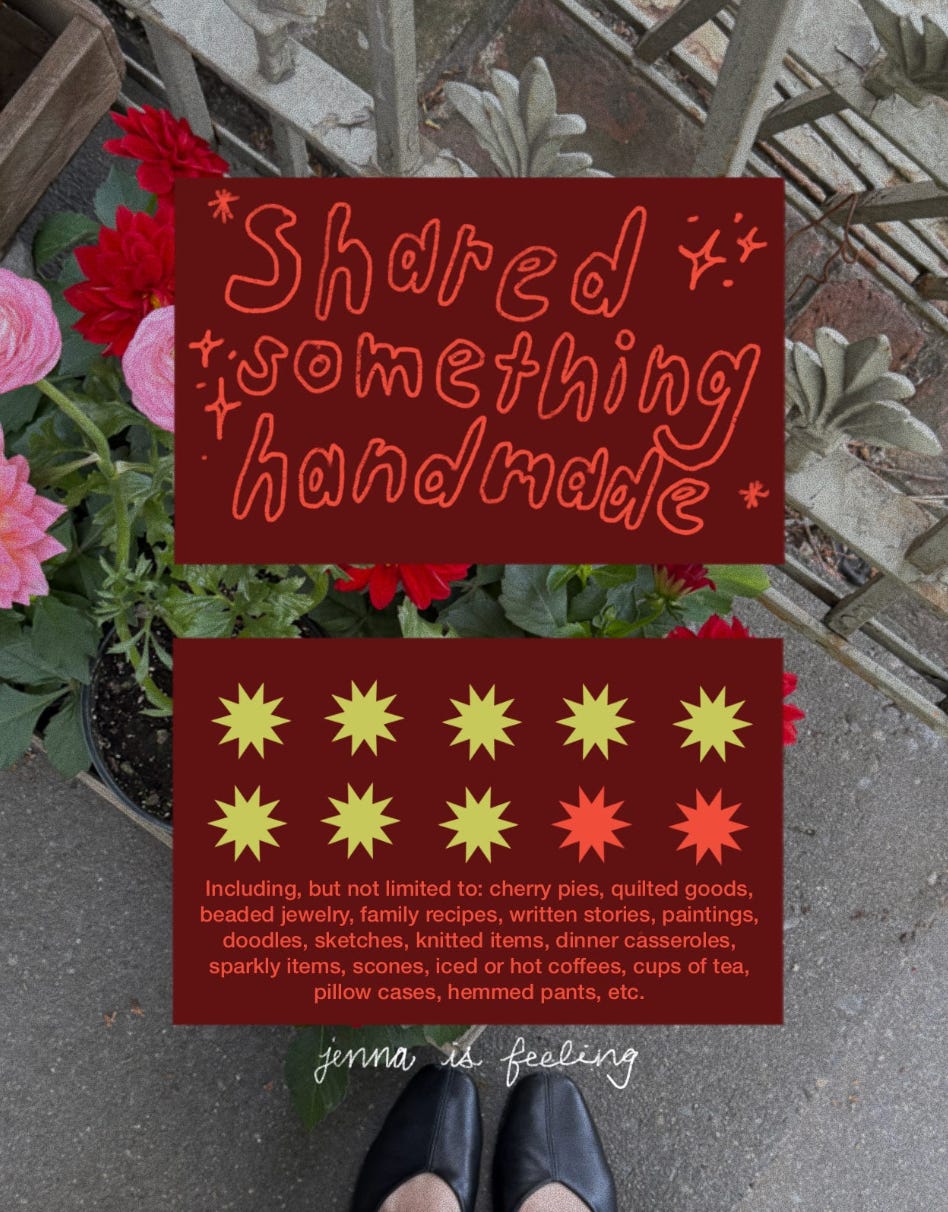
And underneath, it included “Cherry pies, quilted goods, beaded jewelry, family recipes, written stories, paintings, doodles, sketches, casseroles, sparkly items” and more.
With ten little water drops to cross out. Below it “Cannonballs, deep dives, floating, Marco Polo, doggy paddles,” and to not forget your sunscreen.
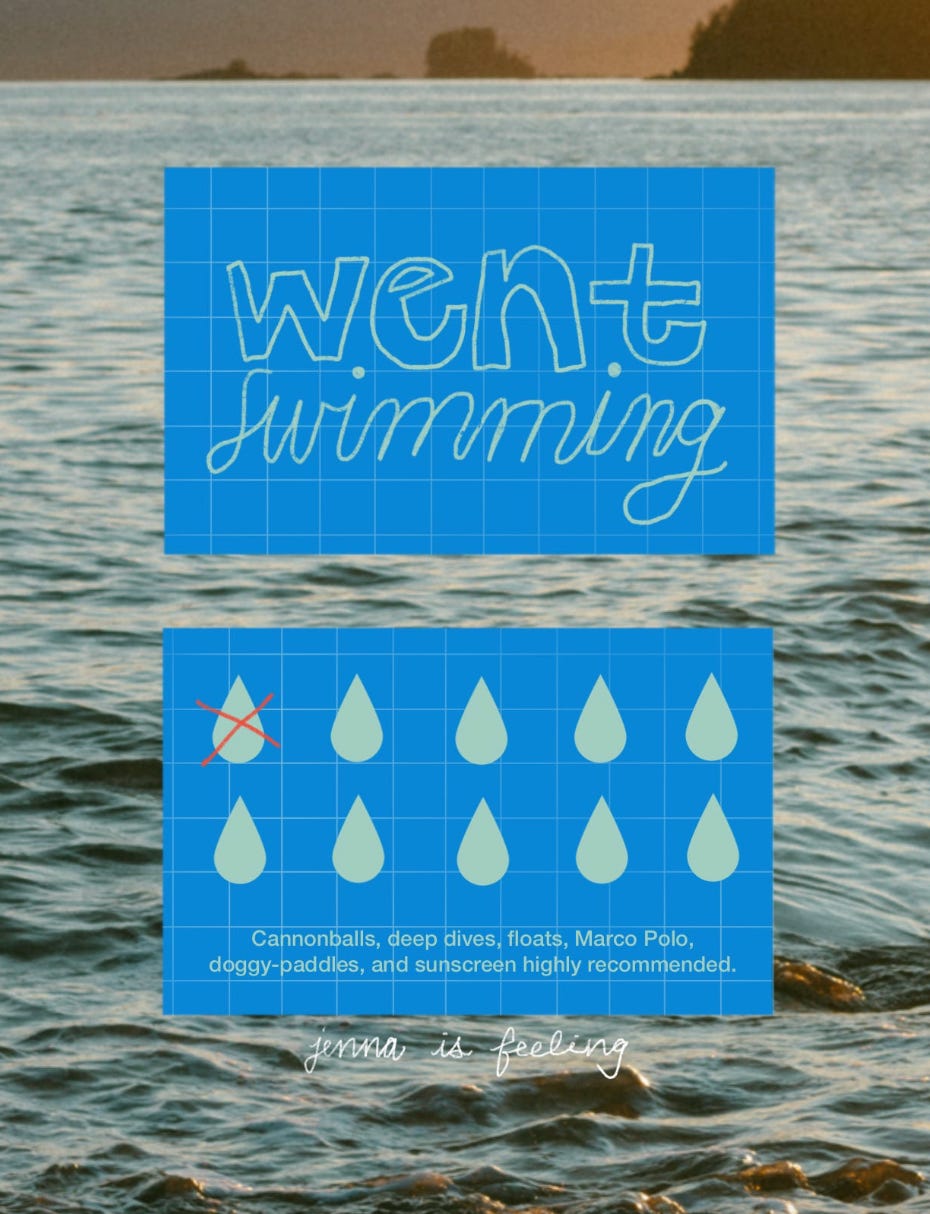
First thought that came to mind was “oh my goodness… these are amazing”. And the second thing was: “what is happening in our brains when something this simple makes life feel a little more exciting?”
Because to some they may not mean a lot… but there is more behind these punch cards, these actions, and the rewards.
If we turn to psychology, these colorful punchcards are turning ordinary summer behaviors into tiny fun rituals. They are basically giving your brain a reason to scan and find joy, kindness, movement, nature, creativity, connection and more. And these little moments and your focus on them, will teach your brain that putting attention on these types of things are memories worth collecting. We have a lot of beautiful moments in our lives we can romanticize. Having a little plan - or a punch card - helps a whole lot.
A punch card is actually a pretty powerful tool. It gives your brain a small, visible marker of some kind of progress.
Your brain loves feedback. Even a tiny bit of feedback. A check mark or a stamp. Crossing out a circle can feel so satisfying. Because these little things tell us “ I did that”. And we can then release it from our brains, or admire where we have gotten.
A small visual cue like checking a box or getting a stamp can feel rewarding to your brain because it connects your actions with a feeling of completion. This process involves regions in the brain that are involved in motivation and reward systems. This includes dopamine-related pathways and brain regions such as the Striatum, which basically tells our brain what we would like to repeat in the future.
Sticker charts and habit trackers can work very well. It makes a plan for us. Instead of thinking “how much do I need to do” or “am I doing enough” and replaces that with a concrete plan: I want to swim at least 5 times in this ocean this summer. One more swim - one more checked box.
When the behavior is a positive one, like a meaningful visit with your family, sending a kind note or handmade gift to a loved one, these punch cards actually can become very powerful.
Because you are not just doing a task.
You are creating connection. With yourself or others.
Reading a fiction book on a park bench is not just reading a book. You are focusing your attention on the story, you can working your imagination, you are getting sunlight and nature in, fresh air, beautiful atmosphere, and you are getting some rest.
Making someone’s day is not kindness alone. It is prosocial behavior, which is when you exhibit a behavior that is benefiting someone else. Prosocial behaviors can also engage reward related brain regions and networks. For example the front-mesolimbic networks, and the ventral part of the striatum. Giving, helping or contributing can make you feel good, because our brains care about social connection and meaning.
We feel reward through receiving but also through giving.
These punchcards make our life easier. If you know what you would like to do more of, make one. If you keep them in a place where you can see them often, and actually make it a priority of using them, they can remove the hardest part of many positive behaviors, which is deciding.
We all want a life that feels more intentional, romantic, and creative. We want to go on more adventures, swim more, be more creative, spend more time outside.
But when we get busy we tend to go to our comfort zones where we don’t need to exhibit effort: our couch.
So note to you: Send the message. Bake that yummy cake. Invite your friend. Take that nice walk. Use your pretty stationary you got 2.5 years ago, but were saving for a pretty occasion.
But wanting all of that, and actually going out and doing them are very different things. I know a lot of people that want to go on more adventures, or want to romanticize their lives more, or spend more time outside. But don’t do it.
Everyone has this to some extent. I know I do too.
Our brains are constantly managing our energy levels, attention, decision piles, social things, and much more. So often things that require a little bit of decision making, like doing that picnic on the beach, or renting a kayak for a paddle, will get pushed aside when you get a little bit tired.
A punch card can change that. Because you get rewarded by finishing the “task”. Even if it’s a fun one.
We often underestimate small actions. That walk in the park - easy peasy I would love to do that twice a week. But then when im exhausted from a work day, the park gets pushed back and pushed back, and I relax on the couch instead.
We think a plan has to be fancy, novel or impressive to be important, but our nervous system learns from repetition, cues and emotional salience.
When we repeat small actions that are meaningful to us, we are giving our brain a note that says “we need to do this again”. And it becomes easier to do it the second time.
Over time, behaviors that are repeated become more natural. This actually goes back to habit research too. Research shows that when you repeat certain actions in the same or similar context, then those actions become easier to start, because the context can start cueing for the behavior.
A punch card can work the same way.
It gives our brain a cue, a goal, and a reward. All the things our brain loves.
I love that Jenna included little prizes at the end.
These prizes are rewards and match the identify of the behavior you are trying to train or practice. For example, writing thoughtful letters with buying pretty stationary. The action and prize match.
That creates a beautiful loop.
When we get rewarded, it basically teaches the brain what we need to repeat. It’s not just about pleasure.
When the reward is aligned with the behavior you are practicing, it actually reinforces the identity behind the action. When your brain receives a reward, it thinks that it’s worth doing again and repeating.
You can make a summer punchcard for almost anything. But remember, the goal is to make good things and activities easier to notice, repeat and therefore do more often.
Here are some easy ideas:
Taking a sunset walk. Prize after 3 times: A yummy lemonade.
Calling or texting a close friend out of nowhere to say hi. Prize after 8 times: A coffee date with yourself.
Trying new recipes. Price after 4 times: A yummy new ingredient like a basil plant.
Worked out or moved my body. Prize after 10 times: A fun new movement playlist, or a new yoga mat.
Made home feel like summer and tidied up. Prize after 5 times: A yummy candle or some fun sunflowers.
Did a scree free hour. Prize after 10 times: A new book or magazine.
Make the behaviors small enough so you will actually do them, and meaningful enough that doing them consistently will improve your life .
Choose something that you want to experience more of this summer: May it be sprinkling more kindness, doing more reading, swimming, creativity, movement, connection, adventure, slow mornings etc.
Turn this “something”, into a specific behavior that you can easily repeat 10 times. E.g. read 10 pages, went for a dip, made a fun craft etc.
Draw 10 little shapes you can sticker or cross out. This can be on a piece of paper, in a notebook, or digitally on procreate or Canva
Think of a small prize that matches the behavior or activity. A new book for reading 100 pages, a fun snack or beverage for the beach when you go swimming a couple of times, a new workout set for working out 10 times, etc.
Put the punchcard(s) somewhere you see them a lot like on your fridge or by the door.
Start collecting the activities. Remember, the small actions count too.
Don’t rush and try to do them super fast. We are trying to make it a repeatable habits or patterns.
When you finish the card, celebrate it with your small prize.
Make another one if you enjoyed it. Take pictures of the moments so you have the memories captured.
It may seem so simple, but it can actually run deeper.
We like progress. We like pretty things. We like rewards. We like rituals. Our brains love all these things.
And when those small actions are connected to something positive such as kindness, creativity, swimming, connection, and joy… these punch card becomes more than a fun summer activity to train you attention.
Let this be your reminder to make it the best summer yet <3!
I hope you enjoyed this article.
With love,
Dr. Reeders
Selected References
Harbaugh, W. T., Mayr, U., & Burghart, D. R. (2007). Neural responses to taxation and voluntary giving reveal motives for charitable donations. Science (New York, N.Y.), 316(5831), 1622–1625. https://doi.org/10.1126/science.1140738
Moll, J., Krueger, F., Zahn, R., Pardini, M., de Oliveira-Souza, R., & Grafman, J. (2006). Human fronto-mesolimbic networks guide decisions about charitable donation. Proceedings of the National Academy of Sciences of the United States of America, 103(42), 15623–15628. https://doi.org/10.1073/pnas.0604475103
Fredrickson B. L. (2001). The role of positive emotions in positive psychology. The broaden-and-build theory of positive emotions. The American psychologist, 56(3), 218–226. https://doi.org/10.1037//0003-066x.56.3.218
Fredrickson B. L. (2004). The broaden-and-build theory of positive emotions. Philosophical transactions of the Royal Society of London. Series B, Biological sciences, 359(1449), 1367–1378. https://doi.org/10.1098/rstb.2004.1512
Cuijpers, P., van Straten, A., & Warmerdam, L. (2007). Behavioral activation treatments of depression: a meta-analysis. Clinical psychology review, 27(3), 318–326. https://doi.org/10.1016/j.cpr.2006.11.001
Gardner, B., Lally, P., & Wardle, J. (2012). Making health habitual: the psychology of 'habit-formation' and general practice. The British journal of general practice : the journal of the Royal College of General Practitioners, 62(605), 664–666. https://doi.org/10.3399/bjgp12X659466
Wieber, F., Thürmer, J. L., & Gollwitzer, P. M. (2015). Promoting the translation of intentions into action by implementation intentions: behavioral effects and physiological correlates. Frontiers in human neuroscience, 9, 395. https://doi.org/10.3389/fnhum.2015.00395.
No posts
Comments
Nothing yet. Say the first thing.
Sign in to join the conversation.