
This article is for educational and informational purposes only and is not intended to provide medical advice, diagnosis or treatment. If you or your loved one has epilepsy, please discuss treatment decisions with your epileptologist and clinical care team, who can provide guidance based on your medical history and needs.
My main research is in the field of Epilepsy Surgery. And more specifically in neuromodulation (I have added my published articles at the end). So this topic is very close to my heart.
For someone with epilepsy, their brains can feel unpredictable.
You can take your medication at the exact same time every day, have a good sleep pattern, and avoid triggers. But you can still have a seizure while eating breakfast, walking to work or standing alone in the shower.
Because of this, you may organize your life around what can potentially happen. You think about what if it happens while driving, traveling… or swimming.
Epilepsy medication controls seizures for many people. And there are a lot of different kinds and a lot of different combinations. But 1/3rd of people with epilepsy do not respond to medication. When they have tried multiple appropriate anti-seizure medications, and the medication has failed to help, the chance that another medication will help decreases significantly.
This is where surgery can come in. And this is the department I work in.
Some people can undergo surgery to remove or disconnect the tissue that is causing their seizures. There are many types of surgeries in epilepsy, and I will cover these in a future article. A whole team of epileptologists, neurosurgeons, neuropsychologists, neuroradiologists, neuroscientists and nurse practitioners come together to discuss each patient in detail and do many, many tests. For some, surgery is a good option.
But when seizures begin in multiple different places in the brain, or they start in areas that are also needed for language or movement, surgery may not be an option.
This is where neuromodulation comes in.
Neuromodulation uses electrical stimulation to change activity in the nervous system. There are a couple of different neuromodulation devices. Depending on the device, it can stimulate the vagus nerve, or a brain region that produces the seizure, or a deeper structure (such as the thalamus) that is involved in spreading the seizures due to their large networks.
These stimulation pulses only take a couple of seconds. But the effects of neuromodulation can accumulate over years.
And this is actually one of the most fascinating things about neuromodulation and we are doing a lot of research on this. But seizure outcomes often improve over time. There are two things that can happen. First, the stimulation can interrupt abnormal activity in the moment a seizure occurs. Second, repeated stimulation may be changing how underlying seizure networks are behaving. Over time, the brain can become less and less likely to create or spread a seizure, or maybe it can better contain abnormal activity.
Neuromodulation forces us to really focus on and investigate on the networks in epilepsy, rather than just one brain region where it may be originating from.
I actually just came back from a talk about intractable epilepsy, and the speaker, a division Chief or Epilepsy and Clinical Neurophysiology, said “I think Neuromodulation is the future of treatment. There is so much we still don’t know, but it already is helping many people”. We are actively doing research on improving neuromodulation, and we have a lot more work to do. But if we can help more and more people over time, that would be the goal.
So let’s dive into what neuromodulation is, and what we do know about how it works in regards to epilepsy.
What neuromodulation does in the brain
VNS, DBS, and RNS
How stimulation can interrupt seizure activity
How outcomes improve over several years
Whether neuromodulation can reshape seizure networks
& much more
Neuromodulation is a medical therapy that uses electrical signals to change or “modulate” how our nerves work. It is used in more than just epilepsy, but in this article I will only focus on epilepsy.
Depending on the location, a small implanted device can send electrical pulses to either a nerve in your neck (the vagus nerve) or a specific brain region such as the hippocampus or thalamus. A full cross-departmental clinical team of neurologists, surgeons, nurses and company specialists all work together to program the device specifically for the seizure patterns, brain-wave recording, response to treatment, and potential side effects.
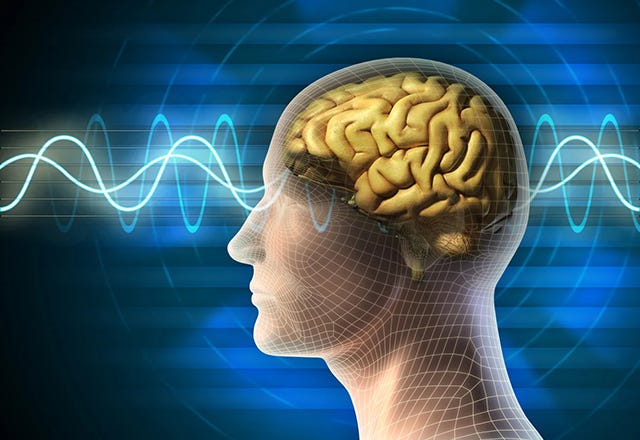
After they choose the location, they can then further control the intensity, frequency, duration, and timing of each pulse. All of these variables together influence which neurons the device will influence.
Clinicians often see if neuromodulation is a good fit when medication is not working, and surgery is not an option.
The outcome goal for neuromodulation is to reduce the amount of seizures, maybe shorten the seizures, or provide greater independence to the person.
Some patients get complete seizure freedom, which is incredible! But unfortunately it is less common. For someone who has many seizures a week, a reduction in the number of seizures can create a significant increase in quality of life.
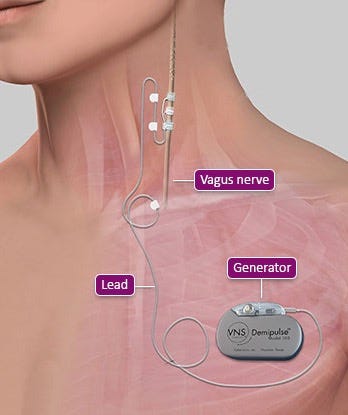
Vagus nerve stimulation is a small device that is implanted beneath the skin of the chest. It has a wire connected to it, that is clamped on and connected to the vagus nerve in the neck.
Pssst… the good stuff is below. 🧠✨
Upgrade to keep reading and unlock the full Neuroscience & Wellness archive.
Learning how your brain works is an investment in yourself. The more you understand the systems shaping your thoughts, emotions, habits, health, and behavior, the better equipped you are to make intentional choices that support a happier, healthier life🤍.
Ready to get to know your brain a little better?
Comments
Nothing yet. Say the first thing.
Sign in to join the conversation.