

As some of you might know, I have written about heart rate variability HRV before. HRV is something that comes as a part of the standard package of any personal wearable device today, where it is touted not only as a measure of physical readiness and recovery but hinting, although vaguely, at it as a measure of general stress. These measures can, or so they say, measure the physical but also the emotional stress (it is always vague, but the suggestion is that physical activity, work, illness, jetlag, emotional stress, hormone fluctuations, social interactions all can be captured within the given index). Whatever stress index you have on your wearable of choice is likely to be some heuristic containing HRV as part of its ‘magic formula’.
I was only always going to be interested in the psychosocial aspects of stress and whether they show up on HRV. But I initially needed to first untangle what HRV was a measure for. Which ended up being the first HRV primer piece. As we now wade into the deeper waters of how and whether HRV, as a measure, reflects different types of stress, I recommend going back and reading the original piece. It is also useful for all of you interested in the autonomic nervous system (ANS) and the vagus nerve, as the HRV is mainly under the control of the ResHRV (aka RSA) which in turn is under control of the cardiac parasympathetic activity via the vagus nerve.
What my initial piece could not address was whether and how are the emotional stress, and I include in that the social stress, show up on HRV. And yet, that was the initial question that I wanted to answer for myself and for you guys. Or at least give some elements of response.
What happened then was in effect a godsend, as I came across the work of Amin Sinichi. Amin is a researcher in HRV and autonomic physiology and he has undertaken an interesting self-experiment: he has been recording his own resting state HRV, first thing in the morning, every day, for the last four years. And he has coupled it with diary entries of what was happening in his life, day in day out during this period. Astounding.
This is more than 1000 days of HRV data coupled with personal history and context. Amin has written up his experience in his 1000 days of HRV piece and has been so kind as to share his experience and story for us here. Whatsmore, he is doing so by placing it in the broader context of what HRV is, what physiological and ANS mechanisms are thought to give rise to it and most importantly what interpretation we can give to the results, in the light of state-of-the-art knowledge on this measure, autonomic physiology and its links with the higher cognitive processes. In an accessible way he answers all the questions I had and much more. It’s a real treasure trove and a definite keeper.
In what I would call a small masterclass on how to analyse the personal physiological data and weave in the state-of-the-art insight from physiology research, Amin covers all of the following IMO crucial questions:
Recap on HRV
Links between mental health and HRV
Links between the cortical connectivity and HRV (potentially relevant for emotion regulation)
What HRV can and cannot tell us re parasympathetic ANS activity
Epistemic humility, replication crisis and caution when it comes to interpretation of results
Puts the whole story in a broader context of evolutionary adaptive role of stress
Makes the link with allostasis and allostatic load (what is frequently today referred to as the body energy budget)
What is the upshot - is there a simple story to embrace?
Most of all this piece shows how difficult it is, even for somebody who is unpacking HRV as a job, and who is formally trained in neuropsychology to fathom fully what HRV output means and what should be its interpretation. This should be a lesson for all of us in epistemic humility and a useful reminder to proceed with caution whenever we want to craft a narrative around some piece of personal physiological data we or our clients might have.
If you are into ANS and therapy, this piece is for you - beyond buzzwords and vague statements. I myself am likely to be going back to it again and again.
Amin’s bio
Amin completed a research master’s in cognitive neuropsychology at Vrije Universiteit (VU) Amsterdam, conducting his thesis research at the Sleep and Memory Lab at the University of Amsterdam. He then continued as a PhD candidate at VU Amsterdam, where his research has focused on psychophysiology, particularly heart rate variability, wearable technologies, and ambulatory measurement.
Some selected papers: Amin’s 1000 days of HRV piece, a piece about what ResHRV (aka RSA) and a piece about how HRV, as a measure, relates to vagus nerve activity. I recommend reading at some point all of them, as they are all highly relevant for the discussions around the ANS regulation and psychotherapy.
When I started my PhD back in 2022, I thought if I’m going to study heart rate variability (HRV) for the next four years, I want to know more about it than what I read in the scientific literature. Soon I got to learn about a protocol which was as follows: you measure your resting state HRV, first thing in the morning. Before going about your daily activity, taking caffeine, etc. So I thought I’m going to give this a try.
This protocol was mainly developed and used in the context of sport and exercise sciences. Those folks used it with the main interest of evaluating the effects of training to monitor fatigue and recovery in elite and professional competitive athletes. The idea is, for instance, if you are not well recovered from a high-load training bout, say over the next few days, that might be a sign to adjust the training load accordingly.
Following the protocol, I started measuring my post-wake-up HRV every day (not for athletic reasons, but out of curiosity). So technically, when I wake up in the morning, for the last four years, the first thing I do before going about my day is to sit down for a couple of minutes, wear a chest strap and measure my resting HRV. I also keep a diary to note what is going on in terms of context (traveling, sickness, stress, etc.). When I started, I didn’t know how long I’d go on, but soon, a few months into doing this, I got covid, and I witnessed something interesting emerging. Take a look at the plot below:
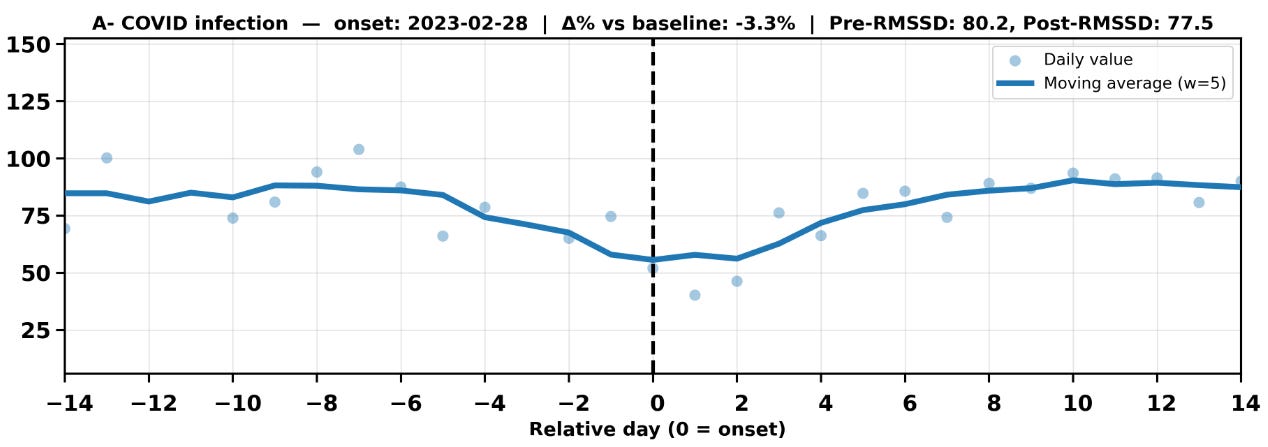
The onset, which you can see as a vertical dashed line, is when I woke up one day and felt sick, with fever and a sore throat, which I later tested for and figured out was COVID-19. Each dot is my HRV reading for two weeks prior to and after the onset of the event. You can note a few interesting things here:
1) The HRV values are actually dropping prior to when I tested positive for the virus. In my diary, I wrote (and I clearly remember) this was a hectic week with a lot of stress, and quite a few nights of poor sleep. That potentially itself suppressed my immune system and made me more vulnerable to catching the virus.
2) After the day I felt the symptoms, I continued to be sick for a couple of days; my HRV remained low, but then, you can see a clear gradual recovery. What is interesting is, it does not jump back up suddenly. You see the gradual shift from one day to the next.
3) You see I’m normally bouncing around more or less the same range, and after the onset of the sickness, I tend to bounce back there.
This was the first convincing signal for me to start to believe there is something interesting going on here. So I kept on measuring. I took 1,000 days out of these four years in which several interesting life events occurred, and turned it into a manuscript that you can access here. Over these years, several other sickness episodes occurred and were clearly reflected in my post-wake-up HRV readings; in addition, many stressful life events also occurred that left a clear trace in this data. The most interesting one by far was last year in June, when I traveled to Iran to visit my family. Two days after I arrived, the country was attacked, so I was now in a war zone. I was also again very sick, and a few days later I lost a family member.
So, a huge source of stress that I rarely experienced so strongly in my lifetime, and you see the result below:
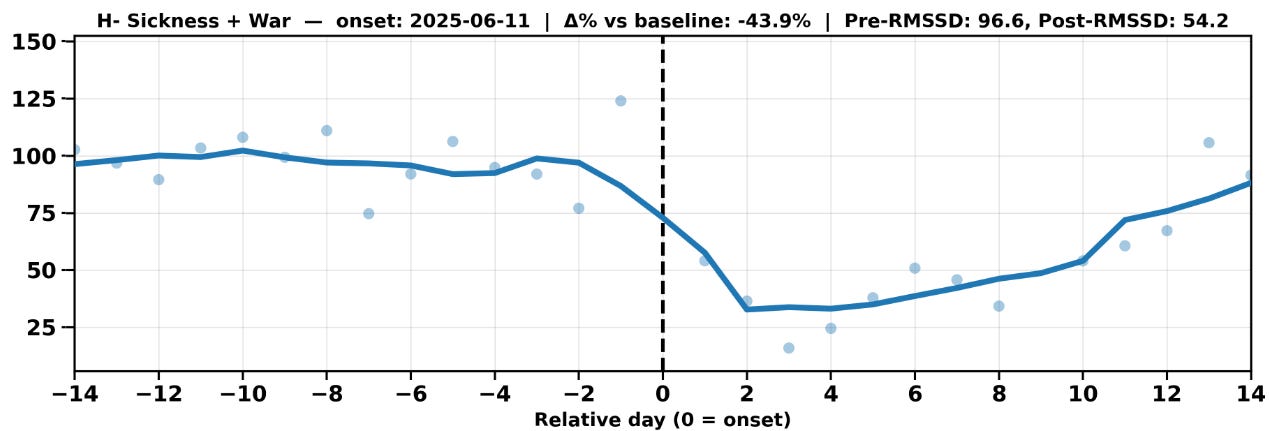
Almost a 44% reduction in my HRV values when you compare two weeks prior to two weeks after this event, and a long recovery slope to come close to where I was before this.
I hope what I just told you got you curious enough to bear with me so I can share some more info about what I know about HRV. Initially, the first time I looked at my HRV around my COVID-19 infection episode, I was really confused about how I was supposed to interpret what I was looking at. It was almost when I had just entered my study, and I was not sure what it was that I needed to take from this data.
I could clearly see, as you just did, that the effect was there; it’s clear that those numbers are going up and down, but those observations immediately generate a bunch of questions that cannot be answered so easily:
What is the underlying mechanism driving it down (or can I even start to isolate that mechanism)?
Is this showing me something about my “autonomic balance”?
About my parasympathetic nervous system?
Does it have (necessarily) anything to do with my rest and digest and recovery system? More importantly, it picked up my sickness, but how specific (or rather, how generic) is this metric?
We just saw it also clearly showed the effect of impactful stress. Is there any specificity there?
And how sensitive is it? Will it always go down if I get sick or stressed?
If I feel depressed for a few days, does it also go down?
Does down always mean bad? Do I need to try to bring it up?
I didn’t know a clear answer to several of these questions. I don’t promise that I’m going to answer (or even know for certain) these questions one by one here.
But my hope is, after reading towards the end, you get a framework on how to approach this topic, where to be cautious with interpretation, and the answers to many of these questions become clear to you.
I also intend to clarify why the protocol I have just described might be interesting in understanding the effect of psychosocial stress on HRV, and in general, what do we know about HRV in mental health research?
In my PhD, I realized that HRV research can easily be a double-edged sword. It’s all exciting and interesting, and it’s very easy to measure nowadays, but it’s also very easy to get something wrong, even for those who have been using it in their work for years. In a recent paper with Dr. Paul Grossman, we tried to focus on what this construct means and does not mean, and in a short piece I recently published, I focused on its meaningful interpretation.
In any case, let’s explore some of these findings and review a bunch of things together. There is a shift in mental health research toward a more holistic view of understanding mental health conditions, and a quest for finding shared psychopathology factors, be it a neural circuit, a genetic risk factor, or a physiological mechanism. That puts a physiological measure like HRV very much under the spotlight, especially if you think of how easy it is nowadays to measure it with wearables (putting the discussion of accuracy aside for a second).
So, what is out there when it comes to these findings?
Just to make sure we are all on the same page before I start, let me briefly tell you what HRV is. I’ll go deeper into it later, and Ana already did a great job covering it, but I want to make sure one can continue reading without those prerequisites:
If I measure your heartbeats over time, and then quantify how far they are from one another, that gives me a timing time series that we call interbeat intervals. If from one beat to the next, your heart beats like this: beat, then a second later another beat, then a second later another beat, we get no variability. It’s three beats with a fixed time interval between them (one second). This is essentially zero variability with whatever quantification method you use (for instance, take a simple variance of this). A healthy human heart does not beat like that though; so you get a beat, then say the next beat is 0.9 seconds apart, and the third beat is 1.2 seconds apart from the second beat. See, that time varies; we see a variance there. I’ll tell you more about why that’s the case, but for now keep that in mind when I talk about HRV. So that variability or variance between the beats can be low, or high, to intentionally oversimplify things for now.
Alright; now, if you take a group of individuals who have a diagnosis of a mental health condition, say depression or anxiety, sit them down in a standardized way and measure their resting HRV, and compare them with matched control cases with no diagnosis (provided everything is controlled, especially medication use), in general, they tend to show lower HRV values. In fact, this goes as far as some reviews showing that across several studies, it is fair to say that there is enough evidence for us to believe that people with most (not all) domains of psychopathology tend to show lower HRV values.
Findings don’t stop here though. You have a body of literature that shows HRV (during rest or a task) might somehow covary with different cognitive domain indices. To just show you one out of hundreds of examples, one study used a task that is a classic paradigm used in memory research. Essentially you learn a pair of words, say: “tape-radio”. Then in one condition, they will ask you that when they show you the word “tape”, you should forget about its associated word “radio” (a bit weird, I know, but it does work and people meaningfully recall fewer associated pairs when you test them). Now this study showed that those who had higher resting-state HRV are in fact those who are better at “forgetting” these pairs; as if they have better top-down control over memory retrieval. There are many of these kinds of studies where they find associations between HRV and some sort of cognitive domain. For instance, higher HRV with better self-regulatory mechanisms, attention, memory, language, executive functions, processing speed, essentially all cognitive cocktails possible!
Then there is also another layer of evidence, where they looked at functional or structural brain correlates with HRV. For instance, in one study, they tested the connectivity between the medial prefrontal cortex (mPFC), which is part of an important network that participates in top-down regulation, including emotion regulation, and another subcortical region, the amygdala. The amygdala is involved in numerous functions, one of the most well-known being the processing of emotions, particularly fear. In general, connectivity between these two regions has been linked to emotion regulation, roughly speaking. And in this study, they found that those with higher resting HRV indeed showed stronger functional connectivity between these two regions. In another study they saw that another frontal part of the cortex (lateral orbitofrontal region) had greater cortical thickness in those with higher HRV.
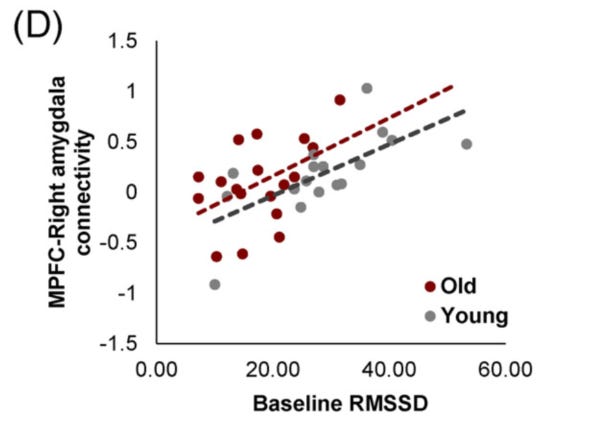
I want you to pause for a second and appreciate how profound this sounds: you are measuring something peripheral, at the level of the heart. The variation in time intervals between individual heartbeats, and somehow that correlates with how well the mPFC is in dialogue with the amygdala? Or how well you might be able to suppress memories or emotions? Or how dense a particular region of your cortex is? Won’t that imply that if I can do a screening with such a simple and non-invasive protocol that apparently correlates with some risk factors of psychopathology (i.e., weaker connectivity of PFC with subcortical structures), I might be able to, for instance, tell who is at higher risk of developing psychopathology, or relapsing into an episode?
That has indeed led to quite a lot of excitement in the field. But we need to wait a second; first, why does such variability exist in heartbeats? So how am I supposed to interpret this? And second, is it always very strongly correlated with what we just described? Is the effect big, meaningful, strong, always found? Let’s see what we know.
Ana already nicely covered the mechanisms through which HRV arises, so that makes my job easier to briefly recap some of those here in one section. I noted that if you measure heartbeats over time, the time difference from one beat to the next is not a fixed interval, and in a healthy adult human, that time difference varies from one beat to the next. There is nothing particularly special about us humans here, per se. It is actually found in many air-breathing vertebrates studied thus far.
Now, why do we see such variability? There are several sources contributing to it. The main one is the synchronization between your breathing and heart rate. That’s why it is referred to as respiratory heart rate variability, or RespHRV. You inhale and the heart beats faster, and as you exhale, it slows down. And if you find a physiological phenomenon like this that is preserved across many species, it perhaps served an adaptive function which remained selected (and it’s not fully clear, but for instance more efficient pulmonary gas exchange could be one of those).
I’d like to clarify a confusing point here: this respiratory influence is NOT the only reason you see variations in beat-to-beat intervals. To give you one other source, changes in blood pressure also increase and decrease your heart rate. At rest, there is this ongoing oscillation through a negative feedback loop that continuously does that: your blood pressure slightly increases, and among other things, your heart rate decreases to stabilize your blood pressure again. With the slightly lower blood pressure that you now have, your heart rate should go up again, and it goes on and on. So this is also creating a variation in your heart rate, and hence in the timing between intervals, though acting slightly slower than the respiration component. There are other much slower-acting components at play that you can’t see in beat-to-beat variation.
What is interesting though, is when it comes to studying HRV in the context of cognitive and psychological research (that is true for some other fields as well), the source that has to do with respiration that leads to quick, beat-to-beat variation, that RespHRV component, has often been at the center of attention. Why is that? Because:
1) We have a better understanding of the mechanisms underlying its generation that might particularly be interesting to us. We know that in the brainstem, specifically in the medulla oblongata, there are specialized nuclei involved in generating the respiratory cycle. Then there are neighboring neurons that send signals through the vagus nerve to the pacemaker area of the heart, and therefore shape parasympathetic, or vagal, influence on the heart. And these two groups talk. So imagine this: the respiratory generation center tells the cardiac parasympathetic neurons that I just initiated inspiration. The cardiac guys say, then I’ll turn down my volume and fire less, so the heart rate can briefly go up (there are peripheral feedback loops also involved, e.g., based on how inflated your lungs are, but this central mechanism is a major source generating this RespHRV, and for reasons I don’t get to here, it’s really mainly the parasympathetic system driving this beat-to-beat variation, rather than the sympathetic one).
Therefore, this RespHRV can tell us something about this cardiac parasympathetic control, but imperfectly. Note that it’s cardiac; it’s not telling us about the liver, guts, nor does it directly tell us anything about the ~80% of vagal fibers that are sensory (afferent). A lot of people would benefit from having a non-invasive, certainly imperfect, proxy for SOME aspect of parasympathetic modulation, even if it is only over the heart and not the rest of the body. That is what it really is!
2) The second reason for its popularity is certainly because of the quantification methods that we have to approximate this phenomenon. For instance, I can take one respiratory cycle, and ask what is the shortest and longest interbeat interval during inspiration and expiration, and take the difference and think of it as a more or less good correlate of the influence of this phasic variation in parasympathetic outflow (this is the peak-valley technique, pioneered by Paul Grossman). You certainly don’t have this luxury with many other sources of HRV (even if you’re interested in studying them); they’re much more mixed and intertwined with other sources that can’t be easily dissected.
First caution relates to the findings we reviewed regarding mental health, stress and cognition. Science takes time, and we are just at the beginning of finding these effects. It is still unclear how big the effects are. They don’t seem to always be as consistent. Several studies, including a large study I published, failed to replicate some of these. Failure to replicate does not mean the initial findings are wrong, but it flags that there are more nuances than we initially thought. We should more carefully think of the population, sexes, age ranges, confounders, and many more things to get a clearer picture of what actually holds and what does not.
Second caution relates to the interpretation of HRV. It is hard to tell “why” we see these associations. i.e., what is the mechanism linking these. There are of course theoretical models and frameworks that give us some explanatory power, and help us make predictions. Depending on the model, it might assume certain neuroanatomical pathways that might be in play. But as George Box said, “All models are wrong, but some are useful”. I think it’s good to know them and even base our predictions on them, but be aware that we might be jumping to conclusions too fast.
If we think that we know exactly the mechanism through which HRV is generally suppressed in mental health conditions, or why we see correlations between HRV and certain cognitive domains, then we might end up inventing interventions that are not necessarily backed up by science either. I don’t want to name any method specifically, but you just need to go on YouTube and search HRV or vagus nerve, to see hundreds of videos with millions of views of “hacks” on how to increase your HRV to defeat your anxiety or to “reset” or “regulate” your vagus nerve (whatever that means!).
My take is, the evidence is there, but scattered, and perhaps smaller and more nuanced than what we think. The replication crisis is real and we might want to stay agnostic about the theoretical models and take them with a grain of salt when interpreting these findings. Evidence synthesis in the long run will prove what holds and what does not, and till then there is no need to take a radical religious side in science when it comes to proposed models of explaining why such findings might exist.
In short: Whenever you hear any claim outside this cautionary interpretation, such as HRV tells us about the balance between the branches of the autonomic nervous system, or tells us about the overall tone of the parasympathetic nervous system, or we measured cardiac vagal tone via HRV, you perhaps need to pause and rethink it. It is also worth noting that HRV is so fragile that if you change the rate and depth of breathing, if you move, change posture, and many other things, you can totally confound its measurement.
In Neuroscience & Psychotherapy I publish weekly dispatches from the frontier of neuroscience and psychotherapy, clinical material, conversations with N&P friends and more.
If you like this piece please hit the ❤️ and share it with your network.
We started this piece with the results of my post-wake-up HRV measurements. I want to wrap it up by going back to it one more time, and this time we start to put together what we reviewed about HRV. Take another look at the figure where it shows two weeks of my war exposure.
If you measure an individual so intensively for such a long time, it might benefit us in two ways: 1) it might provide an opportunity to monitor a person in terms of how they recover from stressful life events. Therefore, you might be able to “detect” that; think about what if, after this stressful event, you saw no sign of recovery in my HRV. 2) Relatedly, that might allow you to do something about it, such as just-in-time interventions to support recovery.
Interestingly, such efforts have led to some preliminary results with ecological momentary assessment. For instance, one study monitored momentary affect states three times a day in one person, and when you take one of the items (“feeling down”), and look at its autocorrelation (how similar the reports are to one another), it significantly increased one month before this person transitioned into a depressive episode.
I’m not arguing that with HRV you can indeed predict transitioning into a shift in a system (from mental health to mental disorder); I have no evidence for that, but we saw that in some cases, HRV might reflect our bodily adaptation to stressful life events from different sources. Which can indeed serve us well.
But why does it go down under stress, and why does it tend to gradually recover?
It’s roughly one million years ago, and you are a zebra on a savanna in East Africa, just resting and digesting under some pleasant shade. I’m going to borrow the example from Robert Sapolsky in his book Why Zebras Don’t Get Ulcers to illustrate how this stress system was adaptive to make us live long enough to pass on our genes.
Okay, now you are that zebra, and you notice some suspicious activity that might be a lion (or not, but better safe than sorry, so you’d assume the worst). Your suspicion is confirmed, and the lion has locked on to you for lunch. Now, what do you do? You RUN for your life. You wouldn’t need to worry about digestion, reproduction, or other less urgent stuff anymore, because if you’re dead in the next minute, you won’t need any of them anyway. All of that can be postponed until a potential future, but only if you survive. For now, all you need is for the machine nature built into you to kick in.
The fastest route you want to recruit is taking advantage of your autonomic nervous system: activate the sympathetic branch of your autonomic nervous system and withdraw some of the parasympathetic influence, so you can send more blood and fuel to your muscles, increase your heart rate and blood pressure, focus your attention on the threat, and run for your life. In parallel, you release a cocktail of hormones into the bloodstream to mobilize energy: catecholamines such as adrenaline and noradrenaline (and these act quickly), plus glucocorticoids (i.e., cortisol in humans).
If you did survive the predator, now what? Once the immediate danger has passed, the acute stress response decelerates, and the recovery effects of the parasympathetic nervous system begin to kick in. You’d make use of the stress response machinery to act immediately, increase your chance of survival, and then TURN IT OFF AGAIN - if that is possible of course given the level of threats present.
Now let’s place all this in the framework of allostasis ( this has been popularly referred to in recent years as the body budget). Allostasis is how the body and the brain maintain stability through ever changing conditions - and it is thought that this happens through anticipatory regulation (you can read more about allostasis here).
Adapting your bodily response to meet a threat is adaptive (an example of allostasis), but if you turn this stress response on too often or too frequently, or don’t turn it off for a long time, you’re going to be in trouble; and we humans are very good at not letting it turn off, because we have such a sophisticated brain that can turn on the very same machinery simply by thinking about or anticipating a threat. Rumination and anticipation can indeed prolong or trigger physiological stress responses. You can end up keeping your blood pressure elevated and your immune function dysregulated, and your risk of developing pathophysiological conditions increases.
This is the idea behind the concept of allostatic load ( term coined by Bruce S. McEwen and Eliot Stellar). If you think of the 1000 days of HRV case study I showed you from this lens, I hope it makes better sense. HRV could be one, among many physiological metrics, that we might be able to monitor to capture some aspects of how the body is responding to and recovering from repeated stress, which might be relevant to allostatic load. This could potentially help us detect when that recovery is not happening normally, before more persistent signs of the so-called wear and tear are there.
So, where does all of this leave us? If my HRV goes down during sickness or a major stressful event, can I say that my parasympathetic activity went down? Not necessarily. Could it be some change in sympathetic activity? Changes in respiration? Cardiovascular regulation? Metabolic demands? Longer-term hormonal changes? Sure; what I am seeing is perhaps some combination of these things.
What is cool, though, is that it does carry useful information. I tend to be cautious about arguing about the mechanism, but there is no need to discount the cool aspect of it. Whatever it tells us, there is valid information there. HRV sits right there at an intersection of three major bodily systems: cardiac, respiratory and nervous systems. It’s no wonder it’s such an integral measure with mixed information.
It’s a nonspecific metric. I think it’s safe to say that mental and physical sickness are generally associated with lower HRV, and mental and physical fitness with higher HRV. That said, absolute values and focusing too much on individual differences might become less relevant. Within-person changes are perhaps a more interesting signal, specifically when it comes to monitoring and understanding adaptation and recovery.
With that lens, if my HRV drops again, I cannot look at that number and tell you exactly what the mechanism is behind why it went down. But perhaps I don’t always need to tell you why either. When measured repeatedly, it can leave a physiological trace of how the system is adapting, how it finds its way back. It is one small window into a much larger adaptive system. And sometimes, watching that window over time can tell us something worth paying attention to.
Sinichi A et al 1000 Days of HRV: A Case Study of Daily Post Wake Up Heart Rate Variability for Tracking Stressful Life Events
Sinichi A, Grossman P. On choosing heart-rate-variability (HRV) metrics to reflect vagus-nerve functioning: The construct counts, not the algorithm. Biol Psychol. 2026
Comments
Nothing yet. Say the first thing.
Sign in to join the conversation.