
This post was written by NQC Facilitator, Leif.
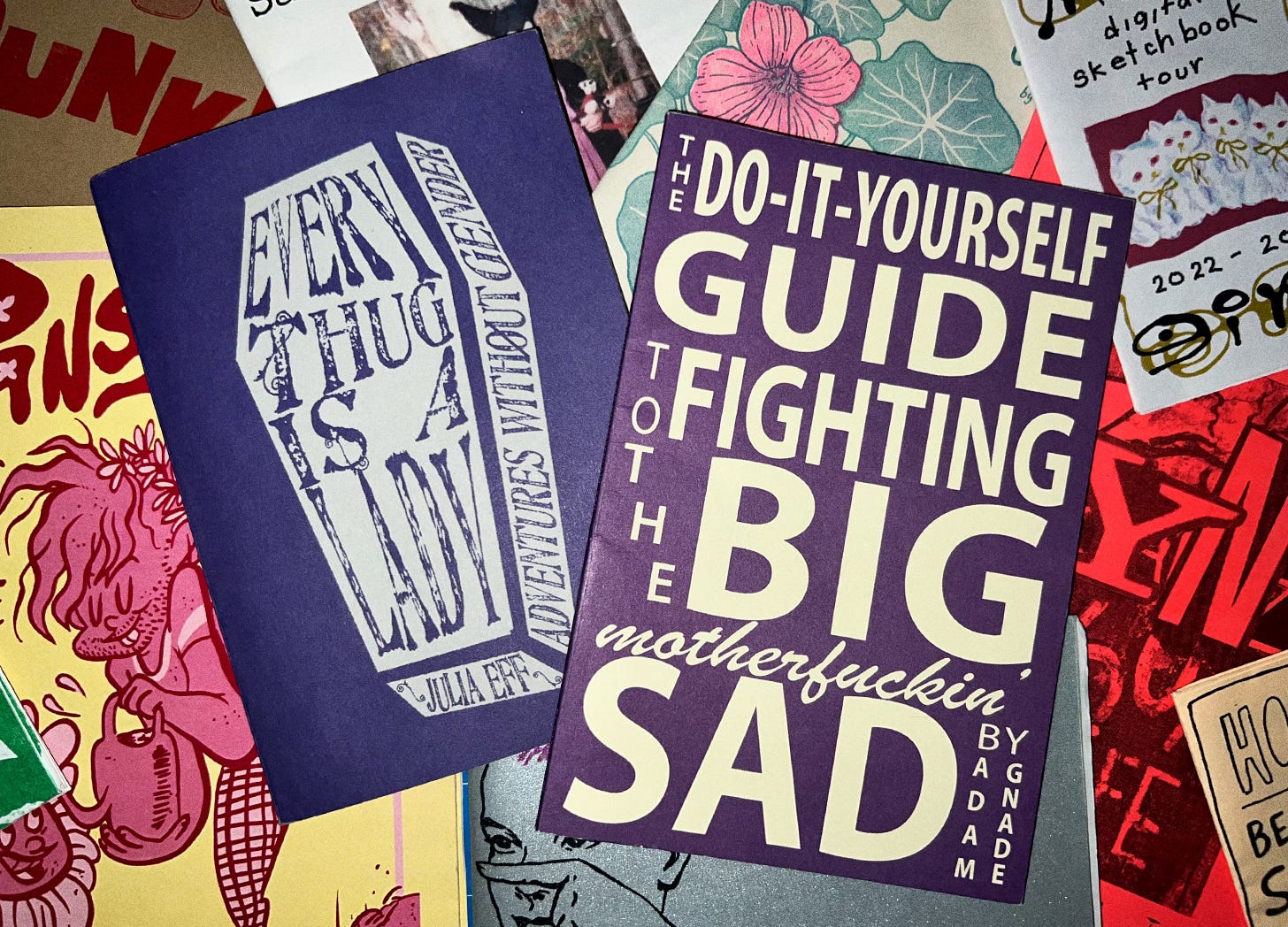
I’m not sure where I first heard of zines, I think it must have been on Twitter around 2014…around the same time I was starting to realize I was some kind of queer. Somehow I stumbled upon the (sadly now defunct) Pioneer Press and ordered my first zines: Every Thug is A Lady, Adventures Without Gender by Julia Eff and Do It Yourself Guide To Fighting The Big Motherfucking Sad by Adam Gnade.
zine: a non-commercial, self published booklet or pamphlet, often photocopied and assembled by hand, offering a platform for self expression, niche interests and counter cultural voices outside of mainstream media. Zines are made for the love of creating and not for huge profit margins.
Every Thug is a Lady was probably the first piece of media I experienced that talked about a gender outside of the binary. In the zine, Julia Eff explains the concept of Neutrosis, “which refers to an individual who has no gender and does not identify as male or female. It is often denoted with the ‘null’ symbol, meaning ‘empty set’.” Null symbol: ∅. Eff uses humor and cultural references to talk about their gender dysphoria and their journey with figuring out their gender, and lists a ton of helpful resources for people who are questioning their own gender.
It would be a couple of years after reading this zine before I would be brave enough to come out as genderqueer, but Every Thug is a Lady was imperative in helping me realize and name things about myself and my identity. I still think of this zine fondly and yeah… I could, and probably would, have figured out I was genderqueer without it, eventually… but I can’t understate how helpful it was in figuring out my own identity.
Adam Gnade’s The Do-It-Yourself Guide to Fighting the Big Motherfuckin’ Sad is a self-described “anti-depression guide/guide to a freer, more lawless life”. As a depressed twenty-three year old, who wasn’t in therapy yet, it was an important resource for learning about how to care for myself in a fucked up world. This is another zine that I owe a lot to, possibly even my life.
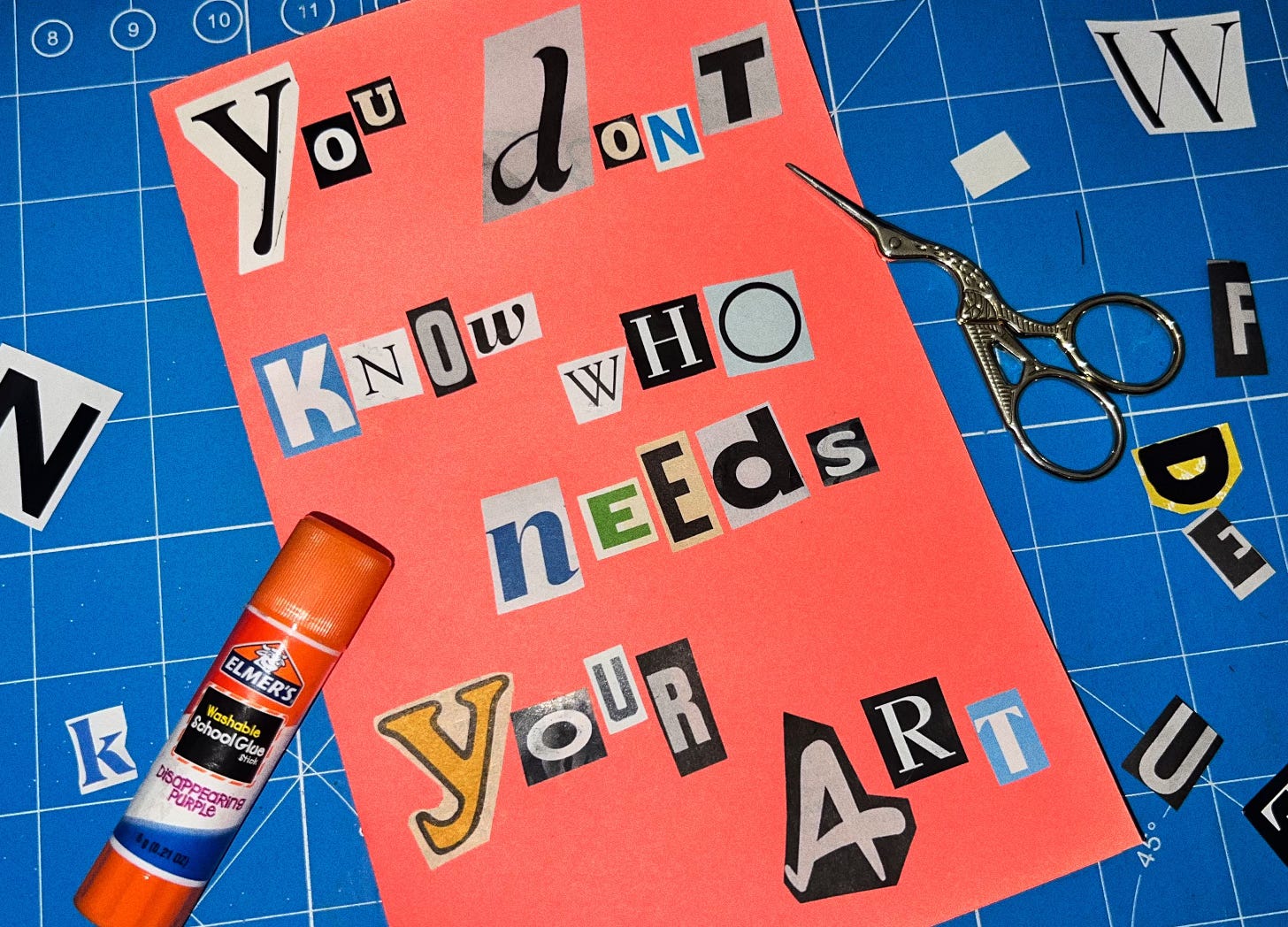
I still own these zines; one of them is displayed on my wall. Zines were an important part of my exposure to queer counter culture and I mention these two specifically, because they illustrate just how much sharing your work, your story, your art, etc… just how much of an impact it can have on someone’s life. This is part of the reason why I love zines so much, they are an accessible way for people to share their passions with the world and I think the world could always use more art. I would go on to collect even more zines as the years went by (over a decade now but who’s counting). I love all kinds of zines, literary zines, art zines, music zines, photo zines, fanzines, review zines, perzines… any and all of them. I find all types of zines to be equally important to share. A sentiment I’ve always loved is “you don’t know who needs your art.” I truly believe that.
I started making my own zines in 2019; it was something I always wanted to do but it took me a while to work up the courage to actually do it. I thought zines were so cool and I had put all of this pressure on myself and couldn’t get past the idea that I didn’t have anything “cool enough” to be able to put into a zine. I think one of the biggest barriers to making zines, along with any art practice… is oneself… the idea that maybe you don’t have anything to share, maybe you don’t think you have permission… the thought of “who am I to make a zine?” etc. But now, instead of trying to make zines to impress other people, my goal is to make zines that my inner weirdo child would think are cool. They are the only one I want to impress. I hope that my Intro to Zine-Making session and the Bad Zine Club can help other people push past the barriers of perfectionism and external expectations, and embrace making for the sake of making.
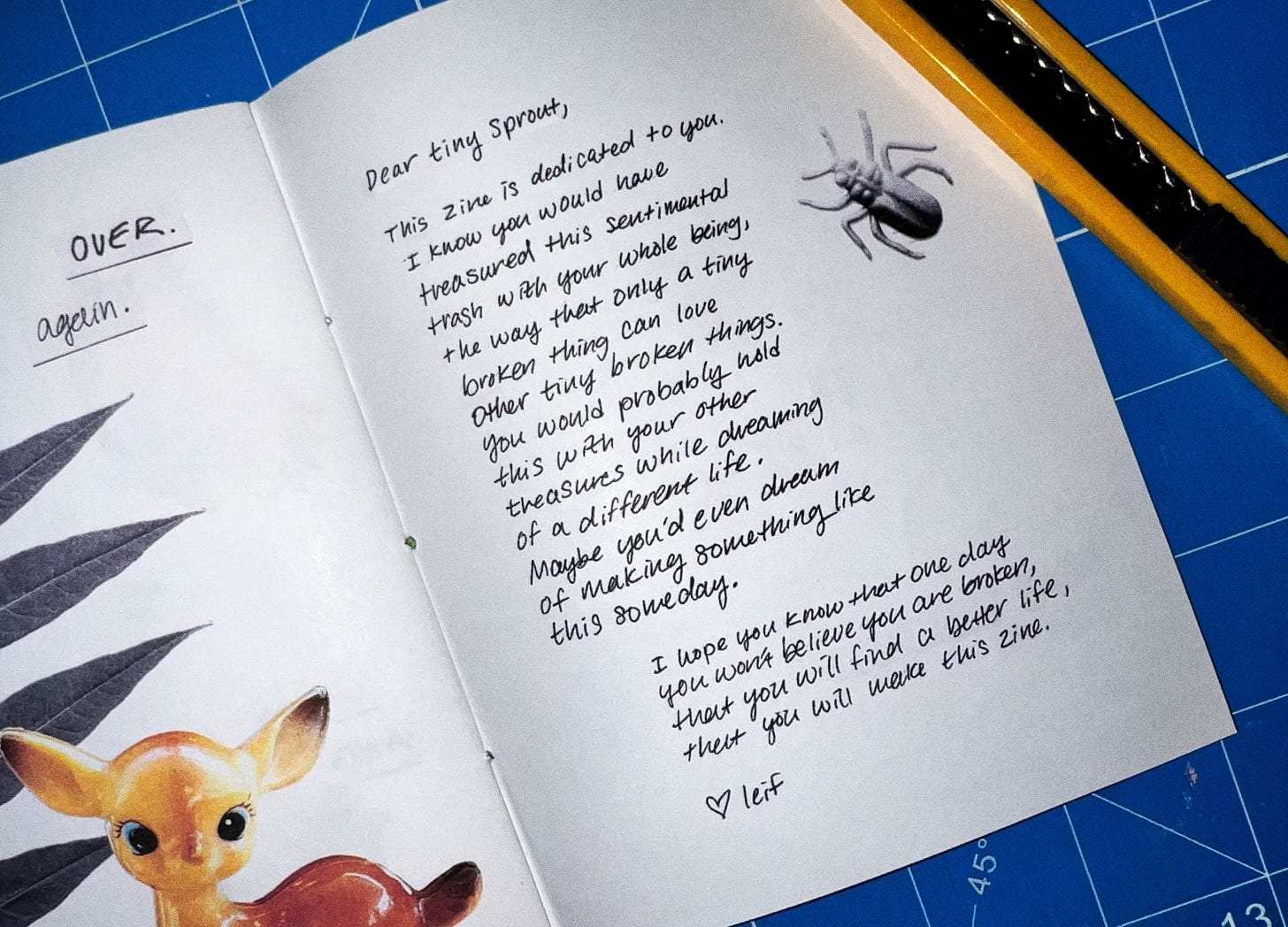
I also love being a part of the Chicago zine community and I hope to make more connections locally and globally through zines.
Zines have roots as far back as the 1830’s, when the American Anti-Slavery Society self-published and distributed wood-printed abolitionist pamphlets, but they were popularized in the 1970’s when the copy machine was invented and widely available for personal use. Using the copier to self publish, zines became a staple (pun intended) of the counter culture and punk movements of the 70’s and 80’s. They continued to be utilized for movements such as the riot grrl movement in the 1990’s.
In my opinion, zines are currently having a resurgence as more and more people are pushing back against the hyper-commercialized digital algorithm. I think people are looking for more ways to engage with physical media and to directly share art, stories and resources with one another.
I want to share zine-making with the NQC community because zine-making inherently neuroqueers the publishing process and I believe that neuroqueer voices, stories and art deserve to be shared with the world. Zines offer a flexible and accessible medium for sharing those experiences. It’s taking something that is inaccessible to most, publishing, and making it as accessible and personalized as possible. Zines don’t require linear thinking, perfection, or permission. Zine content doesn’t need to fit into neuronormative boxes, it doesn’t need some “professional” to approve the content, you don’t need to send it to publishers and editors who want to change your message or voice. Zines don’t need to be polished or to even make “sense” they can be anything you want. There is truly no way to do it “wrong”. Zines are the perfect outlet for non-normative ways of thinking, communicating and sharing. I truly believe anyone CAN and SHOULD make zines.
Through the Intro to Zine-Making Session and the monthly Bad Zine Club I hope to share the practice of zine making with as many people as possible and to create a low-pressure and welcoming space for people to experiment and play with zine-making. I want participants to become more willing to give themselves permission to create, to break out of a perfectionist mindset, and create for the sake of creating. Even if someone just walks away with a spark of inspiration, that is still a success for me.
Leif is the queer Chicago-based AuDHD artist and zine maker behind It’s Weird Now Press. Their creative practice is rooted in survival, self-compassion, and finding humor in the mess of being human. Through zines and mixed media work, Leif explores the beauty and chaos of the in-between. They view art-making as an act of resistance, healing, and re-imagination. Leif believes everyone is inherently creative and through the simple act of making - holds the power to transform not only themselves but also the world. As a member of the NQC Facilitator Community, Leif currently facilitates Intro to Zine-Making and co-hosts our monthly Bad Zine and Bad Art Clubs alongside Sonya Gracey
You can join Leif for Intro to Zine-Making on Saturday, January 24th from 5-7pm GMT via Zoom for only £10 (limited FREE places available on a first-come, first-served basis)
If you have questions, need further info, or have issues booking your place, please don’t hesitate to contact info@neuroqueercreative.com
Comments
Nothing yet. Say the first thing.
Sign in to join the conversation.