
You’re not imagining it — and it’s not your fault. It’s the natural result of how our sensory and strength systems change with age. The good news? Those systems remain highly trainable, even well into our 70s and 80s.
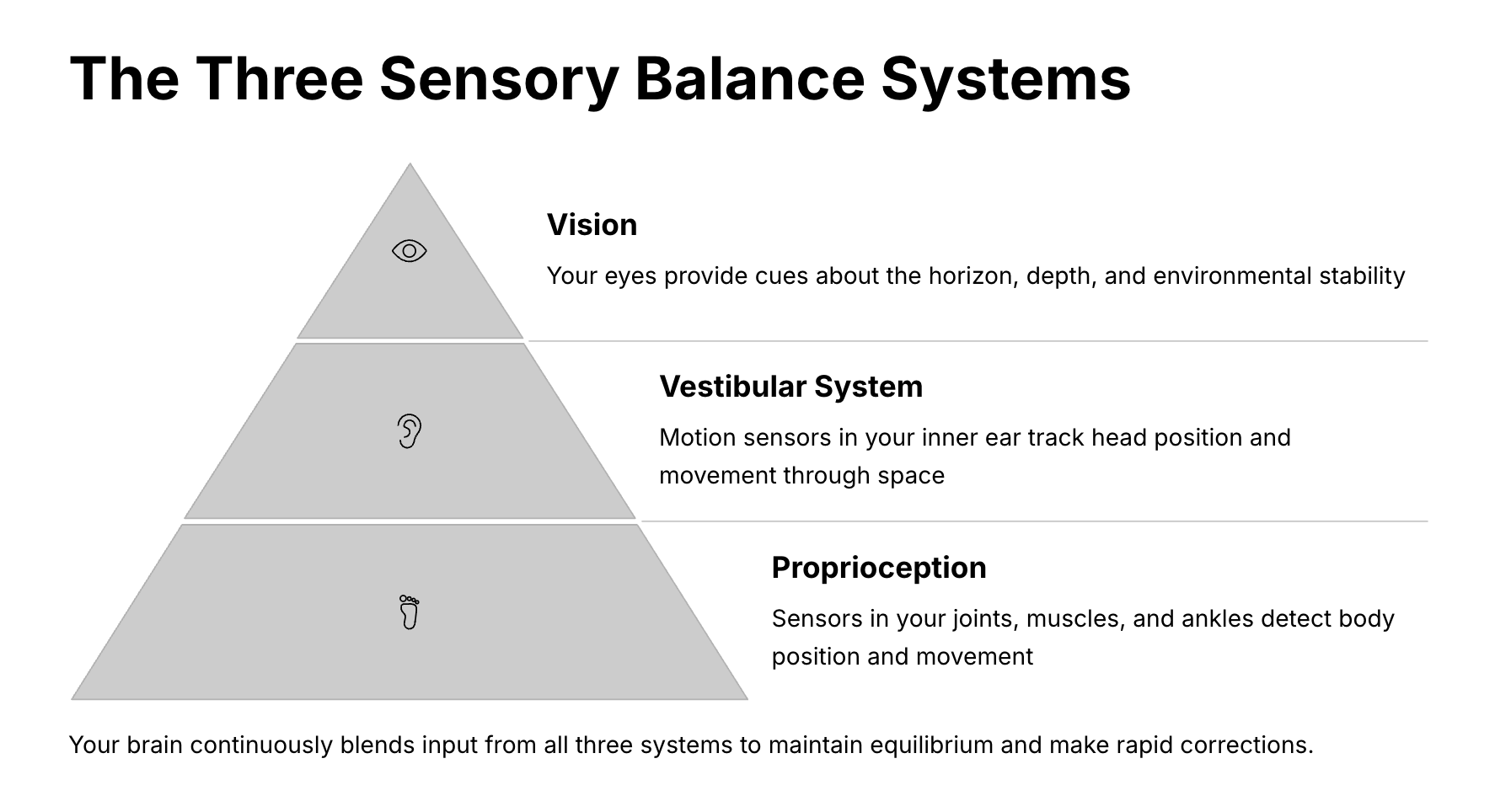
Balance isn’t one skill — it’s a team effort between your senses, your brain, and your muscles. After about age 70, several normal age-related changes begin to overlap:
Vision becomes less sharp in low contrast and low light. This makes it harder to judge steps, curbs, and uneven surfaces.
Proprioception — your internal “GPS” aka knowing where your body is in space compared to other body parts — becomes fuzzier. Receptors in the feet, legs, and joints send slightly less precise information about where your body is in space.
Strength and power decline more quickly. This doesn’t just mean weaker muscles — it means slower reactions, smaller steps, and less ability to “catch yourself” if you trip.
Individually, these changes are manageable. But together, they lower your physiological reserve — the extra capacity you once had to stabilize yourself without thinking. Tasks that were once automatic now demand more attention, which is why busy environments, soft surfaces, or multitasking can feel more challenging.
These shifts explain why many adults notice the first real change in balance in their early 70s, even if they’ve been active for years. But here’s the important part:
The systems that decline with age are the same systems that respond amazingly to training.
Research consistently shows that:
Strength and power training improve walking speed, reaction time, and balance.
Balance and sensory-challenge exercises help your brain re-learn how to use vision, vestibular cues, and proprioception together.
Dual-task training (moving while thinking) improves real-world stability — things like walking while talking or navigating crowds.
In other words: balance changes are real, but they are trainable.
Here are three evidence-based practices you can safely build into your week, even from home. (As always, check with your doctor if you have specific medical concerns.)
Focus on big movements such as:
Sit-to-stands
Step-ups
Heel raises
These train the muscles that keep you upright, stabilize your ankles and hips, and help you react quickly.
Try:
Standing on one leg while brushing your teeth (make sure to hold on to the counter though)
Walking slowly along a hallway “tightrope”
Practicing turning your head side-to-side during easy walking
These challenge proprioception and integration — exactly the systems that tend to decline after 70.
Walk for 5–10 minutes while gently noticing:
How your feet are feeling against the ground
How your posture adjusts with each step
What changes when you look left, right, or ahead
This builds the connection between attention and movement, an essential ingredient for preventing falls.
This week, notice: Which situations make you feel slightly less steady — dim light? Uneven paths? Talking while walking?
These clues help you understand which systems need training, not what you “can’t do.”
In January, I’m running a free online workshop where we’ll go deeper into these changes and practice simple exercises together.
If you’d like to sign up for it, go to balanceafter60.eventbrite.ca to sign up.
And remember, be kind to yourself and others!
See you next time,
Dr. Loïse
Are you in your sixties and want to get tips and insights on how to live a long and happy life? Are you a millennial witnessing your parents’s journey and wishing for them to thrive? Curious about the secrets to a contented life? If so, this newsletter is for you. Subscribe below if you find the content helpful — I truly appreciate it! Thank you!
Comments
Nothing yet. Say the first thing.
Sign in to join the conversation.