
Team,
Here is my position, and it will cost me.
The supplement list is the least important part of supplementing for your brain. The order matters more than the contents. And two of the five most-recommended brain supplements have a headline number attached to them that does not survive contact with the randomized trials.
I will show you all of it. Including the part where I take my own products off the list.
When I began my academic career, I was sifting through enormous amounts of data trying to answer one question: what makes a brain grow?
It was a naive question. It was also the right one. Because if you can work out what builds a brain, you can work out what defends one.
So I went to first principles. Not “what supplement is trending.” Not “what does the market sell.” Just: what is the brain physically made of?
That question led me straight into the literature on EPA and DHA.
The brain is roughly 60% fat by dry weight, and DHA is the omega-3 fatty acid selectively concentrated in the membranes of your neurons. It is not a nutrient that supports the brain from the outside. It is a nutrient the brain is structurally built from.
I expected the trials to be overwhelming. Give people the substrate their brain is made of, and the brain should hold up better.
The trials were not overwhelming. Many of them failed.
That failure is the most interesting thing in this entire field, and understanding why is what separates people who take supplements from people whose supplements work.
In 2010, a randomized controlled trial called VITACOG gave high-dose B vitamins to older adults with mild cognitive impairment. It lowered homocysteine and slowed brain atrophy (Smith et al., PLoS One, 2010). Brain imaging showed the treatment specifically reduced gray matter loss in the regions Alzheimer’s attacks first (Douaud et al., PNAS, 2013).
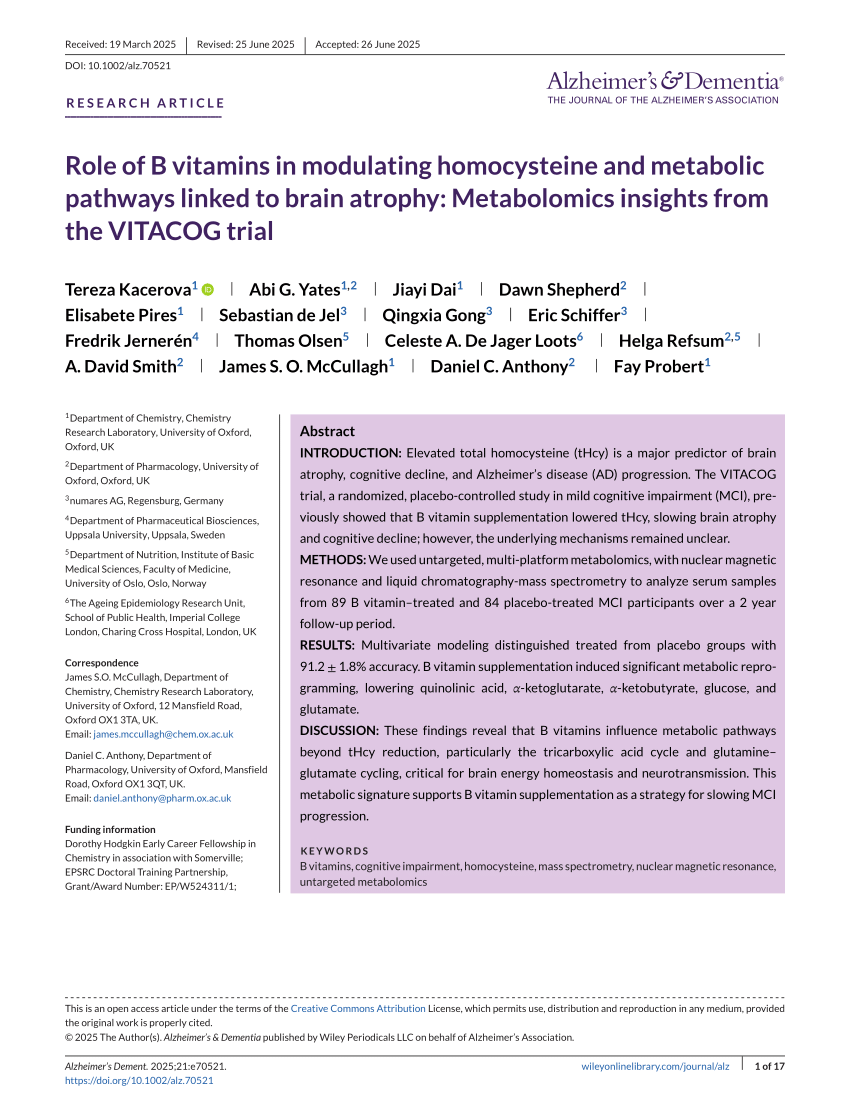
Then the researchers split participants by omega-3 status.
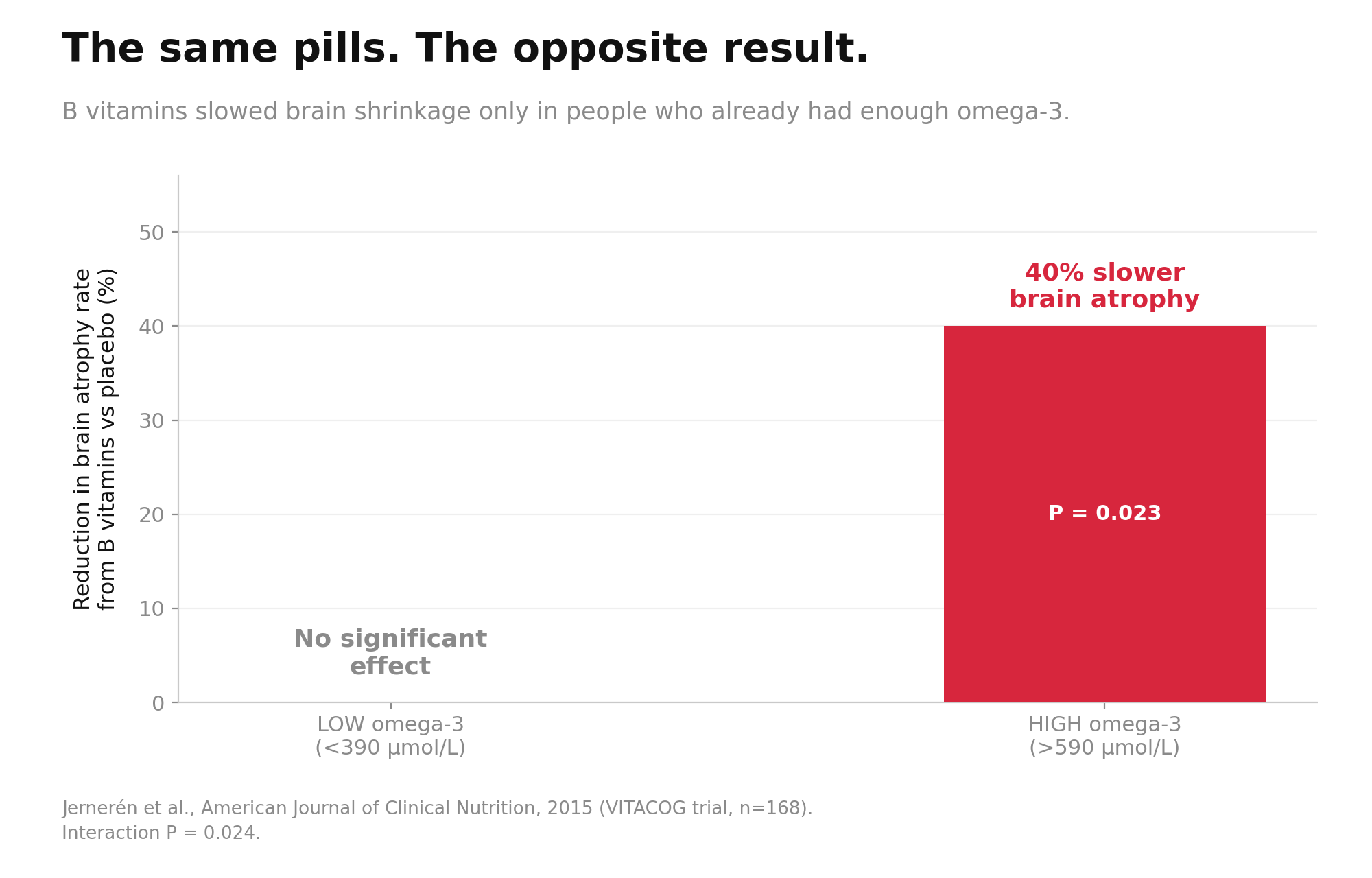
The B vitamins worked in people who already had adequate omega-3. In people with low omega-3, the B vitamins did close to nothing (Jernerén et al., American Journal of Clinical Nutrition, 2015).
Read that again. The intervention did not fail. The intervention failed in the people missing a different nutrient.
Now the same pattern from the other direction. Researchers in the Framingham Offspring cohort counted how many of three nutrients a person was suboptimal in: omega-3, homocysteine (a functional marker of B-vitamin status), and vitamin D. Each additional suboptimal nutrient was associated with roughly 50% higher dementia risk. People suboptimal in all three carried close to four to five times the risk of people suboptimal in none (Alzheimer’s & Dementia, 2024).
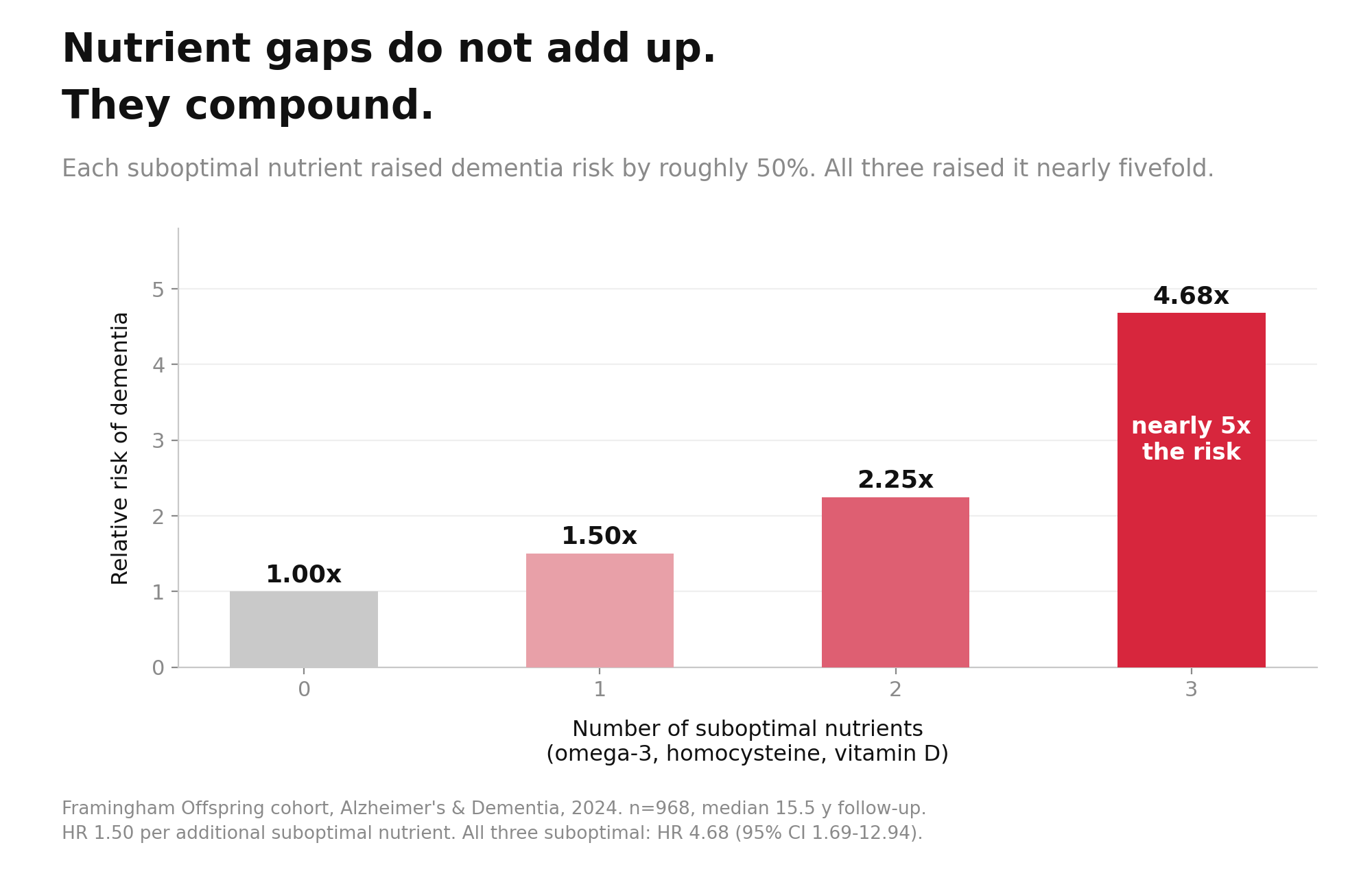
Your brain does not read your supplement list. It runs these nutrients as an interacting system, and a gap in one blunts the benefit of the others.
This is the answer to the question I started my career with. The brain is not built from a hierarchy of nutrients where you take the best one. It is built from a system, and systems fail at their weakest point.
Which means the entire framing of “the top five supplements” is wrong. You do not want the five best supplements. You want no weak links. And you cannot know where your weak links are by reading a list. You can only know by measuring.
That is not a satisfying thing to sell. It is what the evidence says.
Because the silent phase of Alzheimer’s begins roughly 15 to 20 years before symptoms appear. The pathology builds while you feel entirely fine.
For women, the window is sharper. Across the menopause transition, Mosconi and colleagues showed perimenopause itself brings reduced brain glucose metabolism, gray matter changes, and increased amyloid deposition, with peri- and post-menopausal APOE-ε4 carriers accumulating more amyloid than age-matched ε4 men (Mosconi et al., Scientific Reports, 2021). Two-thirds of people with Alzheimer’s are women. This is a large part of why.
The conversation you are told to have at 65 should be starting now. Nutrient status is one of the few levers available to you for that entire twenty-year window, and it is one of the only ones you can measure.
I am going to give you the five, with the trial doses and an honest evidence grade for each, separating what has randomized support from what rests only on observational data.
I am going to tell you why the famous vitamin D number circulating right now is observational, and what happened when it was tested properly.
I am going to flag two safety problems in the standard B-vitamin protocol that almost nobody mentions, one of which can cause nerve damage at doses currently sold on shelves.
And I am going to take two ingredients off this list that I have a commercial interest in selling you, and explain exactly why the evidence does not justify them.
That last one is the reason this newsletter exists. You do not have a shortage of people telling you what to take. You have a shortage of people whose incentive is to tell you what not to.
The three blood tests to run before you spend a dollar. Omega-3 index, homocysteine, 25(OH)D, with the target ranges I use and why the standard lab “normal” for homocysteine is far too permissive.
The five, with trial doses and an honest evidence grade. Which are backed by randomized trials, which are observational only, and why that distinction decides what you should expect.
The vitamin D problem. Where the “40% lower dementia risk” figure comes from, and what the randomized trials found instead.
Two safety issues in the B-vitamin protocol, including one that causes peripheral neuropathy at commonly sold doses.
What I refuse to recommend, including my own ingredients, and the well-marketed supplement that was tested head-to-head in a major trial and did nothing.
Comments
Nothing yet. Say the first thing.
Sign in to join the conversation.