
Neuro Athletics is a twice-weekly newsletter designed specifically for high-performing men and women who want science-backed strategies to optimize brain health, performance, and longevity. Subscribers include executives, coaches, professional women, health-conscious mothers, and women dedicated to peak cognitive and physical performance. If you’re not already subscribed, join 69,000+ people who receive actionable insights directly in their inbox each week.
Team,
There is a substance that’s been classified alongside heroin for over 50 years. It has no accepted medical use according to the federal government. And it just outperformed the best antidepressant we have — in two doses. In this solo episode, I walk you through exactly what psilocybin does to your neurons, why it works where antidepressants fail, the real risks nobody should ignore, and why the President of the United States signed an executive order in April 2026 to accelerate psychedelic therapy review.
This is the most research-dense episode I’ve ever recorded. I cover the default mode network and why its hyperactivity is the neurological substrate of depression, the imaging data showing structural brain changes within 24 hours of a single dose, the head-to-head NEJM trial against escitalopram, the 80% smoking cessation rate from Johns Hopkins, and why the quality of the subjective experience predicts clinical outcomes better than the pharmacology alone. If you or someone you love has ever struggled with depression, addiction, or treatment resistance — this one matters.
TOPICS DISCUSSED
00:00 Intro: A Schedule I Drug That's Making Neuroscientists Rethink the Brain
00:39 The Default Mode Network and Your Sense of Self
02:49 How Depression Locks the Brain Into a Rigid Loop
03:23 Where SSRIs Stop Short of the Problem
04:44 The Brain Imaging Data: "Massive" DMN Disruption and Reorganization
06:58 Confirming It in Drug-Naive Brains
08:04 The Rewiring: How Psilocybin Changes Neural Architecture
08:35 Dendritic Spines and Synaptic Density
09:39 How Chronic Stress Shrinks Your Neural Connections
10:16 One Dose, More Connections in 24 Hours (Neuron 2021)
11:02 BDNF, TRKB, and a Signal 300x Stronger Than Antidepressants
13:21 Psilocybin vs the Gold-Standard SSRI
14:37 Double the Remission Rate: The Numbers That Matter
15:53 Side Effects, Durability, and Treatment-Resistant Depression
16:39 The Addiction Breaker: 80% Smoking Abstinence at Six Months
17:36 Alcohol, Opioids, and the Shared Architecture of Addiction
19:10 The Dark Side: Real Risks and Hard Contraindications
22:35 The Policy Earthquake: Executive Orders and FDA Breakthrough Status
24:37 Why It Actually Works: Set, Setting, and the Mystical Experience
26:57 Bringing It All Together
I’ve spent the last several years inside clinical neuroscience research on some of the most complex questions in brain health. I study neurodegeneration. I study what breaks. I study what protects.
When I look at the psilocybin research that has come out of Johns Hopkins, Imperial College London, and now multiple phase 3 trials — I’m genuinely stunned. Not because it’s trendy. Because the mechanism is unlike anything else in psychiatry.
Every antidepressant we have works by adjusting the chemical environment around your neurons. SSRIs increase serotonin in the synapse. The neurons themselves — their physical structure, their connections — remain essentially unchanged. The grooves in the record are still there. The medication turns down the volume.
Psilocybin doesn’t turn down the volume. It takes the record off the turntable entirely.
The default mode network is the brain’s self-referential system. It’s the network responsible for your inner monologue, your sense of self, your ability to imagine the future. In a healthy brain, it activates and deactivates in a balanced rhythm.
In depression, it becomes hyperactive and rigid. It fires constantly. The brain gets stuck in a loop of inward self-critical thought that becomes increasingly negative and increasingly narrow. This isn’t a metaphor. It’s measurable on fMRI.
A 2024 study published in Nature used precision functional mapping and found that psilocybin produced — their word — “massive” disruptions to this network. The rigid pattern collapsed. And in its place, the brain reorganized. Regions that had never communicated before started firing together.
A separate 2022 Nature Medicine study showed these connectivity changes persisted at 3 weeks. The patients who showed the strongest disruption during dosing were the most likely to be in remission afterward.
The disruption wasn’t a side effect. It was the mechanism.
Here’s the data point that made me record this episode.
Researchers gave mice a single dose of psilocybin and watched their prefrontal cortex under a two-photon microscope. Within 24 hours, dendritic spine density increased by 10%. New physical connections between neurons — visible, measurable, structural. At one month, 60% of those new spines were still there.
Then came the receptor data. The active metabolite of psilocybin binds to the TrkB receptor — the receptor that tells neurons to grow — with 300 times the affinity of conventional antidepressants.
That’s not a marginal improvement. That’s a fundamentally different signal strength.
In 2021, the New England Journal of Medicine published a randomized controlled trial comparing psilocybin directly against escitalopram — the gold standard SSRI — in moderate to severe depression.
Two doses of psilocybin. Six weeks of escitalopram. Same patient population.
The headlines said “no significant difference.” The secondary outcomes told a different story: 57% remission with psilocybin versus 28% with escitalopram. The psilocybin group showed improvement within one week. The escitalopram group was still building to therapeutic effect at week six. And at six months, the psilocybin group maintained their gains significantly better.
Two doses. Faster onset. Double the remission rate. Better durability. Fewer side effects.
The addiction data is equally striking. Johns Hopkins enrolled lifelong smokers — 19 cigarettes a day for 31 years, average of six previous quit attempts — and gave them two to three psilocybin sessions with cognitive behavioral therapy.
At six months: 80% biologically confirmed abstinent. The best pharmacological treatment we have produces 35%.
A 2022 JAMA Psychiatry RCT showed similar results in alcohol use disorder. The mechanism appears to affect the underlying architecture of addiction itself — the rigid neural patterns carved by decades of repetition.
I want to be clear about this. Psilocybin is not for everyone.
Every clinical trial excluded patients with a personal or family history of psychosis, schizophrenia, or bipolar I. Cardiovascular disease requires screening. HPPD is rare but documented. And critically — unsupervised recreational use produces a completely different risk profile from supervised clinical use.
The therapeutic context is not optional. The drug alone is not the treatment. The drug plus the therapeutic container is the treatment. Patients who report a stronger subjective experience — measured by the Johns Hopkins Mystical Experience Questionnaire — have significantly better clinical outcomes. Same drug, same biology, but the quality of the experience predicts the result.
Set and setting aren’t just supportive elements. They may be active ingredients.
On April 18, 2026, the President signed an executive order accelerating federal review of psychedelic therapies. The Compass Pathways NDA submission is expected in late 2026. Oregon already has a licensed psilocybin services framework. Australia has been prescribing it for treatment-resistant depression since August 2023.
The evidence threshold for clinical use has been crossed. The question is no longer whether psilocybin works. It’s how to deliver it at scale without stripping out the elements that make it work.
I’m Louisa Nicola — clinical neurophysiologist — Alzheimer’s prevention specialist — founder of Neuro Athletics.
My mission is to translate cutting-edge neuroscience into actionable strategies for cognitive longevity, peak performance, and brain disease prevention. If you’re committed to optimizing your brain — reducing Alzheimer’s risk — and staying mentally sharp for life, you’re in the right place.
This newsletter is brought to you by Function Health
Most people wait until something feels wrong before paying attention to their health.
The challenge is that many chronic diseases begin years before symptoms appear.
That is why biomarkers matter.
They provide objective information about the biological systems that influence long-term health and performance.
ApoB and Lipoprotein(a) [Lp(a)] help assess cardiovascular risk beyond a standard cholesterol panel. Fasting insulin, HOMA IR, fasting glucose, and HbA1c provide insight into insulin sensitivity and blood sugar regulation. hs CRP reflects systemic inflammation, while eGFR, creatinine, ALT, AST, TSH, and Free T4 help evaluate kidney, liver, and thyroid function.
No single test predicts your future. The value comes from measuring these biomarkers over time, identifying meaningful trends, and using that information to guide conversations with your healthcare provider.
That is why I recommend Function Health.
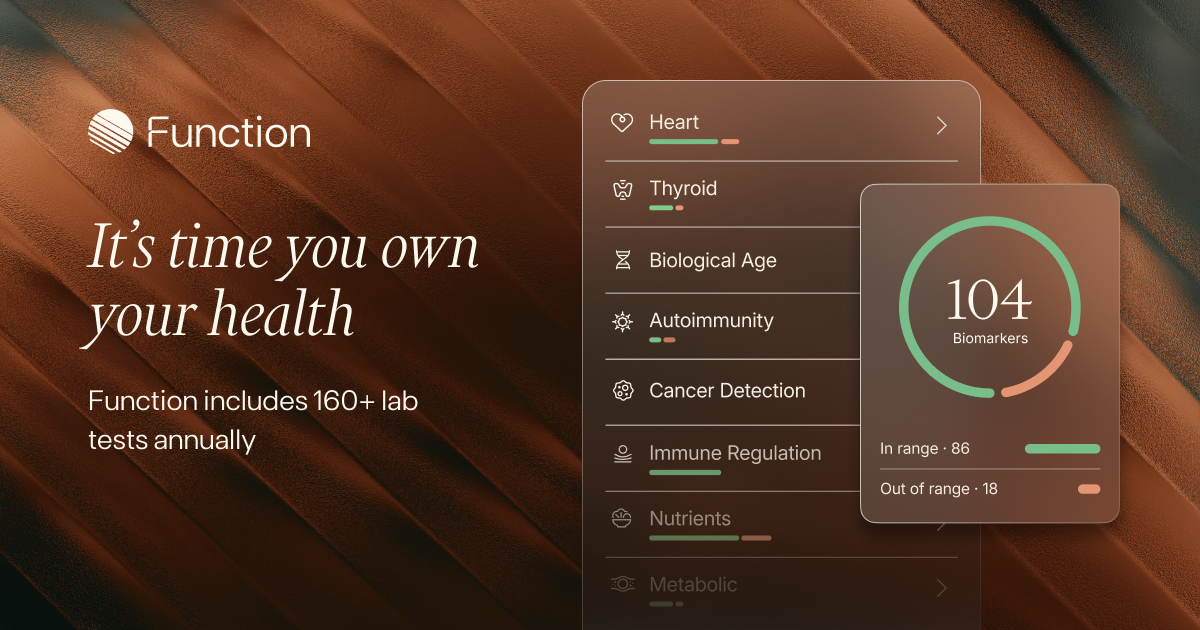
With more than 160+ lab tests annually, Function Health gives you a comprehensive view of your cardiovascular, metabolic, hormonal, liver, kidney, and immune health, helping you make more informed decisions about nutrition, exercise, recovery, and long-term wellness.
The goal is not to look for disease.
The goal is to understand your biology before symptoms appear.
If you’re serious about optimizing your health and performance, measuring is a far better strategy than guessing.
Check out Function Health and use my code below to get started.
Comments
Nothing yet. Say the first thing.
Sign in to join the conversation.