
I wrote the piece below a long time ago — 2013 — for the Making Science Public blog at Nottingham University, which was then home to one or two interesting science policy types. I’m not sure what happened to them, and their project has been dismantled. I refer to the essay quite often, as I think it was quite an important time, at which quite a lot was being revealed. So I thought I’d republish it here, so that it can be linked to again in the near future. If you want to see for yourself what was being discussed on an independent platform, please head over to the version held at the Internet Archive.
By no stretch of the imagination were the researchers at Nottingham on my side of the debate. But they were nonetheless interested in the debate and in the notion that there should be debate, on and off the campus, and between the on and the off. There is, or was, quite a respectable and influential body of academic opinion of a similar mind, even then. Things have deteriorated since then, and I want to write a few pieces about that. And that makes republishing the piece necessary.
Another body of research was also developing at the time, with a far more crass, and manifestly more politically-motivated interpretation of “science communication”, largely out of psychology. Part of that contingent had appointed themselves as Consensus Enforcers, and having all the grace of borderline personality disorder pub bores, would not allow any discussion between reasonable people go unmolested. Nottingham’s project really annoyed them.
The Consensus Enforcers had produced a survey. But their motivation wasn’t quite as straightforward as it fist appeared. They claimed to have found that “97%” of scientific papers agreed with the putative consensus position. It then turned out that this same movement had a hypothesis of political and scientific communication, known as the “Gateway Belief Model”, which claimed that the public were more receptive to scientific claims if they understood (or had been led to understand) that a majority — indeed a consensus — of scientists had such a belief. I said they were crass.
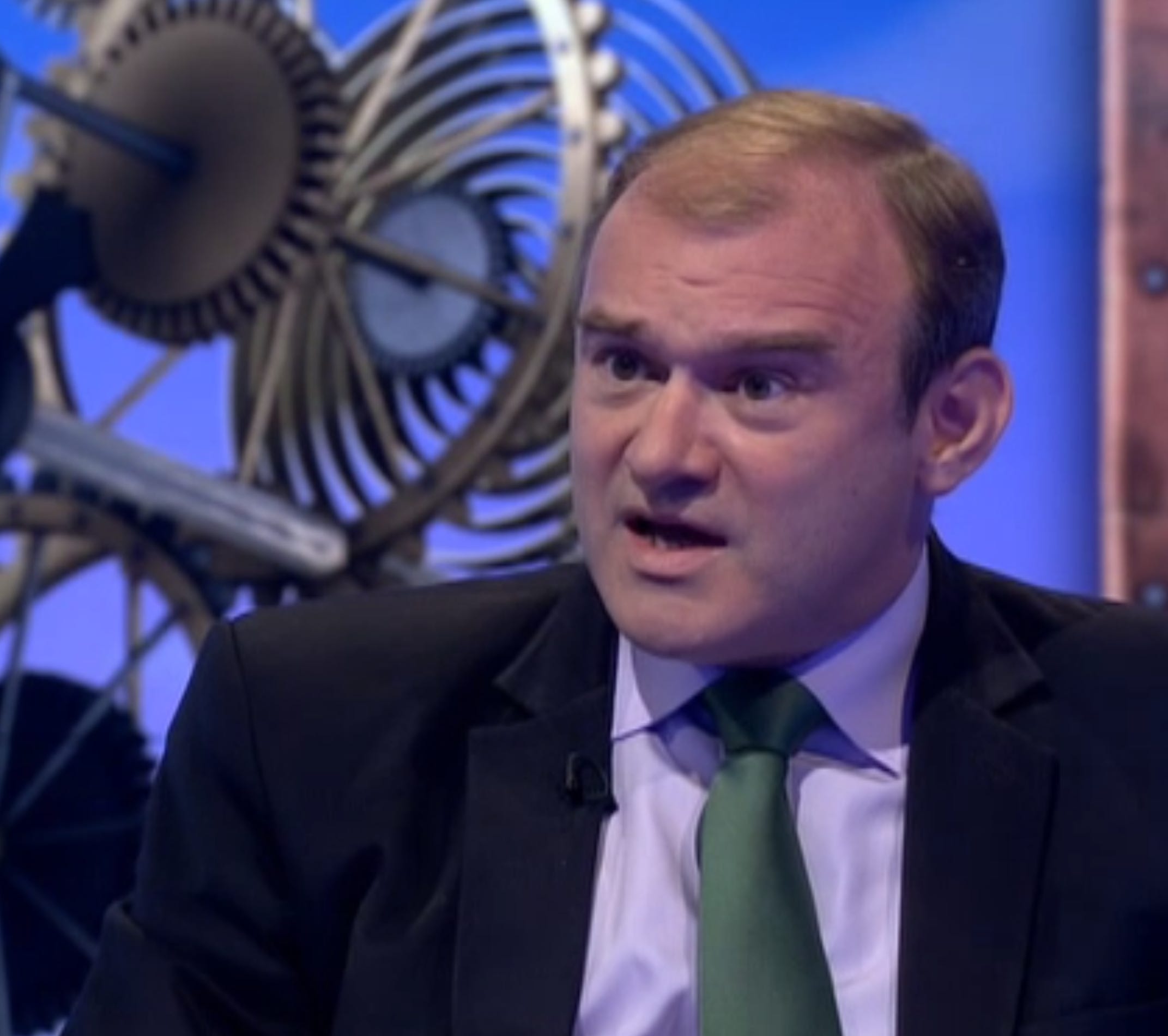
Their survey was influential nonetheless. It was cited by the US president. And it was cited by Ed Milband’s successor in the coalition government, Liberal Democrat Ed Davey, after Chris Huhne (not to be confused with green blob financier Christopher Hohn) ended up behind bars. I find Ed Davey incredibly difficult to read, in no small part because he takes stupidity to the point of extreme malice. Here he was a week or so before I wrote the article on the BBC’s Sunday Politics show, being grilled by Andrew Neil.
There is much more we could say about the interview, given the 13 years since. But I will leave that for later. Suffice it to say that it seemed to me that Ed Davey had virtually no understanding of anything that his brief required of him. The “scientific consensus” could — and indeed did — mean anything at all.
And that seemed to me to be the point of the 97% survey, per the Gateway Belief Model of communication. And the only way its authors could conceive of such criticisms is by invoking the notion of ‘denial’.
A number of people agreed with me. Most significantly, Professor Mike Hulme, who wrote in the comments:
Ben Pile is spot on. The “97% consensus” article is poorly conceived, poorly designed and poorly executed. It obscures the complexities of the climate issue and it is a sign of the desperately poor level of public and policy debate in this country that the energy minister should cite it. It offers a similar depiction of the world into categories of ‘right’ and ‘wrong’ to that adopted in Anderegg et al.’s 2010 equally poor study in PNAS: dividing publishing climate scientists into ‘believers’ and ‘non-believers’. It seems to me that these people are still living (or wishing to live) in the pre-2009 world of climate change discourse. Haven’t they noticed that public understanding of the climate issue has moved on?
The Consensus Enforcers were livid that a fully-credentialed climate scientist had weighed in, seemingly on the side of a climate change denier. And the comments, and further articles exploded. But no light was shed on what “the consensus” actually consisted of, and what had actually been “denied”.
July 23, 2013 | Making Science Public | University of Nottingham
Andrew Neil’s interview with Ed Davey on the Sunday Politics show last week caused an eruption of comment. For sceptics, it was a refreshing change of scenery: a journalist at the BBC, a stronghold of environmental orthodoxy, challenging the Secretary of State for Energy and Climate Change, an office which is rarely held to account. But perhaps because of this, it upset many of a greener hue.
One of these complaints was that neither interviewer nor interviewee were scientists, yet the substance of their discussion was scientific. ‘Two non-scientists discuss climate change on the Sunday Politics show‘, said Roz Pidcock at the Carbon Brief blog. At an oral evidence session of Science and Technology Committee (STC) inquiry into climate change communication last week, the issue of allowing non-expert interrogation of non-experts was raised by James Painter of the Reuter’s Institute for the Study of Journalism, and Ros Donald, also of the Carbon Brief blog — neither of them scientists, either.
Said Painter, ‘When there are really important issues like climate sensitivity to be discussed, it’s much better to have that discussion between climate scientists’. For Painter, an earlier edition of the Sunday Politics that had featured a debate between someone from Greenpeace and James Delingpole was made futile by the fact that both had, on Painter’s view, ‘agendas’. Similarly, Ros Donald told the Committee that, over Twitter, ‘There were at least five scientists offering to go on the Sunday Politics and talk to [Andrew Neil] about decadal forecasting’.
But there are very good reasons why an energy and climate change minister might make a better guest on a politics show than a climate scientist. Whereas climate scientists might well be able to explain to the viewing audience what the current state of science is, only a politician — a policymaker — can explain how advice has been taken from scientists. In the wake of a shift in climate science, it is reasonable to ask a politician how that change is to be reflected in policy.
And the science has changed. Climate advocates may want to claim that the ‘missing heat’ theory of ocean warming explains the lack of surface warming in the last decade or so. It may even turn out to be correct. But the controversial theory is still embryonic, and is a shift away from the emphasis that has been given in the very recent past to atmospheric and surface temperatures. Moreover, this revision has consequences for the estimation of climate sensitivity and its effects at the Earth’s surface — ‘impacts’ — as many scientists from across the climate debate have observed. Interviews with climate scientists on these questions might be interesting in their own right, but right now, they wouldn’t likely shed any light on the UK government’s policies.
The emphasis on expertise is either hopelessly naive or it is an attempt to delimit permissible areas of debate for strategic ends. Heaven forefend that politicians should be interrogated, lest it turn out that far-reaching and expensive policies turn out to have been, if not drafted by people who do not have a grasp of their subject, executed by them. One might be forgiven for thinking that people who emphasise the importance of scientific advice would welcome the opportunity to interrogate policy-makers’ knowledge. But instead, the attention turned to the interviewer — Neil — who now stood accused of having an agenda.
On the pages of the Guardian’s environment blog, Dana Nuccitelli (who is not a climate scientist) compiled a list of what he thought were Neil’s mistakes. ‘These are your climate errors on BBC Sunday Politics‘, he proclaimed. But half of Nuccitelli’s rebuttals related to Neil’s treatment of the study into the extent of the scientific consensus on climate change, co-authored by Nuccitelli, which represents (according to the study) the views of 97% of scientists. Davey had cited the study during the interview, but Neil had said that it had been largely discredited (Neil has just published a response to criticisms from Nuccitelli and others. Nuccitelli has responded again here).
One reason for seeing the survey through Neil’s eyes is the fact that many sceptics have pointed out that the 97% figure encompasses the arguments of most climate sceptics. In evidence to the US Senate Environmental and Public Works Committee last week, Roy Spencer, a climate scientist who is routinely vilified for his apparent climate scepticism, claimed that his arguments fell within the 97% definition. Here in the UK, climate sceptic blogger and author of the Hockey Stick Illusion, Andrew Montford tweeted in the wake of the survey, ‘isn’t everyone in the 97%? I am’. This prompted Met Office climate scientist, Richard Betts to poll the readers of the Bishop Hill blog, ‘Do you all consider yourselves in the 97%?’. It seems that almost all do.
Just as Donald and Painter’s evidence to the STC reflected either naivety or a strategy, Nuccitelli’s survey results are either the result of a comprehensive failure to understand the climate debate, or an attempt to divide it in such a way as to frame the result for political ends. The survey manifestly fails to capture arguments in the climate debate sufficient to define a consensus, much less to make a distinction between arguments within and without the consensus position. Nuccitelli’s survey seems to canvas scientific opinion, but it begins from entirely subjective categories: a cartoonish polarisation of positions within the climate debate.
Yet the survey was cited by Davey himself in defence of the government’s climate policies in the face of changing science. Whatever the scientific consensus is, the fact that this consensus can be wielded in arguments about policy without regard for the substance of the consensus creates a huge problem.
The consensus referred to by Davey and Nuccitelli, then, is what I call a consensus without an object: the consensus can mean whatever the likes of Davey and Nuccitelli want it to mean. Davey can wave away any criticism of government’s policy simply by invoking the magical proportion, 97%, even though those critics’ arguments would be included in that number. Consensus is invoked in the debate at the expense of nuance. A polarised debate suits political ends, not ‘evidence-based policy’.
Would a debate between two climate scientists, or an interrogation of climate scientists have produced anything more useful? At face value, a scientist seems less likely to make such a vapid appeal to scientific authority. But on the other hand, we often see many scientists in the climate debate doing precisely that –even chief scientific advisors — and equally failing to get a handle on the claims of climate sceptics as Davey himself. Moreover, one thing it would not reveal is the consensus without an object operating in government thinking on climate policy. Evidently, ministers are being briefed about developments in climate science partially, defensively, and strategically.
The angry exchanges on Twitter, and criticism of Neil — rather than Davey — continued. Good Science evangelist, ‘nerd cheerleader’ and ‘stats geek’ Ben Goldacre retweeted a link to Nuccitelli’s Guardian article — ‘Climate sceptic canards regurgitated by Andrew Neil get shot down, one by one’ — to his nearly 300,000 Twitter followers. Unsurprisingly, Goldacre subsequently received a number of critical tweets in reply, causing him to complain, ‘Climate bores are keen. 1 tweet, days ago, still going on about it’.
Goldacre shot to fame by denouncing TV Nutritionist Gillian McKeith and by encouraging his readers to become scientific activists in a mission to purge the public health sphere of a woo-woo tendency (homeopathy, etc). Thus, we might expect him to be more circumspect in taking a view on surveys of scientific opinion wielded in the public sphere to advance policy, and to show more grace to people who demonstrate the initiative he nurtured in his own disciples. Even more peculiarly, the ethic of disparaging those who seemingly challenge orthodox scientific thinking as ‘bores’ not worthy of engagement, would deprive Goldacre of his project’s raison d’être. The point of arming citizens with science is surely to challenge authority. Chasing homeopaths out of town: good. Challenging climate and energy ministers: bad.
Exchanges on Goldacre’s Twitter timeline may seem like so much trivia, but it nonetheless shows in microcosm how ideas about science are reproduced. The Sunday Politics episode prompted criticism from those who were concerned that Neil’s errors might influence the viewing public. But what a broader view of these debates reveal is a more troubling phenomenon of an uncritical reproduction of orthodox thinking on climate science by putative experts in science and public policy, across Twitter, the blogosphere, print media, the academy and political institutions. Physicians, heal thyselves!
So much hand-wringing about how an impressionable public might be misled by wonky graphs and hostile questioning of public figures amounts to evidence that should prompt a much more interesting study in science communication than have been produced by countless facile theories of ‘public engagement’. Shoving experts in front of cameras, hoping that it will enlighten and mobilise a largely ambivalent audience will not advance the climate policy agenda. Nor do such commentators — self-styled ‘communicators’ who believe that it will — shed any light on the relationships between government, its departments, NGOs, academia, and the media. Thus the context of the climate debate, and the expectations of climate science are excluded as subjects from the debate — a strategic move, whether or not it is intended as such. Scientism precludes sociological and historical perspectives.
The consequence of excluding non-expert opinion (other than expert opinion’s cheerleaders) from the climate debate is, paradoxically, the undermining of the value of expertise. Rather than engagements on matters of substance, a hollow debate emerges about whose evidence weighs the most, whose arguments are supported by the most experts, and which experts are the most qualified. The question ‘who should be allowed to speak’ dominates the discussion at the expense of hearing what they actually have to say.
Accordingly, rather than being a dispassionate study into scientific opinion, the 97% survey was a superficially academic exercise, intended to obfuscate the substance of the climate debate. Those who fell for it forget that its authors, aside from having their own — shock horror! — agendas, have no expertise in climate science, much less any interest in taking the sceptics’ arguments on. The emphasis on expertise is intended to permit only the expression of authorised opinion: not even the Secretary of State for Energy and Climate Change is allowed to speak. Because when he does, the public debate is revealed to be merely a battle of received wisdoms.
Can we imagine this in any other discussion about public life? Should Andrew Neil be allowed to challenge ministers on unemployment figures or other economic metrics? After all, he’s just a journalist. And such hypothetical interviewees would be mere politicians, rather than ‘experts’.
Some might still sense no problem with such an expertisation of politics, and may even prefer it to what appears to be the arbitrary landscape of politics and ideology. But what the squabble over the Sunday Politics interview reveals is that political debates descend to science; they are often not improved by science and evidence as much as they degraded by undue expectations of them. Being an advocate of science seems to mean nothing more than shouting as loudly as possible ‘what science says…’, second hand.
And those who shout most loudly about science turn out to be advancing an idea of science which, rather than emphasising the scientific method, puts much more store — let’s call it ‘faith’ — in scientific institutions. Hence, the emphasis on the weight, number and height of scientific evidence articles, and expertise, rather than on the process of testing competing theories.
In spite of all the criticism levelled against him, then, Andrew Neil, in just one show, has done more to promote an active understanding of climate science and its controversies than has been done by the Carbon Brief blog, academics at the Reuters Institute for the Study of Journalism and elsewhere, Bad Science warriors, and a legion of Tweeters who claim to speak for science have done in their entire existences. Along the way, it is possible that Neil made some inconsequential technical mistakes. But by contrast, the uncritical reproduction of scientific orthodoxy is a far more egregious error: it denies that error can be observed from without the consensus. So much for ‘science’.
No posts
Comments
Nothing yet. Say the first thing.
Sign in to join the conversation.