
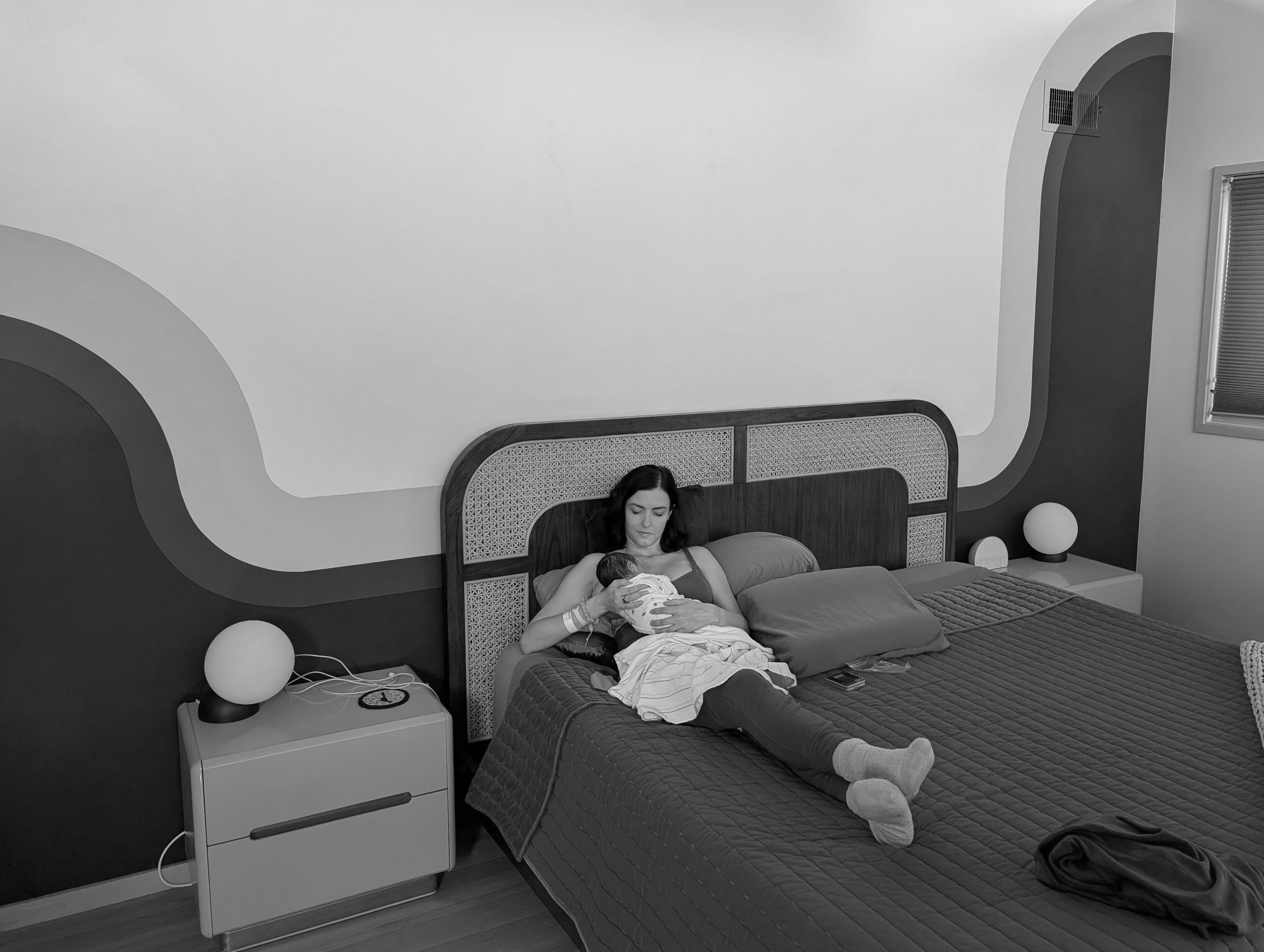
One thing I loathe to do as a mother is complain about how tired I am. We’ve heard it all before, and everyone is tired, right? Of women aged 20-39 in the United States; 52% aren’t mothers. And perhaps they’re night-shift workers, caregivers to other family members, maybe they even have high needs pets. So what makes mothers so special?
In many cases, these other life circumstances can be more temporary.
Choosing to become a mother is, somewhat, signing up for long-term sleep debt.
And one of the things that makes us complain (a term that could be better framed as wanting to be validated and seeking solidarity with fellow mums) is that this experience of tiredness is not exactly distributed evenly in our relationships.
Alas, as I approach my second Mother’s Day, I’m here to say… I’m tired. I hate how my general malaise stops me from showing up at work the way I used to, or having the energy to be more playful with my toddler. But I’m also here to ask, what, exactly, can we do about it?
To start, here’s what the research says about mothers and sleep.
Maternal sleep doesn’t fully recover for at least 6 years after birth -- and possibly longer (we don’t know, because that’s as far as the research has tracked). I’ll let that sink in, because the general consensus is that the infant stage sucks, but then all gets back to normal with your sleep.
Except maternal sleep loss still exists when your kids are in kindergarten.
Researchers tracked parents in Germany for up to 6 years after birth, and found that when their kids were 4-6, mothers were still sleeping 22 minutes less a night than before birth. 1 (Fathers were sleeping 14 minutes less). How satisfied mothers were with their sleep, a subjective measure, dropped and remained low. And higher household income and dual-parenting didn’t protect against this. Sleep just hadn’t returned to pre-pregnancy levels by the end of the study window. So we don’t actually know when, or if, it recovers.
Differences between mothers’ and fathers’ sleep persist after the infant stage.
A Swiss and French study (of families with kids aged 0–5 with sleep disorders) found that 60% of children were cared for exclusively by the mother at night, vs 9% by the father.2 (For the remaining 31%, it was a shared responsibility). The gender disparity persisted even when both parents worked full-time and after breastfeeding had ended.
And the effects of this weren’t ideal for how mothers felt. Greater maternal nighttime involvement was linked to increased psychological distress, and lower relationship satisfaction.
Because the United States doesn’t have mandated paid maternity or parental leave, some of the data heavily skews towards tired mums. So what if we looked to a country with greater gender equity?
Researchers in Sweden tracked 60 dual-working-parent couples with both wearable devices and self-report surveys.3 The devices showed that mothers actually slept longer than fathers (+28 min), but they still reported worse subjective sleep quality and more awakenings.
It’s fascinating that in a country with generous paternity leave, the objective sleep duration gap can flip, but the subjective sleep quality gap still persists.
(A recent analysis of 47 studies across 17 countries found fathers of infants aren’t sleeping great either.4 But they’re just sleeping less-badly than mothers, and via different mechanisms -- i.e., fathers tend to have a shorter total duration vs mothers who tend to have fragmented sleep).
The results from the Swedish study suggest that the cognitive/emotional load -- i.e., the “mental load” of motherhood -- can result in mums still feeling fatigued even if our smartwatches tell us our 7-or-so hours a night is perfectly fine.
I feel it important to note that the literature is overwhelmingly heterosexual-couple-focused, and the “mothers vs. fathers” frame excludes single parents (who no doubt have it worse on every measure) and same-sex parents (who, in the small literature that exists, distribute caregiving more evenly).
We don’t have one simple answer for why mothers’ sleep is so uniquely disrupted compared to fathers’. Why this persists beyond infancy and never quite recovers. And why neither household income nor a country’s gender-equality ranking can entirely fix it.
As a professional-question-asker, I’m left with more questions than answers.
Is it just…biological? Wired into the maternal brain? Or is the support of a partner simply not enough? Do we need more help? Or are we hanging onto the idea that to be a mother is to suffer? To neglect your own needs? Is it… all of the above?
It’s safe to say that persisting gender inequalities in parenting and an ever-increasing mental load probably won’t be fixed by gifting a new sleep mask or silk pyjamas.
Until we know more, I’ll accept some validation. But the kind I want is different from the “you’re doing great, mama!” variety. It’s an acknowledgement that what’s making me tired is hard, and isn’t a failure of my sleep hygiene, my wind-down routine, or all the work I’ve put in to finally stop procrastinating my bedtime. It’s a problem that’s persisted even though many dads (including my husband!) do want to share the load.
For now, sure, I’ll take the silk pyjamas. I’ll just be wearing them while I’m really tired.
Richter, D., Krämer, M. D., Tang, N. K., Montgomery-Downs, H. E., & Lemola, S. (2019). Long-term effects of pregnancy and childbirth on sleep satisfaction and duration of first-time and experienced mothers and fathers. Sleep, 42(4), zsz015. https://doi.org/10.1093/sleep/zsz015
Breton, A., Lecuelle, F., Chaussoy, L., Heitz, M., Leslie, W., Anders, R., ... & Putois, B. (2025). Gender Inequality in Managing Childhood Sleep: Which Parent Gets up at Night?. Children, 12(4), 491. https://doi.org/10.3390/children12040491
Härdelin, G., Holding, B. C., Reess, T., Geranmayeh, A., Axelsson, J., & Sundelin, T. (2021). Do mothers have worse sleep than fathers? Sleep imbalance, parental stress, and relationship satisfaction in working parents. Nature and Science of Sleep, 1955-1966. https://doi.org/10.2147/NSS.S323991
Nielsen, J. S., Brunbjerg, E. F., Lorentzen, M. H., Andersen, A., & Parsons, C. E. (2025). Fathers’ sleep in the first 24 months postpartum: A systematic review and meta-analysis of global data. Sleep Health, 11(3), 279-292. https://doi.org/10.1016/j.sleh.2025.03.006
No posts
Comments
Nothing yet. Say the first thing.
Sign in to join the conversation.