
Lots happening back home in Nepal right now. Following it from afar is like watching it all unfold in slomo.
I know from experience as a former foreign correspondent who covered ethno-separatist and religious wars in various Asian countries that those conflicts can be much more virulent than class struggles like the Maoist insurgency in Nepal from 1996-2006.
Social media can now amplify sectarian grievances more rapidly and widely than before. Even then, piled up grievances do not usually spontaneously combust unless there is political provocation sparking it.
As things took a communal turn in Sunsari and Siraha last week, state security did what it knows best: shoot first, ask questions later. The resulting backlash threatened to ignite the Tarai just like in 2015.
Prime Minister Balendra Shah finally broke his months-long silence, and for the first time since assuming office four months ago, addressed the nation. It was a well scripted speech in Maithili and Nepali, and we can say it sounded almost statesmanlike.
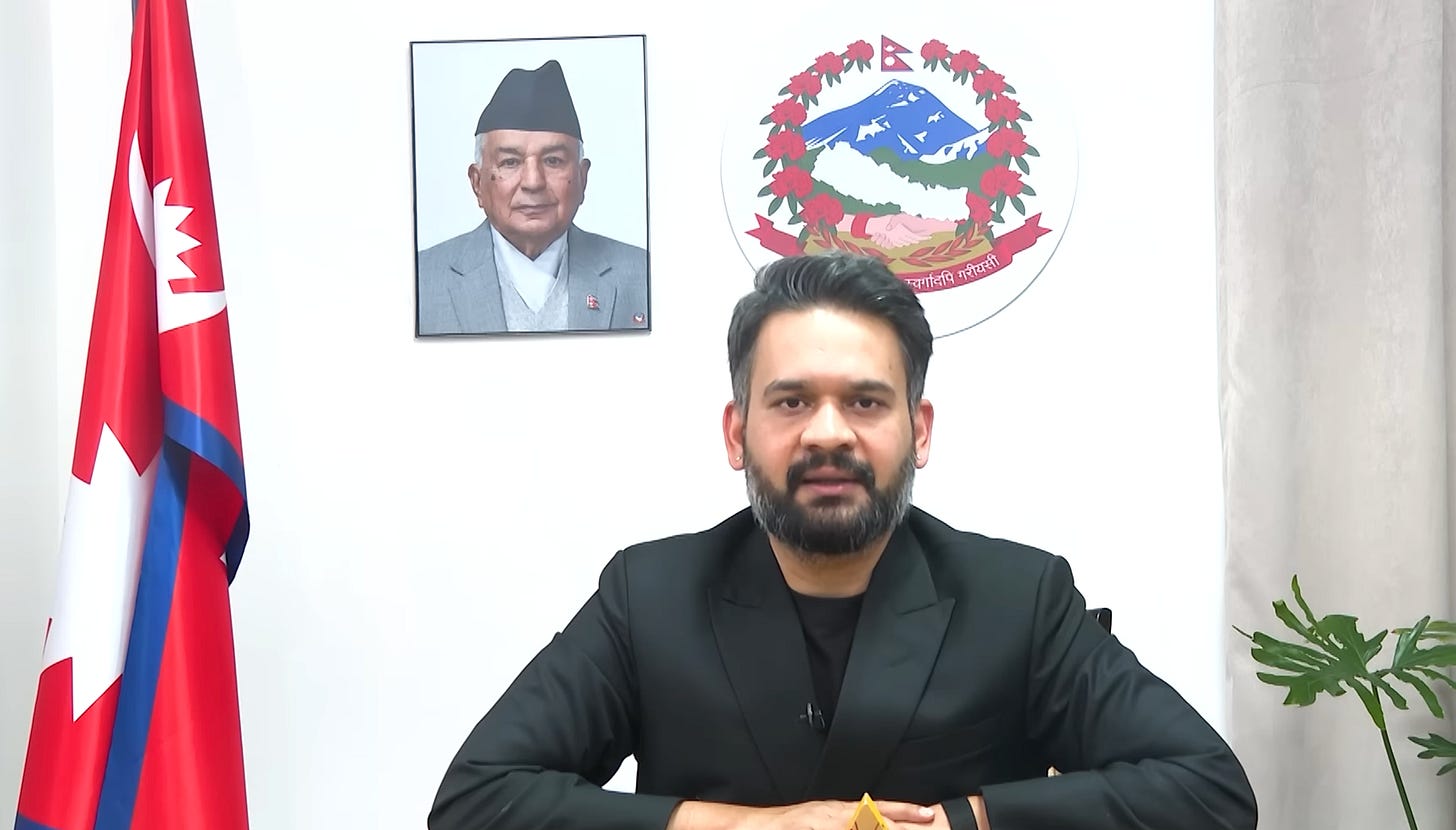
The pre-recorded video was broadcast not on national television, but posted on his Facebook page. Was it AI generated, some asked. Then came another first: the Prime Minister met a President he has heretofore blithely ignored. Did there have to be a national crisis before he acted like a leader who cared?
To be fair, the Prime Minister has had to learn on the job. Growing public pressure and backlash against a series of other mis-steps by his kitchen cabinet had widened the gap between the ruling party and its government.
By now everyone knows that Nepal has two parallel governments: one is supposedly run by the Council of Ministers and the other by a small coterie of the Prime Minister’s buddies. (Covered in last week’s page 1 story, Brocracy.) And the two do not seem to be talking.
The Prime Minister could also have been belatedly trying to take the wind out of the sails of RSP Chair Rabi Lamichhane, who acted with alacrity last week to douse the flames in the plains by building inter-faith and cross-party trust.
We cannot ignore what has been happening across the border in India. The youth-led protests in New Delhi’s Jantar Mantar was stopped from escalating into a wider anti-government agitation after the resignation last week of Education Minister Dharmendra Pradhan. Then prime ministerial adviser Kumar Ben supposedly made a secretive dash to India via a scenic overland route reportedly without bothering to let the Ministry of Foreign Affairs in Kathmandu know.
Was there a connection in all this to the Tarai unrest? Even though the Cockroach Janta Party doesn’t like to be compared to Nepal’s GenZ protests, do not forget that India’s youth was also trying to march on Parliament. The driver in both countries were also the same: mass unemployment and growing outrage over the heavy handedness of incumbents that have been in power for far too long.
But there are differences: India is too vast and diverse and its aspirational youth too busy competing to get ahead in life to launch sustained anti-government protests. This is a theme addressed by Manu Joseph in his book, Why the Poor Are Not Killing Us. Interested readers may want to order a copy.
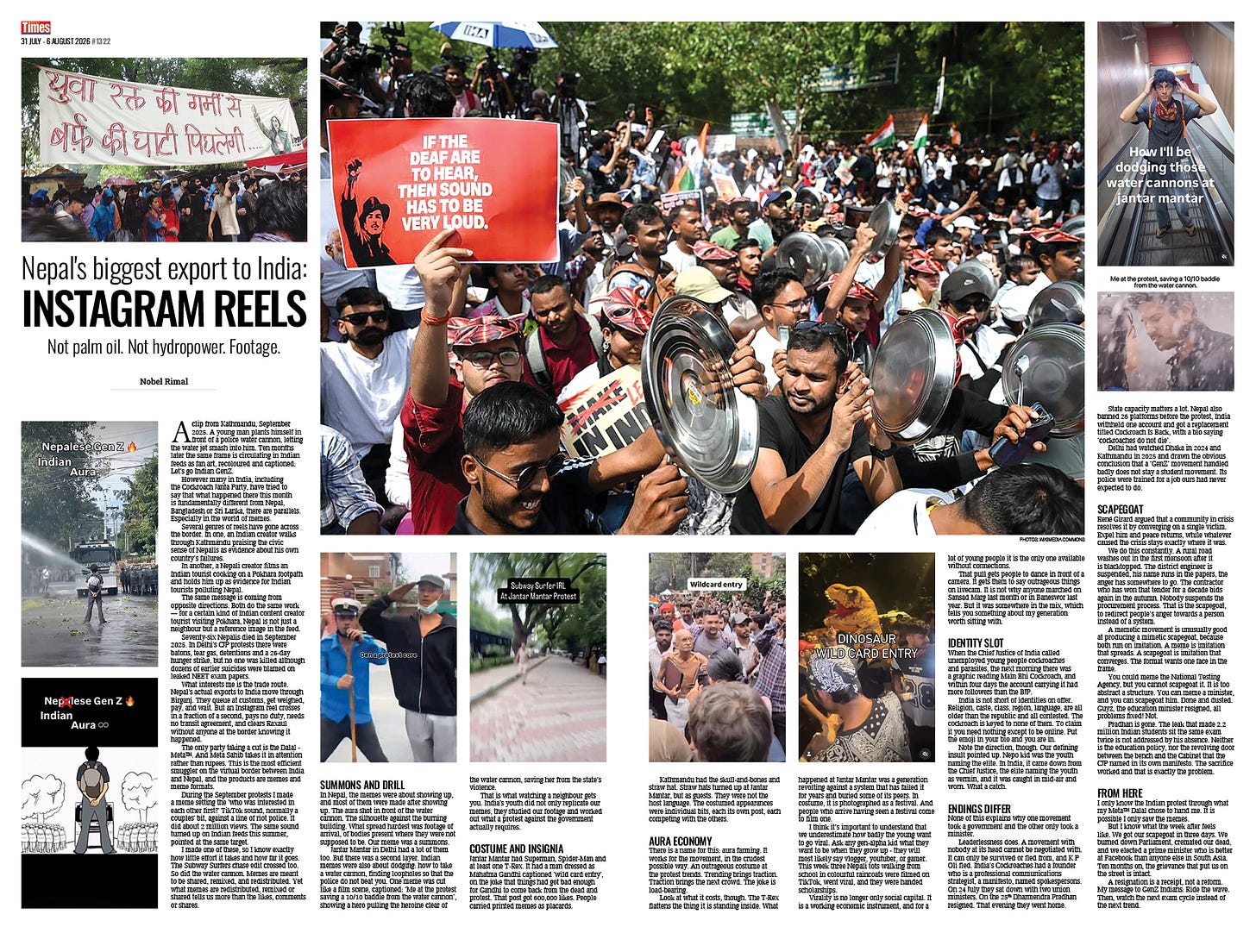
Nepali Times’ in-house GenZ analyst Nobel Rimal has been browsing through Instagram memes that sprung up spontaneously in India, bringing youth out onto the streets. He sees a close parallel with those in Nepal last September. Read his conclusions in Nepal’s Biggest Export to India: Instagram Reels, page 6-7.
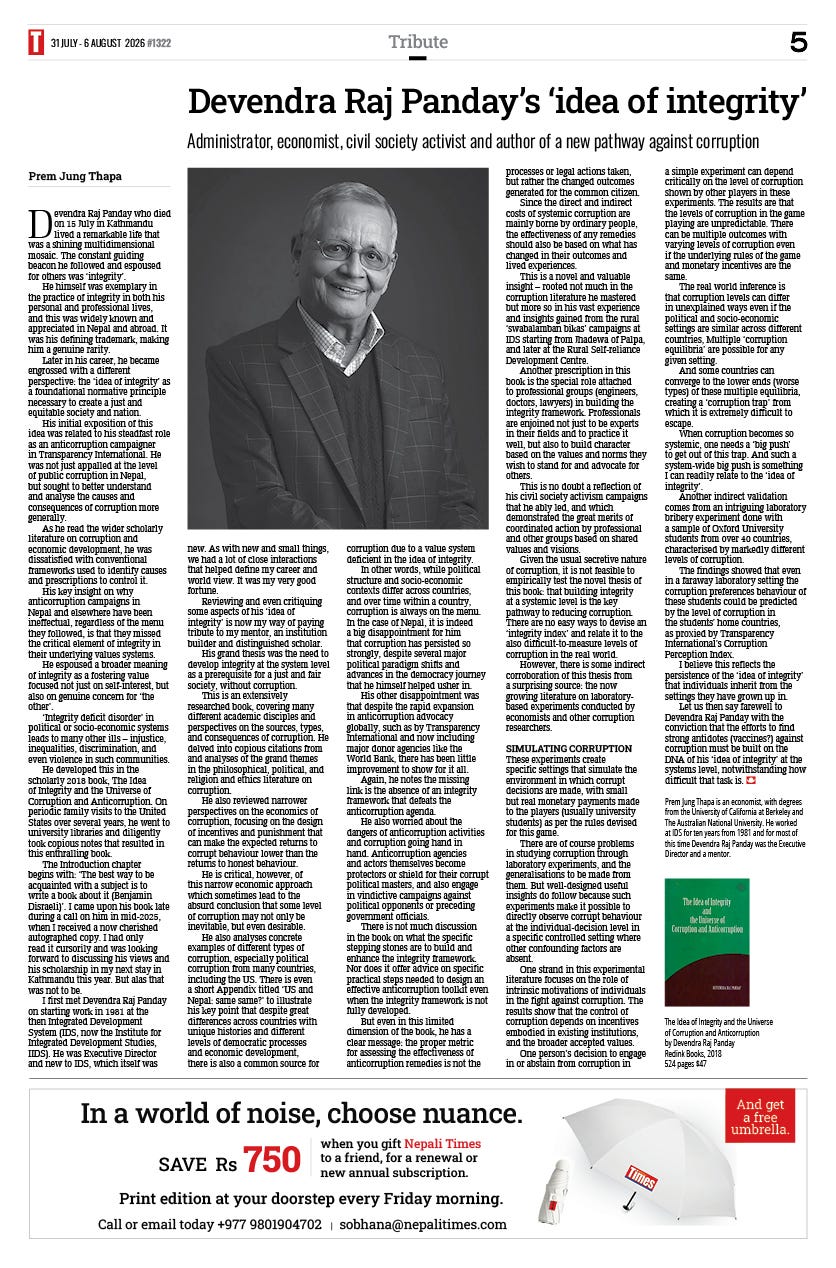
Just before he died last week, veteran administrator, economist and civil society activist Devendra Raj Panday posted from his sick bed on social media that he had become ‘like Balen’ because he was unseen and unheard. Panday’s former colleague and economist Prem Jung Thapa pays tribute to his mentor, and reviews his 2018 book, The Idea of Integrity and the Universe of Corruption and Anticorruption (Devendra Raj Panday’s ‘Idea of Integrity’, page 5).
Khem Lakai is one of those rare Nepalis who worked in hotels overseas, but instead of pursuing a career in international chains, returned to Nepal to train compatriots in his hospitality schools. Read about the Global Academy of Tourism and Hospitality Education (GATE) he set up, and his advice to the new government on creating jobs at home in the tourism sector (A Gateway To Nepali Hospitality, page 4).
And that is also the recommendation of a report prepared by Nepal Economic Forum (NEF) about Nepalis emigrating in increasing numbers to Europe. How they can get decent jobs, are not cheated by recruiters, and be sure their skills and savings can be put to good use when they return to Nepal (Editorial by Shristi Karki, Nepal’s New Migration Corridor to Europe, page 2).
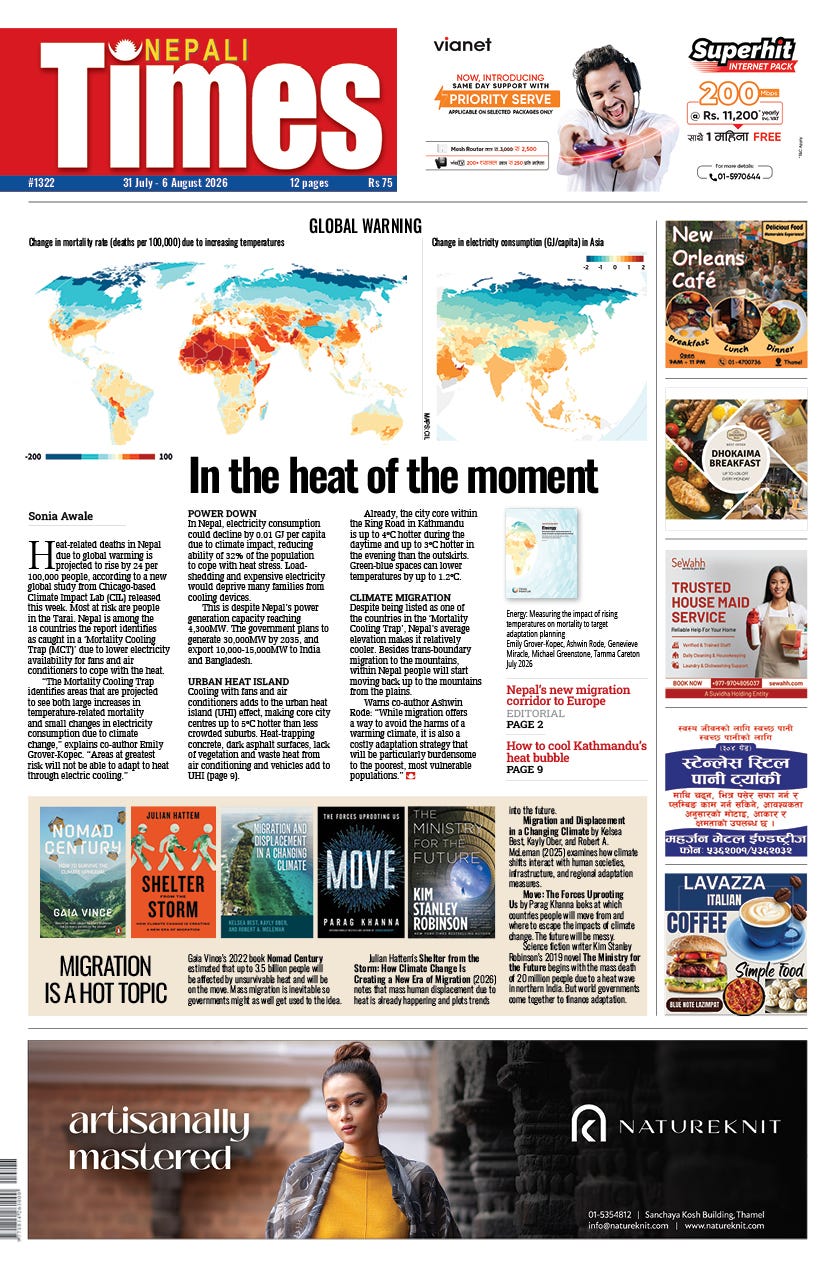
In this edition, Nepali Times turns its attention to how heat stress caused by global warming will increase migration. Sonia Awale analyses a new report by the Climate Impact Lab in Chicago that warns of excess fatalities due to heat waves in poor and hot countries where people cannot access or afford air conditioners and fans (In the Heat of the Moment, page 1).
ICIMOD environmental engineer Prasesh Pote Shrestha probes the Urban Heat Island effect in Kathmandu Valley, and offers practical tips on how to bring down the temperature in the inner city (How To Cool Kathmandu’s Heat Bubble, page 9).
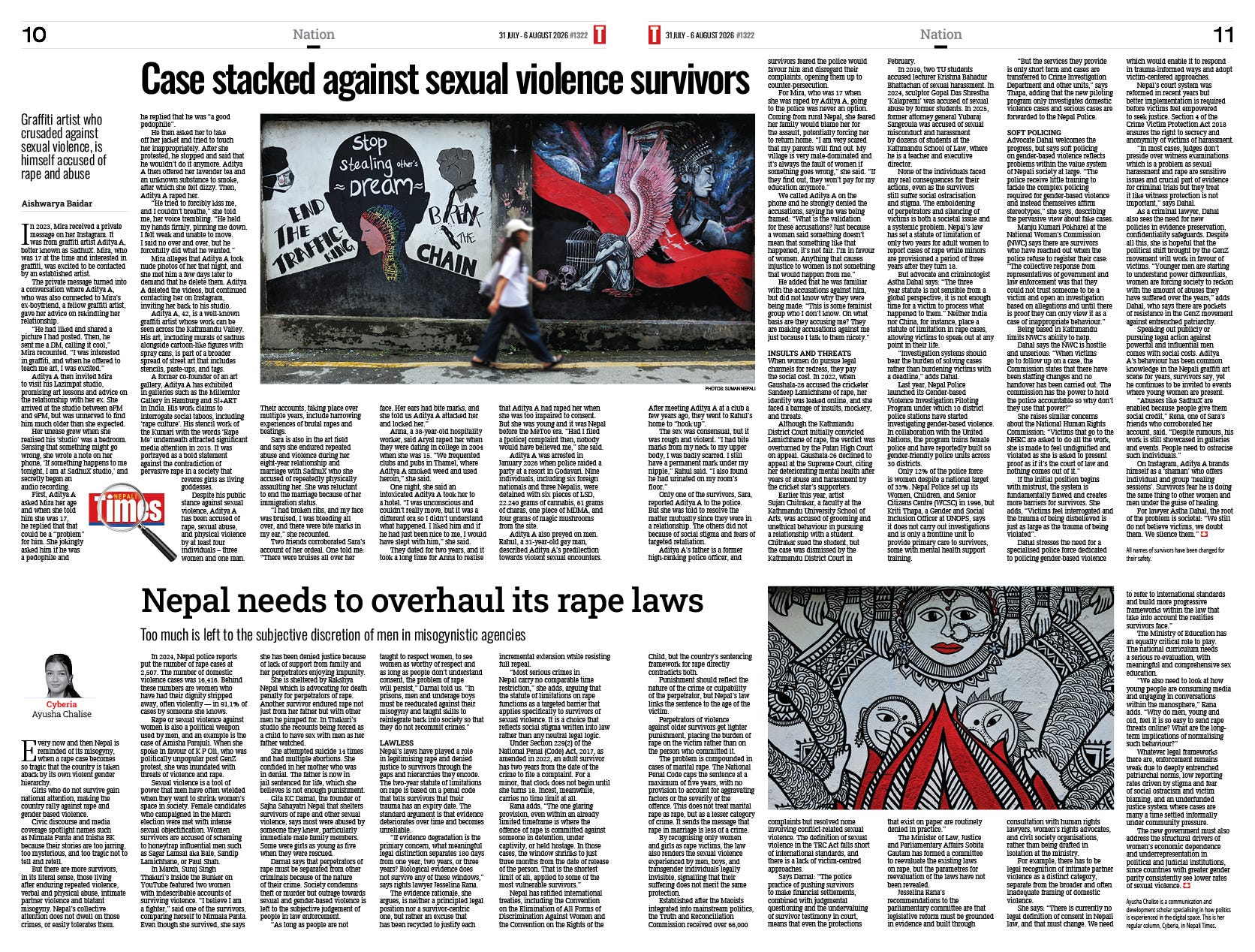
An investigation in this issue by Aishwarya Baidar exposes serial sexual abuse by a noted Nepali graffiti artist. Several women and men who he is said to have preyed on over the years have provided evidence (Case Stacked Against Sexual Violence Survivors, page 10-11).
And in her latest Cyberia column, Ayusha Chalise looks into the reasons why rape keeps happening: ingrained patriarchy and subjective discretion of misogynistic men in the police and courts (Nepal Needs To Overhaul Its Rape Laws, page 10-11).
Finally, 83-year-old snow leopard conservationist Rodney Jackson who was the first to radio collar the elusive Himalayan cat in Nepal in 1973, speaks to environmental writer Ramesh Bhushal during a recent visit to Kathmandu about human-wildlife conflict (The Snow Leopard Man, page 12).
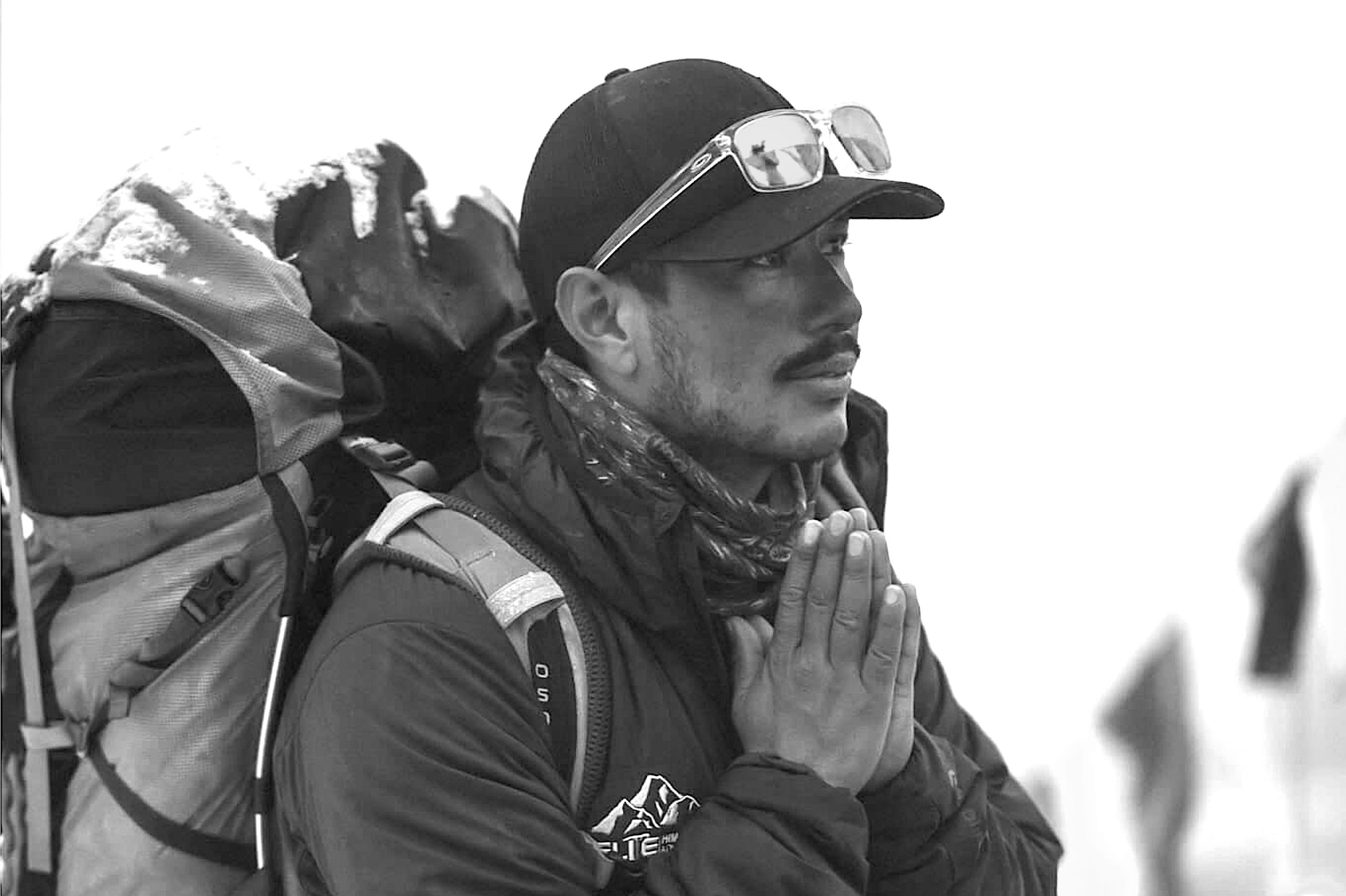
Let me end this week’s newsletter by paying tribute to Nirmal ‘Nims’ Purja. Despite controversies, this self-made larger than life man did more to promote the Nepal brand globally than anyone else. He had told us in an interview in 2019 halfway through his record-breaking ascent of 14 peaks: “I want to show human capacity, I am not climbing to set any records. My competition is only with myself. I was born in a small village in Myagdi. I want to prove that no matter what your background, you can do things considered impossible if you have the right thinking.”
Farewell, Nims.
Thank you for reading this weekend’s longish newsletter. Let us hope we will have some more uplifting news for you next week. Till then,
Kunda Dixit
No posts
Comments
Nothing yet. Say the first thing.
Sign in to join the conversation.