
When I decided to write my first book, I asked a simple question on LinkedIn:
I’m thinking of writing a book. Here are four topics I’m considering. Which one would you read?
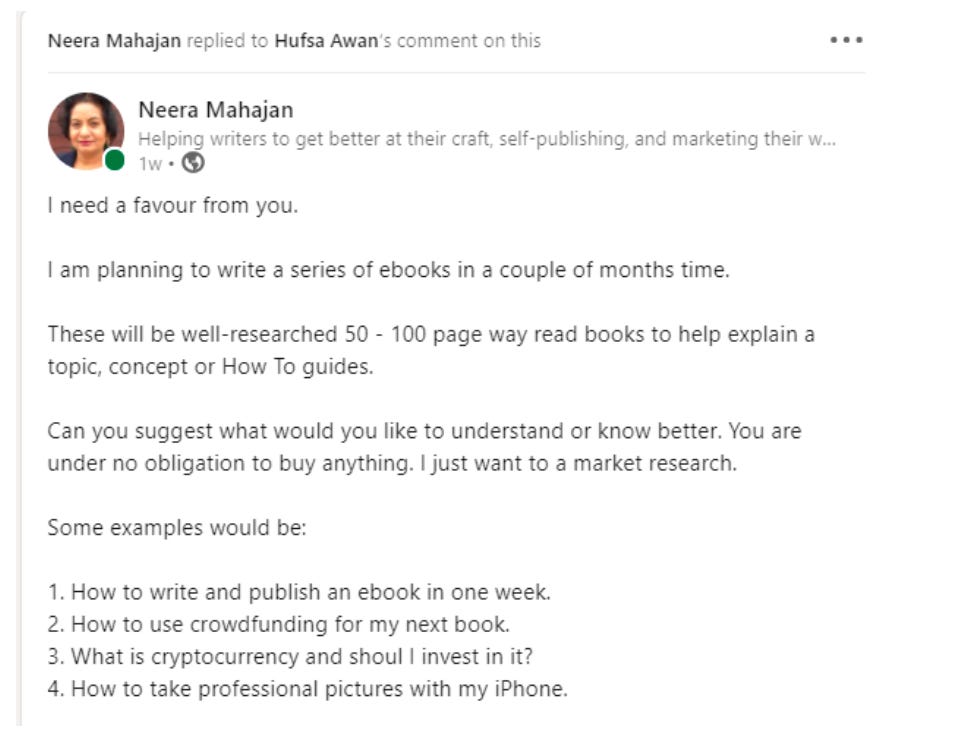
Most people chose How to Write and Publish a Book.
Their answer surprised me. There were already thousands of books about writing and publishing. Why would anyone need another one ,especially from me, a first-time author who had not yet published a book?
So I asked them why.
One reader replied:
Because you make things simple and easy to understand.
Her name was Anar. She was a retired schoolteacher in her sixties from Pakistan. She was active on LinkedIn and wanted to turn her experiences as a teacher into a book, but she did not know how to begin.
I decided to write my first book for her.
As I wrote each chapter of How to Write and Publish an eBook in One Week, I held a clear picture of Anar in my mind. I imagined the questions she would ask, the parts she might find confusing and the reassurance she would need to keep going.
I explained everything simply. I broke the process into manageable steps. I avoided unnecessary jargon and assumed she had no previous experience with writing or publishing a book.
I even included pages from my diary at the end of each chapter, showing my struggles, doubts and progress as I wrote and published my own first book. I wanted Anar to see that I wasn’t teaching her from some distant mountaintop. I was walking the same path, just a few steps ahead.
Perhaps that is why the book did so well.
Readers told me they felt as though I was speaking directly to them.
And I was.
I was speaking to one person.
But thousands of aspiring authors shared Anar’s uncertainty, fears and dreams. By writing specifically for her, I had unintentionally written for all of them too.
When you write for one real person, your book becomes clearer, more personal and more useful to many people like them.
One person helps you make better writing decisions. When you can picture your reader, you know what to explain, which examples to use, which stories to include and what to leave out.
One person changes the way you write. Instead of addressing a faceless audience, you write as if you are sitting across the table from someone who needs your help. Your writing becomes warmer, clearer and more conversational.
One person helps you understand the deeper fear. Anar didn’t simply need publishing instructions. She needed reassurance that someone in her sixties, without publishing experience, could become an author. That understanding shaped what I included in the book.
One person can represent thousands of people. Anar’s circumstances were personal, but her fears and ambitions were widely shared. When you describe one person’s experience precisely, others recognise themselves. Specific writing doesn’t exclude people. It helps the right people feel understood.
When you try to write for everyone, your book usually becomes weaker rather than more inclusive.
Your message becomes too broad. You try to cover every possible situation, so the book loses its clear focus.
Your writing becomes generic. Without a real person in mind, your language, stories and examples are less specific and emotionally engaging.
You include too much information. Instead of guiding one reader towards one outcome, you try to teach everything you know.
Your reader doesn’t feel understood. They may find the advice useful, but they won’t feel that the book was written for someone in their particular situation.
Your book becomes harder to recommend. If people cannot immediately tell who the book is for and what it will help them achieve, they will struggle to describe it to others.
Here are 5 ways you can find your ideal readers and write directly for them.
Comments
Nothing yet. Say the first thing.
Sign in to join the conversation.