
When I started building my writing business, my biggest worry wasn’t whether I could make money.
It was whether I could build a business that still allowed me to travel.
My husband and I are both retired from our corporate careers, and we’ve made a promise to ourselves. While we’re healthy enough to do it, we want to see as much of the world as we can.
We usually take three overseas trips a year, spending almost three months away from home.
At our age, this isn’t something we can postpone until “one day.” This is our time.
[In fact, as you’re reading this article, we are on a cruise in the Mediterranean.]
That created a problem. How could I build a business if I kept disappearing for weeks at a time?
For a long time, I believed I couldn’t.
I delayed turning on paid subscriptions for my newsletter because I felt I had to be constantly available to my subscribers.
I avoided running workshops because I worried I’d be away when people needed me.
Every business idea I came up with seemed to depend on me showing up every single day.
It felt like I had only two choices. Either build a successful business...Or enjoy the freedom we’d worked our entire lives to earn.
Until last year.
That’s when I realised I’d been asking the wrong question.
Rather than asking, “How do I build a business around my life?” I should have been asking, “How do I build a business that keeps working while I’m away?”
Unlike me, he was much younger. He and his wife didn’t have children, but they shared one passion: travelling.
They didn’t want to build a business that chained them to a desk. So they did something different. They designed a business with vacations built into it.
They ran an online marketing business called Psychotactics, helping small business owners improve their marketing. Right from the beginning, they set clear expectations with their customers.
Their promise was simple: We’ll respond to your questions within a few hours with practical advice... except during the months we’re travelling.
They didn’t apologise for taking time off. They built it into the business model.
In fact, Sean D’Souza even called his podcast Three Month Vacation because that was the lifestyle they wanted their business to support. Podcast name set the expectations of their clients
And then something fascinating happened.
The business didn’t suffer.
It flourished.
While they travelled all through the world, their online community kept the discussions going. Members answered each other’s questions, shared experiences, and welcomed newcomers. Sean wasn’t paying them to do this. They simply cared enough about the community to keep it alive.
That was a lightbulb moment for me. I realised you don’t build a business first and then try to squeeze your life around it.
You decide what kind of life you want first...
...and then design a business that makes that life possible.
I announced my first cohort program, 90-Day Write, Grow, Monetise.
It ran from June to August 2025, finishing just before our next overseas holiday in September.
That wasn’t an accident. I planned it that way. I wanted to see whether I could create periods of intense work, followed by periods of complete rest.
When I returned from our trip, I launched the second cohort. This time, I delivered it live. Again, I deliberately scheduled it to finish just before the Christmas break.
My subscribers got a chance to implement everything they’d learned over the holidays, and I got to step away, recharge, and spend uninterrupted time with my family.
That was the moment I realised I didn’t have to build a business that demanded my attention every day of the year, I could build one that worked in seasons.
Periods of creating.
Periods of teaching.
Periods of travelling.
Then back again.
Instead of feeling guilty about taking time off, I began designing my business around it.
Long programs sound impressive, but they’re exhausting. Not just for the person running them, but for the participants too. People have jobs, families, school holidays, birthdays, unexpected illnesses, work deadlines.
They genuinely want to do your program, but life doesn’t stop simply because your cohort has started.
I realised that if I wanted people to succeed, I had to respect their lives as much as my own.
So instead of running long, open-ended programs, I started planning my entire business in quarters.
Each quarter has one clear focus.
A short, live cohort.
Then a break.
My cohorts now run for four to six weeks, which is long enough for people to make meaningful progress but short enough that they can commit wholeheartedly.
Then we all get a chance to breathe.
This is what my year now looks like:
2026 Q1
Write Your Book Cohort 1: 15 January – 15 February
Write Your Book Cohort 2: 5 March – 26 March
2026 Q2
Break: April
Write Your Book Cohort 3: 8 May – 29 May
Substack to Book Cohort: 5 June – 26 June
2026 Q3
Break: 24 July – 29 August
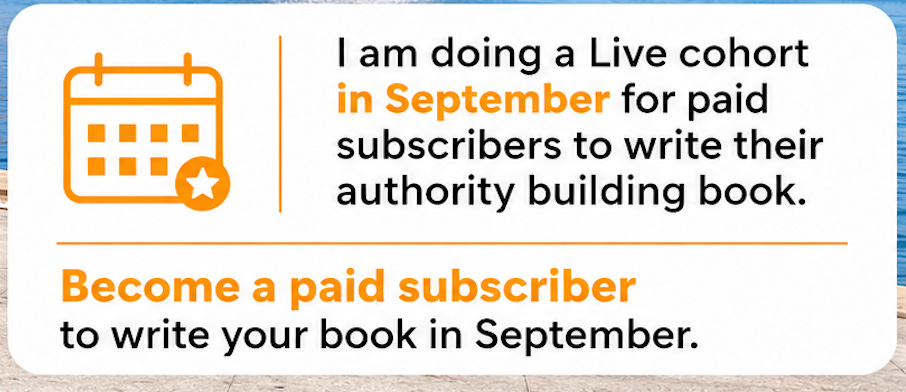
Write Your Book Cohort 4: September (dates TBA)
2026 Q4
Break: October
Write Your Book Cohort 5: November
That’s it.
No endless launches.
No constant pressure to be “on.”
No feeling guilty about taking time off.
Instead, I work intensely for a few weeks, give everything I’ve got to my subscribers, and then deliberately step away before beginning the next cycle.
Ironically, my subscribers seem to appreciate this rhythm too. They know when the next opportunity is coming. They don’t feel pressured to join everything.
And when the cohort begins, everyone arrives ready to focus.
I’ve stopped trying to squeeze my life around my business and have started designing my business around the life I want to live.
Today, before I create anything—a workshop, a cohort, a challenge or even a free series—I ask myself five questions.
1. Can I walk away from this for three weeks?
If the answer is no, I’ve designed it badly.
2. Does it have a clear beginning and end?
People commit more easily to a four-week sprint than an endless program.
3. Will this still help people while I’m away?
Books, recordings, articles and email sequences continue working even when I’m not.
4. Am I building another job or another asset?
I’m trying to build assets now. Not obligations.
5. Does this business support the life I actually want?
Because that’s the whole point.
When I retired, I didn’t want another full-time job.
I wanted a business that gave me purpose, connected me with wonderful people around the world, and still allowed me to explore it.
My business exists to support my life. My life doesn’t exist to support my business.
That’s the business I’m trying to build.
Maybe it’s worth asking yourself:
What kind of life do you want your business to make possible?
I think that’s a beautiful place to stop.
That’s all from me today.
As always, thanks for reading.
No posts
Comments
Nothing yet. Say the first thing.
Sign in to join the conversation.