
When I worked full-time as an IT manager, my days were long. Yet strangely, I never remember thinking there weren’t enough hours in the day.
Back then, my typical day looked something like this.
6:00 AM Get up, write in my journal
7:00 AM Go to gym
8:30 AM Start work
1:00 - 2:00 PM Lunch break
6:30 PM Get home from work
Evening: Dinner, relax, read, watch TV, spend time with family
There were certainly busy days, but when I walked out of the office, work stayed behind. My evenings belonged to me.
When I left my corporate career and became a full-time writer and business owner, I expected the opposite.
I thought working from home would give me more freedom. More flexibility. More time. Instead, I found myself working longer than ever.
6:00 AM Get up, journal, engage with my audience
7:00 AM Go to gym
10:00 - 1:00 AM Work
1:00 - 2:00 PM Lunch Break
2:00 - 6:00 PM Work
6:00 - 8:00 PM Dinner Break
8:00 - 10:00 PM Work while watching TV
10:00 - 11:30 PM Finish off as much work as I could
And then I’d do it all again the next day. Weekends weren’t much different.
From outside it looked like I had complete freedom. In reality, I was quietly occupied almost every waking hour. And the strange thing was, despite working many more hours, I still went to bed feeling behind.
If you’re building an online business, there’s a good chance this feels familiar.
Many creators quietly live like this.
We don’t clock off at five. We don’t leave the office, because the office is always there, sitting on the kitchen table, in the spare bedroom, or in our pocket. The work never really ends.
That made me wonder something. How could I have had, more control over my day than I did as a full-time creator?
I don’t think the answer is that we suddenly became bad at managing our time.
I think it’s something much deeper.
For a while, I thought I had a time management problem. Maybe I needed to wake up earlier. Maybe I needed a better productivity system. Maybe I needed to stop procrastinating.
But the more I thought about it, the more I realised that wasn’t the problem at all.
The difference between my corporate job and my creator business wasn’t the number of hours I had available.
It was the nature of the work itself.
My corporate job had boundaries. I arrived at work. I knew what I had to do. I worked through my tasks. Then, at the end of the day I went home. Whether every item on my to-do list was complete or not didn’t really matter. The working day had finished. Tomorrow was another day. My brain understood that work was over.
Running an online business is completely different.
There is no point at which the work is ever finished. There is always another article to write.
Another email to answer.
Another course to create.
Another AI tool to learn.
Another lead magnet to build.
Another strategy you should try.
Another improvement you could make.
Another platform telling you that you should be posting there.
The list never ends.
The strange thing is that almost everything on that list feels important.
Unlike a corporate job, there isn’t a manager telling you what today’s priorities are. You are the manager. You decide what to work on. You decide when enough is enough.
And that’s exactly where the problem begins.
Because if you’re anything like me, “enough” never comes. There is always one more thing you could do. So you keep going.
And before you know it, you’ve built a business with no finish line.
My background is in Information Technology.
For years, I managed large IT projects involving dozens of people, fixed budgets, and tight deadlines. One thing every successful project had in common was this: It had a clearly defined scope.
Before a single line of code was written, we agreed on what the project would deliver. Just as importantly, we agreed on what it wouldn’t deliver.
If someone wanted to add a new feature halfway through the project, we didn’t simply say, “Great idea, let’s do it.”
We asked questions.
How much would it cost?
How much would it delay the project?
How much extra work would this create?
What would we need to remove to make room for it?
In project management, this is called scope creep.
And scope creep is dangerous.
Every experienced project manager knows that if you keep adding work without removing anything, eventually the project runs over budget, misses deadlines, and exhausts the people working on it.
So we protected the scope.
Looking back, I realise I’ve done the exact opposite with my own business. And I suspect many creators have too. We happily welcome scope creep.
Someone tells us we should start a YouTube channel. We add it.
Then someone says we need a podcast. So we add that too.
Then it’s LinkedIn.
Then another lead magnet.
Then another AI tool.
Then another course.
Then another community.
Then another social platform.
Every new opportunity feels like it might be the thing that finally helps us grow. So instead of asking, “What should I remove?” we simply keep adding.
Little by little, we build businesses that become impossible to finish.
Not because we are slacking or lost our time management skills. But because we’ve designed businesses with no boundaries. We don’t define the scope of our business. We have no clear finish line.
No wonder so many creators go to bed feeling behind. Their business was never designed to be contained in defined hours.
For a long time, I kept asking myself: How can I get more done?
How can I write more articles?
How can I create more offers?
How can I grow my newsletter faster?
How can I launch more workshops?
How can I fit everything into a single day?
But then dawned on me that I was asking the wrong question.
The problem wasn’t that I needed to become more productive. The problem was that I had designed a business that expected me to do too many different things. No amount of productivity can fix a business that has no boundaries.
You can’t optimise your way out of endless work. You have to redesign the work itself. That’s when I went back to something I understood well from my years in IT.
Projects don’t succeed because people work around the clock.
They succeed because someone has made deliberate decisions about what the project will do... and, just as importantly, what it won’t do.
The same should be true for our businesses. Instead of asking:
“How can I do more?”
Perhaps we should be asking:
“What kind of business do I actually want to build?”
Do I want a business that demands my attention every waking hour? Or do I want one with clear boundaries?
One that generates enough income to support my life.
OR
One that leaves enough time to enjoy that life.
And allows me to finish my work each day with the quiet satisfaction of knowing, “Today’s work is done.”
That simple shift in thinking made me find an alternative that’s working like magic.
Instead of trying to become a more productive creator, I started trying to become a better business designer.
Every successful project I’ve ever worked on had the same characteristics.
It had a clearly defined purpose.
It had a beginning.
It had an end.
It had milestones along the way.
Everyone involved knew what success looked like. Most importantly, everyone knew what the project was not trying to do.
I began wondering...
How can I build my businesses this way?
For me, that meant replacing endless activities with deliberate project management activities. Activities that had a clear purpose. Activities I could complete in a timeframe Activities that moved the business forward without making me feel permanently behind.
I don’t want to build the biggest business I possibly could. I wanted to build one that was profitable enough to support my family, meaningful enough to make a difference, and small enough that I could shut my laptop at the end of the day knowing I’d done enough.
That has become my new definition of success.
Ironically, once I stopped trying to do everything, my business started growing more.
Today, I think about Author Circle very differently.
It isn’t just a newsletter.
It isn’t a book coaching business.
It isn’t just a collection of workshops, cohorts and courses.
I see it as one ongoing project made up of many smaller projects. Every small project has a beginning, milestones and an end.
For example, writing a book is a project. It starts with an idea. Then comes validation. An outline. The first draft. Editing. Publishing. Once the book is published, that project is complete.
The next project begins.
Perhaps it’s creating a workshop based on the book. That workshop has its own milestones. Design the presentation. Open registrations. Deliver the workshop. Gather feedback. Project complete.
Then comes another project.
Turn the workshop into a cohort. Run the cohort. Support participants. Collect testimonials. Project complete.
Notice what I’m not doing.
I’m not trying to build ten unrelated things at the same time. Everything grows from the same foundation. The book becomes the centre of the project.
The newsletter shares the ideas from the book.
The workshops help readers understand the book.
The cohorts help them implement the book.
Every project builds on the previous one instead of competing with it.
That gives my business something I didn’t have before. Structure and direction. And perhaps most importantly, completion.
I still have plenty to do.
Running a business will never become effortless. But I no longer feel like I’m juggling dozens of unrelated activities. Instead, I’m simply asking,
“What’s the next milestone in this project?”
That’s a much calmer way to build a business.
And I think it’s a much more enjoyable one too.
To make this framework easier to understand, here's my completed Book-led Business Project Canvas:
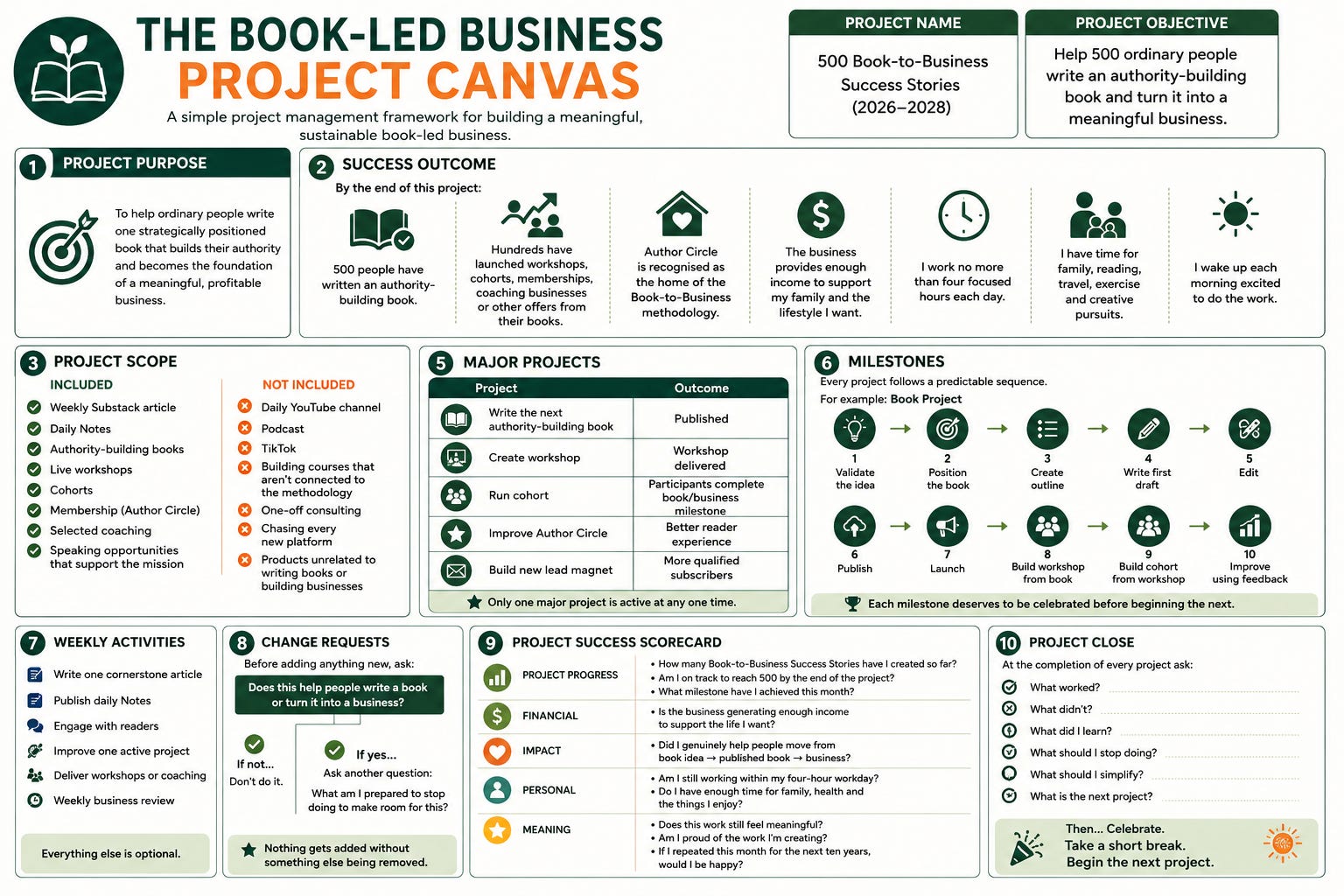
While working in the corporate sector, I loved working on projects. Projects had milestones. They had a completion date.They had a clear purpose.
In many ways, they gave my work meaning.
They also had a way of stretching us beyond what we thought was possible.
Then, when it was finished, we celebrated.
We took a breath.
We had time to recover before the next project began.
The beginning of a new project was always exciting. There was a blank canvas in front of us and endless possibilities waiting to be explored.
Looking back, I think we should be building our entrepreneurial businesses the same way.
Not as an endless collection of activities, but as a series of purposeful projects.
Projects with a clear objective.
Projects with milestones.
Projects with completion dates.
Projects worth celebrating.
That’s the kind of business I’m trying to build through Author Circle. And that’s the business I hope to help others build too.
So let me leave you with one question:
If you were designing your business like a project instead of accumulating it one activity at a time, what would you stop doing tomorrow?
Because sometimes the fastest way to move forward isn’t to do more.
It’s to deliberately choose less.
That’s all from me today.
As always, thanks for reading.
No posts
Comments
Nothing yet. Say the first thing.
Sign in to join the conversation.