
Despite extensive discussion across the Higher Education sector, including TEQSA’s June webinar on assuring online degrees in the age of generative AI and our earlier discussion on Data driven Assessment Reform, the question of what evidence of assuring learning actually looks like in practice remains unresolved.
In 2025, TEQSA published a resource outlining three pathways that institutions might take to assure learning in a GenAI era. Across all pathways, the expectation is consistent: providers must meet the relevant sections of the Higher Education Standards Framework and demonstrate how students achieve learning outcomes across a program of study. In this piece, course refers to an individual unit of study, and program refers to the overall award structure.
For many institutions, evidence of assurance of learning exists across course outlines, internal review documentation, external accreditation submissions, and detailed curriculum maps. If the evidence is there, what is the problem? Often, this information is captured in static documents or spreadsheets. Even where it sits within more advanced Curriculum Management Systems, it is not always integrated, easy to interpret, or readily accessible, particularly from an institutional governance perspective.
While our broader approach to assurance of learning focuses on student development, this piece takes an institutional and governance perspective, examining how learning outcomes are demonstrated systematically.
Making assurance visible
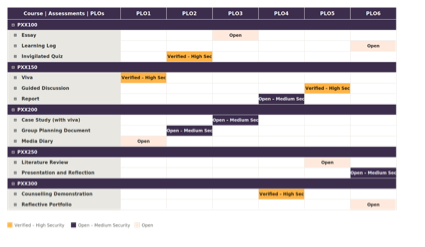
At UniSQ, our Assurance of Learning approach emphasises program‑level assurance through a deliberate combination of verified (high security) and open (low to medium security) assessment tasks to ensure the achievement of program learning outcomes. Assessment security characteristics at both the task and course level, along with mapped learning outcome relationships, are captured in our Curriculum Management System and visualised in our prototype PowerBI Assurance of Learning dashboard. As shown below, the dashboard brings together course and program learning outcomes, mapped assessment, and assessment security profiles into a single, program-level view.
In the first visualisation, mapped assessment is displayed by course, across each of the program learning outcomes.
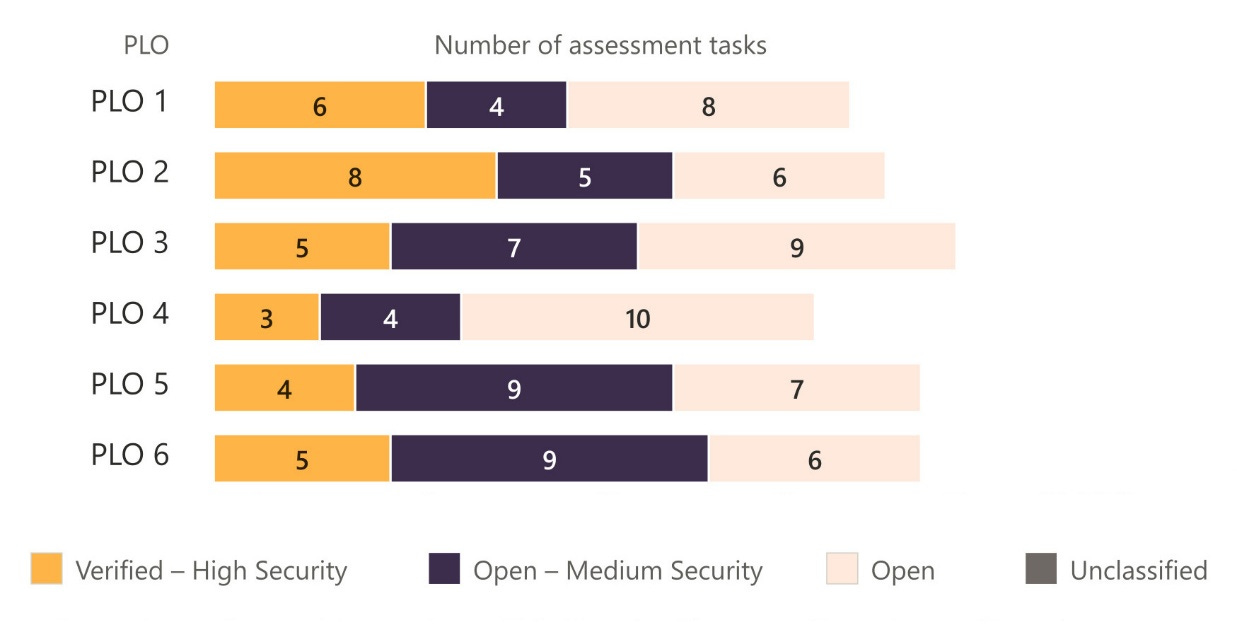
The second visualisation shows the number of open and verified assessment tasks that map to each of the program learning outcomes.
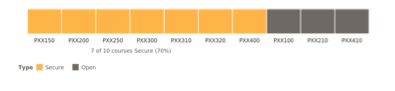
The last visualisation shows the proportion of secure relative to open courses that sit within the core and major components of a particular program of study.
Our approach is not about locking all assessment down. It involves being intentional about how assessment is designed across a program and being able to systematically demonstrate that intent.
What this enables is something simple, but powerful: you can actually see how assessment security is addressed across a program. Using the “hover for detail” function in PowerBI allows the user to drill down for detailed insights across learning outcomes, courses, and assessment types in ways not visible in static mapping.
Why this matters
A systematic and defensible approach to assurance
In an AI-enabled environment, a key question is how much assessment needs to be “secure” and therefore meet assurance thresholds. A program-level view allows Program Coordinators to make informed decisions. It shows where, within a program and across all program learning outcomes, secure verification of assessment is achieved without requiring high-security assessment everywhere.
Enhanced governance conversations
Governance bodies such as learning and teaching committees do not lack data, but they often lack clear and usable visibility of these data. A program-level dashboard supports gap analysis, enabling Program Coordinators, discipline teams, and Schools to review assessment profiles against expectations that may differ markedly (for example, due to professional accreditation requirements), and also supports identifying areas of potential risk or misalignment. It creates a shared view, grounding discussions in evidence rather than assumptions.
Informed curriculum change
The real value of our dashboard is in pedagogical and curriculum improvement. When assessment data is aggregated and visualised, specific intervention points become visible:
where a Program Learning Outcome is not robustly assessed across the program
where verification is clustered too late (or too early)
where assessment types are overly concentrated at the expense of other valid approaches.
This enables more targeted, evidence-informed assessment improvement, focused on where it is needed most. In addition, our dashboard can be used in conjunction with other data and insights to inform decision-making for broader curriculum change.
What we are learning
This work is still in prototype, but a few things are clear.
Assurance of learning must be demonstrated across programs of study
Data infrastructure matters
Visualisation changes the conversation
Once programs can be seen, questions about coverage, security, and progression become much more concrete.
Where to next?
The sector does not lack frameworks or policy for assurance of learning. The challenge is making assurance visible, defensible, and usable. For us, our dashboard is one way of doing that, connecting curriculum design, assessment, and governance into a single, evidence-based view.
Our dashboard approach may not be the final answer, but it is a step towards making assurance of learning something we can actually see, and therefore improve.
Jessica Marrington and Jo-Anne Ferreira lead institutional assessment reform initiatives in the Learning and Teaching Futures Unit, at the University of Southern Queensland.
Chris Zehntner leads the Learning and Teaching Innovation Team and Neil Martin is a Senior Consultant (Digital Curriculum) in the Learning and Teaching Futures Unit, at the University of Southern Queensland.
Comments
Nothing yet. Say the first thing.
Sign in to join the conversation.