
Apologies for missing last week’s Substack article. There is an excellent reason - although I doubt it will win me any sympathy - which is that I was spending the week in a marvellous country pile in Gloucestershire celebrating a friend’s birthday. Now it wasn’t all lounging around reading on over-stuffed sofas, taking a turn around the gardens, getting dressed up for cocktails, scintillating conversation, quaffing vintage Champagne, eating myself silly with delicious food, more cocktails, more scintillating conversation, playing the piano…sorry where was I…Oh yes, it wasn’t all that. I did have to sing for my supper, i.e. host a cheese tasting.

This was no great hardship given my fondness for cheese and talking. Also I was blessed with the presence of a lovely audience with finely tuned palates and a similar enthusiasm for cheese and words; the assistance of Charley - one of the house’s spectacularly competent staff; and the expertise of Lisa the chef, who provided the accompaniments. And this is the crucial bit, because the topic of this piece isn’t actually what a smashing time I had last week, but is instead the mindful selection of accompaniments for cheese.
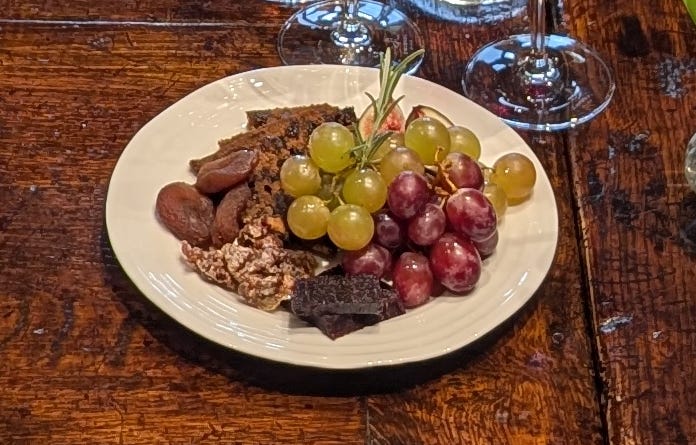
Let us start at nine o’clock on the plate with those apricots. Notice that Lisa chose the darker, drier and more intensely flavoured ones, which are usually available in any good Turkish shop - Malatya province in Eastern Anatolia being a centre of excellence for the sun-dried apricot. I have a couple of theories for matching these. One is by contrast, choosing a fairly young goats’ cheese whose still-pronounced acidity will bring out the rich fruity flavour of the apricot - in this case a young Dorstone, moussy, fresh and bright, but well-developed enough to stand up to the concentrated flavour of a dried fruit. Another would be to find complimentary flavours, for example in the thirty-month Comté which I brought along (it was a significant birthday). Apricot, along with some other amenable notes like walnuts and nutmeg, are common flavours in that mighty cheese. A glass of Palo Curtado sherry would have really topped that combo off, but we had to be content with a peachy Viognier or a well-rounded vintage Pol Roger. One makes do…
Moving in a clockwise direction, we come to the fruitcake, whose presence I greeted with a cry of joy and fellow-feeling. Cheese and fruitcake is a northeastern tradition, and one I was sadly unaware of until I married into a Durham family. Up there the Christmas cheeseboard is incomplete without Wensleydale and Christmas cake, although I feel strongly that this pairing is for life not just for Christmas, and can be enjoyed all year round - the milky tang of the cheese, the dark dense fruitiness of the cake, the moist crumble of both. Which in our case we had not got, but that was fine because we did have Simon and Tim Jones’ special reserve cheese, the Poacher 50. Aged for up to four years, the fudgey crunch of Parmesan and the sharp bite of proper Cheddar were mellowed if not entirely tamed by the fruitcake. Were you to head west from Durham by the way, you would eventually be offered Lancashire with apple-pie, for as the Lancastrian saying goes, ‘a pie without cheese is like a kiss without a squeeze’.
Almost hidden by that jauntily placed sprig of rosemary is a fresh fig, one of my favourite fruits to pair with cheese. Fig and goats’ cheese is a no-brainer, and if you were really going for it, a dab of honey too. One could even grill the whole thing for a showy yet simple starter.
As for the grapes, judicious choice is crucial, and Lisa did not let us down. Notice that there are two types. Firstly the tight, plump red grapes, their acidity cutting through the creamier soft cheeses. I forget their actually type though, because I was so taken with those pretty Muscats, their misty dusting of grey reminding us of the Pinot Gris grape - an all-time great wine for matching with cheese. Their sweetness and slight blowsiness was lovely with the harder cheeses, and even stood up to the 1924, a mixed-milk blue based on pre-1925 Roquefort, hence the passive aggressive name.
At six o’clock is the damson paste, another favourite of mine. This is traditional British condiment which performs a similar role to the Spanish membrillo or quince paste, in that it can be used to moisten well-aged and somewhat mouth-drying cheeses like Manchego or in this case, the Poacher. The darker fruit is of course more intense than quince though I find that damson also works with light fresh cheeses like Dorstone or milder traditional British styles like Caerphilly.
And then in the final position, the pièce de résistance, some candied walnuts which Lisa had made herself specially for the occasion. Sweet, crunchy, nutty, these went with everything, ticking boxes for complimentary, contrasting and textural approaches to pairing. Even so, Stichelton’s name led all the rest. Stilton and walnuts is a well-established match, and Stichelton, being made to a traditional Stilton recipe, performs the same role admirably. One imagines an Edwardian squire sitting at this very table enjoying this very combination with a glass of vintage port. In the absence of the old vintage p. we had a sweet yet light-hearted South African dessert wine made from late-harvested botrytised Sauvignon Blanc. Needs must and all that.
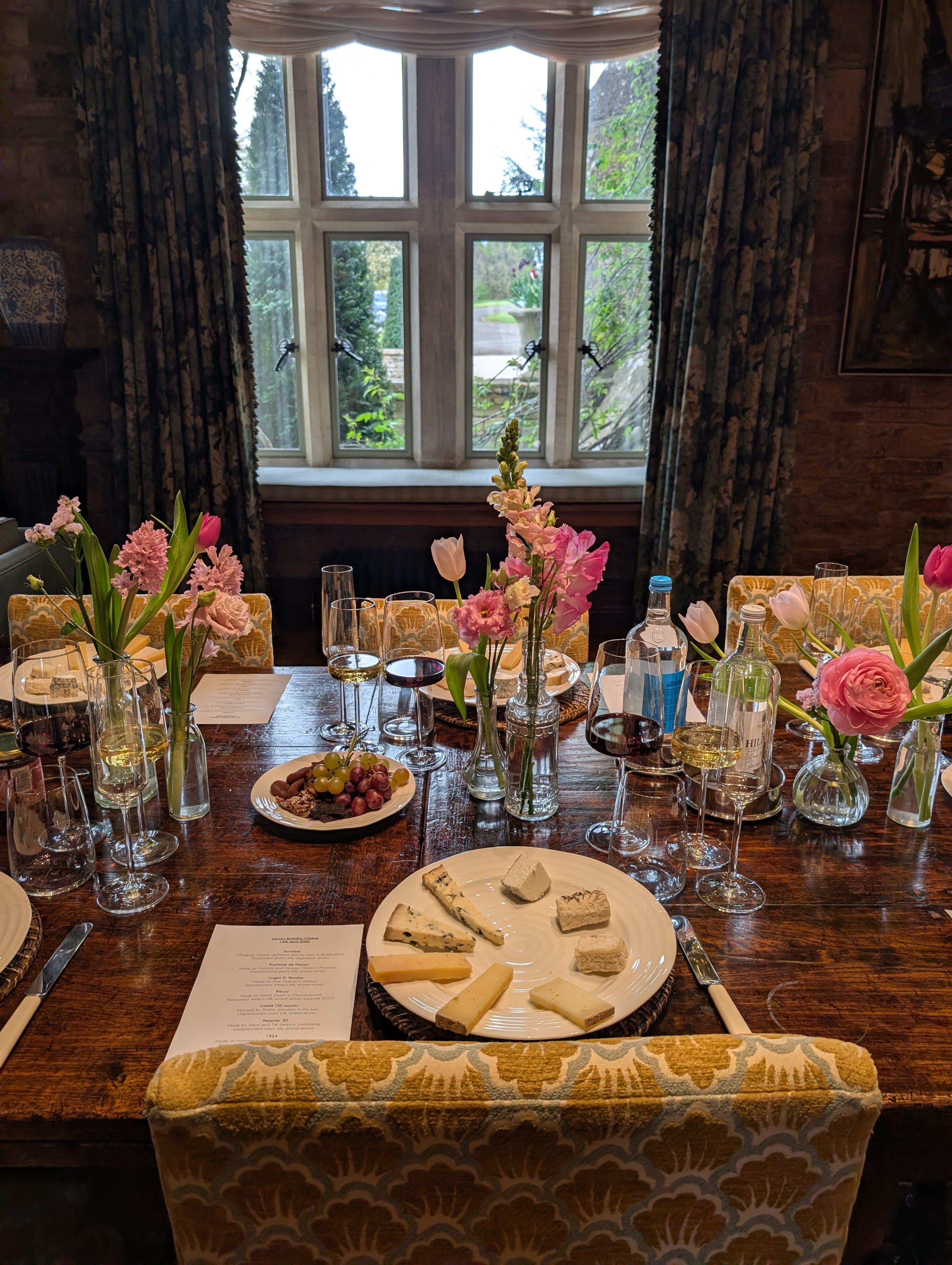
There is a more austere approach to matching cheese, which is to just bring one thing. I am a big fan of England Preserves’ Red Onion Marmalade for this. The long-caramelised onions provide stickiness and sweetness over a base of umami, thus covering pretty much all your cheese pairing needs. The R.O.M. has never failed me. Or you could go properly old school and bring out the Branston Pickle, the ultimate nostalgia pairing for those of us of the Boomer/Long Gen X cohort. The pickle’s deep brown flavours, reminiscent of HP and Daddies sauces, are redolent of that brownest of decades, the Seventies. The rich sweetness of dried figs and prunes and the contrasting malt-vinegar tang, are perfect in a sandwich with a proper Cheddar, or indeed any hard or semi-hard British cows’ cheese, accompanied with a well-steeped cup of orange-hued builders tea.
This week’s recommendations:
Substack: Food Relics, in particular this wonderful post EDIBLE EPISTEMOLOGIES// Cheese Cellar as Archive, from last year but a stone banger nonetheless.
Book: The Last Retreat by Marina Palmer. Full disclosure: Marina Palmer is the pen-name of Imogen Robertson, who, fairly low down her list of notable achievements, is married to me. But never mind that, this a fantastic book with a driving plot, great characters and a timely theme (scary millionaire tech bro wants to take over the world). Also, it’s quite fitting: “After surviving a raid in Ukraine, war photographer Tash Carter is in desperate need of recuperation. She accepts a job teaching photography at Belford Abbey, a luxurious estate where the super-rich come to switch off and be renewed.” See? Please pre-order this now so that Imogen can take me back to Coombe End.
Podcast: This American Life, In the Shadow of the City. I’m not going to tell you anything about this. Come to it fresh.

Cheeses from Neal’s Yard Dairy and Mons Cheesemongers, Diermersdal Noble Late Harvest Sauvignon Blanc 2024 from Laithwaites Wines. Utter joy from Laura, Ade and all the staff at Coombe End.
Thanks for reading! This post is public so feel free to share it.
Comments
Nothing yet. Say the first thing.
Sign in to join the conversation.