
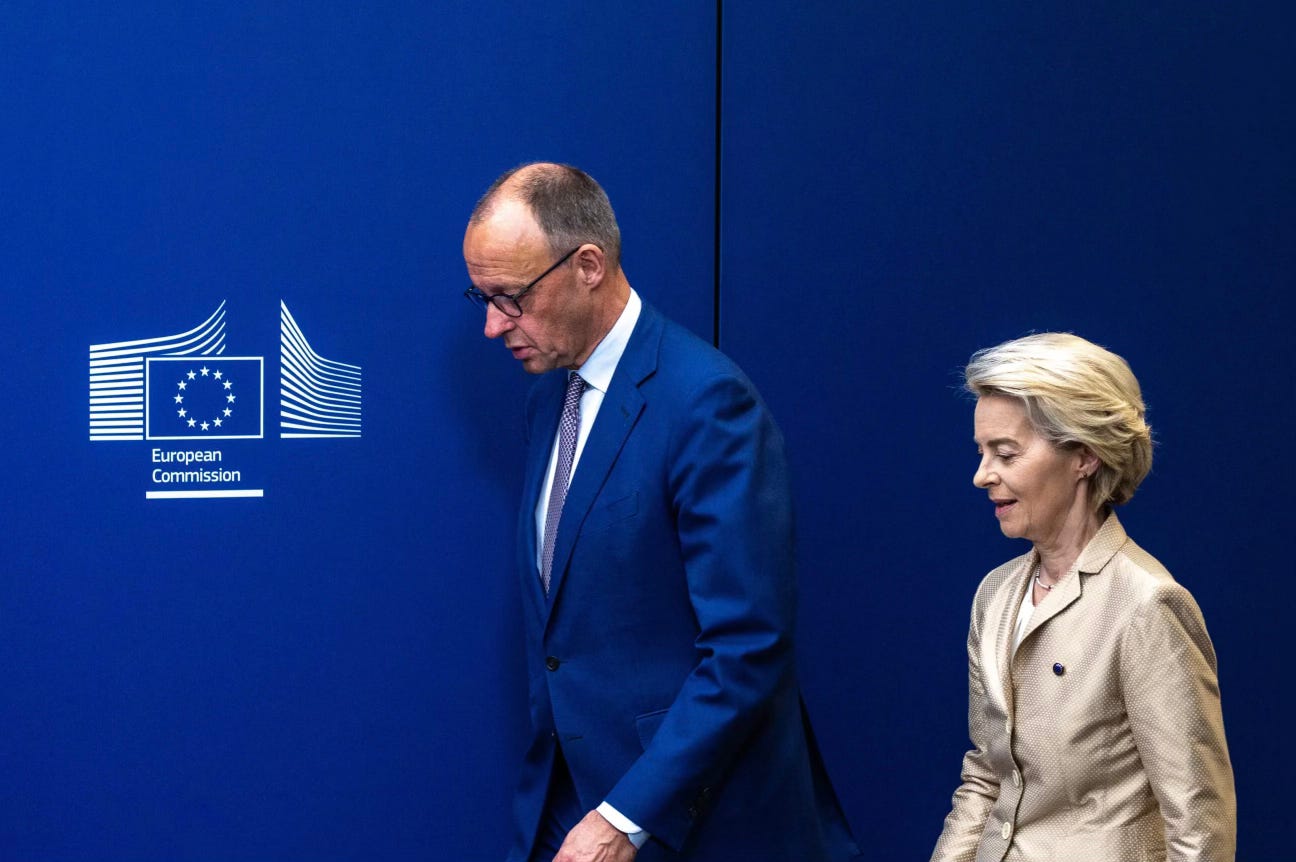
In the weeks since EU leaders gave the European Commission a green light to develop a more forceful trade response to China, the German government has been working overtime to decide how far it is prepared to go. German officials are working with their French counterparts on a joint paper on China policy that they plan to present at a Franco-German ministerial meeting on July 17. Chancellor Friedrich Merz’s coalition, after intensive talks last week, has gone further than it ever has before in calling for “robust protection” through faster, sector-wide trade measures. Meanwhile, a group of hawkish young parliamentarians from Merz’s conservative camp is working on an update of the party’s China strategy from 2023. “There is a feeling that we need to send a signal – not to put pressure on the government but to make it easier on them,” an official involved in shaping the new strategy told me.
But amid the flurry of activity, the comment that stuck with me from all my conversations in recent weeks is the following from a German official who is at the center of the deliberations in Berlin: “I am not per se defeatist. But you need to ask yourself: do you really want to start this fight if there’s a risk that you will have to surrender in a matter of weeks?” Yes, Germany is moving on China, as Merz’s tougher rhetoric of the past weeks has made clear. The news last month that Volkswagen plans to slash 100,000 jobs and close four additional factories brought home the depth of Germany’s industrial crisis and the need for a radical rethink. But no one should expect the German government to lead from the front on this.
“We’ve never heard a German chancellor talk like this before. New energy is being injected into the system. All the signs are strong and positive,” an EU trade official told me. “But a system like this isn’t going to pivot on a dime. The Germans are changing but it will be incremental.” The key question therefore, as we head into the most consequential few months for European China policy in years, is not whether the German government will throw its weight behind a more assertive approach to China but whether it will be dragged into one - by a policy process at EU level which takes on a momentum of its own or through ground-up political pressure in Germany as job losses mount (or a combination of the two).
Now that the German government has stepped onto the China train, will it be able to slow it down, let alone jump off? This is the question that officials in Berlin are asking themselves. The proverbial train left the station last month when EU leaders gave the Commission a mandate. And it will pick up speed as the summer unfolds, with September shaping up as a crucial month. The Commission will begin consultations with member states on its trade plans then, with President Ursula von der Leyen expected to spell out elements of the strategy in her mid-month State of the European Union speech.
Comments
Nothing yet. Say the first thing.
Sign in to join the conversation.