
If one were to reduce the past decade of European policy towards China to a single sentence, it might look something like this: Years of steadily rising concern about China’s authoritarian turn, manufacturing dominance and economic coercion that has unfolded without a forceful policy response due to Germany and its powerful car lobby. This is the dynamic that played out repeatedly under Angela Merkel, who thwarted EU efforts to protect the solar industry and turned a blind eye to the risks posed by Chinese 5G suppliers because she feared Chinese retaliation against the big carmakers. It continued under her successor Olaf Scholz, who in 2024 at the behest of these same carmakers, mounted an aggressive, but ultimately unsuccessful, campaign to prevent the EU from imposing tariffs on electric vehicles from China.
A change in Europe’s approach to China, therefore, has always hinged on a shift in the German calculus – and by extension that of its car industry. That is why remarks last week by Oliver Blume, the CEO of Germany’s largest carmaker Volkswagen, were so interesting. In a rare, unguarded moment on a call with analysts to present the company’s second quarter results, Blume praised the EV tariffs that he helped convince Scholz to oppose two years ago and urged the European Commission to extend them to cover plug-in hybrid vehicles from China, which captured nearly a third of the European market in the first half of this year. Volkswagen later issued a statement to Chinese state media outlets which played down (and creatively misrepresented) what Blume had said on the call. But there was no denying the significance of his remarks.
It was the first time that the head of one of Germany’s big three carmakers had called publicly for trade defense measures against China. This is new territory and the reason is simple: the threat from Chinese competitors has become so big that the default approach of the past decades – lobbying Berlin and Brussels to do absolutely nothing – is no longer viable. This poses a philosophical problem for the German car industry association (VDA), the last bastion of willful blindness in an industrial landscape that has seen one industrial sector after another flip on China.
Volkswagen, by the way, is now pursuing a strategy that consists of:
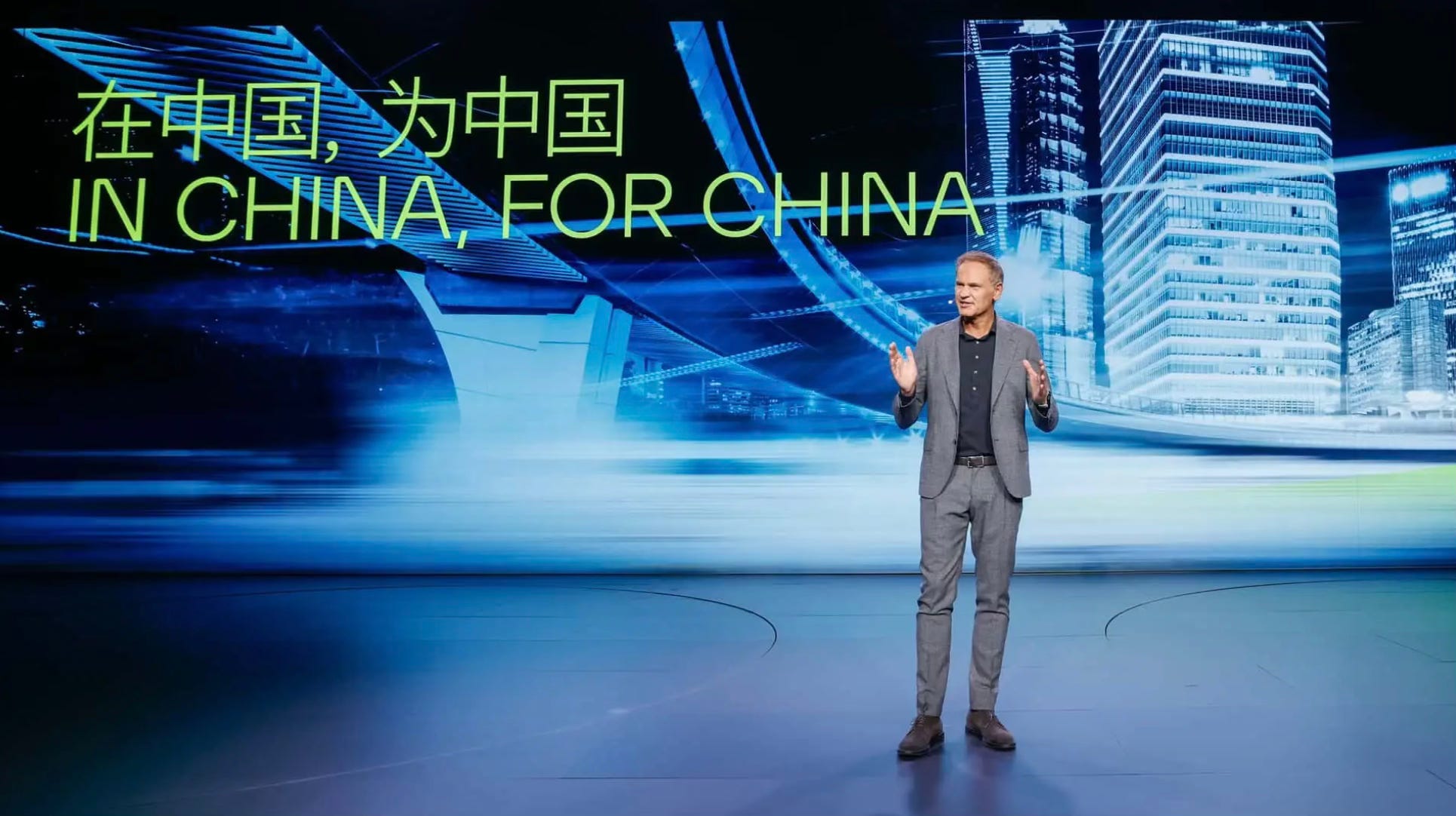
Doubling down on manufacturing at its EV hub in Hefei, China as part of what Blume describes as an “in China for China” approach.
Exporting the cars it produces in China, in Blume’s own words, to Southeast Asia, Australia, India, South America, Africa and Europe, in what looks more like an “in China for the world” strategy (minus the US market).
Pursuing mass layoffs in Germany, while luring Chinese carmakers into the German factories that Volkswagen is struggling to sustain.
Urging the EU to accelerate and broaden its trade defense measures against Chinese competitors that are seizing market share for plug-in hybrids at an astonishing rate.
If your head is spinning, you are not alone ...
Although its membership remains divided, I am told that the VDA is working on a new paper on trade policy which for the first time could open the door a crack to a more defensive approach. “I don’t expect the VDA to call outright for tariffs on China. But we are likely to see a change of tone,” one car industry executive told me. “Its biggest member is shifting and that can’t be ignored.” The paper is one of many on the trade relationship with China that are in the works from business associations across Europe, from the Federation of German Industries (BDI), to Business Europe and the European chemicals association (CEFIC). All are expected to call – some overtly, some cautiously – for a more forceful European policy response.
What are the implications of this for Berlin and the broader EU debate on China policy? There is no question that German Chancellor Friedrich Merz has sharpened his tone on China over the past months. In mid-July, at a Franco-German ministerial meeting with France’s Emmanuel Macron, Berlin and Paris called in a joint statement for the “swift and systematic” use of all existing EU instruments to counter unfair competition from China. He has asked his ministries to work with the French on a joint strategy paper on China that is expected to be finalized before the next European Council in mid-October. If Germany and France are able to overcome their differences and chart a way forward on China, the rest of Europe would follow.
In my mind, the big question is no longer where Merz will land on China, but whether he can see the policy shift that he has initiated through to the end. Following a botched cabinet reshuffle last month, Merz is weaker than ever. Senior members of his own party are telling reporters that confidence in his leadership has been irreparably damaged. Some are predicting that he will be forced out as early as next month, when his Christian Democrats could suffer crushing defeats to the far-right Alternative for Germany (AfD) in three state elections in eastern Germany. Polls give the AfD a substantial lead in two of the states (Sachsen-Anhalt and Mecklenburg-Vorpommern) and a good chance of emerging as the top party in the third (Berlin).
Even if he hangs on, it is unclear whether Merz would have the authority to push through a major rethink in China policy. His Economy Minister Katherina Reiche, who survived the cabinet cull, has openly defied him in recent months, killing a statement on China policy that diplomats in Berlin and Paris had been preparing for the Merz-Macron meeting and then surprising the chancellor by skipping the Franco-German ministerial meeting altogether. Weeks before that, she ignored warnings and traveled to Brussels to meet with China’s Minister of Commerce Wang Wentao, a day before his sit-down with EU Trade Commissioner Maros Sefcovic – a move one German diplomat described to me as an “outrageous” attempt to undermine the Commission.
When senior figures at the Commission learned of her plans, they called officials in the Chancellery and asked them to stop her trip. Not only did she go ahead with it, but after assuring colleagues that the meeting with Wang would be kept low profile, her ministry issued a public statement on it which read as if it had been written by Beijing. The fury over Reiche has been building for months – and not just in Berlin and Brussels. Last December, senior officials in the French Treasury handed over the draft of a non-paper on trade policy to their counterparts in Reiche’s ministry. Their hope was that Berlin and Paris could agree on a text that would set the direction for China policy in Europe. But they never heard back from Berlin and after months of mounting frustration, turned to Italy, the Netherlands and several other countries, who happily signed up.
When the paper was leaked to the Financial Times in late May, German diplomats complained that they had not been given sufficient time to respond. They learned later that Reiche’s ministry had been holding the paper for nearly half a year and hadn’t shared it within the government. “The message from Reiche’s ministry has been: there are no overcapacities and there is no China shock,” one German official fumed. “They don’t want to take any action.”
After coming to power in May of last year, Merz created a National Security Council to resolve internal government disputes like this. But to the frustration of many, the NSC has not tackled the divisive issue of trade policy towards China. “It is a mystery – one of many Merz mysteries,” a senior diplomat told me. Another diplomat said: “Merz is talking tough in public but not giving clear instructions internally. There is a lack of direction from the top.” Still, it would disastrous if Merz were toppled weeks before the European Council meets in mid-October to discuss next steps on China policy. The man that would almost surely replace him, North-Rhine Westphalia Premier Hendrik Wüst, is a foreign policy novice. Berlin would be starting from scratch again.
What can we expect in October? The Council meeting is being seen as a make-or-break moment for European China policy: either leaders will back a tougher approach or they will shy away from confrontation, seizing on symbolic concessions from Beijing and calling for more dialogue. This view has been fueled in part by Trade Commissioner Sefcovic’s comments, following his meeting with Wang Wentao in late June, that the EU will need to see “tangible results” by October. After a summer of intense talks between European and Chinese trade officials, Sefcovic will travel to Beijing at the beginning of October. EU leaders will then gather in Brussels mid-month to decide which path to take – conflict or compromise. Or so the thinking goes.
But as one official familiar with European Commission President Ursula von der Leyen’s thinking put it to me: “It is wrong to see October as a fork in the road. We will not go left or right, towards a deal or towards a trade war. We will go straight ahead, with further talks and with new measures.” From the Commission’s perspective, the second half of the year will be more akin to a game of three-dimensional chess. It must deploy the tools required to shield European industry from Chinese overcapacities, continue to engage with Beijing to avert an escalatory spiral, and keep European member states on board at a time of acute political uncertainty – and not only in Germany.
France, Italy, Spain and Poland, countries that make up nearly half of the EU population, will all hold national elections next year. In all four, populist far-right parties could end up holding (or sharing) the reins of power. Europe’s shift on China has been driven by the economics – most recently a tsunami of job losses in the German car sector. But the politics will determine whether the shift can be sustained.
No posts
Comments
Nothing yet. Say the first thing.
Sign in to join the conversation.