
In responding to Comment #29 in the preamble of the QMSR1, FDA addressed several terminology questions, including correction, corrective action, preventive action, and the definition of batch or lot.
One detail is easy to miss: FDA intended to retain the batch/lot definition from the former QS Regulation.
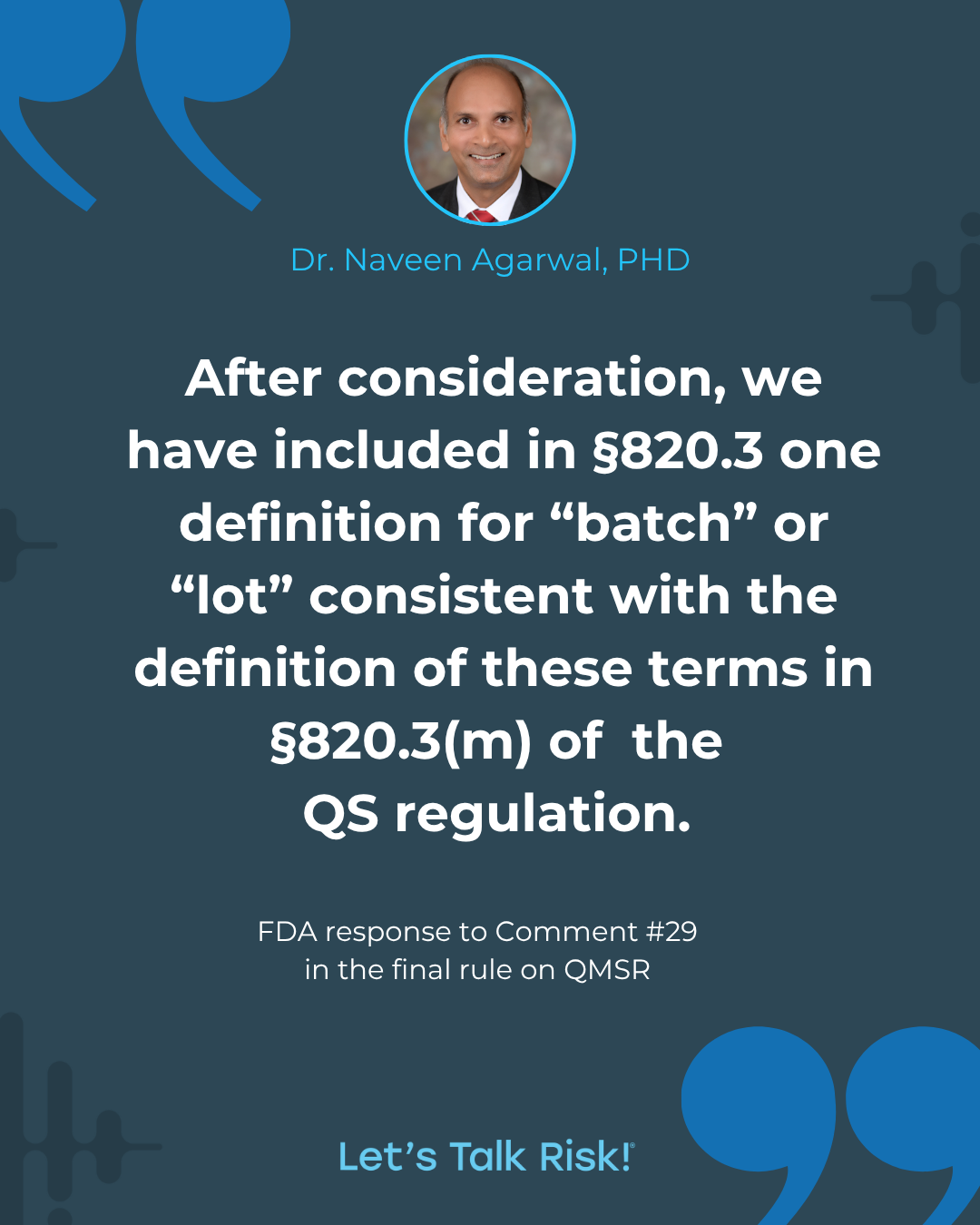
FDA later corrected the QMSR regulatory text to include the batch/lot definition that the preamble said FDA intended to retain:
Batch or lot means one or more components or finished devices that consist of a single type, model, class, size, composition, or software version that are manufactured under essentially the same conditions and that are intended to have uniform characteristics and quality within specified limits.
That definition matters because batch and lot are not just manufacturing labels. Although these terms are used in ISO 13485, they are not adequately defined. That is why FDA chose to include them in §820.3 of the QMSR.
When a nonconformity is identified, the organization has to determine what is actually in scope.
Is it one unit?
One lot?
One batch?
One software version?
One supplier shipment?
Multiple distributed lots?
The answer can change containment, investigation, disposition, correction, CAPA, risk assessment, and potential postmarket action.
This is why batch/lot clarity matters in the same discussion as correction and corrective action. A correction fixes the detected nonconformity. A corrective action addresses the cause to prevent recurrence. But both depend on understanding the population affected by the issue.
Key point: Batch and lot definitions are not just labeling details; they define the population affected by a quality decision.
A weak batch/lot definition can lead to weak containment. Weak containment can lead to an incomplete correction. An incomplete understanding of the affected population can also weaken root cause analysis, CAPA scope, effectiveness verification, and risk-based decision-making.
QMSR harmonizes with ISO 13485, but FDA retained this definition because ISO 13485 uses batch and lot terminology without defining those terms in the same way FDA needs for regulatory clarity.
That is the practical lesson - definitions shape decisions.
And in a QMS, unclear definitions can become unclear control.
So, think about this question and share your opinion in the poll below:
👉Where does unclear batch/lot definition create the most QMS risk?
Comments
Nothing yet. Say the first thing.
Sign in to join the conversation.