
Buzzards are the scavengers of the sky. Without them, we’d be constantly stepping around dead carcasses and waiting weeks for dead bodies to dry up and disintegrate. As ugly and smelly as vultures are, we should be grateful to them for doing a job that most animals won’t – eating putrid, rotting flesh and liking it.
Except – is there a limit to what a buzzard will eat? A friend of ours recently killed a venomous snake and left it on a rock for the vultures, but the next day it hadn’t been touched. Do they somehow know it’s dangerous? IS it actually dangerous to scavengers?
Andrew also says he’s seen armadillo roadkill ignored by buzzards and laying in the road for days. Is there something about armadillos that buzzards dislike?
First, I’ve got to clear up some terminology. Here in the U.S., we use the terms buzzards and vultures interchangeably; however, the correct term is vulture because buzzards are actually a type of bird of prey in Europe. So, from here on out I’ll be more careful to call them vultures.
I’ve written before about how vultures find their decaying food using their excellent sense of smell, a skill we humans have put to use by using their flight patterns to identify gas line leaks. We also know they can eat rotten meat without distress because their stomachs contain acids strong enough to kill and neutralize any botulism, anthrax, salmonella, or cholera that might cling to carrion. As a matter of fact, it turns out their stomach acid is strong enough to neutralize the venom of snakes like the copperhead our friend left on a rock. The brief video below even shows a vulture swallowing an entire leg bone, which will eventually dissolve in its stomach acid.
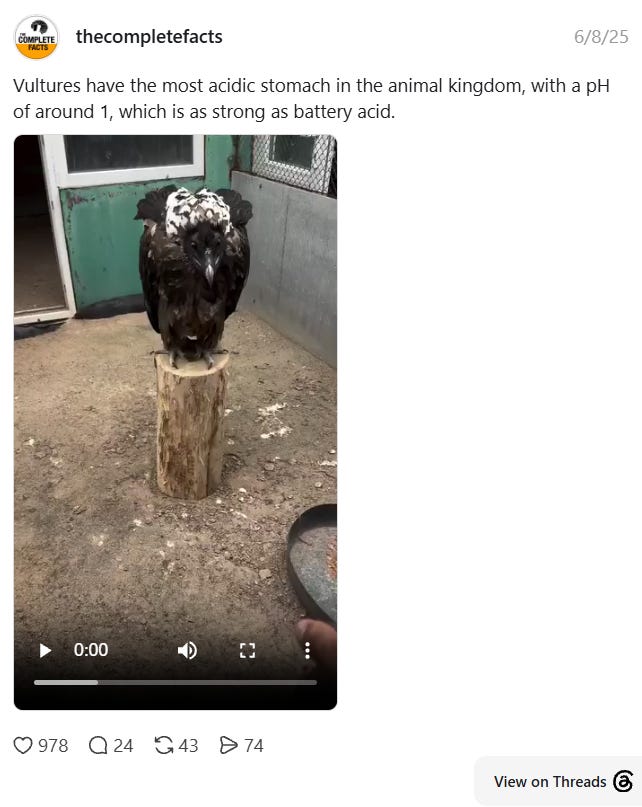
If they can eat that, then is there anything they won’t eat?
Vultures don’t particularly like fresh meat – it must have decayed enough for them to tear into it, and for them to even find it, it must be somewhat rotted and giving off putrid smells to track. So, the fresh snake our friend killed may have simply been not dead enough. The same is true of armadillos, since shortly after beginning this newsletter, I observed a local wake of vultures gathered around an armadillo carcass. If vultures are ignoring a dead animal, it may simply be too fresh.
However!
There are some studies that show that vultures vastly prefer the meat of herbivores over carnivores. When presented with the carcasses of domestic dogs and coyotes, the vultures tend to stay away unless there is nothing else to eat.
Actually, most scavengers tend to avoid the carcasses of carnivores and prefer herbivores. If they do eat carnivores, they’re very careful not to cannibalize their own kind. Researchers think they’re able to do this through chemical detection, and it’s likely a way to protect against parasites that can easily transfer from dead to living tissue within the same species.
I wondered: why would scavengers, including vultures, prefer herbivores? Then it occurred to me – as humans, do we also prefer herbivores? We tend to eat the meat of cows, chickens, and fish. When we hunt, we go after deer, elk, turkey and trout. It’s less likely that we eat bear or snakes or birds of prey, all of which are meat-eaters.
This took me down a rabbit hole about ecosystems, one I’d probably learned about back in high school and subsequently forgotten. It has to do with trophic levels:
The image above is an ecosystem. Most ecosystems are 4-5 levels deep, with each level consuming the level below. It’s formed in a pyramid shape due to energy loss and what’s called the 10% rule.
Only 10% of the energy at one level is passed along to the level above. For instance, a rabbit (a primary consumer in the pyramid above) only stores 10% of the available energy from eating grasses and flowers – the rest is lost as heat, used for movement, or is processed as waste. The same is true of a secondary consumer fox eating a rabbit – it can only ever store 10% of its calories.
In other words, for every fox there must be ten times the number of rabbits, and for every rabbit there must be ten times the amount of plant material. This explains why an ecosystem is shaped like a pyramid – there are WAY more herbivores than carnivores out of necessity because energy is lost as we move up the food chain.
Scavengers are unique because they can eat at any level of the food chain – dead secondary consumers, tertiary consumers… they might even find a dead apex predator from the top of the food chain. However, due to the 10% rule, a dead herbivore provides ten times more energy than a dead carnivore would.
What about us humans? We view ourselves as apex predators because we have developed technology to protect ourselves against every other animal on Earth. As far as having an impact on the planet, we are definitely top of the heap.
But as far as the food chain goes, we actually fit better in the middle rather than at the top. In a 5-level energy pyramid, we clock in right about a 2.2, along with pigs and anchovies. We are omnivores and eat a little of everything, though with a score below 2.5 that means we eat slightly more plants than animals. When we eat plants, we’re acting as a primary consumer, and when we eat herbivores, we’re acting as secondary consumers.
As you can see from the illustration above, plants contain much more potential energy than primary consumers, which in turn contain more energy than secondary consumers. In other words, just like vultures, we prefer to eat herbivores over carnivores because they provide us more energy.
But there’s another reason scavengers often eat lower on the food chain. The higher up the chain you go, the more likely an animal is to have consumed toxins due to biomagnification. Because of the 10% rule, tertiary and apex predators must consume a great deal of prey. Fat-soluble toxins can accumulate in these predators and affect the taste of their flesh once they die.
This is why we have to limit the number of certain kinds of fish we eat to avoid consuming mercury. And it’s why we almost lost the California Condor and other birds of prey to DDT back in the 60s and 70s, when the accumulation of DDT in small and large fish resulted in the thinning of Condor eggs and death of their offspring.
Animals that eat other animals tend to “stack” the toxins from the trophic levels below. Smart scavengers (and omnivores) will therefore be careful about what they eat.
So, as to the question about what vultures WON’T eat, it seems they care more about where the animal falls on the food chain than they do about its putrification or how many diseases it carries. Sounds like they’re smarter than I thought.
Thanks for reading Natural Wonders! This post is public so feel free to share it.
No posts
Comments
Nothing yet. Say the first thing.
Sign in to join the conversation.