
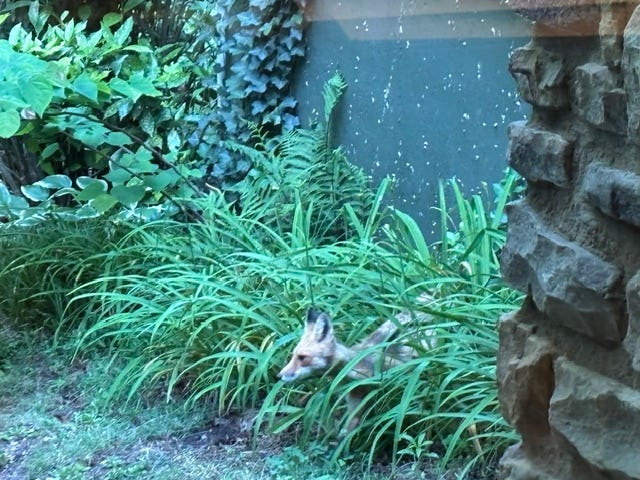
Two days ago, as I sat on my computer in the dining room, out of the corner of my eye I saw a golden blur run past our cars. Peering outside, I saw it round the corner of our house and appear right beside the dining room window – a red fox, just two feet from our house steps.
It pounced into the growing day lilies and appeared to eat something (a mouse? insects?). It then calmly left the day lilies and trotted away into the yard.
But as it left, I noticed it didn’t look normal…

We’ve had foxes near our house before, but never this close. They’ve always had fluffy, bottle brush tails and healthy coats. This one looked much different. Its fur was spotty and even down to bare skin near its neck. It was an odd, light-yellow color, possibly due to it having lost much of its overcoat.
Was this mange? Could our dog catch it just from being in the same yard as the fox? And could mange cause the fox to have this unusual lack of fear of us humans? As it hunted briefly in the day lilies, Andrew and I talked quietly not ten feet away, which should have scared it away.
I did some research and found that mange is actually very common in red foxes – unfortunately, it’s the leading cause of death after car collisions. The disease is caused by parasitic mites called Sarcoptes scabiei that burrow into the skin, depositing eggs, fecal matter, and exoskeletons along the way. This causes itching, which in turn can cause infections from excessive scratching.
The disease is highly contagious and hard for the foxes to get rid of as they pass it from one to the other from close contact and the mites are usually prolific in their dens.
Dogs are protected from the mites by their monthly flea and tick medicine, but it is possible for the mites to transfer to a human if for some reason you came in close contact with a fox or its living quarters. Fortunately, the subspecies that lives on foxes won’t reproduce on humans, so the disease would be itchy, but short-lived.
However, there is a mange mite that is specific to humans. It’s known as scabies. I remember, years ago, encountering a person with a case of scabies when I went to the hospital. I had been bitten by a dog that was not up-to-date on its shots, and because the bite had broken the skin I had to get a series of rabies shots over the course of several weeks. Rabies shots do not come premixed, so I had to visit the emergency room each time and wait while they prepared the mixture. As I sat behind my curtain, I heard a hospital-wide announcement for a scabies cleanup in bay 8, just three curtains down from mine. That poor person and I were both suffering from animal bites, though on reflection I preferred my situation over theirs.

It is common for foxes with mange to act abnormally and seem to lose their fear of humans. If they have a strong infection, they may be malnourished and exhausted. The loss of fur can cause them to lose body heat, so they may approach human heat sources, and if it affects their ability to hunt, they may begin to look to human trash for food. The skin on their faces may become crusted and inflamed, impairing their ability to see or hear. This could make them less aware of humans and less fearful because they can’t sense us. All of this could explain why our fox so easily approached our house and wasn’t frightened off by the noises we made.
Sometimes foxes with mange are mistakenly thought to be rabid, however foxes with rabies will act disoriented or even aggressive, foaming at the mouth or staggering about, while foxes with mange don’t alter their behavior as drastically.
Mange can be fatal for the deer, coyotes, squirrels, and foxes that contract it as the excessive scratching can cause infection and the fur loss can cause dehydration or hypothermia. However, if the animal’s immune system is strong enough, they can recover.
While there is treatment available for animals with mange, it’s illegal to administer it yourself as it can be lethal to other animals or pets. It has to be provided by a licensed veterinarian or wildlife rehabilitator.
Mange has threatened the health of the endangered San Joaquin kit fox in California. Researchers are conducting a study using mange-prevention collars in an attempt to control the outbreak and hopefully protect the few remaining kit foxes.
Some studies indicate that forest fires, particularly controlled burns organized by trained land managers such as the U.S. Forest Service, can have a positive effect on the prevalence of parasites such as ticks, fleas, and mites. Burning the leaf litter where they live can control the population, and the stimulation of new plant growth can support the health of native wildlife.
It doesn’t appear there’s much we can do to help this local fox, other than hope its immune system is strong enough to fight off the effects of the mites attacking it. It has not returned in the two days it’s taken me to write about it, so I’m hopeful its visit was a temporary one and that it’s able to find the nourishment it needs in the forest where it belongs.

Thanks for reading Natural Wonders! This post is public so feel free to share it.
No posts
Comments
Nothing yet. Say the first thing.
Sign in to join the conversation.