
Day 3 of the ICA Congress was just as packed as the second, and presented a more coherent programme end-to-end. I attended talks focusing on the archives of marginalised people, all of which I felt combined the forward-looking yet history-conscious spirit of the archive sector in a deeply moving and motivating way. The day began with a session on archives in Palestine, followed by a keynote speech dealing with decoloniality and reparations in the Caribbean. Before lunch, I attended a session on the interaction between archives and refugees, then ending the day with a fascinating discussion regarding the future of archival description through Records in Contexts. Although I was regrettably unable to attend the final presentation of the day, I ended day 3 with a similar optimistic mood to that of day 2. I’ll cover this more in the conclusion, but for now, let’s have a closer look at four of the talks on offer yesterday.
The day opened with a powerful set of presentations on the archival dimension of the ongoing genocide and colonial occupation in Palestine. The systematic destruction of Palestinian documentary heritage over the past 80 years was described in detail as part of a programme of epistemological violence. This assault on Palestinian knowledge production is aided by the fact that Palestinian archival material looted during the Nakba and thereafter is now stored in Israeli state and military archives. Rula Shahwan’s presentation went on to outline the ways in which Palestinian archivists and researchers are systematically prevented from accessing this material, while their Israeli counterparts browse it freely.
In response to this information emergency, a Palestine Task Force of archivists has been formed. This body intends to aid in the documentation and preservation of information regarding the current genocide in Palestine. Among their aims is to collect social media data to allow Palestinian voices to create a self-made archive of accountability and memory. Instagram, X, and other platforms are frequently used by Gazans to document their daily life - information which would quickly become lost without some kind of digital preservation. In this sense, the Task Force is working to break through an information blockade, or an enforced archival silence, which surrounds Palestinian memory and history.
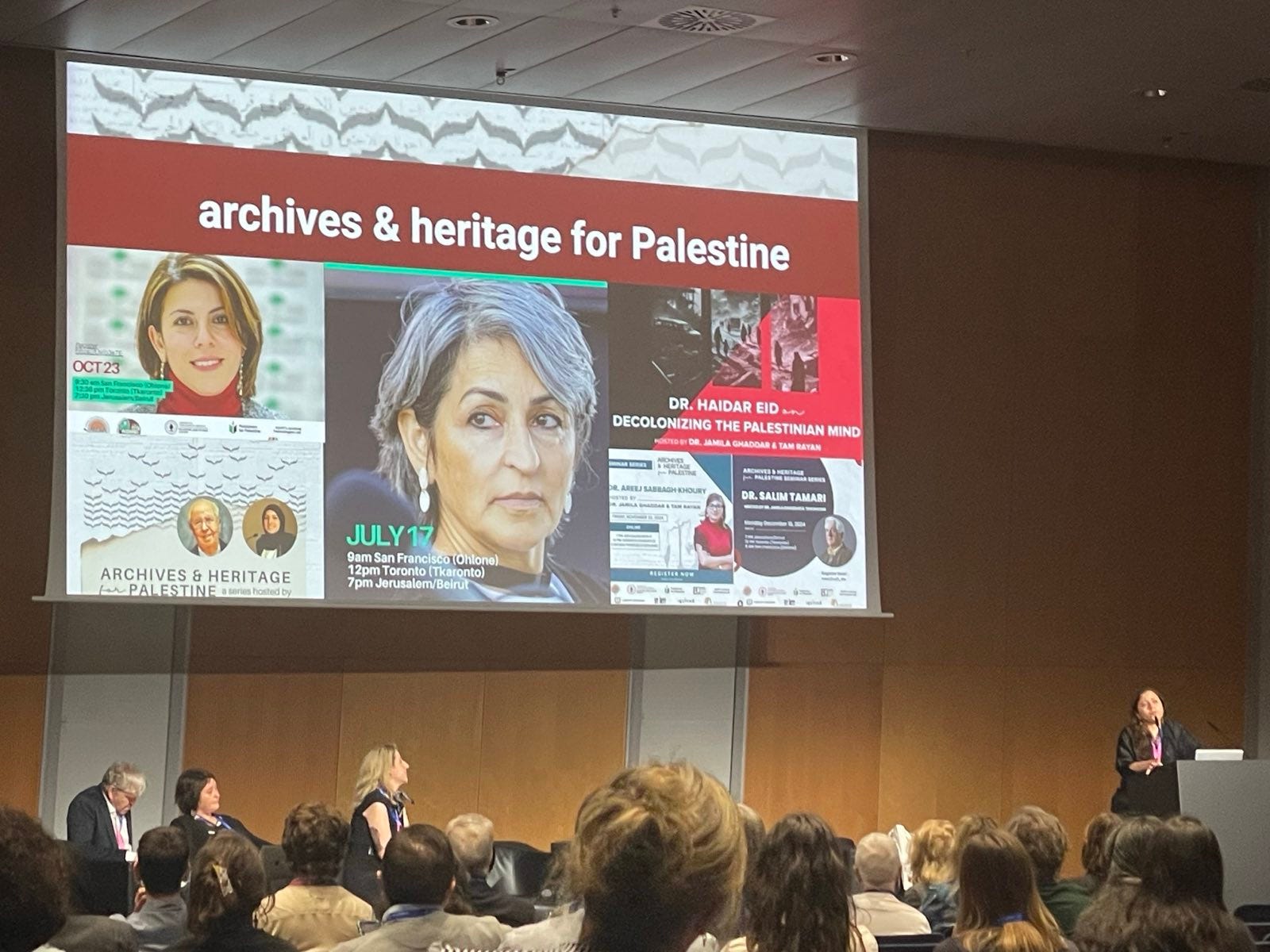
The talks in this session focused on archives as a locus of power, with the potential to enact violence against knowledge itself. The need for solidarity in both word and deed was expressed repeatedly - not just with the Palestinian people, but with oppressed and subjugated people worldwide. The preservation of social media and other material coming directly from ordinary people was presented as a “counter-archive” to that of the institutions, which frequently come under the control of oppressive state and colonial forces.
The second keynote of the 2025 Congress returned to the theme of AI, although in a more measured tone than the first. This speech dealt primarily with the legacy of colonialism and its ongoing effects in the archives of the Caribbean. As part of the process of colonisation, indigenous ways of managing knowledge and history were displaced in favour of European methodologies. This continued throughout the colonial period, leading many in the Caribbean to become alienated from their own heritage. In response to this, archivists and organisations are now working not only to re-examine their own histories, but explicitly revalorise the thought, philosophy, and methodologies of indigenous people in the Caribbean.
The ongoing custody of the records of former colonies (which I’ve discussed before on this blog) was also covered. One particularly interesting note here is the fact that such records are typically in the language of the colonising power (i.e. English, French, Dutch, etc.), leaving them illegible to many in the former colony. In this sense, the archives of colonialism symbolically exclude the voices of the colonised, supplanting them with European points of view.
From this point, the presenter moved to discuss the potential role of AI and the digital humanities in aiding this process of decolonisation. Far from the relatively jingoistic tone of the first keynote, this presentation cautioned about the applicability of AI to decolonial projects. Aside from the fallibility of AI (including in terms of faulty Optical Character Recognition and its tendency to hallucinate), the organisations who create AI tools are frequently based in the global North, with many in former colonial powers.
A result of this is that the approaches built into the tools, and the datasets upon which they are trained, are steeped in Western modes of thought and epistemologies, with practically no space for the voices of the subaltern. In this sense, it’s possible that widespread, unthinking applications of AI to marginalised archives may create a form of re-colonisation. Much like the previous presentations, the keynote ended with a stirring call for international co-operation and resistance of technologically-enable neocolonialism.
This session set out to discuss the wide-ranging interactions between refugees, archives, and information systems both past and present. It began with the discussion of some local history - the influx of refugees to France from Catalonia at the end of the Spanish Civil War in 1939. Based on records from the French Ministry of the Interior, a database was created to illustrate where these refugees came from, and where they were interned in France following their arrival. This database was created through a participative process, in which individual names, places and dates were extracted from the many thousands of internment forms contained within the archive. The process was complicated by the fact that these fonds had been split in two since the 1940s!
In 1940, many records from the French National Archives were confiscated by occupying German forces, being sent to Berlin and later to Czechoslovakia. Four years later, the liberation of eastern Europe by the Red Army caused these files to be sent not back to their home in France, but to Moscow. They would remain there for several decades, being catalogued and preserved according to Soviet norms of archival science, until the late 1990s, when they were returned. This period of time in the USSR affected the structure of the records, as well as making them practically unknown to the French research public.
This account of archival history was followed by another - a researcher from the National Bank of Greece presented his work on the records of Greek refugees from Asia Minor following the Greco-Turkish War of 1919-22. These refugees were compensated for their lost land and property by the national bank - hence, their records remain in the bank’s holdings. This presentation again hinged on the creation of a database from these refugee records for the purposes of genealogical research. Both of these talks drew my attention to the vital importance of refugees’ records, both for accountability in the short and medium term, but also for their descendants’ genealogical research in the future.
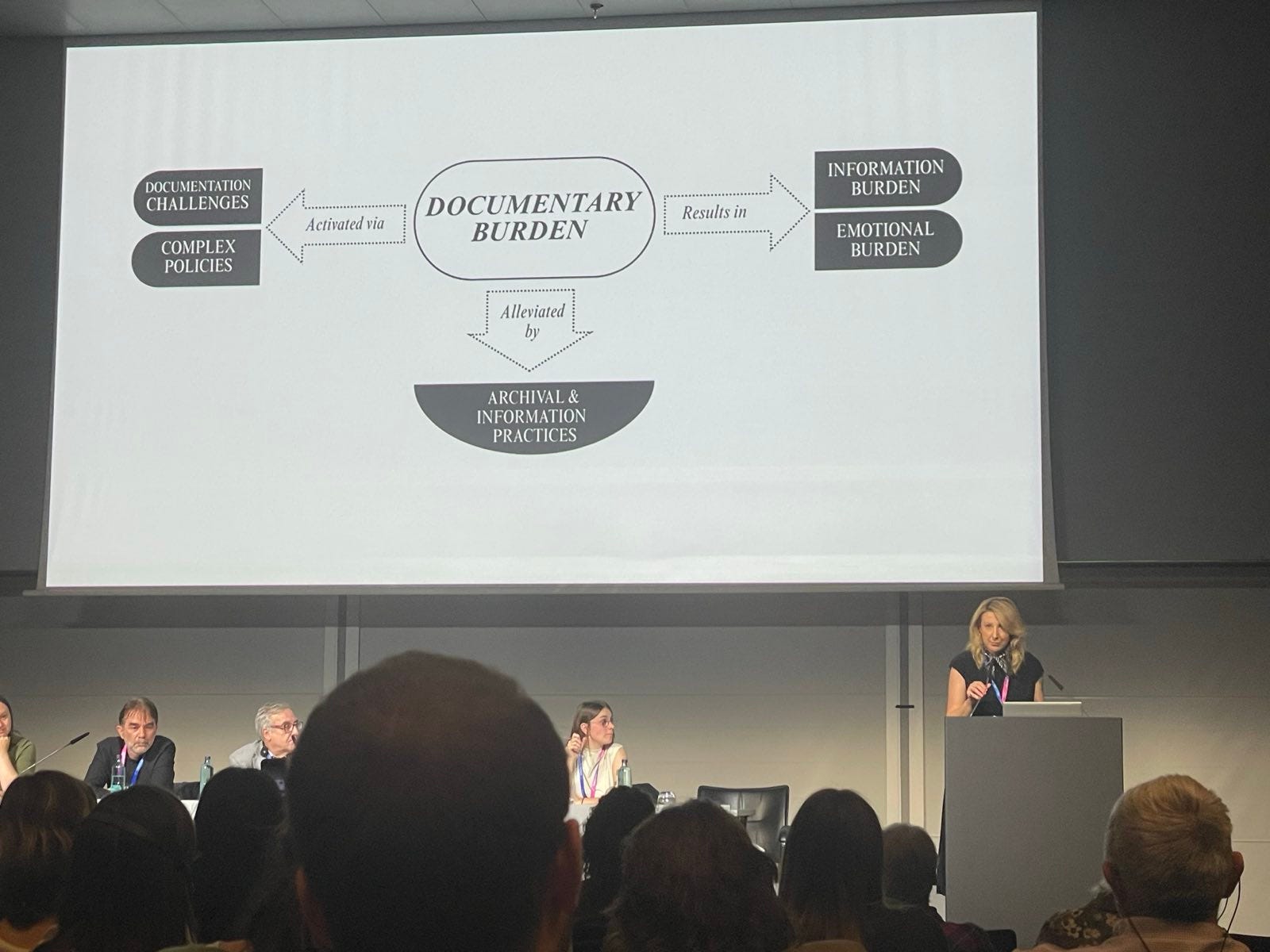
Following these talks, a representative of the UNHCR archive discussed their work - again, the themes of accountability and memory were front and centre. This presentation homed in on the “crisis of responsibility” surrounding archives like that of the UNHCR. Where donations are made in a voluntary or philanthropic capacity, archives across the world are seeing their funding sources dry up. The UNHCR archive exists, at base, to provide a voice for refugees and a window into the real-world effects of geopolitics across the last 80 years. In light of this fact, I thought it somewhat odd that Gaza, and the refugee population associated therewith, was not mentioned once in the presentation. I doubt this was malicious on the part of the presenter, but it did feel like a bit of an oversight.
The final session I attended yesterday was one I’ve been looking forward to ever since I booked my tickets. The future of archival description, according to the presenters of this session (and me!) is Records in Contexts (RiC), a bold new cataloguing system which has been in development over the last several years. This session acted as an update on the work of the Expert Group on Archival Description (EGAD), the group tasked with developing RiC, as well as a couple of use cases for the system.
I found this to be a fascinating session. The passion and interest of the presenters was clear throughout, and the admittedly complicated RiC system was laid out as clearly as possible, with signposting to further ICA resources on the topic. It seems like RiC is picking up pace, with the long-promised implementation guidelines soon to be published in website form. While the actual structure and inner workings of RiC weren’t really the subject of discussion, a quick view was given of what it might look like when applied to a database. The 2011 Romanian census, the last to be given on paper, was converted into a CSV database, which itself was then treated as a RiC “record set.” This allowed the data to be looked at in much more detail, and through more lenses than would otherwise have been possible.
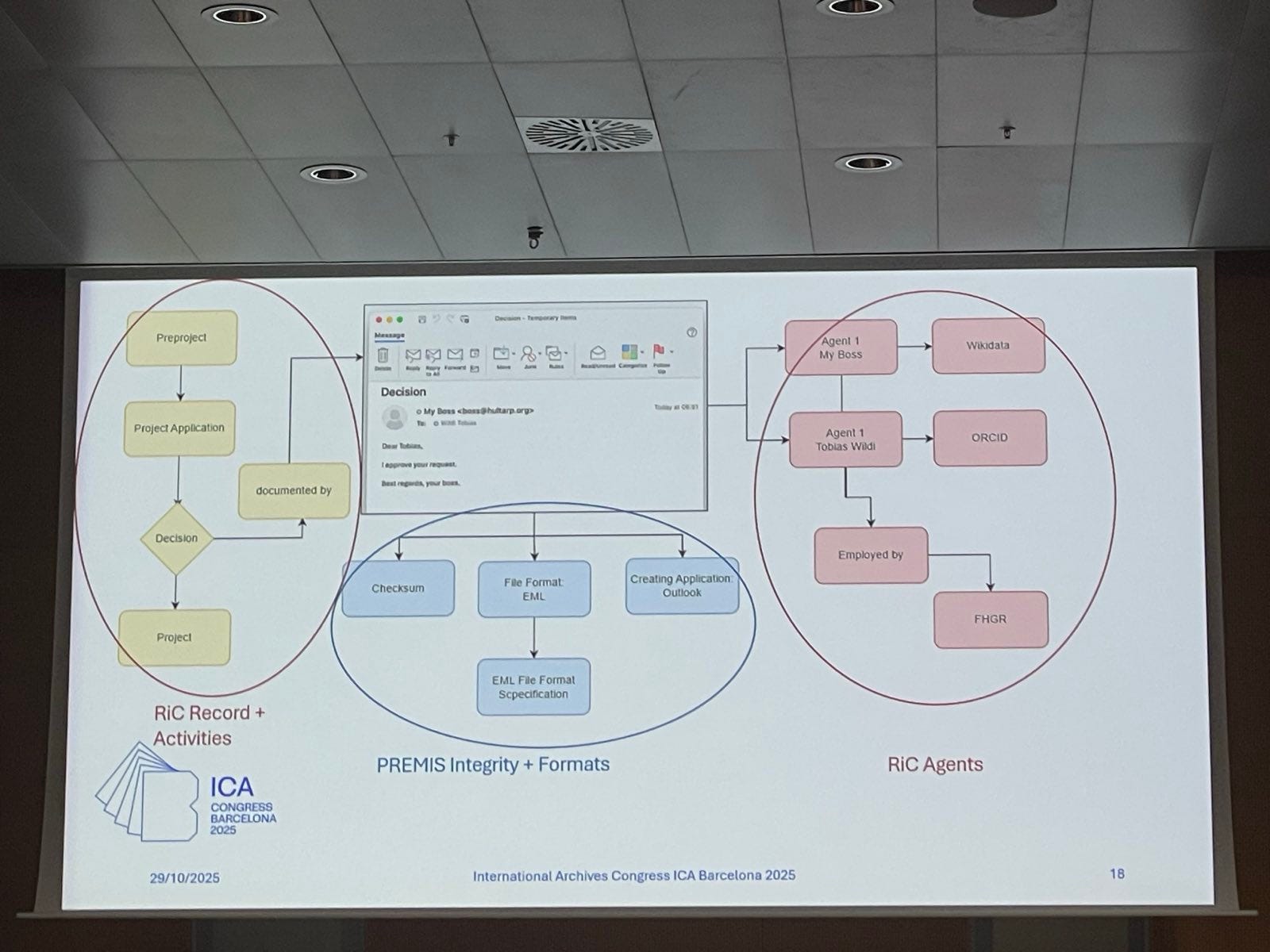
Another case study was given of the French National Archives, who implemented the RiC Ontology on a medium-sized sample of index vocabularies, place names, and personal names, in order to explore new approaches to research and archive access. The resulting “linked entity chart,” while impressive, is only a middle step - it is not yet fully user-friendly to human or machine enquiry, and only exists in a test environment. Nonetheless, this was an inspiring talk on the potential future of RiC in finding aids. The three presentations in this session, while all relatively surface-level in their discussion of RiC, provided a fascinating insight (for me, at least) into the future of archival description. If anything, however, I felt that these presentations remained too far removed from the ground-level practicalities of RiC implementation, particularly its labour-intensive, detailed structure.
As I mentioned in the introduction to this blog, today was a relatively coherent one in terms of the topics discussed, and the throughlines in each presentation. The theme of information ownership was constant, and discussed in no uncertain terms with relation to current and past colonial domination over the global South. It seems like there’s a real decolonial turn at work within the global archives field - I was particularly pleased with the position being taken on Palestine. The interplay between rapidly advancing technology, right-wing extremism across the globe, and the effects of climate change on already marginalised groups and nations was discussed in a variety of contexts, in surprisingly vivid detail. AI was discussed in several forms, but in a far more realistic tone than on day 2 - it was presented as something to understand and learn about before thinking about implementing it, rather than an inevitability that will “fix” the humanities.
Day 3 was overall a very forward-looking day. Archives were presented as something that needs to hold a central place in society as we move into the future, as well as a tool that can be used to aid in the emancipation and revalorisation of subalternised narratives. While I would have appreciated more discussion of day-to-day work in some of the archives being discussed, I can’t say that I left any of the sessions feeling dissatisfied. Check back in tomorrow for a recap of day 4, the final day of the ICA Congress 2025!
No posts
Comments
Nothing yet. Say the first thing.
Sign in to join the conversation.