
Yesterday was the second day of the ICA Congress 2025, and the first one I attended in full. It was a packed schedule, with several of those irritating timetable conflicts I mentioned yesterday. Nonetheless, I managed to find my way into a lot of interesting sessions, delivered by a wide range of people from institutions all over the world. After the first day of talks, I’m left with a real sense of pride in the archives sector, and confidence that we have what it takes to adapt with the changing times and remain in a position of importance into the future. For now though, let’s dive into some of the talks I attended, before bringing together some themes from Day 2. Although I said I’d try and keep it brief, this article ended up getting away from me somewhat!
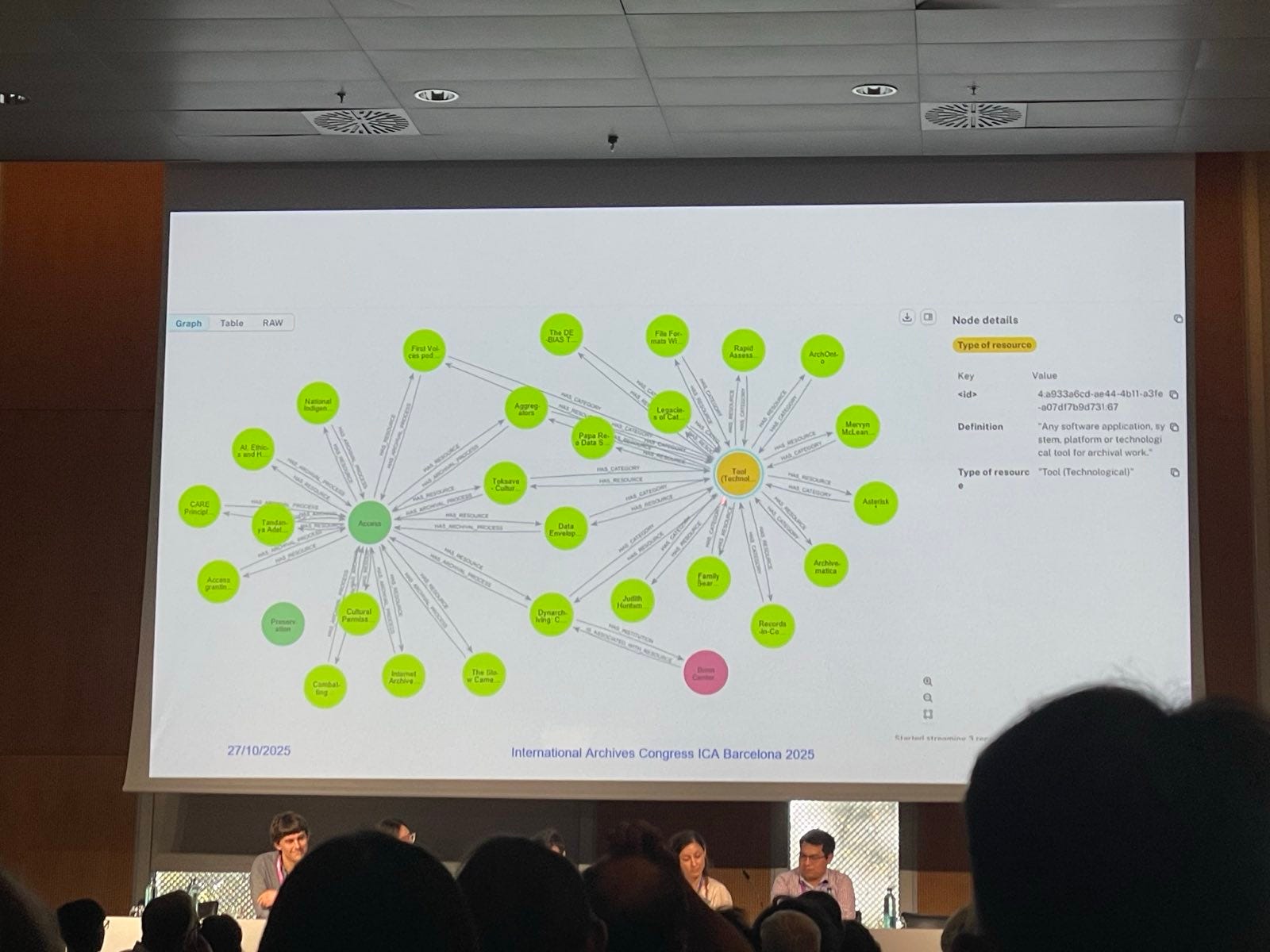
The first session I attended was hosted by the ICA’s New Professionals section, chaired by Laura Luca and Nicola Laurent (who’s featured heavily in my trauma-informed archive practice - I confess I was minorly starstruck...). The New Professional cohort is selected from a field of applicants every two years, then divided into two working groups and given six months to work on a project of their choosing. Each group presented the results of their work in this session: the first discussed their experience of creating a “resource guide to traditional and new approaches,” an ambitious attempt to create a database documenting and linking archival practices and traditions from around the world.
This project is an effort to foster international collaboration and recognition of the diversity in archival approaches from throughout our global field. The ever-present phrase “linking theory and practice” was another constant refrain throughout the presentation - while the phrase (and the concept) is almost a given at any event of this sort, it’s always a welcome presence. This project in particular showed a real willingness to engage with the realities of archive work in a variety of global contexts. These contexts included indigenous and local languages, and aimed to include indigenous management of knowledge in its database, but unfortunately (or, perhaps, expectedly?) the majority of the resources located by the group were in English.
An RDF (Resource Description Framework) methodology was chosen in order to make an accessible, dynamic, and scalable database (I must admit, it’s always a pleasure to see RDF “in the wild” - I think it’s a lovely, logical, and adaptable system.) In this sense, I’d have to say the group succeeded. New resources can easily be plugged into the framework, and connect with the existing population of the database. In light of this, the presenters made an open call for attendees to scan a QR code and alert the group to archival approaches which may have slipped through the net.
The second half of this first session discussed “Rethinking Archival Practice,” based on survey and interview data collected by the working group. Much like the first group, responses to this survey were very geographically limited, almost entirely coming from Canada, the USA, and Europe. One of the speakers addressed this directly, discussing her own work and experience in the Egyptian archives sector. Her short presentation explored the potential the global archive sector has to focus on a professionalised, global north, upper- or middle-class perspective, to the exclusion of those who do not fit this mould.
Throughout this half of the session, the archive was discussed as a “shared space of encounter,” where communities strive to make their voices heard in a sector which has excluded the non-professional perspective for so much of its history. A central focus of the presenters was on community ownership of archives, and cataloguing as a process of “co-authorship.” This sense of groundedness continued for the rest of the session: the realities of “digital resilience” were discussed in depth, as well as the need for organisations to get their archives out of the basement and into more suitable storage!
After a short coffee break, it was on to session 2, for which I attended the ICA-organised “lightning talks” - representatives from various ICA subgroups and sections were each given five minutes to discuss their work and their future aims. As this was my first Congress, I thought it would be a good idea for me to get a basic overview of the organisation and its various substructures. While most of these talks were very informative, I think the short-form nature of the lightning talks prevented a lot of the information from being presented well. Additionally, three of the advertised speakers didn’t turn up, which left Nicola Laurent (chairing again) in a bit of a bothersome spot. In the end, we managed to get by just fine.
In keeping with the “lightning” theme, let’s blitz through some of the topics covered in this session. The Expert Group on Archival Description is currently in a “maintenance phase” following the release of Records in Contexts 1.0, with guidelines on implementation soon to be published. The Section on Research Institutions and University Archives advertised themselves as a platform for sharing, outreach, and support in the field of university research. The Section on Archives and Human Rights discussed their frequent publications, meetings, press releases and engagement with the UN, as well as the work of Arxivers sense Fronteres (Archivists without Borders). The Caribbean Regional Branch discussed their ongoing work to build regional cooperation and resiliency networks across the Caribbean, particularly given the increased risk to cultural heritage from extreme weather caused by climate change. Finally, the Expert Group on Indigenous Matters discussed the importance of incorporating Indigenous theory and worldviews into our approaches to archives.
There was a friendly and casual atmosphere throughout this session, and it was clear that the presenters were all pretty familiar with one another, which helped make the session very welcoming to those attendees who weren’t as familiar with the organisation. Leaving the room (20 minutes ahead of schedule) I felt much more confident in my understanding of the Congress and how the ICA interacts with archivists across the globe.
After another short break, a horde of archivists and information professionals trooped through a large underground corridor to the conference centre’s auditorium for the Congress’ opening ceremony. Seating over 3000, the lower levels were completely filled by the Congress attendees. It took a while for us all to file in, so the ceremony ended up beginning almost 15 minutes behind schedule - not all that bad, considering the scale of the event.
The President of the ICA gave a very good speech, calling on archivists to cooperate, to secure the future through diligent preservation, and to ensure the continuation of democracy. This was followed by the mayor of Barcelona, the local minister of culture, and the Secretary of State for Culture, all of whom gave speeches on the importance of archives for preserving cultural heritage, the archival history of Barcelona and Catalonia, and once again the idea of archives as central to democracy and collective memory. These speeches were relatively run-of-the-mill, I thought, but this kind of opening speech from politicians or local authority figures tends to be not all that groundbreaking.
Following these introductory remarks, the keynote began. Its theme was “AI-Ready Archives,” delivered by a researcher at the Barcelona Supercomputing Centre. The presentation began with a general overview of AI, and how various forms can be used for different purposes. One example given was that of “Specalised Foundation Models,” which can be used for scientific discovery - Alphafold, a SFM for protein analysis, was based on a 1970s databank of protein folding, using it to predict protein structures. The presenter went on to discuss the capabilities of AI in the humanities, particularly the use of Large Language Models for text analysis, but cautioned that such implementation should be done rationally and at a slow pace. The rapid introduction of AI, she mentioned, could lead to an overemphasis of perceived “empiricism,” a value which the archives field has been striving to move away from for some time now.
Despite all this, the central point of the keynote was that we, as archivists, have something of a duty to make data and archives “AI-ready” through continuous stewardship and improvement. This was the part of the presentation I found myself disagreeing with - it’s all very well to urge caution regarding the implementation of AI, but that point seems somewhat nullified if immediately followed by a call-to-arms about AI-compatible data stewardship.
After this relatively uninspiring keynote, and a slightly more inspiring buffet lunch, it was time for the first CoLab of the Congress. Again, one of the presenters didn’t turn up, so there was plenty of discussion time. The first presentation was given by two students from the Pontifical Catholic University of Peru (PUCP), focusing on the representation of women in the university’s collection of poet’s and artists’ records.
This talk focused on the ways in which women’s voices can often become subordinate to those of men, even within the archive. The fonds of several women poets, for example, were kept in a basement in a remote part of the archive building, leading some researchers to refer to it as the “hidden collection.” Here, the lack of visibility of women’s voices becomes quite literal - it’s difficult to access them, they’re stored in ways which prioritise their fathers, husbands, brothers and so on, and there’s only a limited amount of resources allocated to catalogue them properly.
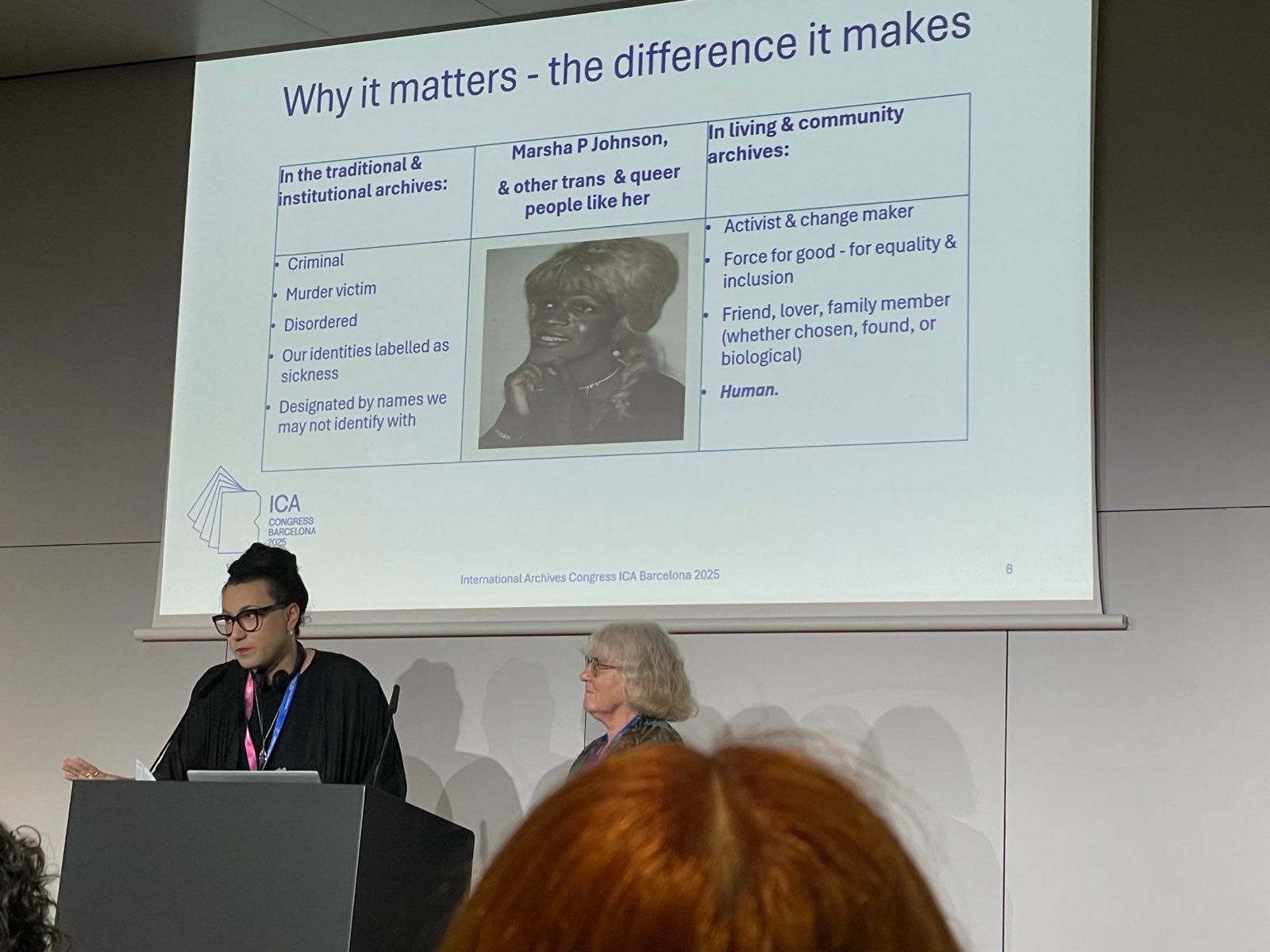
The second presentation discussed the cabaret as a sort of “living archive,” where both the audience and the performer act as “observer-participants” in creating the record of the event. The definition of the archive was expanded in a radical way, incorporating aspects such as the performance, the oral tradition, and the spectacle. The earlier theme of community preservation through archives was continued here, emphasised by discussion of queer figures whose records had been suppressed, altered, or misrepresented by carceral institutions such as the state, the psychiatric system, or the police.
Here, the theme of authentic representation was discussed in depth. Institutions, although they often have the resources to ensure long-term preservation, are often likely to look down on (and be part of the oppression of) marginalised groups. The example given in the presentation was that of transgender people, who are often medicalised or criminalised in the body of records associated with them. Frequently, trans people are referred to with names or terminology which they don’t claim for themselves. As well as creating an inaccurate and misleading archival record, this kind of practice perpetuates the oppression a trans person faces, often long after their death. This section of the presentation was, for me, deeply moving, and I was glad to see the presenters include it in such an honest and up-front way.
The first day of presentations left me with a lot of thoughts buzzing around my brain. I think the throughlines of the day’s presentations have come through pretty clearly in this blog - the archive was presented as a locus of community memory, where identity and cultural practices can be preserved, but also remain living. The space within and around an archival collection is ever-shifting, and must be the subject of constant watchfulness and development on the part of the archivist. Throughout the day, presenters emphasised the subjective nature of the archive, and how bias and prejudice will always manifest themselves (as I’ve returned to time and again in previous blogs.)
One thing I haven’t covered all that much in this blog is the prevalence of AI as a throughline. I didn’t end up going to any of the AI talks apart from the keynote, as I was far more interested in the other material on offer, but I think it’s important to note the extent to which AI is becoming integrated in the archives landscape. I think it’s part of a drive for increasing efficiency and greater output on the part of archivists and their parent organisations, as well as our desire to seem just as “high-tech” as any other sector. However, I can’t help feeling like this is at odds with all of the other throughlines which seem so important at this year’s Congress.
If we, as archivists, become satisfied with allowing AI to be implemented in every aspect of our work, I think we’ll all find ourselves out of a job pretty soon. That said, I think we shouldn’t be so hasty as to dismiss AI wholeheartedly. I think some forms of AI could be helpful, particularly for finding connections between records and series as we slowly move towards a RiC-enabled archivescape. I think this is something which will have to come with time, though - we’re still a way away from widespread RiC adoption...
Anyway, if you’ve read this far, thanks for making it through! Day 2 was something of a whistle-stop tour through present-day archives thinking, and it’s left me wanting a lot more tomorrow. Check back in this time tomorrow for another summary of Day 3!
No posts
Comments
Nothing yet. Say the first thing.
Sign in to join the conversation.