
Welcome to another edition of ‘Hiraeth’ from me, Nathen Amin.
Hiraeth is a Welsh word that means a longing for the past, for places, people and a time we can no longer reach. In this regular newsletter, I try my best to explore that past. If you’d like to learn more, please consider subscribing to get all posts, videos, talks, reviews and more directly to your inbox - and best of all - it’s FREE!
I recently paid a visit to the beautiful Suffolk town of Bury St Edmunds, or as it used to be called, St Edmundsbury. It’s a quaint place teeming with history, filled with timber framed buildings cloistered around grand Georgian squares and nestled in between a series of villages boasting impressive thatched roof cottages.
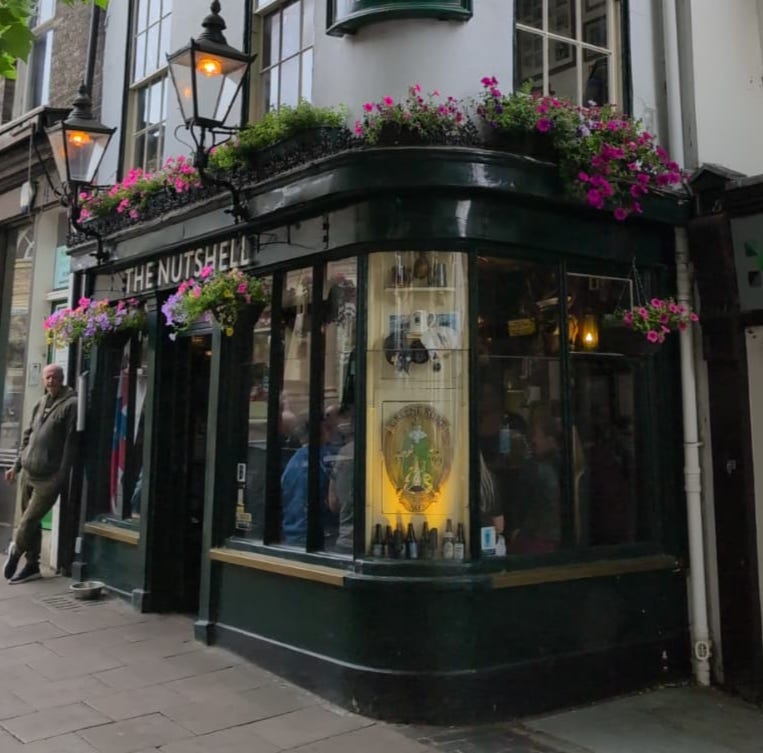
Known locally as Bury, the town boasts an impressive ancient heritage and a thriving modern food, drink and shopping scene. Be sure to check out The Nutshell, reputedly Britain’s smallest pub and which only a handful of people can fit inside at any one time.
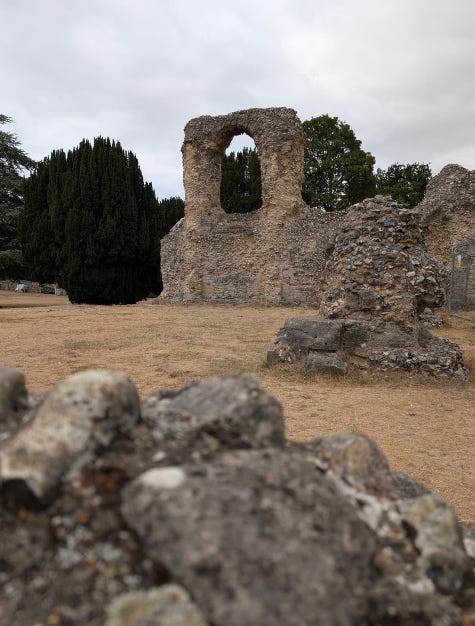
Bury’s historical legacy ranks up there with any town or city in England. In the centre of town lies the ruined Benedictine abbey which once ranked as one of England’s wealthiest monasteries. It’s fame lied in being the burial place of the Anglo-Saxon king of the East Angles, Edmund the Martyr, from whom the town derives its name.
As perhaps to be expected, the monastery boasted an impressive royal pedigree. In November 1214, England’s barons met in the abbey under the oversight of Stephen Langton, Archbishop of Canterbury, to work out how to solve a tyrannical problem like King John. The resulting summit led to the preparation of what would become Magna Carta.
At just over 500 feet long, the monastery was reputedly the fourth longest in the Christian world, with only Winchester longer in England. Its wealth was resented by the struggling community around it, leading to the abbey being besieged during a riot in 1327. Several monks were killed leading to the formidable Queen Isabella herself having to relive the abbey. It was again attacked during the Peasants’ Revolt in 1381.
In 1431, Henry VI stayed in the abbey for Christmas, while in 1447 great controversy arose when the king’s uncle Humphrey, Duke of Gloucester, died in mysterious and questionable circumstances three days after his arrest for treason. Many believed he had been murdered.
Though the church underwent further work during the reign of Henry VII at the beginning of the sixteenth century, like many around the kingdom, it did not escape the attentions of Henry VIII’s commissioners during the Reformation. It was dissolved in 1539, stripped of anything that could be reused like stonework and lead, and gradually demolished.
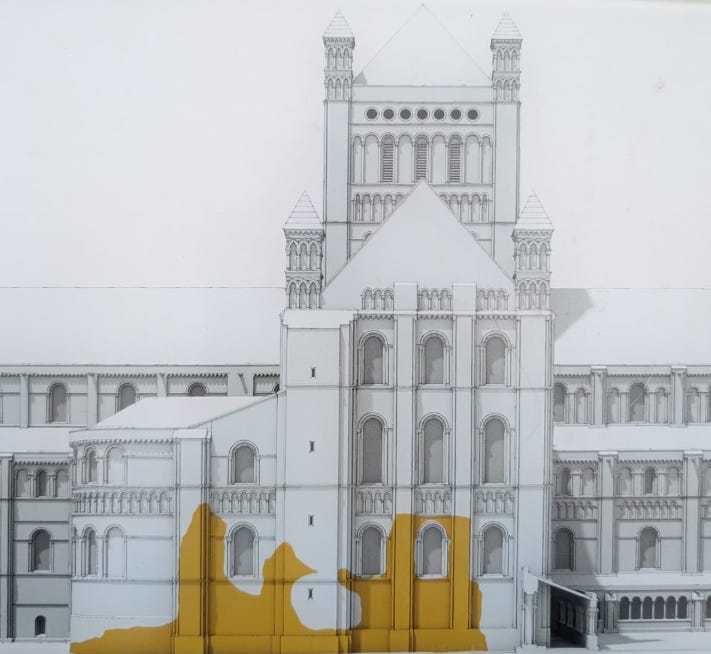
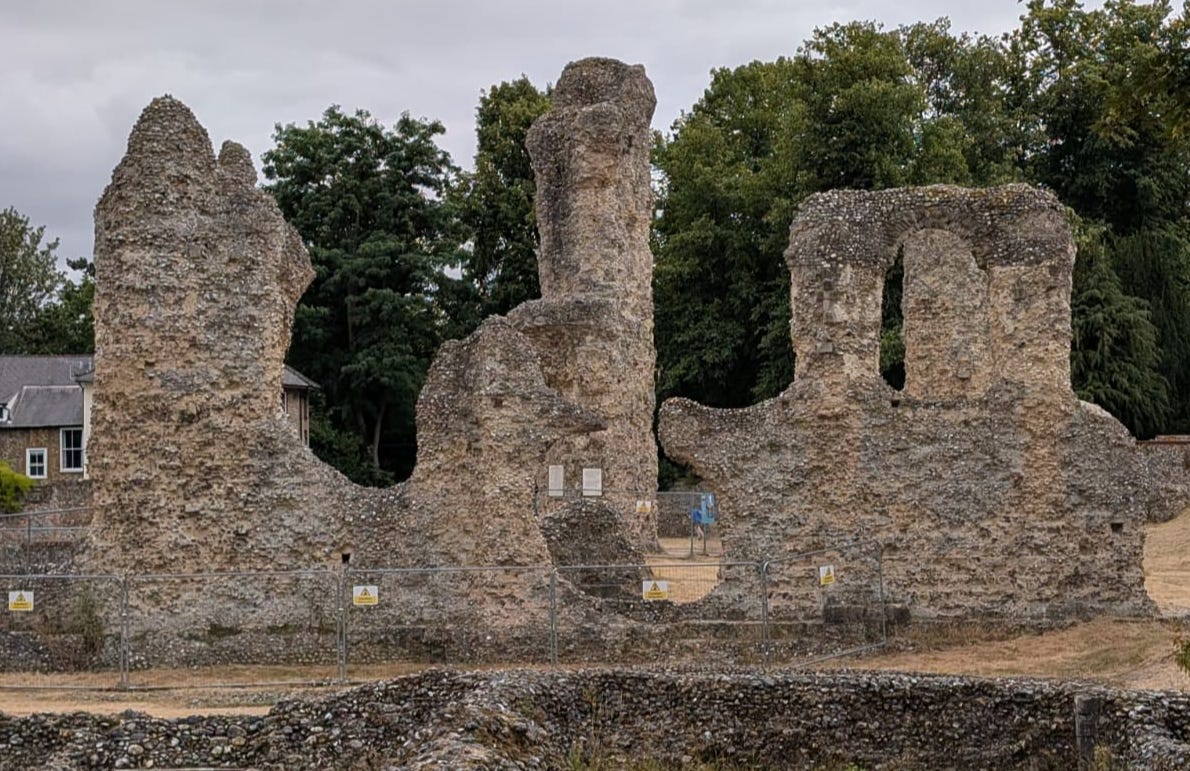
In the same year as its destruction, the antiquarian John Leland paid a visit, reporting that he had not seen a monastery more noble than this one, considering its ‘largeness or unparalleled magnificence…’so many gates it has, so many towers, and a church, than which nothing can be more magnificent’.
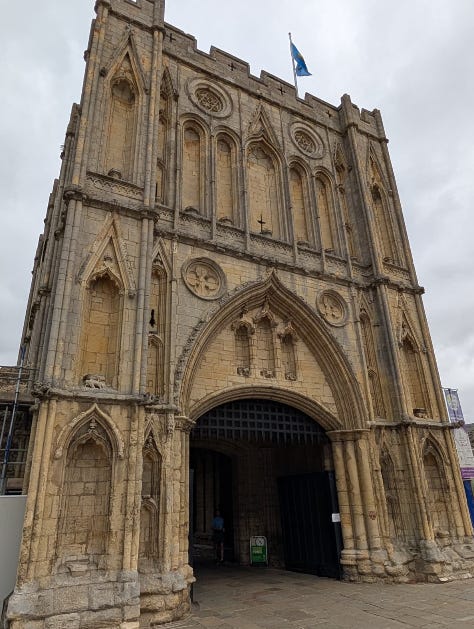
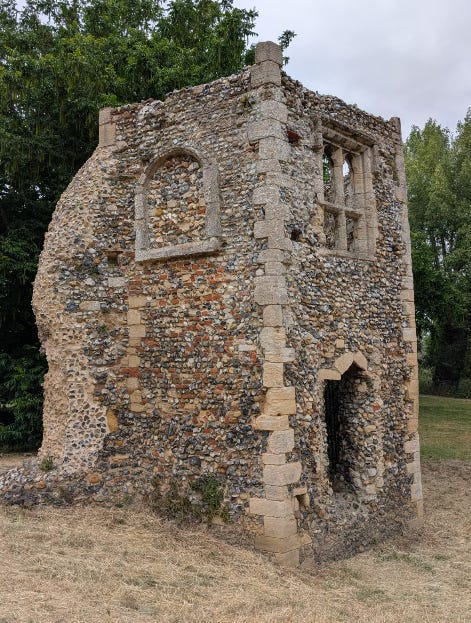
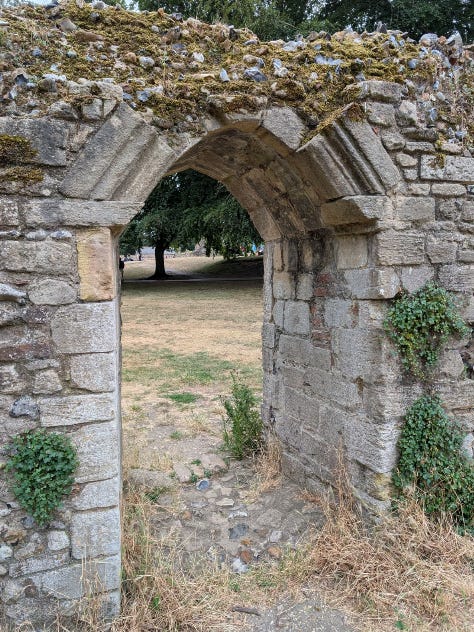
Today, aside from two gatehouses, the 12th century Norman Gate and the striking 14th century Abbey Gate, and a hexagonal tower that once formed part of the abbot’s palace, very little remains of the abbey outside a collection of flint and rubble remains. My favourite fact about the abbey was that there were three breweries within the complex as each monk was allowed eight pints a day. Pass me a Habit and sign me up!
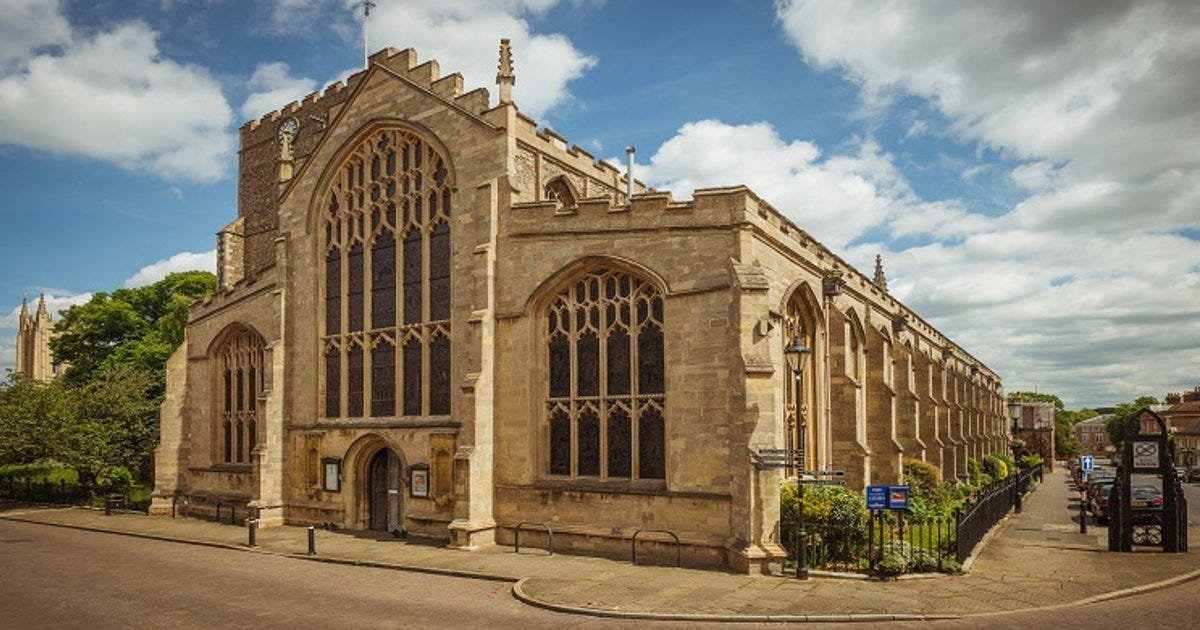
Nearby meanwhile, and within the abbey complex, stands St Mary’s Church, which was originally built around 1125 but then rebuilt between 1425 and 1435. It would have been a building site, then, as the coffin of my favourite medieval figure was brought into the church for burial in January 1427.
People often assume that Henry VII is the fifteenth century figure I am most fond of, but the truth is the man I admire the most is his distant relation, THOMAS BEAUFORT. Why Thomas, you may ask? (at least, I hope you’re asking, or you’re going to find the next part BORING).
The fifteenth century was one of the most tumultuous of periods in English history, starting with the usurpation of Henry IV in 1399, the back-end of the Hundred Years’ War which brought the highs of Henry V’s victories and the lows of England’s eventual capitulation across the Channel, and of course, culminating in the bitter dynastic conflict between the houses of York and Lancaster, the death of Richard III, disappearance of the Princes in the Tower, and the dawn of the Tudors.
During that period, plenty of figures rose to the fore, their names still etched on our public consciousness, thanks in large part to a certain William Shakespeare, who harvested the 15th century for some of his most inspired work. Henry’s IV, V, VI and VII, Richard of York and his troublesome sons Edward IV, George of Clarence, and Richard III, overmighty subjects like Cardinal Beaufort, Humphrey of Gloucester, Warwick the Kingmaker all feature heavily in the Bard’s works.
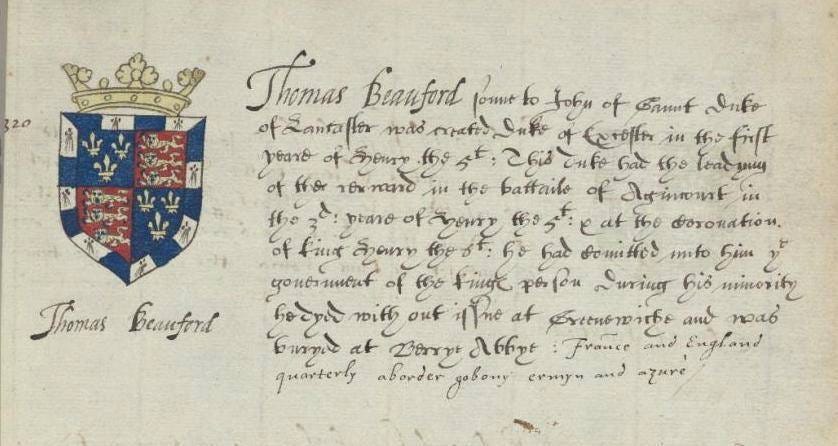
It is Thomas Beaufort, however, that I feel has long been overlooked, so allow me use this opportunity to introduce you to him.
Thomas was the youngest male of the first generation of Beauforts, the initially illegitimate children of John of Gaunt and Katherine Swynford. Whilst his elder brothers became an earl and a bishop respectively, the bar was set lower for Thomas who took up the sword to make his name. He was a younger son - he had to work to make his fortune.
Thomas excelled in this field, learning his craft during the Welsh revolt of the early 1400s, alongside his nephew Prince Henry, who was just eight years younger than him. In 1403, he was appointed Admiral of the Fleet, his remit extended in 1409 to cover all the ports cover all the ports of Ireland, Aquitaine and Picardy. In 1410, he even was briefly selected to fill the position of Chancellor, the first non-titled nobleman to fill the post in over 30 years and the first non-churchman in two decades. I mean, this was some guy.
In 1412, Thomas’s half-brother Henry IV declared war on France and he was selected as one of the leading commanders. Before disembarking, he was created Earl of Dorset. When his nephew became king the following year, rising to the throne as Henry V, Thomas further established his military reputation when he was personally tasked with holding the strategic gains of Harfleur and Rouen.
It was Thomas who was able to provide the foundations for Henry V to push on towards immortality – during one tough moment when it seemed like Thomas would be forced to submit to a French army, it was reported by later historians he snapped ‘tell your master that Englishmen do not surrender!’ For ‘his service to the king and the realm on both sides of the seas’, Thomas was raised to the dukedom of Exeter, the only duke in England who was not one of the king’s brothers.
In 1420, Thomas was by his nephew’s side when Henry V married Katherine de Valois in Troyes Cathedral, securing a remarkable deal that the English king would become the next King of France. This had been the reason he had given years of sweat, blood and tears across the Channel. With Paris captured, it was Thomas who was appointed the city’s governor and given the delegate task of guarding the elderly and ill king of France, Charles VI.
Sadly for Thomas, his nephew’s dream of uniting the crowns of France and England was not realised, Henry V dying in August 1422 just outside Paris. Summoning the an he called ‘his very dear uncle’, to his side, he had one last mission for Thomas - to return home and become the guardian of the king’s 9-month-old heir, now Henry VI. The conscientious duke was moral, devout and courageous, every inch an upstanding product of the House of Lancaster and it was clearly anticipated he would serve as an ideal father-figure and mentor to the young king.
The historical record shows Thomas was brave in war, pious by nature, and loyal to his core. Above all, and the reason I feel he stands out over other knights of similar accomplishments, was the fact it is known he was generous to those less fortunate. The chronicler William Worcester wrote of Exeter:
‘every day he had 13 poor people and each of them was served with a first course and a second course of food with two loaves of bread, one of white and one of Chete-lof and each of them had three pence a day…He himself paid the cooks’ fee and ordered 26 gallons of pottage for the poor to eat, sometimes 300, 200 or 100 of them each day he fed, and everyday with wine’.
The duke went even further; on the eve of St Mary, each poor almswoman was given a set of bedclothes, a mattress, a pair of blankets and a pillow, whilst every woman lying in childbirth was provided with food and wine every day. On Maundy Thursday, Thomas always washed the feet of the poor, giving to each person a robe and as many pence as their years, sometimes even giving his cloak, doublet, belt and money purse. He did not abide swearers or liars in his company, and if anyone he had served with in France had fallen on hard times, he would provide food, fuel and candles. He sounds like he would have been a decent friend!
A scholar, soldier and statesman, regarded as ‘the wise and well-learned counsellor’ to three successive Lancastrian kings, Thomas Beaufort was unquestionably one of the last great knights of the Late Middle Ages. He had been a remarkable man and had lived an extraordinary life. After his death at East Greenwich in 1426, his loss was not only keenly felt by the remaining Beauforts, but also by his fellow Englishmen.
Despite requesting a lowkey funeral, Thomas was nevertheless given a state funeral in St Paul’s Cathedral, and deservedly so. In his will, he had also requested:
‘My body to be buried with Margaret, my wife, in the Chapel of the Blessed Virgin annexed to the Church of St Edmund’s Bury, in the Diocese of Norwich’.
Margaret had predeceased Thomas by a decade and the pair had no children. His will was honoured. With all pomp, the cortege took Thomas’s body through the streets up to Bury St Edmunds where he was presumably interred in St Mary’s.
In his will, he had also left instructions for a tomb to be erected over his grave, for which he provided £100. If the tomb was created, then no trace remains. Perhaps it was destroyed in the aftermath of the adjacent monastery’s dissolution.
On 7 February 1772, however, his grave was apparently rediscovered when several labourers uncovered a heavy, oak-coffered coffin which contained a cloth-covered body that was perfectly preserved. A local surgeon said the body was sturdy, about six-feet tall with greying brown hair. The remains were eventually reinterred near to where they had been found, although gruesomely minus a hand which was kept by the Royal College of Surgeons. The hand later went missing and its fate is unknown. If you happen to be in possession of Thomas’s hand, please let me know!
In St Mary’s, meanwhile, are also the remains of Thomas’s great-great-great-niece, Mary Tudor, Princess of England who as wife of Louis XII became the brief queen consort of France. Mary was the daughter of Henry VII and was described during her lifetime as a ‘handsome and well favoured…a paradise’ even.
After her first husband’s death, Mary married, in controversial fashion, Charles Brandon, who might not have been regarded a suitable suitor for a king’s daughter and sister. Nonetheless, her brother Henry VIII forgave the rash couple after his initial temper tantrum at their presumtiveness, and courtesy of her husband’s recent ennoblement Mary lived out the remainder of her life as Duchess of Suffolk.
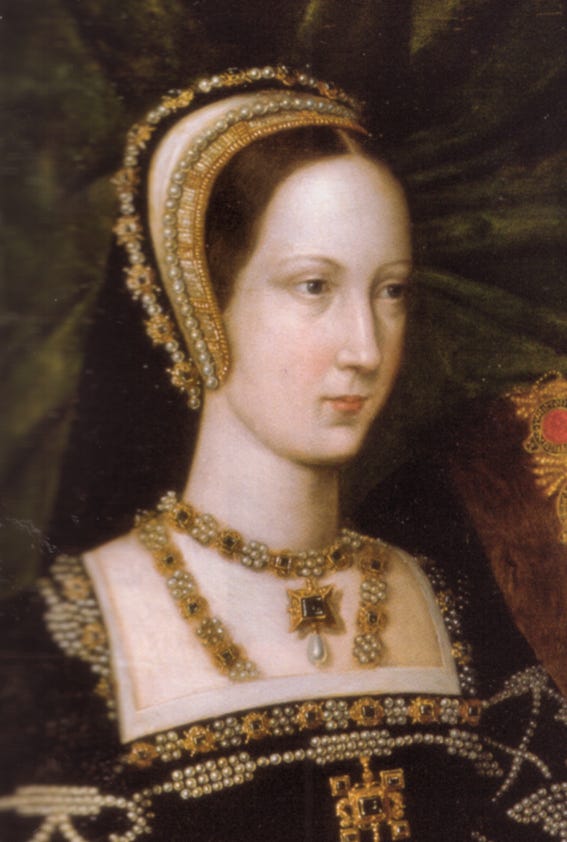
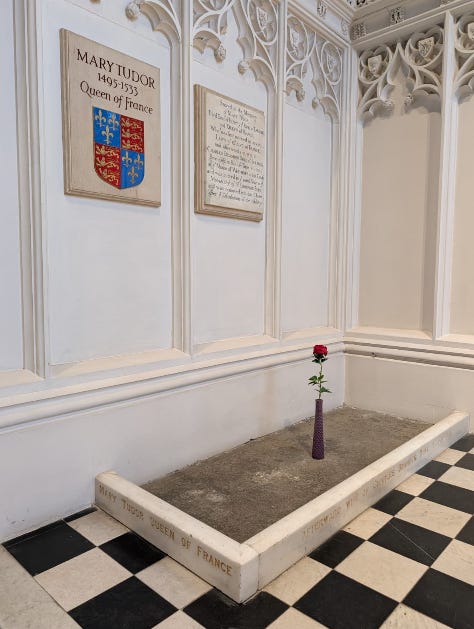
Mary died aged thirty-seven in June 1533, and after a suitable time lying in state, this former queen was brought to the abbey for burial. Five years later, after the dissolution, her remains and the box tomb were moved into St Mary’s Church. Disturbingly, in 1784, Mary’s grave was opened, her lead coffin removed, and locks of her hair taken.
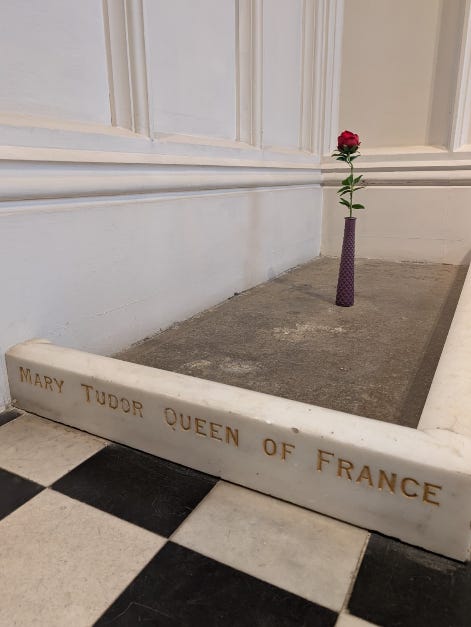
She was reburied under a simple slab near the altar. When Edward VII visited in 1904 he ordered a marble kerb to be placed around the slab. For someone who was daughter, sister and wife of kings, a princess and queen in her own right, it is surprisingly modest resting place.
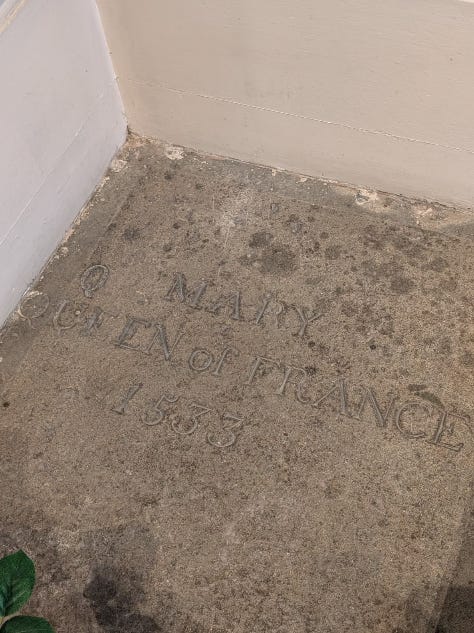
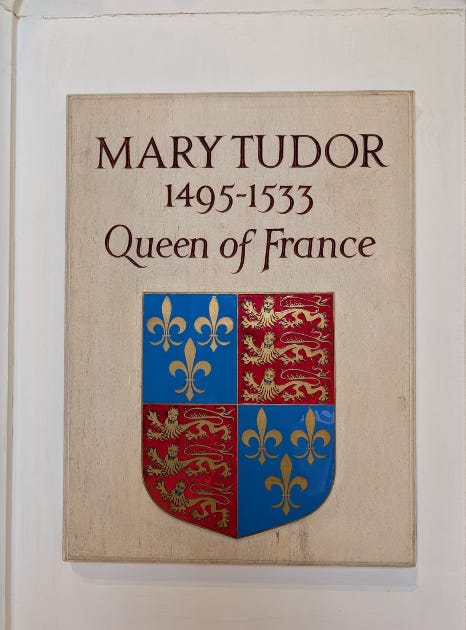
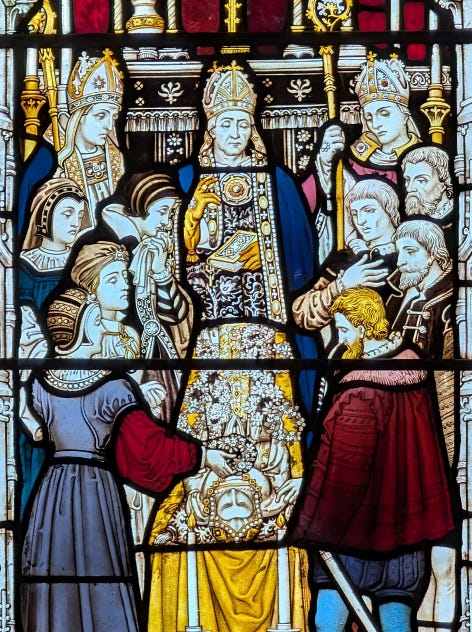
Mary wasn’t forgotten, however. A 1881 window was presented to the church by Queen Victoria in which the Tudor queen’s life was commemorated. Different panels depict events like her marriage and her period as queen, as well as her funeral in St Mary’s.
Comments
Nothing yet. Say the first thing.
Sign in to join the conversation.