
Welcome to another edition of ‘Hiraeth’ from me, Nathen Amin.
Hiraeth is a Welsh word that means a longing for the past, for places, people and a time we can no longer reach. In this regular newsletter, I try my best to explore that past. If you’d like to learn more, please consider subscribing to get all posts, videos, talks, reviews and more directly to your inbox - and best of all - it’s FREE!
On 1 August 1485, Henry Tudor and his disparate army that featured French mercenaries, Yorkist rebels and a handful of Lancastrian veterans boarded the ships that bobbed on the Seine in Harfleur harbour, then set sail.
They probably numbered around 4-5,000 men and their destination was Wales, where it was anticipated (correctly as it turned out), that there would be a groundswell of support for Tudor. It was for this reason Henry raised a new battle standard featuring the Welsh Dragon that fluttered high above the deck.
We can never know for certain the atmosphere on the vessels as Henry and the soldiers stepped towards either immortality or death. According to the account of Bernard André, Henry as commander-in-chief chose this moment to issue a rousing speech.
What follows is likely to have stemmed from the imagination of André, a partially-blind Augustinian friar, royal tutor and French poet who wrote these words fifteen years later at Henry’s insistence. But we have to consider that aside from André having access to Henry’s memories and speaking to many veterans of the Bosworth campaign, he could even have been present himself. It’s certainly embellished and features some odd refences to antiquity that clearly were not uttered, but it perhaps captures the spirit of the moment.
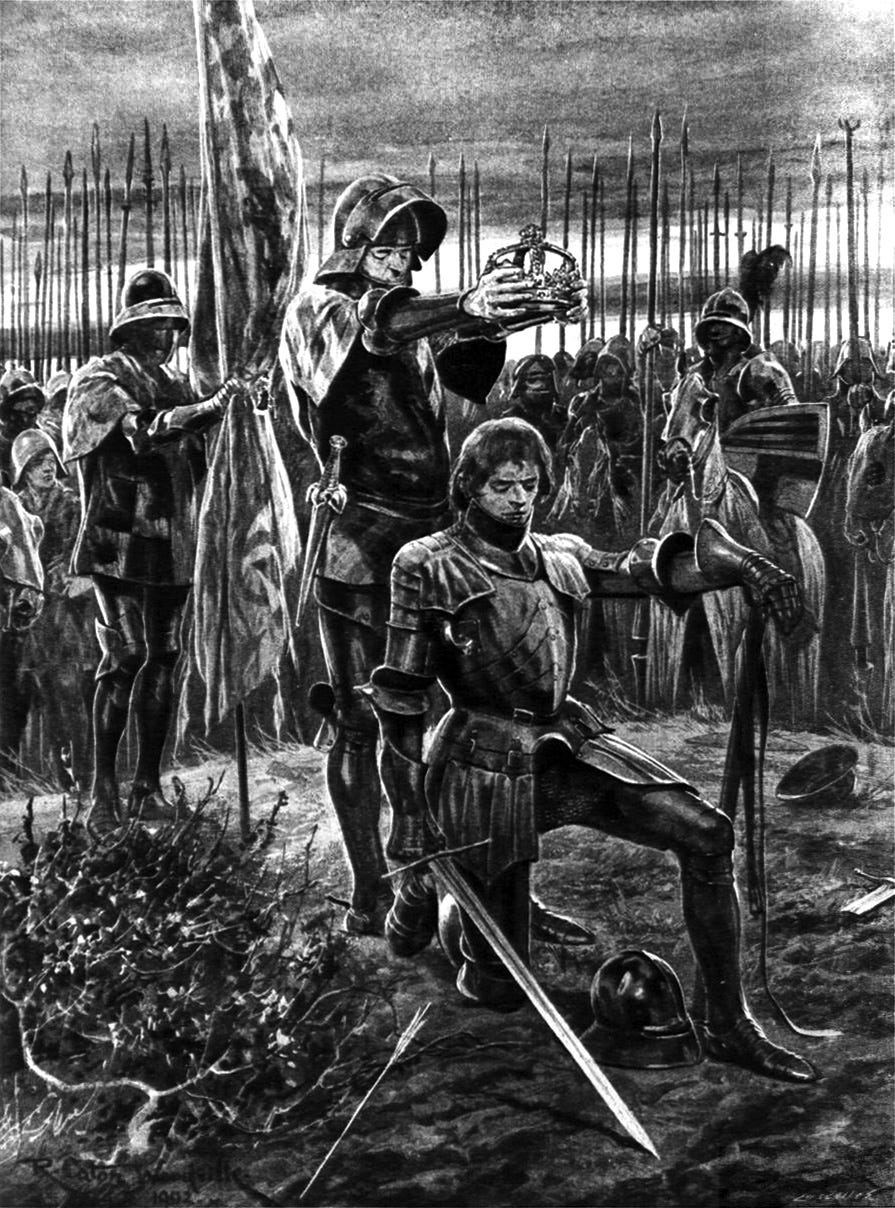
What follows is the translated speech André recorded for Henry. Whether it was actually spoken can be questioned, but for Henry to hold together a brittle and chiefly-bought alliance for a one-week sea journey and then two-week march through challenging terrain to face down the mighty King of England’s army suggests several inspirational speeches must have been given throughout the campaign to keep the wheels on the track
“On this day, O most merciful God, I shall embark according to your command. As you are my best witness, I make this journey not for greed, ambition, or certainly any desire to spill human blood. I go rather as one aggrieved at the long and wretched captivity of the kingdom of England and her people.
You know, O God most excellent, that cruel men so raged against my family that little remains of them, for they destroyed them all by the sword or by proscription. There is left to me only my dear mother, who has suffered great sorrows on my account, sorrows of long endurance.
Therefore, O righteous judge, you shall grant me the power if I am deserving. But if the right of the kingdom is not due me, then I humbly pray you to counsel us for the better and guide us from this day, that we may not depart from your will.
And you too, my valiant fellow soldiers who have lived in exile these many years, distant from your wives, your children, your own country, and your parents. If it should please God to allow us to return to what is rightfully ours, then take heart and take your place beside me in England with hearts renewed and pure. You see that the tyrant has defiled everything with blood.
He butchered the duke of Buckingham, once dearest to him, and many other innocent people, even heroes of the kingdom, and he murdered his own nephews. The bloodthirsty king also longs to destroy us in like manner - we who were passed over by the will of God - and in truth he would have done so already had not God drawn us back from the journey that we began not long ago.
But now the time draws near when God, the righteous judge, will punish his crimes by our hands. Be strong therefore in this battle, and keep God ever before your eyes.
In truth, it grieves me exceedingly that, contrary to my nature, we must prove our cause in cruel battle. But it is better to obey God’s bidding than to pass the rest of our lives among foreign peoples. And although we embark with only a small band and go to a region that is full of inhabitants and mighty in battle, if we place our hope firmly in God surely the few may conquer the many.
While Moses held his hands aloft to heaven, the Amalekites were defeated, but when his hands fell his opponents prevailed. It would be tedious to recount how many leaders, kings, emperors, and large armies were overcome by small bands united together.
Besides Xerxes, Darius, Croesus, and many other kings, so too Spartan, Theban, Athenian, Carthaginian, and Roman leaders were defeated by small armies. Victory comes not from the number of warriors but from the hand of God.
This occasion, though, does not call for long speeches. For I can see that your valor has been fully roused for the fight. I shall add just one more point and then be finished. You whose duty it is to serve as God’s ministers, all you priests and clergy of God, I earnestly entreat you to pour out unceasing prayers to God, until by His mercy they may be heard, and we may recompense all with rewards worthy of their labor”
What do you think? Would you have gone into battle after such a speech, or would you likely have got your phone out to google who the hell Xerxes was?
August 1485 represented the Dawn of the Tudor Period, while August 2026 sees the paperback release of my book ‘Son of Prophecy: The Rise of Henry Tudor’.
This is a non-fiction book I spent more than a decade composing, and tells the entire origin story of the Tudor Dynasty paying close attention to how Henry Tudor was able to steal the English crown away from the Plantagenets.
It is released on 15 August in the UK and you can order now from wherever you get your books.
For those from overseas, Blackwell Books ships worldwide for free.

Comments
Nothing yet. Say the first thing.
Sign in to join the conversation.