
Slavery doesn’t happen by accident. It takes years to systematize it, to make it efficient, to strategically invest capital into it, to insure it, and to scale it. For slavery to work, people must turn a blind eye to injustice and regularly violate human rights and dignity. Slavery was a business. Slaves were traded at markets. Slavery produced a labor force. Slaves* helped Europeans get rich by farming sugar cane in the Caribbean, including St. John, which is now a part of the United States Virgin Islands.
Quick Refresh for my non-USVI readers: Before St. Thomas, St. Croix, and St. John became a territory of the United States in 1917, it was a part of the Danish West Indes. You can find that history here.
I recently learned about the history of the Annaberg Plantation in the Virgin Islands. It is now a part of the U.S. National Park on St. John, and I visited the plantation on my day off, Monday, 2/16/26. Through technology, readers can get a virtual tour of the plantation.
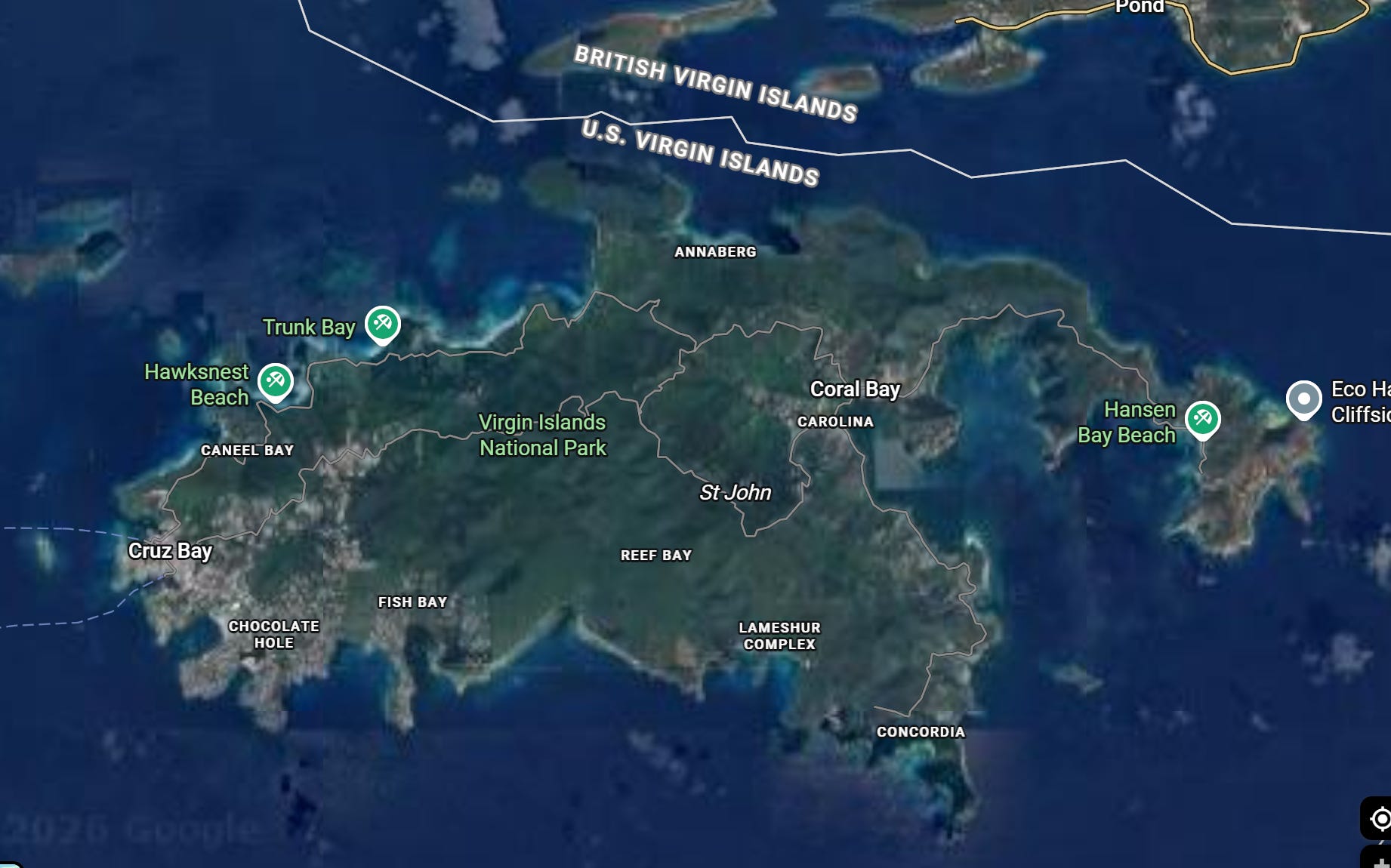
Annaberg Plantation is located at the top-center part of this map of St. John.
Here are a few Key points:
Annaberg Plantation became the largest sugar-producing operation in St. John’s history.
Several smaller farms and plantations were combined by James E. Murphy and in 1796, Murphy bought Waterlemon Bay and renamed it Leinster Bay, to honor his Irish ancestry. More history here.
At one point, Murphy amassed 1,245 contiguous acres, of which 494 were used for sugar cane farming, with the largest labor force of any single operation: 591 enslaved workers.
Here are some key questions I’m wrestling with after my visit:
Do we fault Mr. Murphy for making money the way he did?
Does the generational wealth that was produced by the exploitation of enslaved Africans matter to us today?
How does the colonial mindset of wealth extraction show up in our 21st-century world?
What lessons can be learned from history, particularly as Christians, so that business practices reflect the ideal of the human dignity of all people? As Americans, do we believe in the “inalienable rights” of people to pursue life, liberty, and happiness in our day?
These are not easy questions. I won’t attempt to offer easy answers. But I think it’s important to tell the stories of history in ways that help us lead better lives. I believe our consciences should be formed by the Holy Spirit, who leads us toward the truth.
"And you shall know the truth, and the truth shall make you free." (John 8:32)
*I have deliberately used the more direct form of referring to “enslaved people” for impact.
Comments
Nothing yet. Say the first thing.
Sign in to join the conversation.