
How I Know Myself is my series where I sit down with different people to explore their journey of self-discovery. Sometimes funny, often moving, and always honest, these conversations remind us that knowing yourself isn't a destination but a practice of learning to tune in, show up, and gradually become more of who you really are.
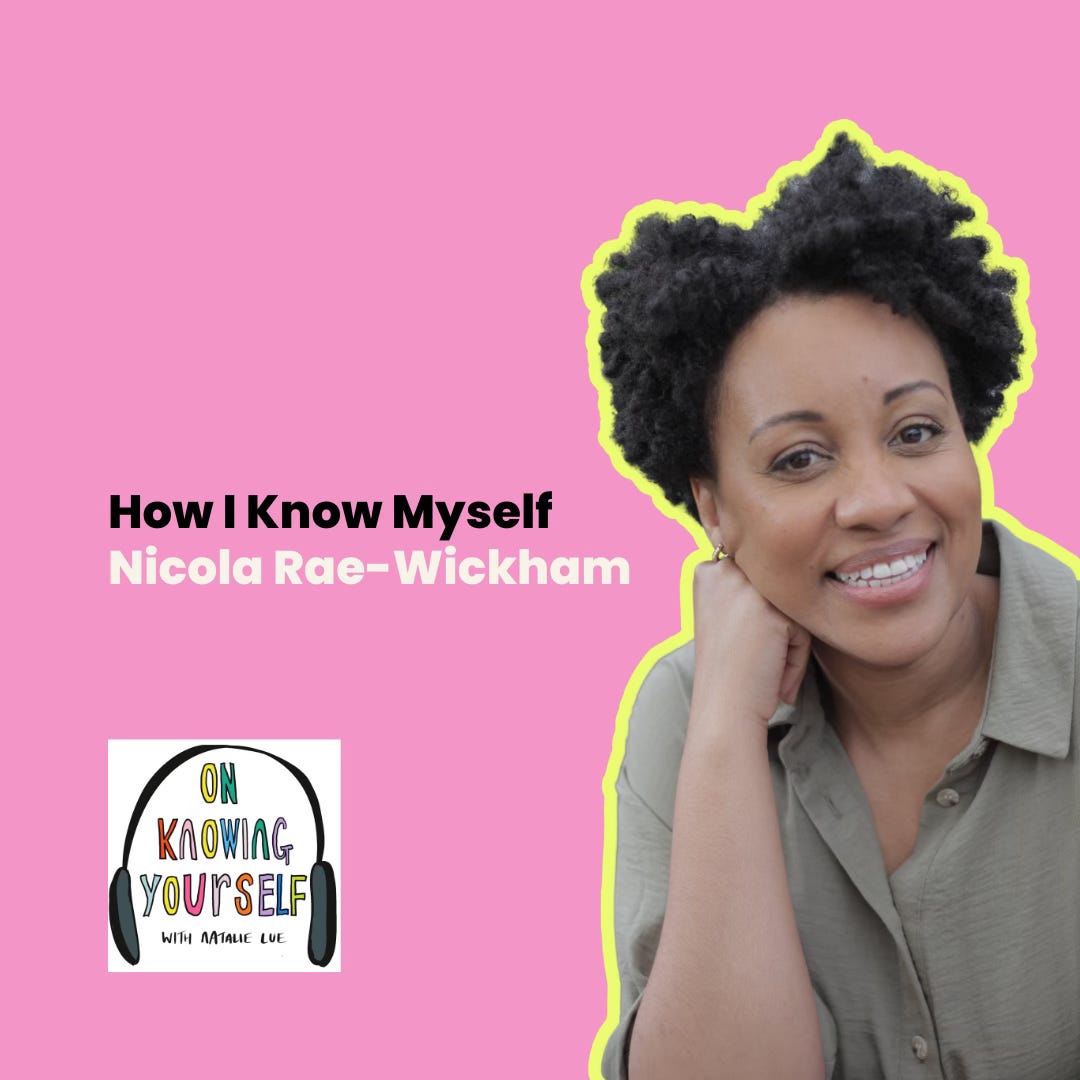
My multi-faceted friend, Nicola Rae-Wickham is a career and life coach who also does a lot of work around supervising and training other coaches. Even though we’re navigating very different things, we have so much synergy. Aside from her being one of my most favourite and trusted people for counsel and insight, I also wanted to chat with her for this series because she made a decision (divorce) that upended her world view and habits, including people pleasing.
Below is a condensed version of our conversation and, for free subscribers, includes the first 10 minutes of the audio. To listen to or watch the full episode, which features accompanying stories and insights from both of us, become a paid subscriber.
Divorce dismantles more than just a relationship, affecting every area of your life, but it can liberate you into a truer version of yourself.
You don’t have to know everything about yourself to move forward. Life is about continuous learning and unlearning—there’s no one final version of ‘knowing yourself.’
Authenticity starts with self-trust. Nicola realised she was more herself in her work than in her closest relationships, prompting her to re-evaluate what authenticity meant to her.
Saying no is a practice, not a one-time decision. Trusting yourself makes it easier, but having a support system that challenges you in a healthy way is invaluable.

The biggest and most recent was making the decision to get divorced. That was the point where I thought, what I've known to be true doesn't feel quite right. A version of myself I’d lived with wasn’t fitting anymore—it never really had—but it was becoming undeniable.
To be the good girl. To be very compliant and to be the product of all the hard work and sacrifice. I felt an acute desire not to be a burden. I've always been very intuitive—reading the room, reading people’s energy, and wanting to make sure everything was okay.
Starting my business was one of the biggest personal development journeys of my life. In my work, I was being affirmed, celebrated, and validated for being myself, and I realized I didn’t really know what authentic felt like before that.
I’d go to events and think, These people know more about me than the biggest relationship in my life does. I’d get to my front door and unconsciously switch that version of me off because, in that house, it wasn’t acceptable. My work was the first place I got to show who I was and be accepted for it.
Saying no is a moment-by-moment thing. When I trust myself, it's an easy no or an easy yes. But some scenarios still feel more difficult, and I’m grateful for the support system around me that helps me check in and question what’s true.
Saying no has also become easier in terms of meeting my needs. Before, I might have just gone along with things. Now, I think, No, I don’t fancy that.
It wasn’t one specific moment—it was a culmination of a lifetime of people-pleasing. I had been ticking the boxes of success that were given to me—societally, culturally, familially—but none of it made me happy. That was when I realised I’d been living by other people’s expectations rather than my own.
I used to believe I was too much—too sensitive, too emotional, too soft, that people didn’t really get me. But now I see all of those things as my superpowers. They’re what make me good at what I do and who I am.
Now, I think more in terms of energy than time. I borrowed the idea of "spoons" from the chronic illness community—waking up and asking, How many metaphorical spoons do I have today? Then I assess how much energy each task or interaction will take.
Some things are easy because they light me up, while others require more energy. Managing my energy this way has been a game-changer.
Journaling. It helps me unravel my thoughts and see what’s really going on. Talking to friends who reflect things back to me is also powerful—it’s often not even about their response, but the process of getting my thoughts out.
My values are always present—I even have them as my laptop screensaver. I check in often, asking, How am I living into them? How are they showing up for me?
If things feel off, I put my values over the situation like a lens and ask, What does this tell me? If I feel disconnected, I remind myself that connection is my highest value, and that alone can shift my energy.
I tune into how I feel around a person. I ignored that for a long time, but now I ask: Who do I get to be around this person? That tells me whether the relationship is good for me and whether I can exist in it with my boundaries intact.
I'm still on a journey of learning to trust myself—sometimes that wavers. What helps is reminding myself: I make good decisions. I can repair. I’m resourceful and can figure things out.
Go gently. Have compassion for each version of yourself. Don’t put the pressure on yourself to become the "perfect" version of who you think you should be.
I’m more playful than I thought I was. More fun. Around certain people, I’m actually funnier than I expected. I used to just laugh at my own jokes, but now I actually say them out loud.
Now, it means I get to live a life that’s truly mine—every day is a learning and unlearning. Before, it meant this is what success looks like, this is where you’re going. There was a layer of perfectionism over it. Now, it’s more about being present in who I am.
What's your people-pleasing style? Are you a gooder, efforter, avoider, saver, or sufferer?
Gooding, with a bit of saving.

Recent favorite read, podcast, or TV show?
Shrinking (Apple TV+). She’s right. I devoured both series and absolutely loved it.
Are you friends with your exes?
No, no, no, no, no, no, no, no, no.
What’s your go-to happy song?
Beverley Knight’s Made It Back, featuring Redman.
What’s a particular habit you’re working on?
Drinking more water.
Connect with Nicola: website | Instagram | newsletter (Substack)
To listen to or watch the full episode, which features accompanying stories and insights from both of us, plus journaling prompts, become a paid subscriber.
Comments
Nothing yet. Say the first thing.
Sign in to join the conversation.