
I don’t remember why exactly it started, or even when, really, though I was still working full time in my previous career, that I know - I started sketching wildlife in a single coloured pencil.
Graphite is my first love, always and still, and I will never not sketch and draw with graphite, even when (if) the zombie apocalypse comes. It is life-giving to me, truly, and I do not care what the brand or the form is, just give me a regular old school grade HB and some paper and I am happy for hours on end.
At some point though, when I started sketching with a single coloured pencil, it somehow transformed the way I sketched, and the relationship I developed with my own creativity - including significantly lowering the noise of perfectionism.
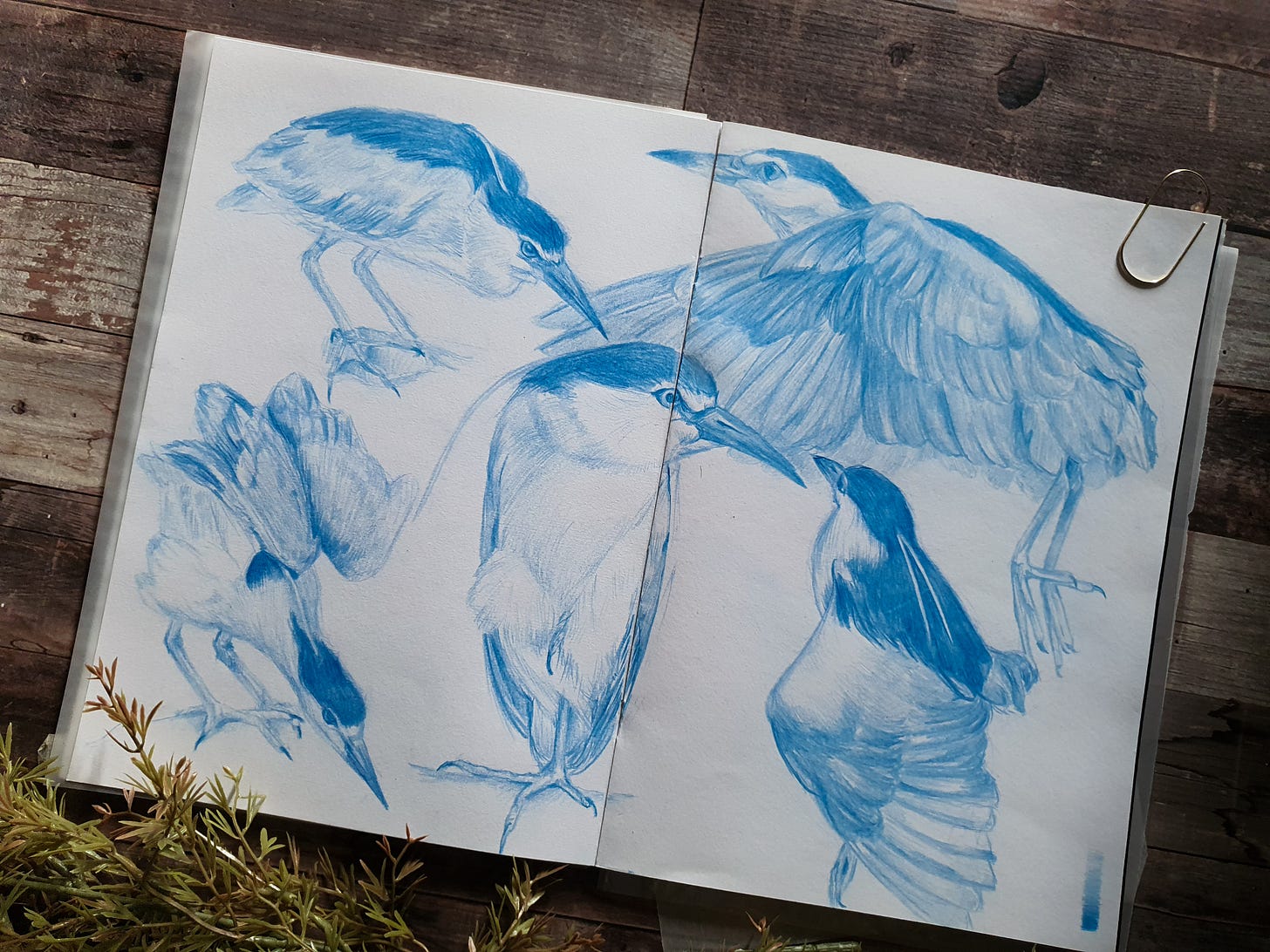
The practice became larger and more meaningful when I was caring for my sweet kitty who had numerous surgeries and had to be confined, and would whine for me constantly. I could sit on the floor of the loungeroom with the door of her enclosure opened so she could sit beside me (or with a paw on me, as was her way), and I would sketch. A single coloured pencil, a single wild being, and a number of different poses so I could get to know them a little better.
It became the core of the first big course I created, and then, in a simple sketch per page iteration it became its own course entirely. More than 200 people have taken this course now, many of them are also inside my Hedgerow community, and they speak to how it deeply affected their own skill building of realistic wildlife sketching, understanding of values (light and dark), confidence in creating, and releasing of the meanest kinds of expectations we always put on ourselves.
And also, that it was just fun.
It might just be that the coloured pencils are magic. Or maybe (and highly more likely) they are the tiny coloured conduit to getting some of the magic that is already inside you onto the page. Graphite can sometimes be a little intimidating - all those H’s and B’s. It is seen as a serious medium, even though we all learned to write with a simple graphite pencil. Fancy drawings can be achieved, and sometimes that makes it feel like only fancy drawings should be attempted. Why else would you need more than one flavour of it, and how could you possibly know when to use all those flavours?
Graphite conversation another time - this one is for coloured pencil sketching.
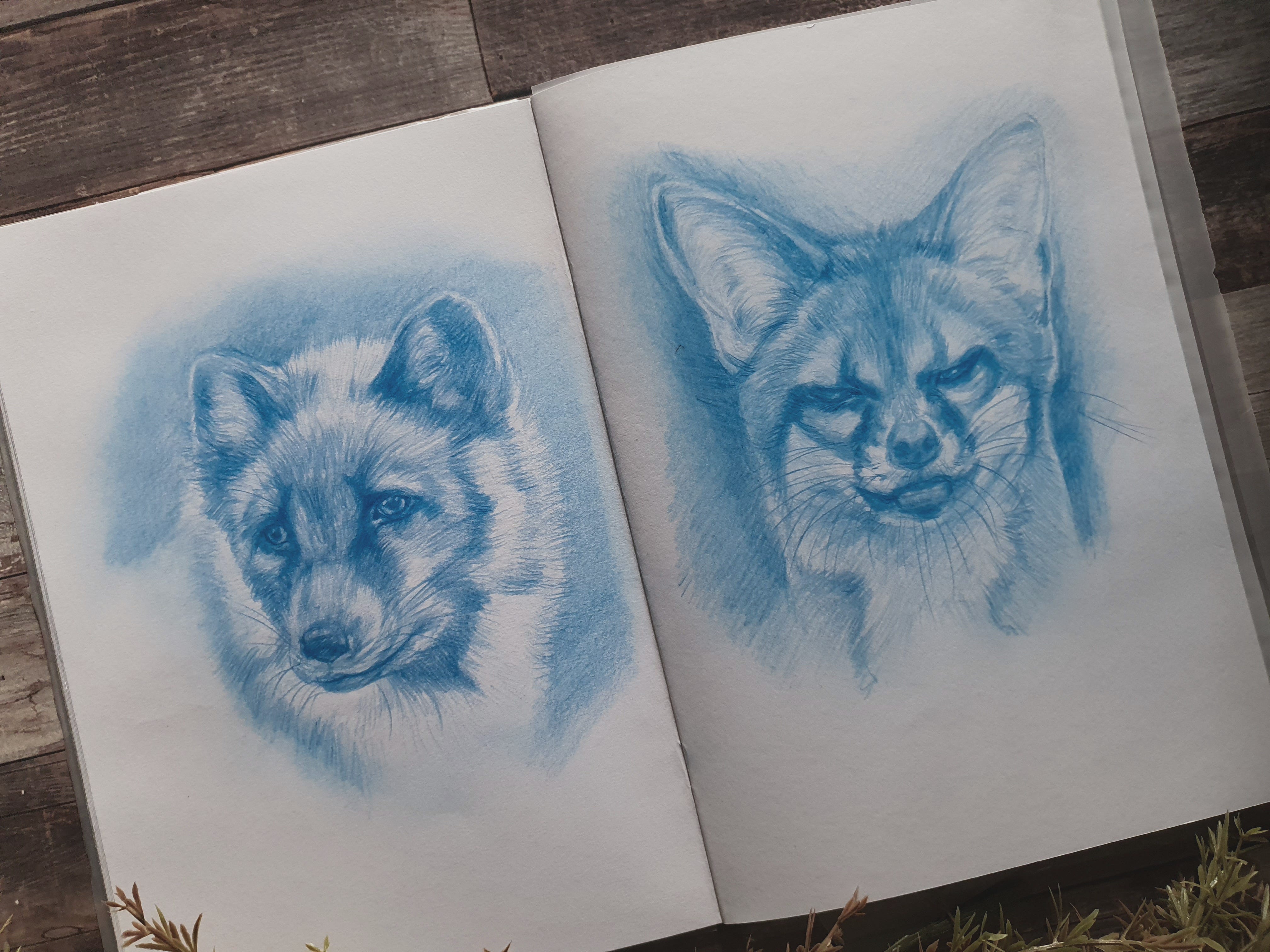
There are no rules in art making, coloured pencils are for sketching, and inexpensive sketchbooks can be the perfect place to gather your wild gallery of play. I love the Jackson’s Studio sketchbooks and they are only a couple of dollars each - many of the drawings you see here are in that sketchbook. The most important thing is to just start, to try, to play, to experiment (and to know that even if I never see any of your sketches and scribbles, oh, I am cheering you on!).
A random but apparently very important thing I discovered while sketching wildlife with the rainbow is that I love-love-love sketching in blue. No particular shade, though I do have my favourite blue sketching pencils (Polychromos Helio-Reddish Blue and Prussian Blue, and Staedtler 2mm clutch with a blue lead, I am looking at you).
I didn’t think I was a ‘blue’ person - it is my mum’s favourite colour, and I think of her when I see it, she wears blues beautifully, and her eyes are the colour of clear winter skies. But apparently I love blue to sketch with.
I wonder, did you notice that all the images I have shared here are blue sketches before I mentioned sketching in blue, or did you primarily notice the wild beings themselves?
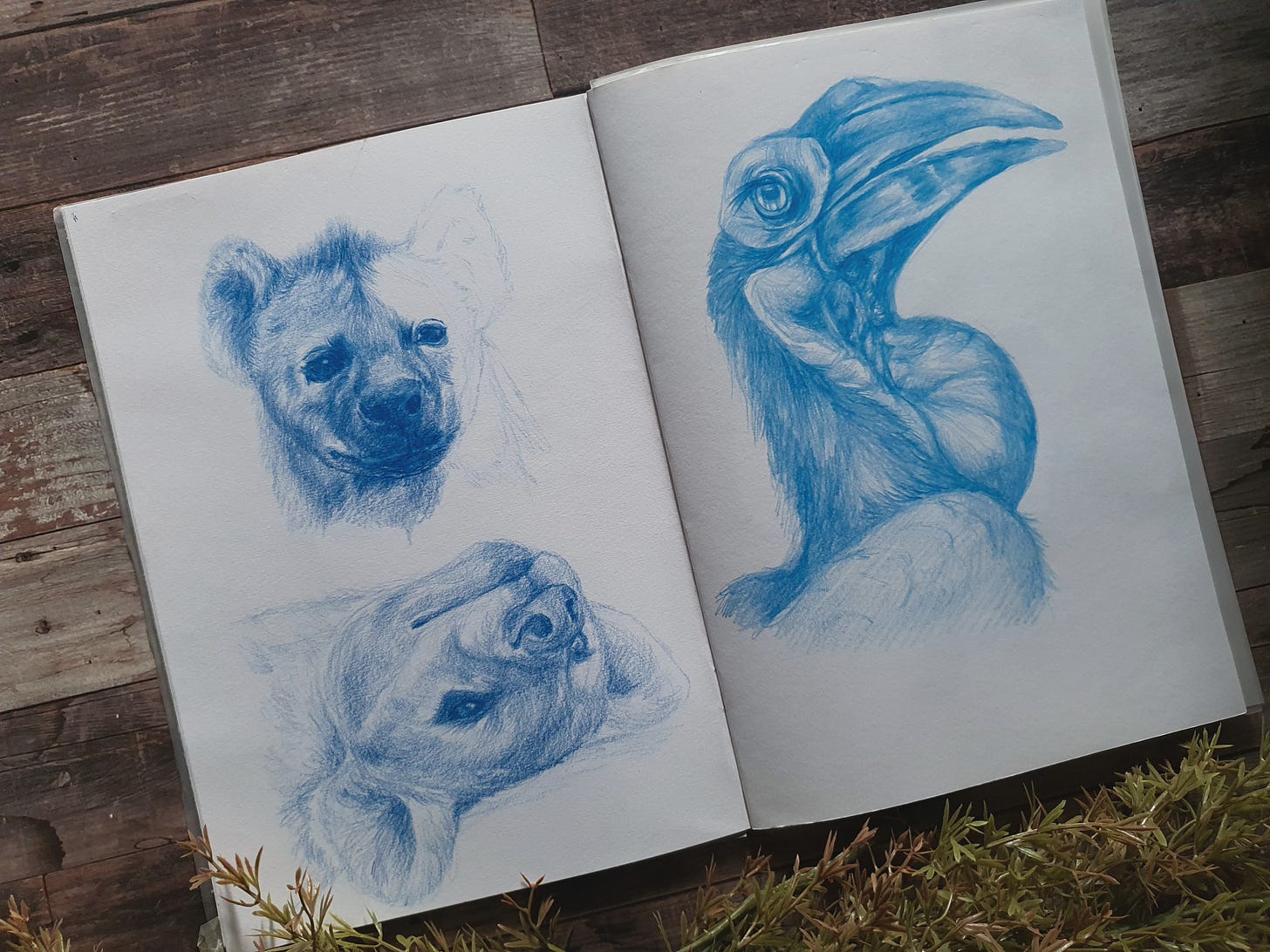
There are quite a few birds that have blue feathers, but, spoiler alert, they are not actually blue (and neither is the sky. I know, I know, it hurts my brain too). There is no blue pigment in feathers, but they appear blue to us because of physics (tricksy!) and a phenomenon known as structural colouration. Light scatters through the tiny air pockets in the keratin structure of the feathers, and they appear blue to us the same way that the sky appears blue. When a blue feather is wet and scruffed up, you will see it looks dark and not blue anymore (though our brains might tell us there is still a blue tinge). The real test comes when you grind a feather up, there is no blue pigment - unlike red and yellow feathers which contain carotenoids.
So now I have you looking at the utter vibrancy of a Peacock or the muted dusty blues of a Blue Jay and wondering “what in the world are you talking about Natalie”, join me in the amazement that is the Satin Bowerbird (which I have had a gorgeous purple eyed female in my yard a few times). Their ‘come hither’ colour is blue - the satiny black males collect all manner of blue things to entice the females to their bower.
Before the plastic BIC pen lids and water bottle tops that they use now, they would collect things like Eastern Rosella and Crimson Rosella feathers, beautifully blue.
Do they know blue feathers (and the sky) aren’t blue?
And if they did, would it matter? Blue delights them. And it turns out blue coloured pencils delight me, too.
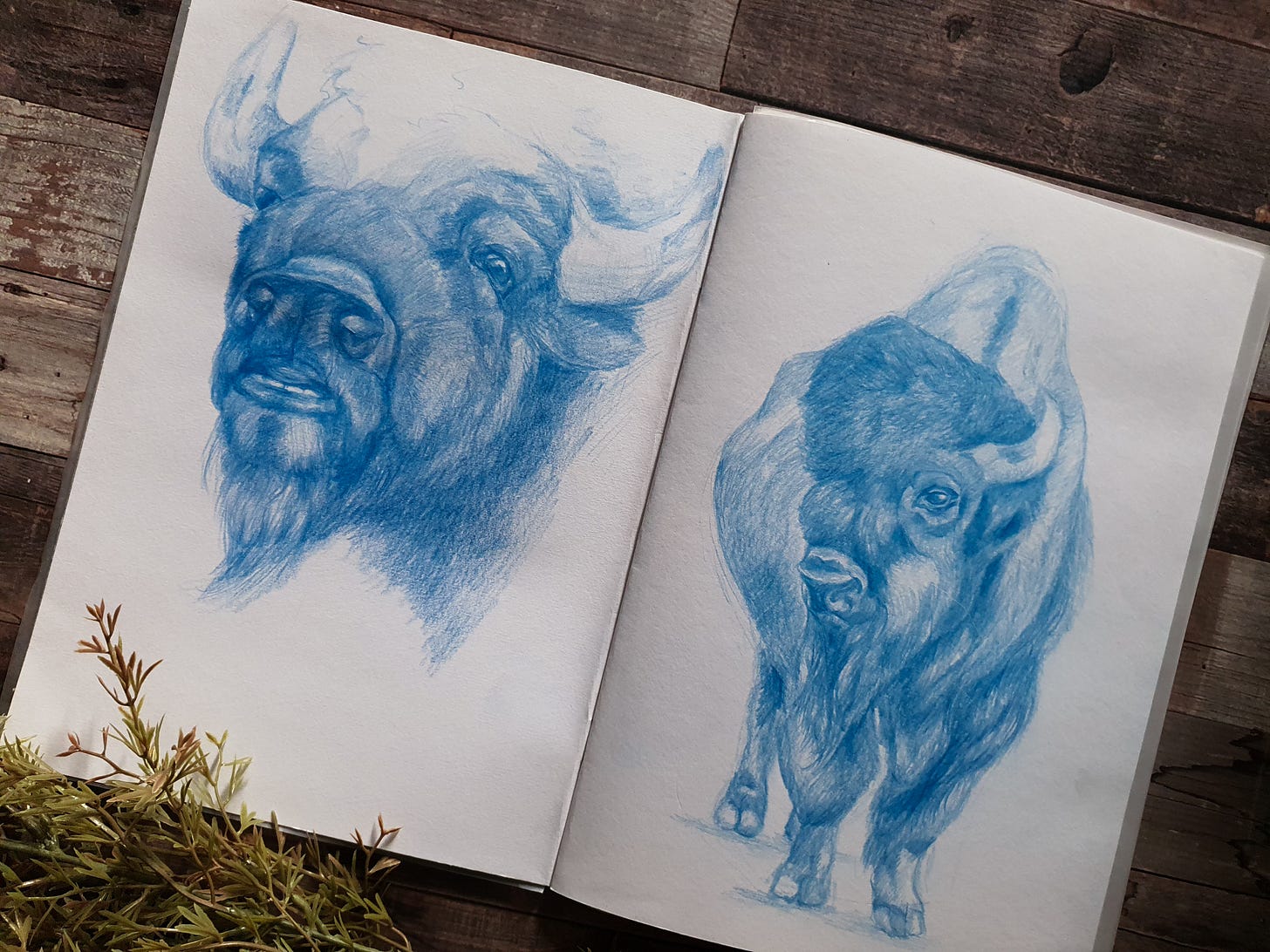
The thing that lends realism to any sketch is the interplay of values - lights and darks. It is not ‘details’ per se, other than those details being more and more refined iterations of value. It is knowing where the very darkest parts are, and how they help bring out the very lightest parts by having something to contrast against. With graphite you can get those values to the extreme - almost black, and the white of the paper. With coloured pencil, you are limited to the range of values that particular colour, that particular pencil, can produce. But even if that is compressed greatly from what you can get with graphite, the results will still be the same if you remember to keep that contrast.
And that is all very technical and super important when you are drawing realistically, but honestly, what is even more important is connection, not perfection.
Connection, not perfection.
It is one of my mantras inside Hedgerow, and indeed inside my creative life as a whole.
Connection, not perfection.
My aim for any drawing is not a perfect outcome - perfection is boring and sterile. Nothing in nature is machine perfect, and yet everything is utterly perfect. My aim, my goal, my craving and desire from the smallest, quickest scribble, to the more elaborate multi-hour drawings, is connection.
Connection primarily to my subject - I want to know them, I want to know them as an individual but also as their species. I want to revel in their intricate details, the wonder of their being. I want to see the world through their eyes, howl at the moon, silently fly through forests, scamper and scurry.
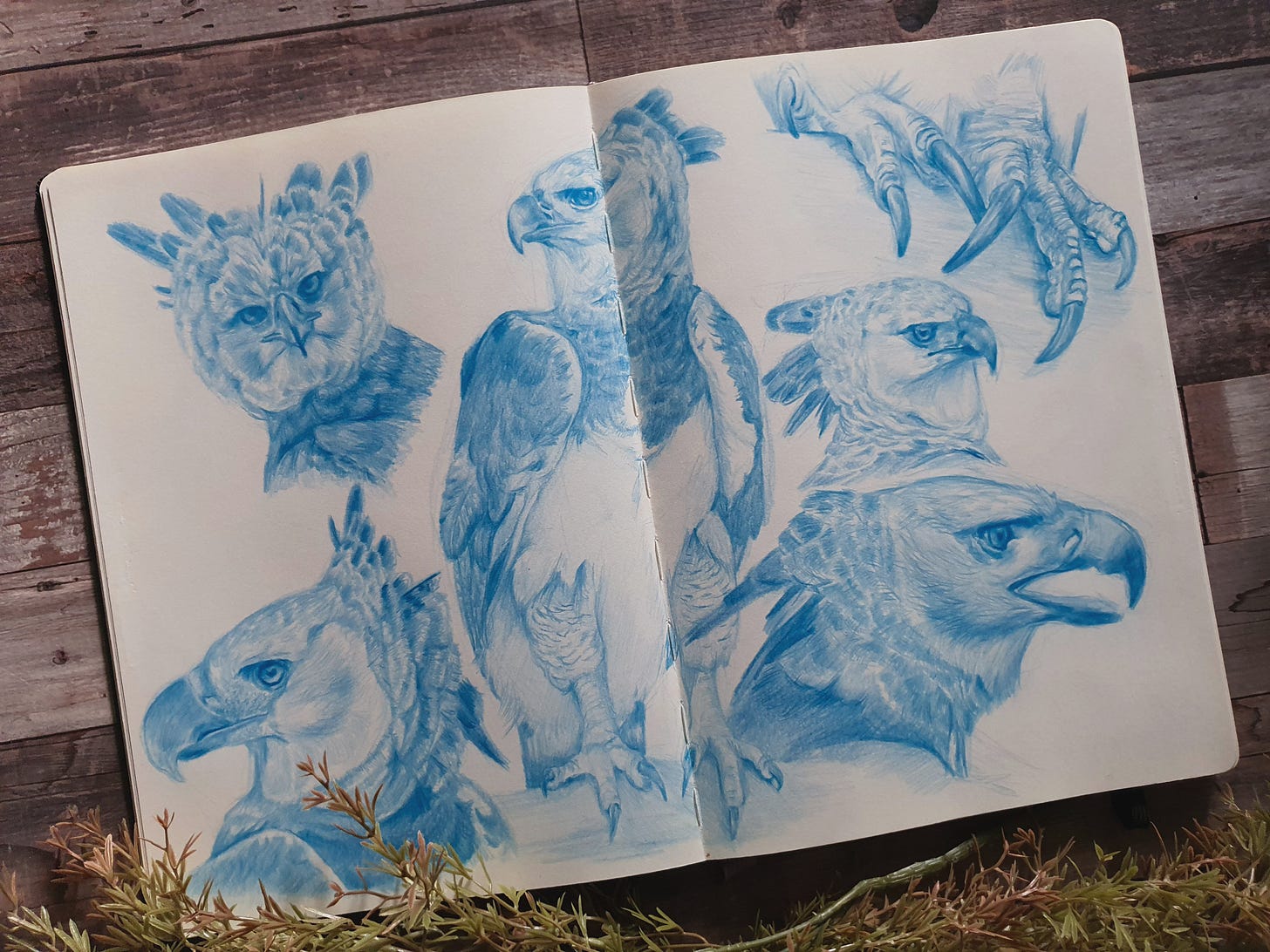
Taking them into my body through my eyes, having them travel through my mind and heart and hands with a desire for connection means that what comes out on the page is them + me. It also means I get to keep a little bit of the wonder that they are inside too.
But also connection to my own creativity - keeping curiosity about how I can use my tools to describe the incredible beauty that I see. Wondering if and how and why to make marks.
Connecting to the seasons of my creativity too - because we are not machines that can be always on. Sometimes our creative flow is strong, sometimes it is a trickle, and all of it is right and good and true, because we are animals who get tired and frustrated and have a million other things on our minds and also things going on inside our bodies. Connecting with my creativity, with my creative body, means that I get to develop a deeper relationship with that energy, with me as a human animal, too.
When I sketch in coloured pencil my work is less refined, but it is no less meaningful. I would go so far to say that sketching with coloured pencil is what brought me so much more connection - I reduced the pressure on myself, and was instead more curious about how I could use this tool to explain what I was seeing. And doing multiple studies of the same being meant that I could shrug on their fur and feathers and roll my shoulders and move like them. I could play with rocks between my hands and be Otter. I could use my strong, taloned feet to grasp a branch (or prey) like a Harpy Eagle. I could feel my crest feathers on the top of my head be pushed forward by the wind. Feel the dirt in my coat as I rolled around on the ground with Hyena.
Sketching in blue turned out to be an aesthetic delight that added to the pleasure of making art that I feel, deeply, with each new sketchbook page.
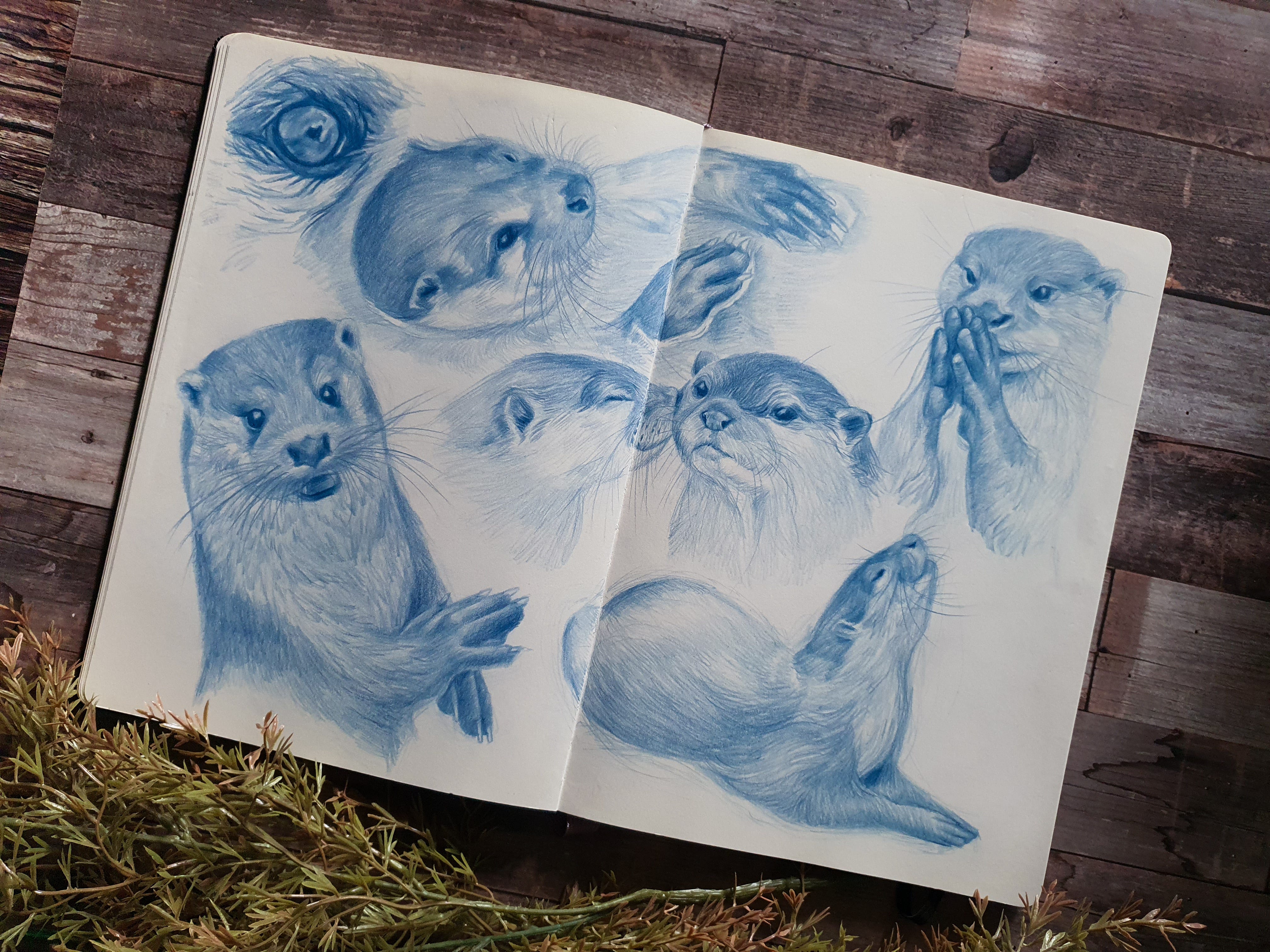
And now I am wondering why I have not sketched a Satin Bowerbird in blue, too - because in blue and in connection we are, well, connected. Maybe that will be the next spread. And I can go back to the photos of the female who visited my yard to add to the story (she might even get a splash of lavender for her eyes).
Maybe I even give that sketchbook page to the Bowerbird I know nests in the park at the top of the hill from my house. How amazing would it be to have them use shreds of my connective sketches in connecting to their female mate?
Mary Oliver said “Attention is the beginning of devotion”, and I quote her so often because I think this perfectly sums up what wildlife drawing and painting is for me - pure devotion. And it has come from a deep desire to pay attention. I am an apprentice to growing my art skills, but I am also an apprentice to the wild world. I will forever be grateful to learn from them, to be in utter wonder and awe, to be humbled by their beingness, because it is in the wild world that there is a beauty and truth and hope that is becoming ever more scarce in the general overstory of modern humanity.
My love, pick up a pencil and play. Make it an inexpensive coloured pencil from a supermarket set (use a darker colour to avoid frustration), and use printer paper if that is all you have. But make marks - you were born to create, and we need to see the story of you + wild.
And if you would like some company while you apprentice yourself to sketching the wild (I hope my own apprenticeship lasts the rest of my life), or if you’d like some support to actually start, you will find that and eleventy-billion other wonderfully wild things in Hedgerow. We practice making art, but we also practice being fearless in our creativity, because showing up is so much more important than any outcome.
Connection, not perfection.
I see you, wild one,

Comments
Nothing yet. Say the first thing.
Sign in to join the conversation.