
Grab a cup of tea (or something cooler if you are in the Northern Hemisphere), and lets have a gab.
Comfy? I would share my chocolate with you but I just ate the last piece. Sorry.
Getting to work on a new creative journal each month means I get to think and re-think and even re-re-think a little more about, well, a whole bunch of things actually. Much of it is about both how to empower the dear reader to have a connected, creative life, but it is also about how my own creative life keeps evolving and getting deeper, stronger, more embodied.
When I first realised that making art that is focused on wildlife was what I really wanted to do, it came from a place of sheer wonder and delight at the diversity of species we share this planet with, that there were so many grand and beautiful beings - and I wanted to draw them all. I have always felt a deep connection with non-human animals, seeing them as the persons that they are. And yet, it took me a while to understand that exploring that more fully was a major missing ingredient in the art I was making.
I think that part of the process, part of the apprenticeship of a creative practice, is that your work becomes more embodied and focused, more a part of your own living philosophy, and that over time you become open to that larger relationship. I’m not sure. But whatever the case, my personal work now is very much a process of knowing, rather than a practice of ‘capturing’. And because of that, this is also the basis of my creative community and my teaching - now and forever.
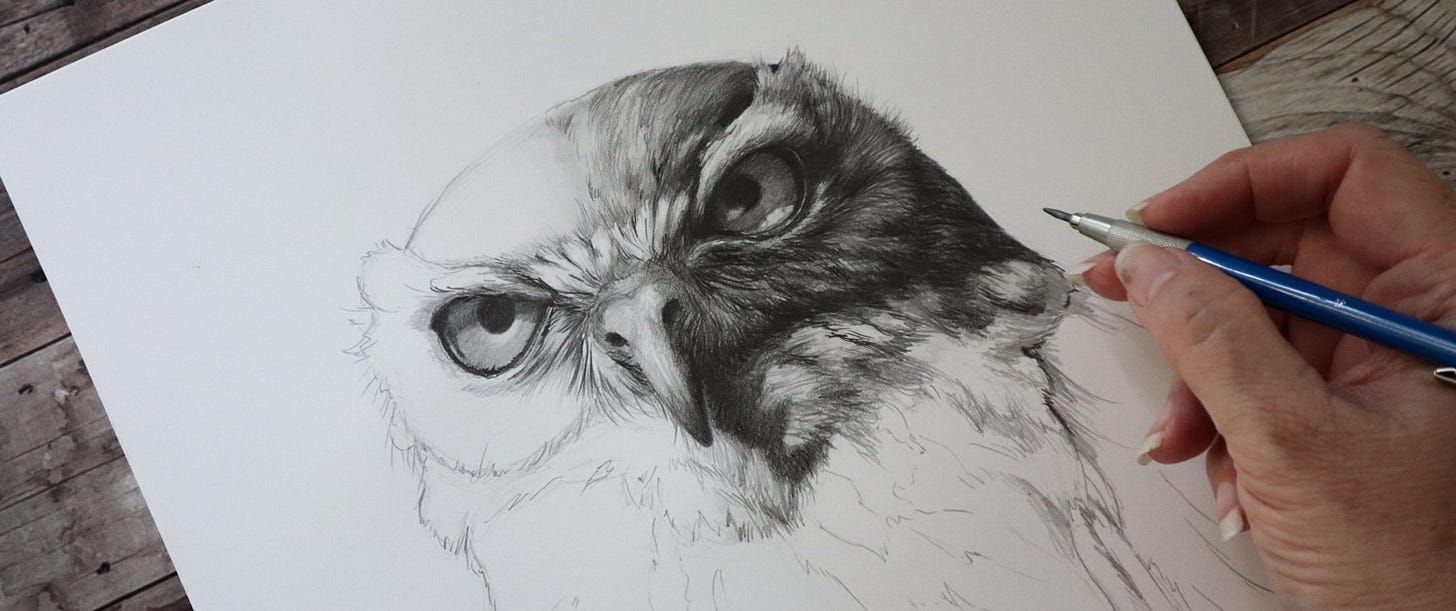
We might giggle at medieval paintings of wildlife, how hilariously wrong they can be, how wildly anatomically incorrect they are. Who doesn’t love a “which medieval owl are you today” meme? But it is photos (and videos) that have changed the landscape of animal painting dramatically - prior to that it was observing a wild being from afar, or a taxidermised example (with the hopes the taxidermist actually knew what they looked like), or even someone else explaining the being to you. The understanding of how the animal lived in the world was incomplete, at best.
Photos changed that. Photos allow us to see animals that we will never, ever meet in real life - and it is an utterly extraordinary gift. Gosh, I mean I am so freaking thankful for the art of photographers - they have allowed me to connect with wildlife in ways that I could not imagine when I came back to art ten years ago. To have photographic reference to use is essential in my work, and how I teach - essential essential.
But I have also come to realise that making art from photos can be a bit extractive too, without any intention to be so.
Working from a photo without knowing more about the being I am working with now feels to me like a way of capturing them. Of making them an object, not a subject. Something to collect, even to hoard. Something ‘out there’, separate from me - a thing.
Without knowing them they become a commodity - mine for a moment, or until the drawing is produced, then filed away as finished, no longer necessary.
This is not a moral failure by any means, it is something I did for a long time, something I probably still do sometimes. I want to be clear that there is nothing wrong with working like this, in fact I think it is part of the learning journey - and this applies to everything in life, not just creativity. We can’t know what we don’t know. I want more, because I want to live holistically deeper with my creativity and with the wild that inspires and teaches me. I want relationship and connection in my work, not just a bunch of finished drawings and paintings - and this also means working more slowly and deliberately, which is the antithesis of modern ‘content’ creation.
It is hard to go into philosophical nuance like this in drawing courses (or social media), but it is something I feel deeply, and inside my creative community, and here in The Wild Forgotten, is where I can explore that further, and hear what your thoughts are too.
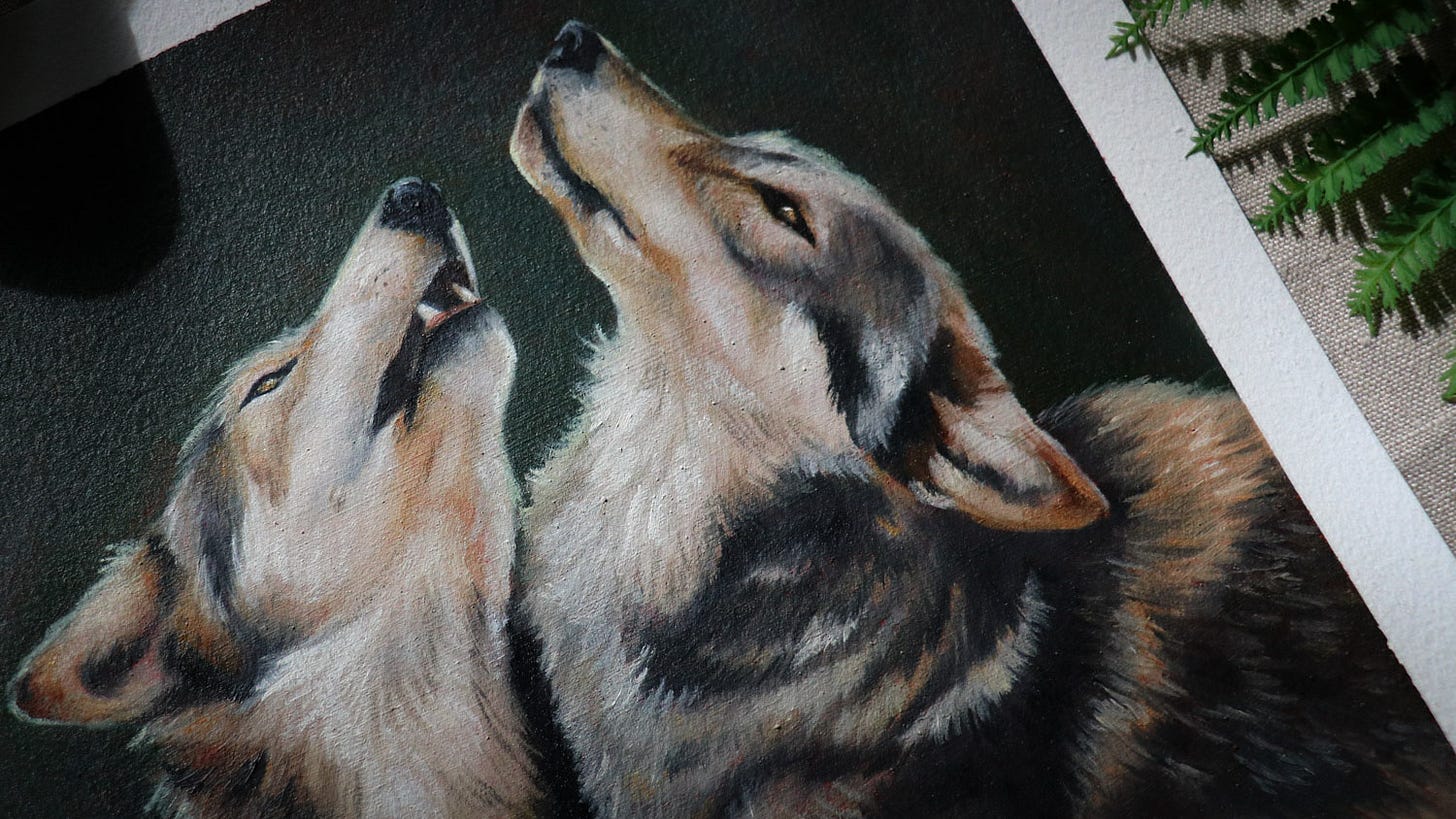
There is something else tied up in this as well, and I think it was pulling on those threads that may have helped move me into this thinking. The first is perfectionism. The second is loving kindness applied to the subject, then to creativity (and therefore to the whole of self).
I draw and paint realistically, and that is what I teach. Describing with pencils and paint the likeness of a being using shapes and values is something absolutely anyone can learn (and put that eyebrow down, this is an absolute truth). It is a skill set that has to be practiced, and the way of holding and using your pencil is just one part of it - the majority is about observation (aka curiosity and wonder and a willingness to see).
But if you have a bit of perfectionism (and I think that is most of us modern humans educated in these post-industrial-celebration-of-machine-specificity-and-productivity-times) it is easy to think what you are drawing (painting, sculpting) needs to be an exact replica of the photo, or it is not correct.
Me too - for many years.
But a couple of years ago, working more and more in my sketchbook, I realised that the 40+ hour drawings were not lighting me up in the same way that a 4 hour one was. Both were highly detailed, but one was much closer to the photo.
Was the one closer to the photo actually closer to describing the extraordinary being I was witnessing? Did it show their very aliveness? Did it tell the story of their being?
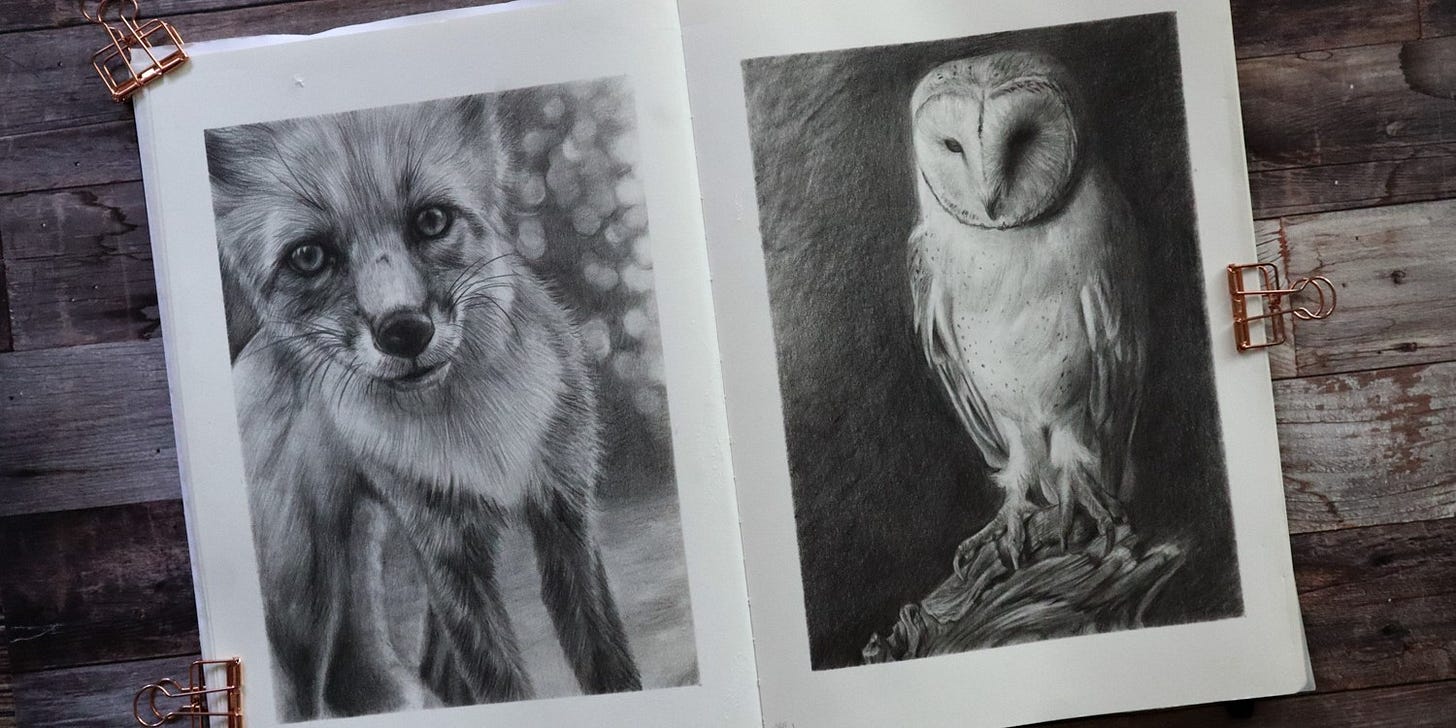
I have never wanted to be a photo-realistic or hyper-realistic artist, and while I think it is an amazing skill that so many artists do incredibly, and I love seeing it (particularly imaginative hyperrealism) it was not what I set out to do. And even if I was leaning that way subconsciously, consciously I was just so full of curiosity and wonder. How is it that the feather can have that marking? How is it that the fur shifts direction just there? Detail was for me the excitement of seeing more deeply and getting curious about how to make marks that described that (and a little bit of neurospicy hyperfocus too).
Using a sketchbook, and teaching drawing in a sketchbook, let me loosen the grip of the wonder-as-represented-by-photographic-correctness, and embrace trying to describe the feeling of the wild being in the photo. How it would feel to run my hand lightly over them, how it would be to shrug on their fur or feathers and become them. I wanted to work until I could feel their presence on the page - to say, ‘oh hello, there you are!’ (and if you have taken any of my courses you know I literally say that out loud, and talk to them in all other sorts of weird and wonderful ways!).
This, of course, led my curious mind to want to actually know more about them and how they are them - the individual, yes, when possible, but their kin, more specifically. Where do they live, how have humans encroached on their lives, what relationships have we had mythically over time, what do they eat, how do they raise their young?
To extend loving kindness to them (the practice of maitri, just one of many teachings I am forever grateful for from Thich Nhat Hanh).
My desire to care deeper also made me want to create deeper. To know more, to stand still and watch first, to understand, to go below the surface of the photo. To embody the reciprocal nature of relationship. I may not be able to directly help that individual (if they need help), but through my attention and devotion I can advocate for their people, I can celebrate them, and share what I have learned and seen in ways to (hopefully) delight others into caring and connecting too. And I can teach others to do the same.
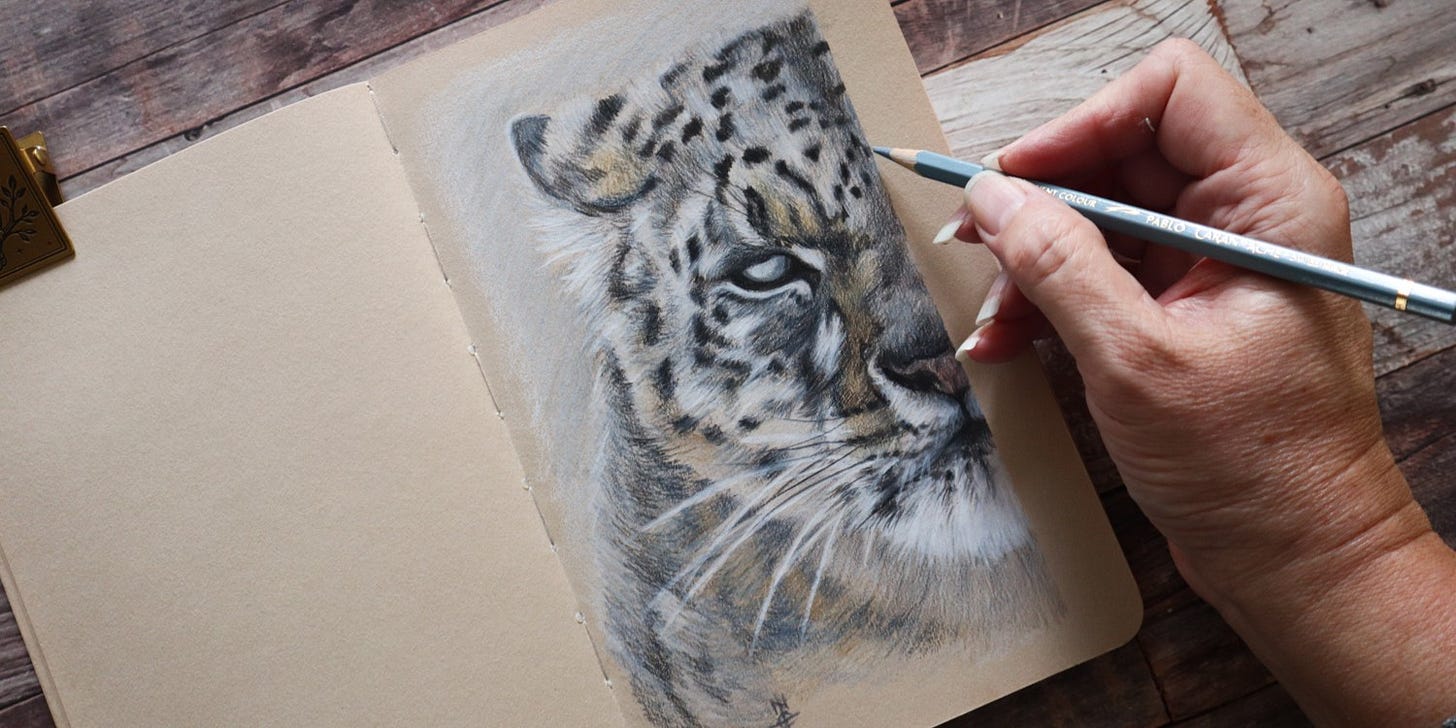
The best (and sometimes the most annoyingly wonderful) thing about practicing loving kindness means that it spills over into other areas you perhaps didn’t explicitly direct it at. Extending care and love to my subjects inevitably led to me extending it to myself, and to my creativity. Much of the frustration of ‘that is not right’ turned into an acceptance of this is what it is today, and it is all practice. I began to love the lines that were not in the place the finished drawing might warrant, because they were evidence that me, this human animal, made this. Not a machine.
And what is on the page is not just my subject, but my subject and me. I am delightfully imperfect, and my pages are as well.
Talk about liberation.
We are none of us alone, and creativity is a beautiful thread that binds us together in a way that is expansive and abundant rather than extractive and diminishing. Especially when it comes from a place of loving kindness, wonder and awe. I believe, actually I know, that making art in this way, being a creative human that wants to enter into and strengthen their relationship with the rest of the natural world (because spoiler alert, we are nature too) changes us as the artist. Drawing this way changes the drawer - and infinitely for the better.
(And next time I will chew your ear off about drawing the beings you share your physical space with. That is major level-up changing, truly.)
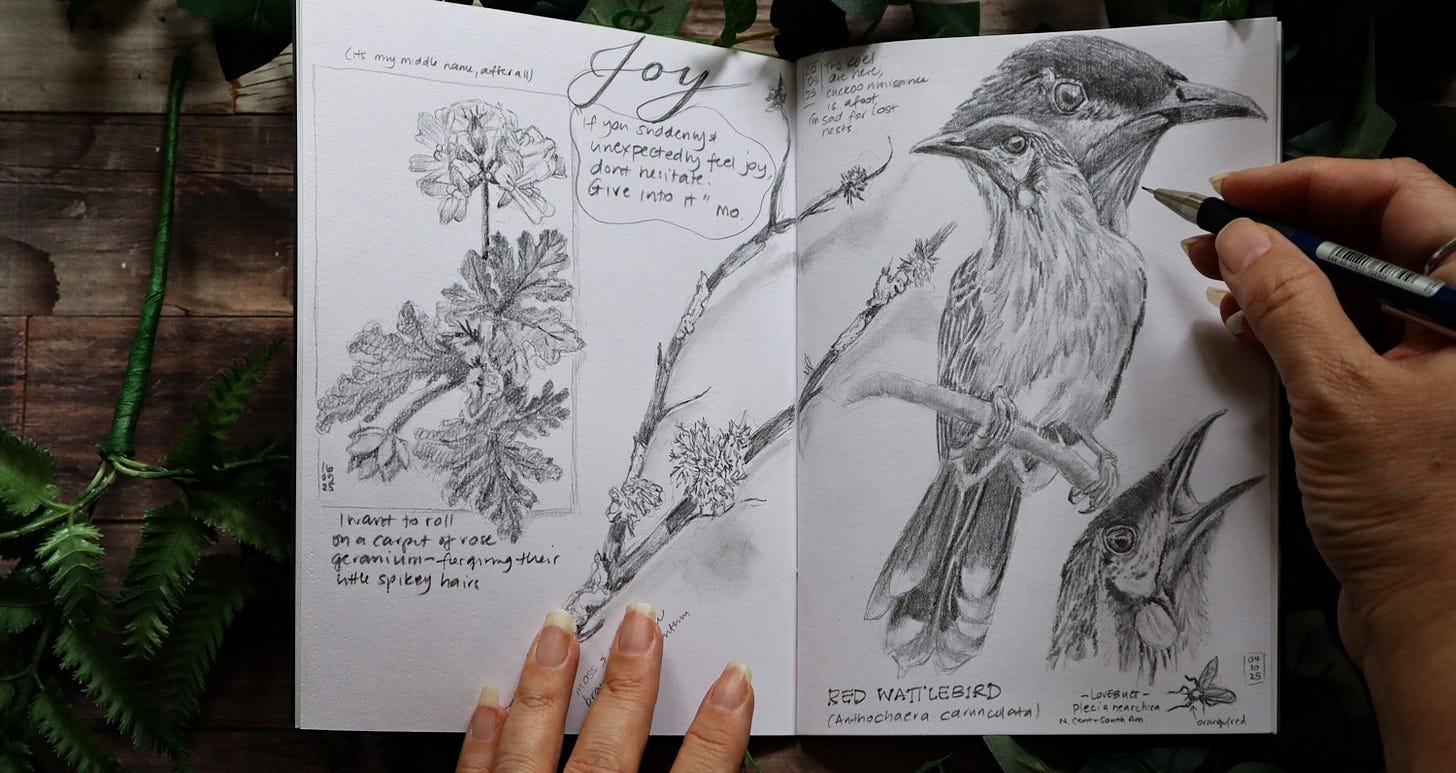
The potency and possibility that comes through creative relationships born of curiosity and wonder and a desire to engage in reciprocity is limitless. And incredibly fulfilling - nourishing in ways that making drawing after drawing without that goal can never be.
I have become someone who notices, who delights, who celebrates and advocates, who mourns loss, but who loves beauty and is curious about how to use my hands to describe that beauty the way I see it. Drawing or painting is only a part of it - the rest comes down to Googling, and being in utter awe at how mind-blowingly gorgeous this planet we grow on is. Sometimes being saddened, but mostly being in wonder. And, like Mary Oliver said, wanting to tell about it.
(Will I work Mary Oliver into every single piece of writing - quite possibly)
Getting to work on a new creative journal each month means I get to do that a lot, tell about this wild world, share about it all, inspire creative responses from gorgeous human animal bodies about gorgeous more-than-human animal bodies and the landscapes they call home, and paint and draw and wonder. What a freaking gift, right?
This is how I live my creative life. Maybe you would like to wander (and wonder) this wild way too. I have got my lantern - let’s step on the path together.
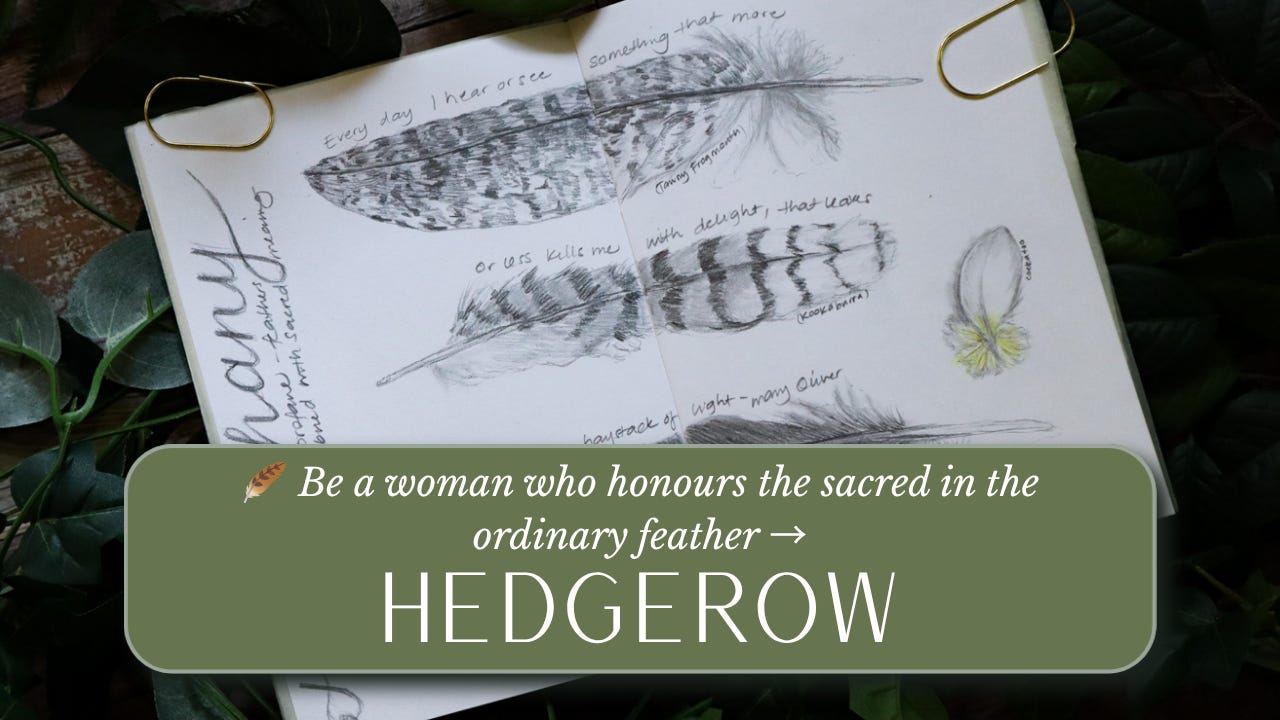
In celebration of this amazing world that contains so much wild love and hope (and freaking feathers man - they’re amazing!),

Comments
Nothing yet. Say the first thing.
Sign in to join the conversation.