
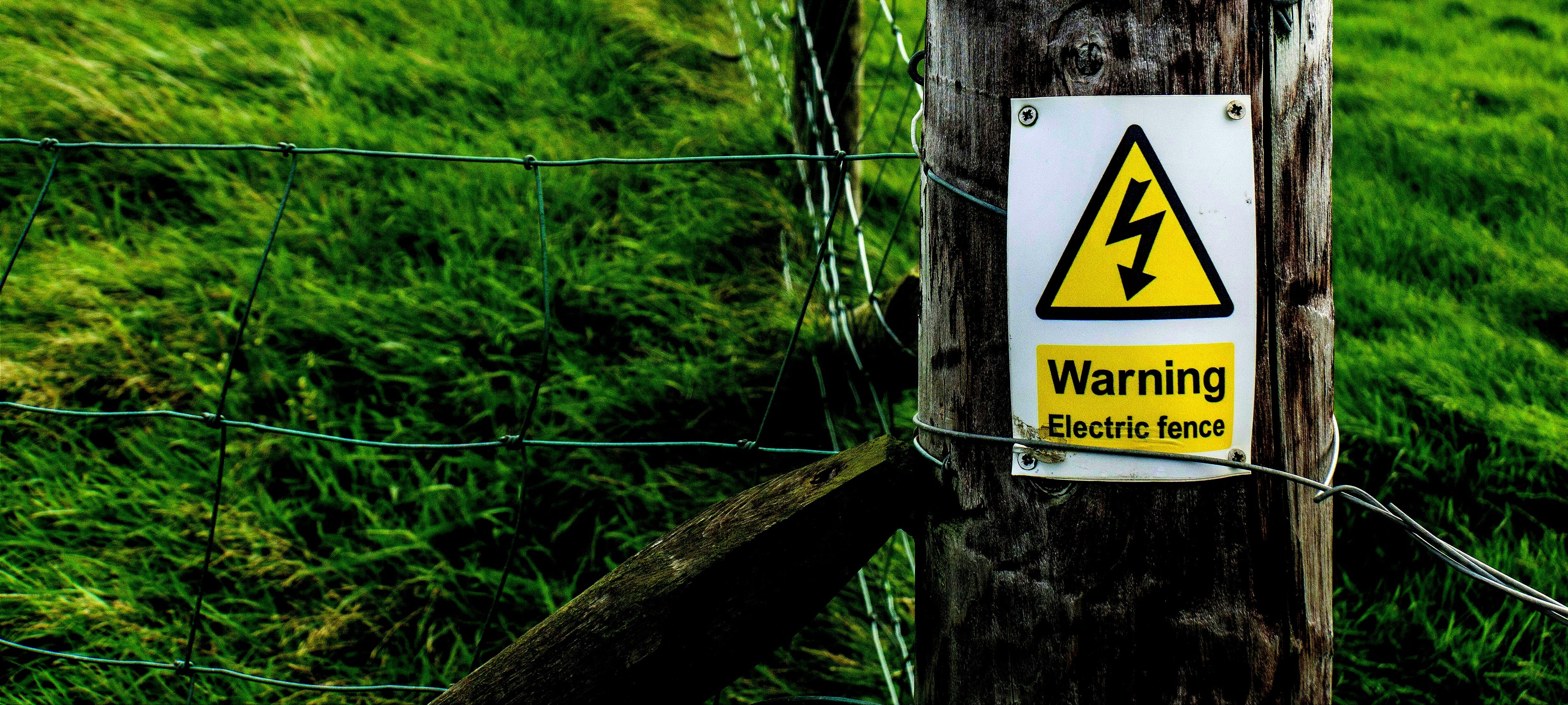
A while back, I was talking to a farmer who breeds cattle on the outskirts of a mountainous village. He used several pieces of land as pasture, separated by an electric fence and situated between a few houses. Curious about the fence as a safety precaution, I asked him about it. He smiled and replied, “Oh, there is no electricity on the fence. I used it for a while and then switched it off. The cattle learned very fast not to approach it, and I never had to switch the electricity on again.”
That’s one of the ways brainwashing works, and we don’t even need a direct personal experience with the shock. Humans can vividly imagine the punishment. We don’t need to feel it ourselves. The mere threat, the social story, or the anticipated consequence is often enough to keep us in line.
In my article, Close Encounters with Brainwashing #1, I noted that we casually use the word “brainwashing” to describe attempts to sway opinions, yet we usually assume it’s something happening to other people. Based on my own firsthand experiences, I claim that we are all experiencing it daily, and I defined brainwashing as follows:
Brainwashing involves unknowingly being in a state of ‘unconsciousness’ in certain specific areas of our lives while remaining fully ‘conscious’ in the rest. It’s like having a partial paralysis of consciousness without being aware of it.
Sometimes this state of ‘unconsciousness’ is self-imposed, and the clearest symptom of this partial paralysis is self-censorship. The quiet, internal decision to stay silent, edit our words, or suppress our thoughts before they ever reach the surface.
Self-censorship rarely feels like dramatic oppression. It usually arrives dressed in reasonable, everyday concerns and even passes for wisdom. It is a quiet internal restraint or negotiation that happens before we speak or act. Understanding its roots means looking honestly at the full range of pressures that shape what we allow ourselves to say.
The most primal layer is simple survival. We stay silent because controversy is exhausting, and the current climate can make even mild dissent feel dangerous. Saying nothing feels like the path of least resistance, and when physical safety or the safety of loved ones feels genuinely at stake, silence can seem not just reasonable but necessary.
Closely related is the pull of belonging. We are social creatures, and our words are always evaluated for their impact on our relationships. The fear of hurting someone’s feelings, of being seen as a traitor to shared values, or watching friendships quietly cool is often enough to keep thoughts unspoken. Sometimes this pull is even invisible to us, keeping us loyal to a family history we are not even consciously aware of. The desire to keep the peace, stay safe or remain loyal is wired into us, but it can accumulate into a habit of never saying anything that carries real weight or meaning.
Professional life adds its own pressures. An opinion that cuts against the consensus in one’s field, or that contradicts the employer’s stated values, can turn into a professional liability. Worse, there is the awareness that words can be stripped of context, repurposed, or surfaced years later in a very different climate. The rational response is often “to say nothing,” and that quietly shapes what many are willing to say publicly, or even think about.
Then there is the architecture of public reputation, which social media has completely redefined. A personal brand, once a concern only for public figures, now belongs to anyone with an online presence. A post can be screenshotted, misread, or shared into hostile territory in minutes. The fear of being canceled, boycotted, or labeled as problematic, ignorant, or on the wrong side of history is not paranoia. It has happened to people who said less. So the editing begins early, in the drafting stage. One asks: could this be read as punching down? Could it be called a conspiracy theory? Might it cost me a sponsor, a customer, a friend or an ally? Maybe it’s not worth it at all.
What makes self-censorship so durable is that each of these reasons, taken alone, is understandable. Safety matters. Relationships matter. Careers matter. Reputation matters. The problem is not any single calculation but their accumulation and the way these pressures compound into a permanent internal editor that runs before thought becomes speech. These internal voices often sound prudent, even virtuous. But over time, they function like that switched-off electric fence: the shock is no longer needed once the habit of avoidance is installed.
There is a deeper price to this constant internal editing.
We get trapped in chronic low-frequency states which diminish the overall quality of our life and our wellbeing, and ultimately lead us to function in a state of constant numbness.
What begins as a social adaptation and an individual problem turns into a dumbed-down and numbed-out society that locks itself into ignorance and untruthfulness.
The cattle only avoid the fence because they once felt the shock. Our society avoids entire topics and truths because all of us have internalized the possibility of the shock. As a result, we built enclosures, and most of us never notice the walls because we helped build them. Like Truman Burbank, we move through a life that feels open and chosen, and yet, it turns out we are quietly obeying layers of scripts we never consciously agreed to or knew existed.
Unlike the original Truman Show, we play different, carefully edited versions of ourselves for our employer, our family, our social media followers, our neighborhood, our political tribe. And each audience demands its own set of acceptable opinions, its own version of who we are. We are not trapped in one show but many nested inside each other, and the deepest one shrinks a little every time we choose the performance over the truth.
When we wake up to our lack of authenticity, we blame it on those in power. But then again, we forget that we are the ones giving power. As I wrote in my article Next Time Someone Wants to Empower You, Tell Them “I’ve Got This”!, what makes someone in power powerful is the way we perceive them.
Hence, we live in layers of Truman Shows, and the cruelest part in all this is that the producers are mostly invisible. They do play a role, and it’s an important one. However, in many cases they have pulled out along time ago and they have left it to us. We imagine the punishment. We cancel ourselves before anyone else gets the chance, smoothing off our edges so automatically that we eventually mistake the sanded-down version for our actual being.
Breaking out of any one of the Truman Shows would require courage and honesty. The good news? Unlike the cattle, we can become aware of the (lack of) fences. We can notice when we’re self-censoring. We can ask: Is the electricity actually on, or am I just reacting to an old memory of the threat? And which threat is bigger — silencing myself or telling my truth?
Breaking the pattern begins with small acts of reclaiming consciousness in those partially paralyzed areas. Noticing the internal excuses, questioning the imagined consequences, and gently choosing truth over convenience.
I would suggest that we start with an honest self-evaluation:
What is so deeply hidden that I don’t dare to tell it even to myself?
What am I not telling others for fear of consequences or cancellation?
What would I do differently if there were no “electrified fences”?
We have been taught to trust only what can be measured, replicated in a laboratory, and approved by the prevailing scientific consensus. Everything else like intuition, consciousness, psychic perception, and the whole range of experiences we quietly label as mystical, unscientific, or unproven, has been filed away under “not serious.” And most of us, eager not to seem naive or irrational, have accepted that without much protest.
The first lie is that these things are unproven. As I wrote in the first article in this series, a lot has been proven, and yet, it remains widely unacknowledged. We are obediently staying behind a non-existent fence.
The second lie is that unproven means unreal. The reality is that much of what now passes as settled science was once heresy. More importantly, much of what is most alive in a human life like the feeling of connection and love for another living being, or the sudden clarity that arrives after the night - these things have never fit neatly into a controlled study, and yet no one seriously argues they don’t exist.
But here is what I notice. The fence around these territories has perhaps been the most heavily charged of all. However, lately, it has been also wide open. The social punishment for taking them seriously can still be dismissive. We may still be labeled ridiculous or odd, so most people keep those experiences private, mentioning them only in hushed tones to trusted friends, if at all.
And yet these are precisely the capacities that make us most fully human. Not our ability to optimize, to produce, or to perform, but our ability to perceive beyond the obvious, to sense what hasn’t been said, to connect with something that has no label yet, to dismantle the very concepts of space and time.
Therefore, the deepest question to add to the list is this:
What are the things that I am capable of that neither AI, nor any technology or machine, can ever do?
And if it feels right, add your list to the comment section. If not, keep them in your most cherished journal. But write them down.
Comments
Nothing yet. Say the first thing.
Sign in to join the conversation.