
Born in 1922 in Hreitan, a village outside Aleppo, Fateh Moudarres grew up amid the kind of rural hardship that would return to his canvases for the rest of his life. Loss sent his mother and siblings to a village in the northeast, where the landscapes, animals and hard, patient labour of the countryside first entered his sketches. That displacement, and the agricultural world it placed him within, shaped nearly everything he painted afterward, reappearing across five decades as a theme that receded and returned, sometimes disguised by the abstraction and urgency of a given decade, sometimes plainly visible in a single figure bent over the land.
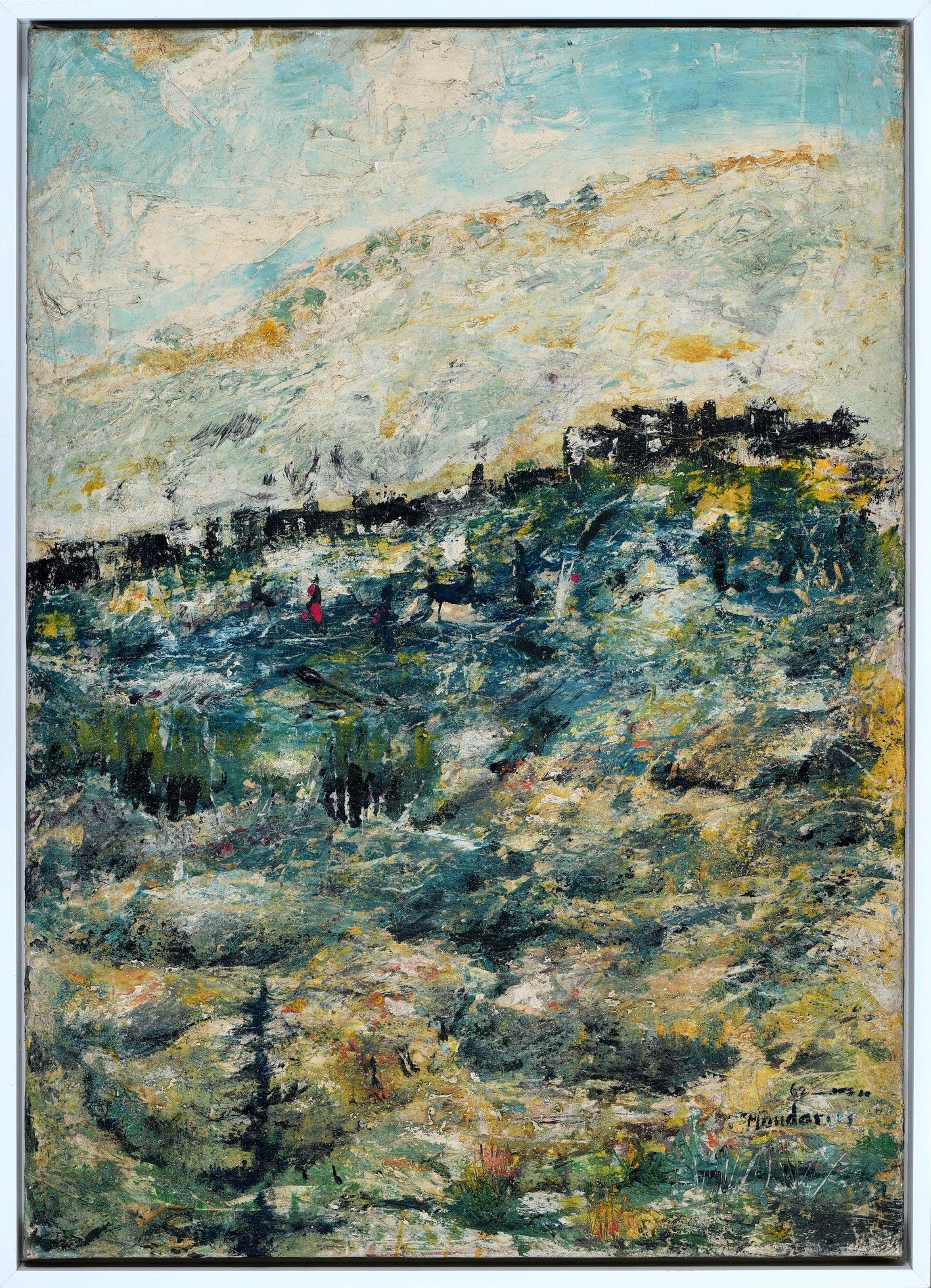
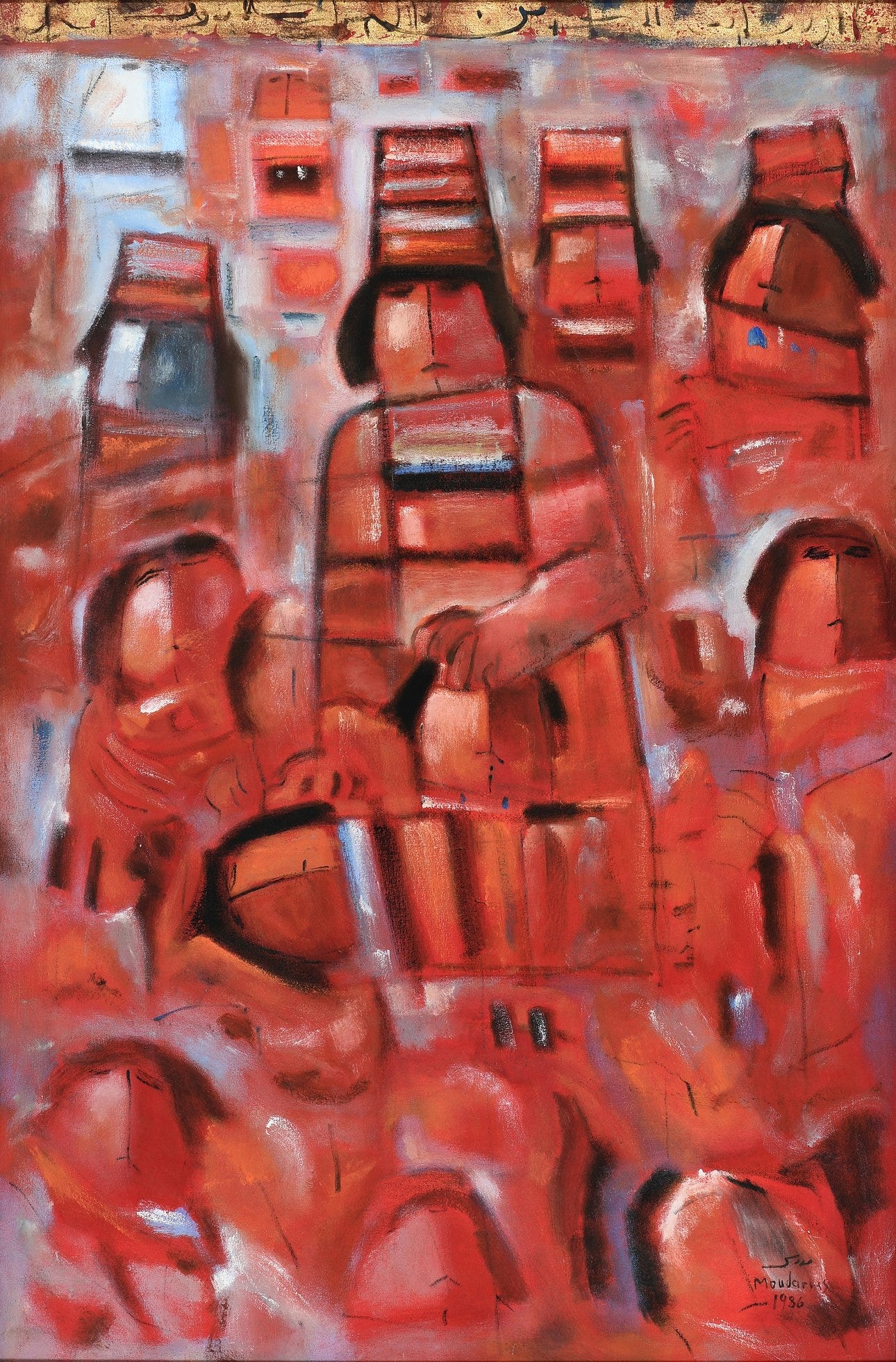
After finishing school, Moudarres left Syria to study at the Accademia di Belle Arti in Rome from 1954 to 1960, and later continued at the École des Beaux-Arts in Paris. Those years in Europe gave him a formal vocabulary he tested against his own material for the rest of his career, moving from an early, self-taught realism into surrealism, and by the 1960s into an abstract expressionism built from thick, textured brushwork, warm earthen colour, and, in some works, sand folded directly into the paint. His figures, when they appear, are unmistakable: solid, square-shaped heads that draw on Assyrian statuary, Palmyrene funerary busts and Christian iconography, rendered in a manner that feels at once ancient and immediate, as though a Palmyrene face had simply been given a new century to inhabit.
Returning to Syria, Moudarres joined the faculty of fine arts at Damascus University, where he taught for decades and served as dean until 1993. It was there that his path crossed with Louay Kayyali, the Aleppo-born painter of social realist scenes. The two would go on to represent Syrian modern art together at the Venice Biennale, carrying a young national art scene onto a stage it had rarely occupied before.
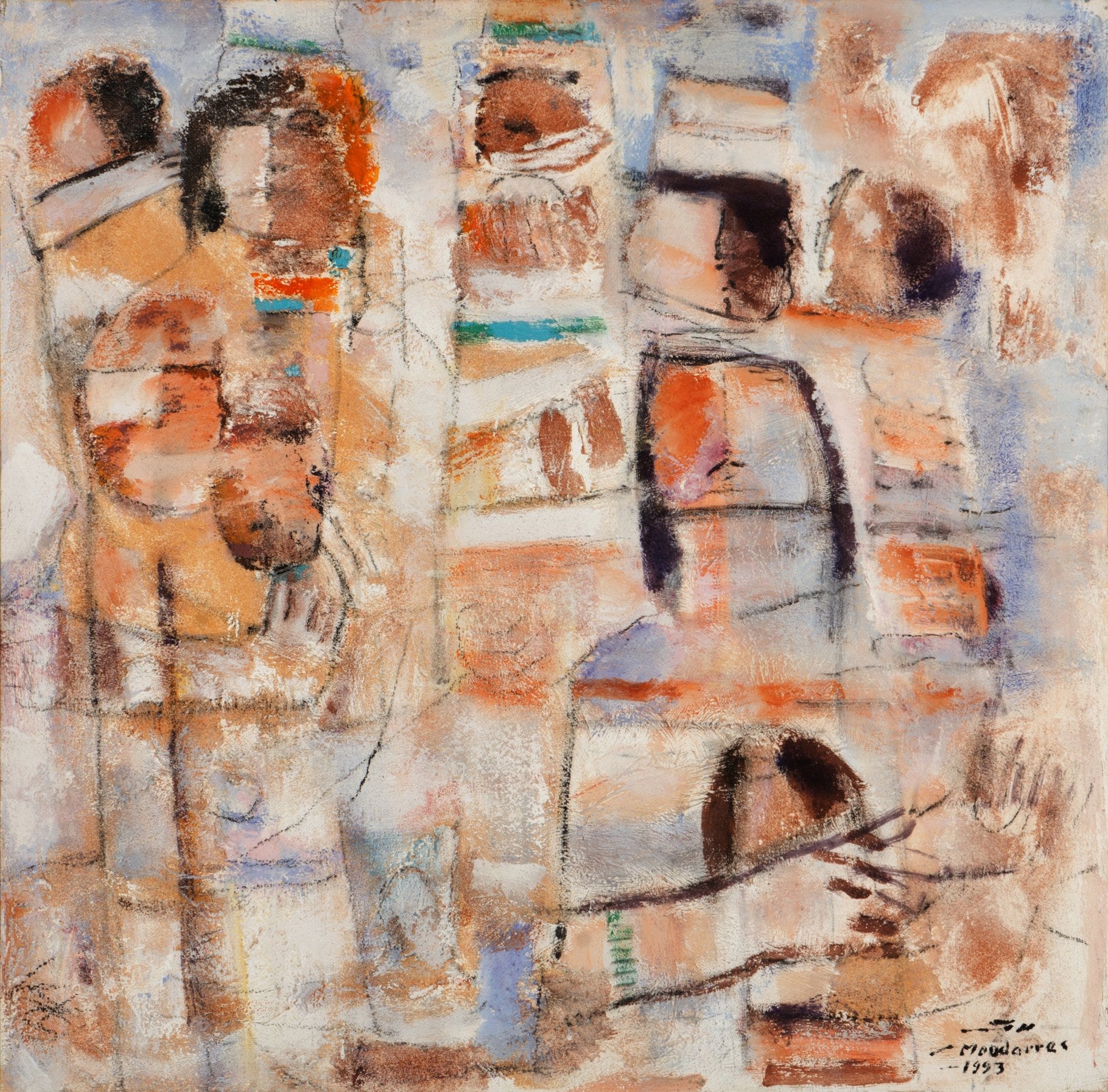
Moudarres's standing as a founding figure of Syrian modernism rests on more than the biennials and the decades he spent at the front of a classroom, both of which mattered enormously to the generations of Syrian artists who trained under him. It rests on the way he built a visual language out of material that was entirely his own: a childhood village, an Assyrian profile, a strip of Aleppan earth, worked and reworked until they became a vocabulary other Syrian painters could recognise and extend. He died in Damascus in 1999, and his paintings now sit in the archives of institutions such as Mathaf, the Barjeel Art Foundation and the Atassi Foundation, where they continue to be read as one of the clearest records of how a modern Syrian art history came to define itself, in earthen colour, from the ground up.
Cover image: Fateh al-Moudarres, Still Life, 1962, oil on canvas, 89 x 69 cm. Courtesy of Mathaf: Arab Museum of Modern Art, Doha.
No posts
Comments
Nothing yet. Say the first thing.
Sign in to join the conversation.