
Inside: A tactical trade setup for rising geopolitical friction, the latest performance metrics for Rick’s Rolling Portfolio, 8 active ETF signals, and a comprehensive NASDAQ-100 decision map classifying 101 stocks into preferred buys and key avoids.
Read this on our Substack for best experience.
America and Iran are once again doing that charming little dance where everybody says they want peace while actively bombing things.
Trump says talks with Iran can continue. He also says the ceasefire is over. The U.S. wants Iran to stop attacking ships. Iran wants more control over traffic through the Strait of Hormuz. The UN shipping agency basically told everybody not to recognize Iran’s attempt to play hall monitor over one of the most important waterways on Earth. Very normal stuff. Definitely the kind of environment where you confidently book a tanker and select “no insurance” to save twelve bucks.
Want to know what matters?
Shipping traffic has slowed again. War-risk costs remain a problem. Ships face higher insurance and chartering costs. Reuters Breakingviews called it a kind of de facto toll: Iran does not need to put up a booth. Fear collects the money automatically.
And what did oil do Friday? It fell.
Brent closed at $76.01. WTI at $71.41. Traders heard that talks might continue and that’s all they needed to hear for a knee-jerk reaction.
Meanwhile, Americans are already paying an average $3.88 a gallon for gasoline, up six cents in a week, right before the midterms. Trump has accused oil companies of price gouging because apparently after decades of deregulation and corporate consolidation, the shocking discovery is that corporations enjoy money. Nobody could have seen this coming. We may need a congressional investigation into whether bears enjoy forests.
Say the shooting calms down, the headlines improve, but shipping stays expensive and weird?
Because Wall Street is pricing the Strait like a light switch: open or closed. The real world, meanwhile, has a dimmer.
And right now, I think the market may be celebrating because somebody turned it from “disaster” to “expensive dysfunction.”
The trade is in that difference - and I reveal it all in my Hot Take later in the newsletter.
0:00
-17:55
The portfolio fell 4.9% between July 1 and July 10, trailing the broader market over this short period. It is a disappointing result, but one brief stretch does not define the strategy.
Since January 2022, $10,000 has grown to $46,277 in Rick’s Rolling Portfolio, compared with $17,833 in the S&P 500 and $20,542 in the Nasdaq-100. The strategy has also beaten the S&P 500 in seven of eight completed six-month periods.
The current window is still underway, so no changes are being made yet. The next portfolio selection will be finalized at the end of July.
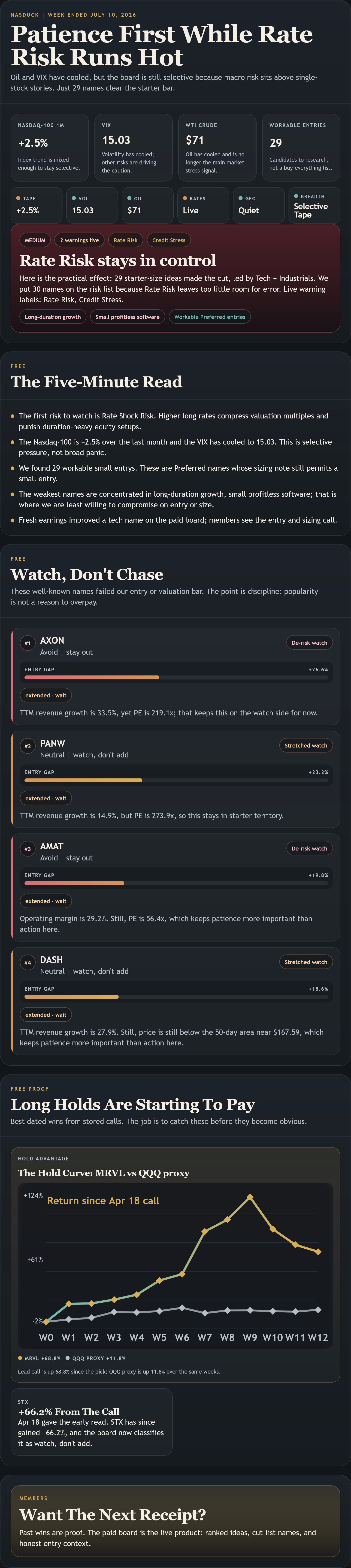
Members get a complete PDF with our view on all 100 stocks!

Comments
Nothing yet. Say the first thing.
Sign in to join the conversation.