

At YC's W26 Demo Day, the fastest-revenue companies weren't the most technically sophisticated. They were professional service firms rebuilt on AI, charging for outcomes with software margins. The LatAm version of this opportunity is larger, less competitive, and almost entirely untouched.
Panta, an AI insurance brokerage in YC’s W26 batch, described its model plainly: “A service business with software economics.”
Charge for outcomes, not licenses. Operate with software margins because AI does 80% of the work and a human handles the 20% that requires judgment or sign-off. It is not a complicated idea. But across the W26 cohort, the companies running this playbook had the fastest revenue of any category in the batch.
Four AI law firms. An AI accounting firm. An AI insurance brokerage. An AI policy consulting firm founded by three ex-lobbyists who sold into their own Rolodex from day one.
LegalOS trained on 12,000 successful visa petitions and reached a 100% approval rate. Arcline signed 50 startup clients before most software companies in the batch had found their first ten. These were not the most technically sophisticated companies at Demo Day. They were the ones that found a desperate customer, charged from day one, and built a data moat with every engagement.
The US framing of this opportunity is about replacing expensive knowledge workers. A law firm associate costs $200K. An AI firm undercuts on price, expands on margin, wins. That logic is sound. But it describes a narrower version of the opportunity than what exists in Latin America.
The professional services market across Latin America is broken in two directions at once. The AI-native service firm addresses both.
The first is the incumbent problem. Professional services firms in the region carry large staff counts not because the work demands it, but because the work has never been systematically automated. Billing rates are not at US levels, but the value delivered per hour is low. Processes are manual by default. Output depends on which person in the firm picks up your file. An AI-native competitor does not need to win on price alone. It wins on consistency and speed, neither of which the incumbent can match without rebuilding from scratch.
The second problem is access. The majority of Latin America’s economy has never had meaningful professional services at all. These are not companies overpaying their lawyers. They are companies that have never had a lawyer, never had a properly structured insurance policy, never had an accountant who did more than file the minimum return. The incumbent is not just weak. In most of the market, it does not exist.
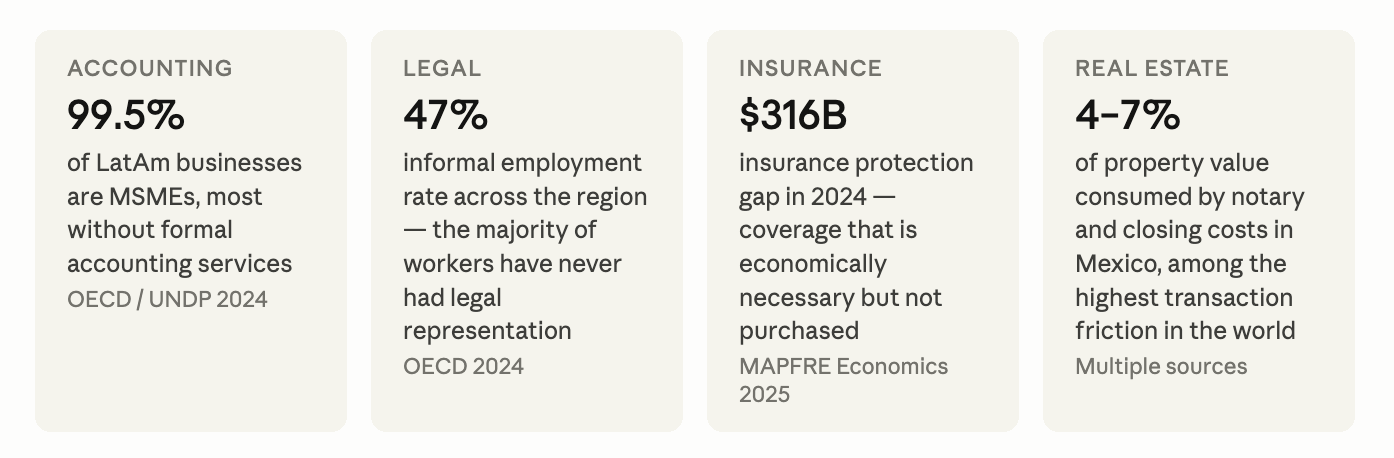
Put those two things together and the opportunity is not incremental. An AI-native accounting firm that starts by serving the 20-person manufacturer with no accountant is not competing with Deloitte. It is creating a market that did not previously exist, and building toward the sophistication Deloitte charges a premium for, at a price the market can actually bear. The most defensible companies in this category will not be the ones that took clients from incumbents. They will be the ones that served the majority the incumbents never reached.
The YC writeup named it directly, and it deserves a straight answer: AI-native services without a data moat have the fastest revenue and the lowest defensibility. The core technology is replicable in weeks. Traditional firms will adopt AI within 12 to 18 months. If the entire moat is LLM plus domain prompts plus human review, a well-resourced incumbent can copy it before the startup reaches Series A.
This is a real risk. Two things specific to Latin America change the calculus.
The first is that the training data does not yet exist in structured form across the region. Nobody has 12,000 SAT audit outcomes in a clean dataset. Nobody has indexed Colombian property title disputes or Brazilian labour litigation results at scale. The first firm to build that owns something a latecomer cannot buy, and the window to build it is open now.
The second is the incumbent adoption timeline. In the US, a well-resourced law firm or accounting practice can retool in 18 months. In Latin America, the primary incumbent in most professional services verticals is a sole practitioner working in Excel and WhatsApp. The adoption timeline for that cohort is not 18 months. The window to establish distribution and accumulate data is substantially longer.
The risk that remains, and it is the one most worth taking seriously, is the solo technical founder in a relationship-sold market. Professional services across the region runs on trust and personal networks in a way that makes distribution the hardest part of the build. A technically excellent product with no path to the first 20 clients is the most common failure mode in this category, not a weak model.
Each of the following has the same underlying profile: a human intermediary charging by the hour or by the transaction, a regulatory environment complex enough to become a moat once you understand it, a majority market with no current access to the service, and an incumbent whose operating model has not changed since the 1990s.
Accounting, tax and financial operations
Every business with any formal activity across the region has a mandatory tax filing obligation, and the regulators are getting more demanding over time. Mexico’s SAT e-invoicing requirements, Colombia’s DIAN audit posture, Brazil’s SPED system. Each of these creates compliance obligations that most SMEs currently manage through an informal contador with no technology infrastructure and limited capacity to do anything beyond the minimum required return.
The opportunity is a stack, not a single service. An AI-native accounting firm enters at the bottom with bookkeeping and reconciliation, moves into tax compliance where regulatory depth creates defensibility, and builds upward into financial operations: cash flow forecasting, scenario planning, board-ready reporting. CFO-quality output at accountant prices, for the company that currently has neither. Every filing outcome and audit result trains the model for the next client. Pilot built to a $1.2B valuation in the US on this exact progression. The LatAm version does not exist at scale.
Moat: regulatory complexity across jurisdictions, proprietary outcome data, client lifetime value across the full finance stack.
Legal services
Most of the LatAm legal market flows through large firms serving large clients on complex matters. Everything below that, which is most of the economy, is underserved in ways that are obvious once you look. The 50-person Colombian company navigating a commercial dispute. The Brazilian founder who has never had proper IP counsel. The Argentine SME that needs a supplier contract and cannot afford the firm that would do it properly.
LegalOS built its defensibility on 12,000 visa petition outcomes. The equivalent cases in Latin America are everywhere: corporate formation, labour compliance, commercial contracts, regulatory filings. All document-heavy, all rule-bound, all currently handled by someone billing by the hour for work that is largely templated. Harvard’s Center on the Legal Profession noted recently that LatAm law firms understand the urgency of AI adoption but remain slow to act. The window is open for a firm that competes with them rather than sells to them.
Moat: case outcome data by jurisdiction, regulatory depth, distribution into the SME segment incumbents have never prioritised.
Insurance brokerage and claims
Latin America has a $316 billion insurance protection gap. Fewer than 15% of the population holds a life insurance policy, against roughly 50% in the US. The market is not underpenetrated because people do not want coverage. It is underpenetrated because the product has never been properly distributed to most of the population, and the claims experience has been opaque and slow enough that trust is structurally low.
The AI-native insurance firm attacks both sides. On brokerage: understanding the client’s actual risk, selecting the right policy, structuring coverage correctly rather than selling whatever pays the highest commission. On claims: preparing documentation, managing submission, handling disputes end-to-end on an outcome basis rather than leaving the client to navigate the process alone. Over 90% of LatAm consumers seek more than one quote before buying insurance, according to McKinsey’s 2025 survey of 7,000 consumers across the region. The market is describing exactly what it wants. Nobody has built it yet.
Moat: claims outcome data, underwriting models trained on regional risk profiles, distribution into the currently uninsured majority.
Real estate transactions and title
Every property transaction in Mexico passes through a Notario Público. Every transaction in Colombia passes through a similar notarial process. These roles are legally mandated and will not be disintermediated. But almost everything surrounding them — due diligence, title search, document preparation, tax calculation, compliance verification, contract drafting — is done manually by lawyers billing by the hour, or not done properly at all. Closing costs in Mexico run 4 to 7% of property value. Registration at Colombia’s ORIP takes 5 to 20 business days after signing. A transaction that takes days in the US takes months here.
The near-shoring wave has made the gap more acute. Industrial property transactions in northern Mexico are happening at a pace the current intermediary infrastructure was not built to handle. Foreign capital entering Bogotá and Medellín faces a process opaque enough to deter rational actors. The buyer in this market is not curious. They are waiting.
Moat: transaction data across jurisdictions, title history, distribution into the foreign buyer and corporate near-shoring segments.
The YC data on this is worth taking at face value. The companies with the fastest revenue in the professional services category shared five traits. Most founders in this space get at least one of them wrong.
They sold the outcome, not the tool. Not “our AI handles your tax filings” but “you will not receive an SAT penalty again.” The customer buys the result. The technology is your problem.
The founder had customer relationships before the product existed. Not warm leads. Actual relationships with people who would take a call and sign a contract.
They charged from day one. No free tier, no pilot purgatory. Customers who do not pay do not engage, do not give feedback, and do not convert.
The customer was desperate, not curious. Banks with $2B in delinquent loans. Clinics denied $150K in reimbursements. In LatAm: the SME facing a tax audit with no records, the property buyer who has lost two months to a title dispute, the startup about to sign a shareholder agreement drafted by someone who has never seen a cap table.
The MVP was embarrassingly simple. A human with good software, not a platform. They described outcomes, not architectures. The platform came later, when the data justified it.
The service is the wedge. The software is the moat. The gap between those two things is where the value gets created, and where most of the mortality in this category will occur.
The strongest pattern in the YC batch, by some distance, was what the data called “I Lived This Pain.” The founder who was the customer before they built the product. They did not need customer discovery because they were the customer. In professional services this means the accountant who spent years serving SMEs and watched the same problems repeat, the lawyer who ran a high-volume practice and knows exactly which 80% of the work is templated, the insurance professional who processed thousands of claims and knows where the delays actually come from. Their former clients and colleagues are their first market. Distribution exists before the product does.
Two other routes are legitimate. The first is the founder who built the platform they are now replacing — the engineer who built compliance infrastructure at a major accounting firm, the product person who worked inside a government tax system and understands the architecture from the inside. They know where AI creates a step change because they built what it is replacing.
The second is what the data called ‘the 50-conversation sprint’. Founders who do not have lived experience but have the intellectual honesty to talk to 50 potential customers before writing a line of code. Ressl AI in the YC batch started as a consulting engagement, used the work to find where the real friction was, and built from there. Harder to pattern-match at pre-seed, but a legitimate path for founders who combine genuine curiosity with a clear answer to the distribution question.
The thing all three have in common is not a job title or a specific number of years in an industry. It is a clear, honest answer to one question: who are your first ten customers, and why will they take your call?
The model has been theoretically possible for two or three years. What has changed is the capability of the underlying models and, more practically, the existence of proof points in the US market that remove the “does this work?” question from the conversation entirely.
When a founder in São Paulo or Mexico City sits across from a potential client today and describes building an AI-native accounting firm, that client has heard of Pilot. When a legal tech founder describes competing with traditional firms, the four AI law firms from YC’s batch are public knowledge. The conversation has shifted from whether AI can do this kind of work to whether the specific founder in the room understands the local regulatory context well enough to be trusted with it.
That is a more winnable conversation. And the window between “this is clearly coming” and “the category is defined and the winner is obvious” is where pre-seed capital earns its return. In Latin American professional services, that window is open now.
Building in this space? We want to hear from you.
We are actively looking to back pre-seed founders working on any of the areas above across LatAm.
Reach out directly. No deck required to start a conversation.
No posts
Comments
Nothing yet. Say the first thing.
Sign in to join the conversation.