
When I started listening to Reflecting Hours, I expected to spend a lot of time thinking about the novel itself.
I thought I’d ask myself:
What worked?
What didn’t?
Would the novel be worth revising?
After all, those are the questions I’ve always asked before when returning to past work.
But, I surprised myself. While listening, I engaged as a reader rather than analyzing the piece as its writer. And I found myself wearing an unexpected hat after I reached “the end.”
Rather than focusing on the novel, my attention widened. I thought about my life’s list of creative projects:
courses
theatrical productions
certification programs
talks
illustrations
and many other containers I’ve built over the years.
I had enough distance from the novel to see a thread running through it. Having seen it, I suddenly saw that same artistic inquiry repeating through my life.
All along, I’d been asking the same questions, exploring the same fascinations.
In fact, the same desire kept showing up. I wanted to help people reconnect with parts of themselves that had been buried beneath performance, fear, busyness, or expectation.
The artistic medium shifted, but my inquiry was consistent.
The realization gave coherence to an assortment of work that sometimes had felt like random, disconnected efforts.
That led me to ask myself:
If I’d been doing my work all along, why had I spent so many years feeling like I wasn’t?
For a long time, I thought I was searching for the right container.
Maybe my work was fiction.
Or, could it be teaching writing?
Workshops? Speaking? Theatre? Illustration?
Maybe it was some combination I hadn’t discovered yet.
Whenever I found a promising container, I poured myself into it completely.
If I decided to design a course, I’d passionately shape the most thoughtful course I could imagine.
If I decided to create a community, I insisted on filling the space with an overabundance of resources, experiences, and possibilities.
I’d push myself and anything I created beyond our limits, believing this was simply what it took to make something excellent.
Looking back, I think something else was happening.
I wasn’t only building containers. I was asking every container to answer a question it could never really answer:
Does my work matter?
I needed every piece to overdeliver because I kept holding my breath and daring to hope.
I’d think: this next project—it will be the one. And when it succeeds, I’ll finally have proof that I’m doing the thing I’m meant to do.
The burden I placed on each project was enormous. Every launch became a test.
I couldn’t ask, “What’s the best expression of this particular idea?”
I was too busy asking, “Can this next creation prove that my perspective, my contribution, is real?”
Of course I kept overbuilding.
Of course I kept trying to fit more and more of myself into every offering.
A class couldn’t simply teach one thing well. It had to convey my entire philosophy.
A book couldn’t simply be a book. It had to carry my entire point of view.
In hindsight, I can see that this pressure didn’t make my work stronger. If anything, it weighed things down. My expectations forced every piece to carry more than it should.
And at some point, too much is just that: too much.
If every project is bogged down in proving your worth, your legitimacy, your future, and your purpose, how will it ever have the spaciousness it needs to become what it, specifically, has the potential to be?
I think many of us do this.
We tell ourselves:
If the book succeeds,
If the launch works,
If enough people say yes,
… then I’ll know.
But what, exactly, will we know?
Maybe that our work matters.
We’ll know we’re on the right path, that we’re finally allowed to trust ourselves.
Revisiting past work, I’m becoming curious.
Have I been asking the wrong question?
The thread that runs through my work, the paradoxes, my fascinations… those didn’t appear because any one project succeeded.
They were there in the tiny projects. In the failed ones. And also in the ones that grew and became beloved.
It’s true: the marketplace can tell us useful things about a particular container. Through response, we might learn whether a course is too complicated, whether a book has found its audience, whether an idea resonates.
But the marketplace isn’t equipped to tell us whether our work matters.
For years, I thought that hard work, trial and error, and market response would lead me to know once and for all: What is “my work?” What am I here, ultimately, to do?
Now I’m hearing something new in one of my favorite quotes from Madeleine L’Engle’s book, Walking on Water:
“The largest part of the job of the artist is to listen. To listen to the work and to go where it tells you to go. And this involves faith. Letting go of your own control and having faith in something you do not control.”
Somewhere along the way, I think I’d confused listening to the work with waiting for permission.
I kept asking the world to tell me which pieces mattered most.
I kept hoping success would reveal the shape of the work itself.
But I think the truth is quieter, more personal than that.
Genuine listening to our creative work means releasing it from expectations. And particularly, never asking any one piece to carry the entirety of our being on its own.
Each piece needs to find its own meaningful shape.
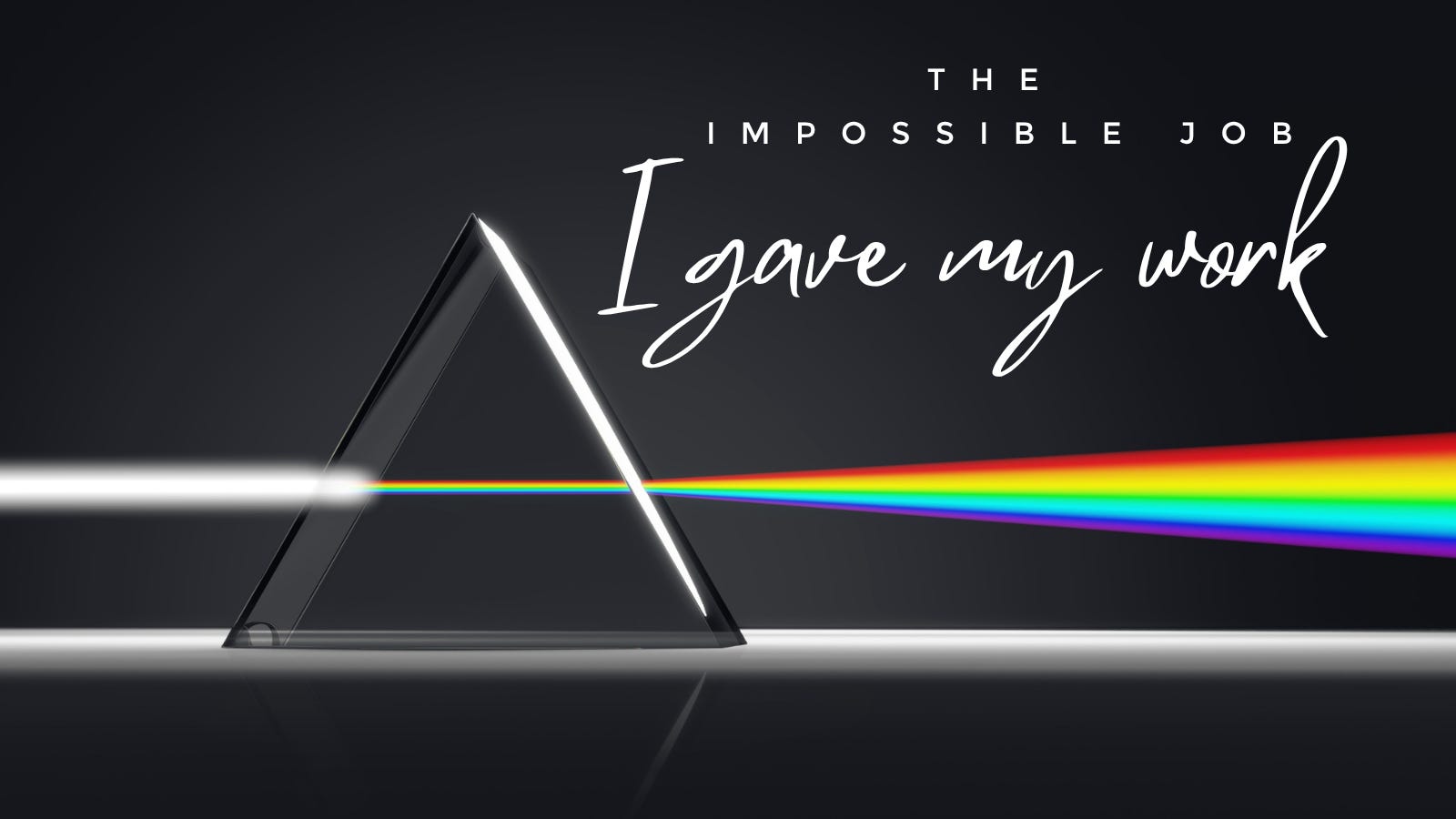
As they do, and over time, our collection of creative work becomes a prism of many sides. Each facet adds beauty to the whole. As the body of work grows, its collective meaning continues to clarify, and each individual piece gains depth.
How remarkable!
That means we can trust a workshop to simply be one meaningful experience.
We can trust a story to elegantly follow a character’s unfolding journey.
We can trust ourselves to create, and create again, each work expressing one piece of something larger.
If you find yourself taking a deep breath right here, feeling a weight lift off your shoulders, you’re not alone. Me, too.
Would it be too much to say that I’m existentially relieved?
Possibly.
But, that deep breath is coming at a soul-level, not a surface one.
I think I’ve finally moved past looking for the perfect container. And in the space that creates, a new question has emerged:
What is this landscape I’ve been creating all along?
I can see its outlines now, even if I can’t fully describe it yet.
For now, I’m learning to listen.
No posts
Comments
Nothing yet. Say the first thing.
Sign in to join the conversation.