
It was my birthday last week, and this one feels different than others. This birthday felt important, in a way I’d like to try putting into words.
Life tends to speed past. I think this is part of getting older in any era, but especially in this current moment. Things move fast.
And I think it’s important now and then to pause, to say, “Wait a minute—woah!” To name an uncommon moment for what it is.
Naming an experience is one way it becomes more than simply another passing hour in a lifetime of hours. When we say, “This experience matters especially, and here’s why,” we place a marker in our life’s trail. We can return to these markers, and use them to more clearly see our story—past, current, and future.
For the past few months, I’ve been revisiting old journals, old ideas, old creative threads, and trying to understand the shape of my own story more honestly. The process has been both joyful and painful, but mostly, it has been clarifying.
Along the way, my curiosity sparked, giving me courage to return to a novel I wrote many years ago, one that I shut away after it failed to find a publishing home.
I’ve been using an app called Speechify that reads docs with surprising quality, and I wondered: might I listen to this book as a reader, the way I might listen to any other audio book?
… It could be an interesting birthday present to myself.
Seriously? another voice in my head argued. Reflecting Hours was rejected. You put it in a drawer for a reason. And now you want to suffer through it for your birthday?
Just a chapter or two, I promised myself. I could stop at any point.
And so I started listening. As scene by scene unfolded, I kept being drawn in further. I didn’t want to stop.
When I first wrote Reflecting Hours, I knew the book mattered to me. I had already published several books by then. I understood the difference between writing competently and writing from my artistic heart.
And with this book, I’d dared to write from that deeper place.
Reflecting Hours wrestles with imagination, identity, reflection, performance, and perception. It explores the ways we become trapped inside versions of ourselves that are polished for survival but disconnected from truth.
These are questions I care about, questions I’m still exploring in my current projects.
But when Reflecting Hours didn’t sell, I didn’t only leave it behind. I let it become proof that either:
a) what I meant to say wasn’t what others wanted to hear, or
b) I wasn’t artistically capable of putting into words the things my heart wanted to say.
Either way, needless to say, the book got in my way.
Listening to it has been one of the oddest experiences of my creative life. I’d closed the story out of my mind long enough that, at many points, I genuinely didn’t know what would come next.
I certainly don’t suddenly think it’s a perfect novel. It isn’t.
With the perspective distance offers, I can hear places I would tighten. I’d shape certain interactions differently. There are many sections where I can hear my artist self still developing.
But I also hear something else very clearly now: Reflecting Hours was a real piece of artistic work.
Entirely separate from the measures used to evaluate whether a book is publishable, such as whether it is commercially viable or “important,” this book is not “an unsuccessful attempt at a novel,” the way I’d come to believe.
When listening, my response was not to analyze or put on my editorial hat, but instead, like a reader, I simply stepped into the questions.
It felt like reading a book written especially for me.
I think I spent many years unconsciously believing that external acknowledgement is the way to know if something you make is capital A “Art.” Even though I routinely tell my students otherwise, when it came to my own work, I relied on the world to reflect back to me whether what I produced was meaningful.
Maybe I could see that especially clearly because reflecting itself—both personal reflection and what the world reflects back to us—lies at the heart of this book.
Rereading it, I realized that a deep creative thread has run through my work for as long as I can remember.
I could see it in the novel.
And further, illuminated by the novel, I could spot it everywhere else:
in the workshops I built
in the imaginative experiences I’ve created for young writers
in the Illuminary
in the way I teach
in the way I think about story
in the questions I keep returning to over and over again
Regardless of medium, the questions themselves are ever-present.
In this new light, I also saw a deeper truth:
For a very long time, I’ve been longing to “become an artist” when all along I’ve been engaged in a continuous body of work.
I’ve been doing the work I’m here to do.
It’s like someone has gently handed me a mirror and said, “That thing you keep saying you can’t wait to do? You’re already doing it. You’ve been doing it for a very long time now.”
And unlike I might have done in the past, I don’t experience this realization as regret. I just hear the quiet truth of it: I’ve been doing my work all this time. And now I can continue with more gentleness, ease, and flow. I don’t have to struggle to become something out of reach, but instead, I can work right here, inside the becoming itself.
That’s why I’m doing my best to pause and put the experience into words. Because it feels both like any other momentary insight, and also like a life-changing understanding.
I think that if I dare to walk through this doorway—and if I allow myself to carry this truth as I go—the next chapter of my life will be different than the last.
It begins with a deeper trust in my own voice, my own knowing.
Not every artistic work flows naturally through traditional commercial channels. But work can be meaningful—life-changing, even—without outside accolades.
It continues with recognition of something core to my work: the way I understand imagination itself.
I think many adults believe imagination belongs primarily to childhood. We no longer recognize the ways we still use it every day. With imagination, we narrate our lives, imagine futures, rehearse fears, construct identities, interpret the actions of others.
Imagination, in fact, is one of the primary ways we metabolize reality.
And when imagination becomes disconnected from reflection and relationship, it can turn against us. We begin performing versions of ourselves instead of inhabiting ourselves.
And finally, it leads to deeper clarity about the work I want to make going forward.
I want to make work that allows people—of every age—to use their imaginations in ways that are relational and restorative.
I want to continue reconnecting with the quieter, more coherent part of myself, and I want to create spaces where others can do the same. I want to make art that reminds us of who we are, that points to the parts of ourselves that too often get buried beneath performance, productivity, fear, and noise.
I’m not sure where this next chapter will lead, but I’m beginning to catch glimpses of the possibilities. And importantly, I’m no longer asking myself: when will I finally become an artist? When will I start making real art?
Because now I know this: Art doesn’t become real only once someone else declares it worthwhile. All that’s necessary is to tune into our own voices, to listen deeply, and to take ourselves seriously when we know we’ve made something that matters.
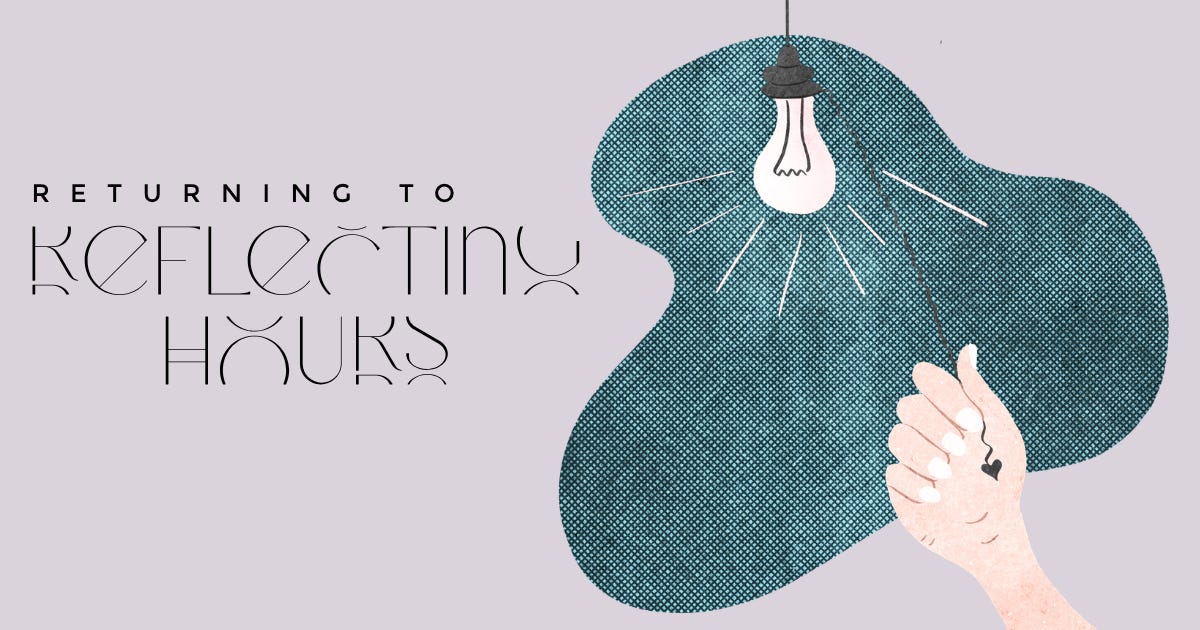
The work itself, and the knowing that comes along with it, can light the path forward.
No posts
Comments
Nothing yet. Say the first thing.
Sign in to join the conversation.