
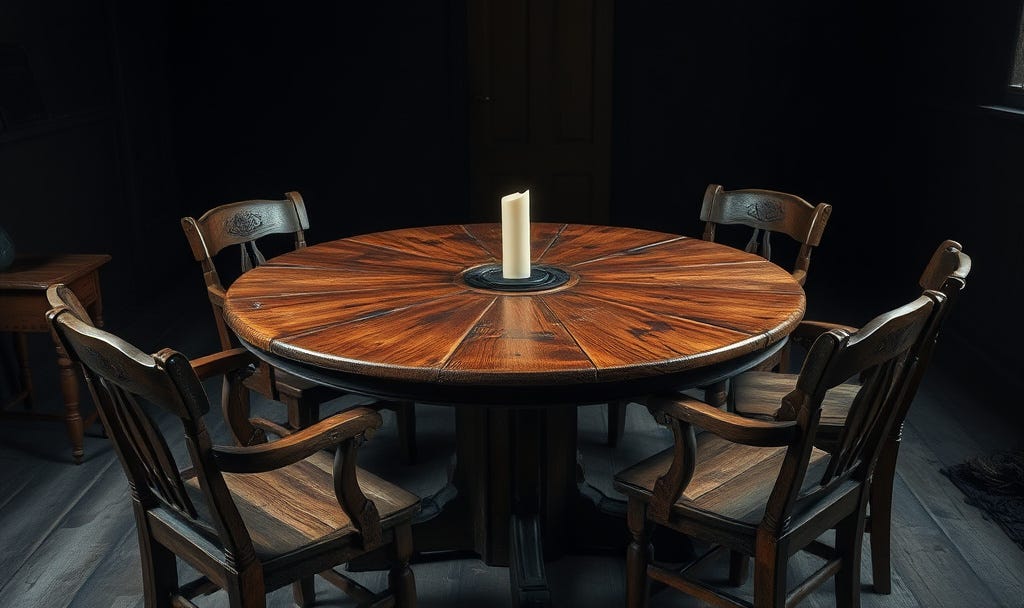
Picture a real table. Wood, not marble. A candle in the middle, a few empty chairs, and people who came for different reasons.
This quiz tells you which chair is yours.
My book, Ancestral Séance, comes out next year. Think of this as your pre-invitation, your early seat at the table. The book is designed around thirty different seances, all save one can be done without other sitters.
Answer the eight questions below, keep track of your letters, and count them up at the end. The letter you pick most is your seat. Tie? You sit in two chairs.
1. The table’s set and the candle’s lit. What are you doing in the first five minutes?
A. Already listening. You felt someone before you sat down.
B. Checking the doors, making sure everyone’s comfortable, setting the salt.
C. Opening your notebook and writing the date at the top of the page.
D. Holding the one photograph you brought, the person you came here for.
E. Watching everyone else and wondering how much of this is real.
F. Setting one more plate than there are living people at the table.
2. Something knocks three times on the underside of the table. Your first thought?
A. “There you are.” You answer back.
B. “Is everyone okay?” You check the circle first.
C. “Three knocks, 8:14 p.m.” You write it down before you forget.
D. “Is it you?” You say the name you came to say.
E. “Whose knee was that?” You look under the table.
F. “Welcome. Come sit.” You nod toward the empty chair.
3. In a pinch, with nothing else on hand, which everyday object do you reach for?
A. A mirror. You’ve always felt watched in them anyway.
B. Salt and a candle. Something to hold the edges.
C. A pen and any scrap of paper. The back of a receipt works.
D. A single photograph. One face, one name.
E. A Magic 8 Ball. At least it admits it’s guessing.
F. A kitchen chair. Pulled out, turned to face the room.
4. A friend wants to reach her grandmother, who passed over last spring. You say:
A. “Sit with me. I’ll see who comes.”
B. “Let’s do it right, so you’re safe. I’ll walk you through it.”
C. “Tell me her full name and her dates first. Everything you know.”
D. “I understand. There’s someone I’ve been trying to reach too.”
E. “Alright, but let’s not fool ourselves about what we hear.”
F. “Come for supper Sunday. We’ll set her a place.”
5. What actually pulls you toward ancestral work?
A. You’ve felt the passed-over your whole life. You can’t not.
B. Somebody has to hold the space so nobody gets hurt.
C. The records. The names. The proof that they were here.
D. One specific person. You have a question only they can answer.
E. You want to know what’s real and what’s the mind filling gaps.
F. Nobody should be forgotten. You keep a chair for all of them.
6. The night goes sideways. The candle gutters, the room goes cold. You:
A. Stay in it. This is the part you came for.
B. Take charge. Close the door, ground the circle, end it clean.
C. Keep writing. Cold room, 9:02, candle out. It all matters.
D. Ask your question anyway, fast, before the door shuts.
E. Note that cold air sinks and old houses have drafts.
F. Steady the table. “We’re alright. Nobody leaves upset.”
7. Which one sounds most like you at a family gathering?
A. You always know who’s about to cry before they do.
B. You’re the one making sure everyone ate and Grandpa took his pills.
C. You keep the photo albums and you know all the dates.
D. You ask the oldest relative the questions nobody else asks.
E. You gently fact-check the family legends.
F. You save a plate for whoever couldn’t make it.
8. It is all in your intent. So what’s yours, when you sit down?
A. To listen, and to let them speak through you.
B. To keep everyone safe enough to try.
C. To make a record that outlasts the night.
D. To reach one name and get one answer.
E. To find out what’s really there, honestly.
F. To make the passed-over feel welcome at the table.
This post is free for everyone. Paid subscribers receive monthly Witch’s Ledger, Dark Moon Omens, and seasonal presentations by community leaders.
Mostly A’s: The Medium (Head of the Table)
You’re the one who feels a Spirit first. Before anyone sits, you already know the room isn’t empty. You don’t need a board or a bell. Your gift is that the passed-over come close to you without a lot of coaxing. Your work is learning to tell their voice from your own. My book’s opening chapters are built for your chair: how to open, how to listen, and how to close the door so you don’t carry passengers home. You’ll want the pages on discernment too. Feeling everything is not the same as hearing clearly.
Mostly B’s: The Keeper of the Circle
You’re the one who keeps everybody safe. You check the door. You set the salt. You notice when someone at the table has gone pale and needs to stop. Mediums get the credit, but nobody reaches anyone without you holding the boundaries. Your spellwork is protection and it matters more than it ever gets thanked for. The risk for you is doing so much tending that you never sit down and reach for anyone yourself. The chapters on setting the space and closing it clean are yours. So is the reminder that the keeper gets a seat too, not just a post at the door.
Mostly C’s: The Scribe
You’re the one with the pen. While everyone else is caught up in the feeling, you’re writing down the time, the knock, the name, the exact words. You know a night nobody recorded is a night that didn’t happen, at least not on paper. This is where séance and genealogy shake hands. Your gift is a memory that outlasts the room. Your caution: don’t get so busy recording that you forget to look up and be there. The practices in the book were made for people like you, and the séance record format will feel like coming home.
Mostly D’s: The Seeker
You came for one person. You’re not here for a general audience with the Beloved Dead. You have a name, a face, and a question you’ve carried for as long as you can remember. That focus is your power, and it’s also your risk, because wanting an answer badly is exactly how a person talks themselves into hearing one. The book spends time on how to ask a question. Your seat is the one everyone secretly understands. Most people come to the table for one name, even the ones who swear they don’t.
Mostly E’s: The Witness
You showed up, and you still don’t fully buy it. Good. Every table needs one doubter. You’re the one who checks whether that was a spirit or somebody’s knee against the table leg. There’s no proof of most of what happens in that room, and you’re the only one willing to say so. Your gift is that you keep the whole practice honest. Your work is staying open. The book won’t ask you to believe a word. It’ll ask you to try it at your own table and see what actually happens.
Mostly F’s: The One Who Sets the Extra Plate
You’re the host. Your instinct is hospitality, an extra chair, or a chair left open for whoever couldn’t make it in the flesh. This is old practice. People have set a plate for the passed-over at supper for as long as there have been suppers. Your gift is warmth, the kind that makes the dead feel invited instead of summoned, and nobody arrives cold to your table. Your caution is remembering you’re allowed to want something from them too. You don’t command the passed-over. You make room, and you wait.
My book, Ancestral Séance, arrives next year. This was your pre-invitation. The chair is already pulled out.
So which seat did you land in, and is it the one you’d have chosen for yourself? Tell me in the comments.
Comments
Nothing yet. Say the first thing.
Sign in to join the conversation.