
We had a goal date to close a project in May, but we closed it in June.
Pretty normal scenario for most remodelers. But when I sat down with our May financials, that sales cycle shift showed a real-world example of the importance of the WIP adjustment.
Using round numbers here’s what May looked like on paper.
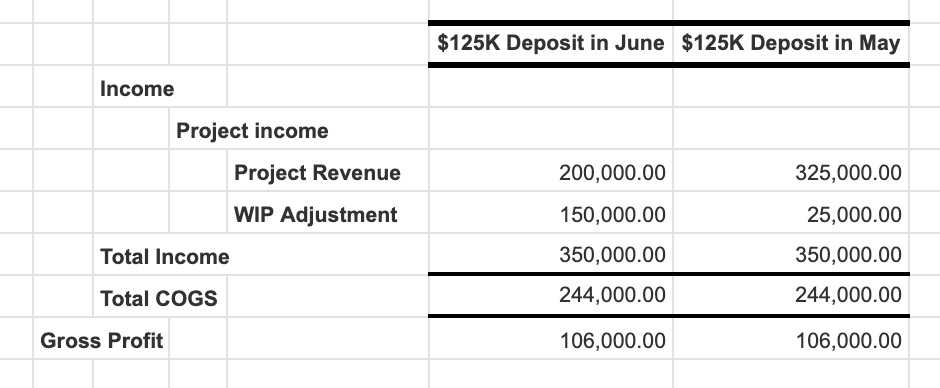
Our build revenue came in at $200,000. Lower than we wanted. But sitting right below it was our WIP adjustment, the monthly reconciliation that converts what we billed into what we actually earned, positive $150,000.
That’s a big adjustment. Big enough that if you only looked at the $200,000 line, you’d think the month was soft. Look at the $350,000 it actually represents once the WIP adjustment does its job, and the picture changes completely.
So why was the adjustment so large? Because our team had been working on and generating billings from existing projects without us bringing in large deposits from new sales. Basically we were earning the money that we already had in the bank.
Now say we’d closed the deal and collected that deposit in May. Build revenue goes up by the deposit amount. The WIP adjustment shrinks by that same amount, because now that deposit is revenue but unearned. The definition of an under-billing. Add the two lines together in either scenario and you land in the same place: $350,000 in real, earned revenue for the month.
Same gross profit dollars. Same actual money the company made. The only thing that moves is how the number gets split across two lines on the P&L, depending entirely on whether a client started or ended their vacation on Memorial Day.
When a company shows a large WIP adjustment, the first question I ask is whether they took a big deposit that month. Billing timing, not profitability, moved that number. Taken as a percentage of gross profit to revenue, I’d have drawn two completely different conclusions about the same month depending on nothing but a signature date. The WIP adjustment evens the numbers and shows the true financial picture.
Here’s how to check this in your own numbers, the next time your gross margin swings hard from one month to the next.
First, before you react to a revenue total, find your WIP adjustment for the month and ask which direction it moved and by how much. A big swing in either direction is a signal to look closer, not a verdict on its own.
Second, ask whether a deposit or milestone payment landed that month, on any project. That single event can move an under-billing or over-billing by tens of thousands of dollars without a single hour of production happening differently.
Third, do the math I just did above. Add your billed revenue and your WIP adjustment together and compare that total to last month’s. If that combined number is stable, your business didn’t get better or worse. Your sales cycle just moved.
That third step is the one most people skip, because the revenue is easy to total up as the month progresses and its sitting right there at the top of the report. But the WIP adjustment takes time and effort to do accurately. This example shows why you need to know both numbers if you want a clear picture of where you stand financially at month end.
No posts
Comments
Nothing yet. Say the first thing.
Sign in to join the conversation.