
Eric Aaron Castro argues that an extension of Faustian civilization is possible only through an affirmation of the Spanish spirit, which he described as possessing a “Faustian drive fused with eschatological yearning and honor-driven fatalism”. Castro does not only present a controversial claim here, for many obvious reasons, but presents a rather original and unique analysis of the complex dynamic between the different national spirits that drive Western culture. This is also an argument that clashes, and potentially overlaps, with the concept of Aridoamerican culture presented by Aspen in the Spenglerian Optimism series (Read his contribution here!). Castro’s argument here, whether one agrees with them, or not, should be clearly taken seriously. For although I do somewhat disagree with some points he makes, or rather, his approach to the topic, there is a lot of truth in what is being presented here — truths that should be taken seriously at this stage of Western culture’s life-cycle! I will not say much now, since these serious ideas deserve a proper critique which I will be working on soon. Enjoy the read!
*Eric Aaron Castro is not on Substack yet, but will hopefully be joining soon. If you want to contact him please reach out to him on his Linkedin page:
https://www.linkedin.com/in/ericaaroncastro/
Society, Soul, and Style: Spengler and the Question of the West in the 21st Century
The public needs a serious update of the status of the world-civilizations in 2025. Right now, most people’s perception of the world is via piecemeal sight; fragments which consist of isolated headlines, viral trends, algorithmic feeds. Like a pointillist painting viewed too closely, our perception is made up of disjointed dots: economic anxiety, technology hypes, identity politics, digital surveillance, spiritual malaise. What’s missing is the frame; a world-historical structure that brings individual clarity into an operative state of awareness. If we want to win the west, we need a shared understanding from which to act on because when there is no overarching coherence structure, action does not lead to design, but to damage.
“Faustian man does not feel that he belongs to any particular group, but rather to a world-historical idea.” — Oswald Spengler. So, what is this world-historical idea of the West?
Faustian also known as the Western culture is the civilizational form that originated in Europe and extended outward through its cultural projections: the Americas, Australia, New Zealand, and other settled societies shaped by European institutional mechanisms: languages, religious tradition, legal systems, educational institutions and scientific theories.
Oswald Spengler proposed a cyclical theory of civilizations. For the West, he identified two primary cultural forms (Apollonian and Faustian) that have shaped its civilizational trajectory:
Apollonian (Classical: Greek/Roman) Culture
Emergence: circa 1100 BC (early Homeric period)
Flourishing: 800 BC – BC 100
Civilizational Phase / Decline: 100 AD – 500 AD
Faustian (Western: Latin Christian) Culture
Emergence: circa AD 900 (Carolingian Renaissance)
Flourishing: 1000 AD – 2000
Civilizational Phase / Decline: 2000 – Present
Western identity can be seen as a synthesis: the Apollonian ideals of clear, measured reason; a disciplined appreciation of form and proportion; and a focus on the tangible, immediate world are given new life within the Latin Christian framework, which emphasizes individual dignity, moral responsibility, and a transcendent inwardness that orients life beyond the temporal toward the eternal. As Colombian philosopher and aphorist Nicolás Gómez Dávila wrote, “The dignity of the individual is a Christian cast made out of Greek clay.” This is the aphoristic image that truly captures how Christian ethics have molded classical Greek ideals into the distinctive Western worldview and aligns seamlessly with Spengler’s two-phase cultural cycles that the West has undergone. To first know the West, we start here.
“We should of course press our inquiry only so far as the insight of man’s reason is allowed to climb the height of heavenly knowledge” — Boethius’ Theological Tractates: De Trinitate.
Boethius captures the fusion of the Greek reverence for rational inquiry with the Christian belief in divine transcendence. Boethius represents for us the moment where reason becomes a ladder not merely for understanding the world, but for approaching the eternal.
It is in this moment that we see a genesis of the inner drama that defines the Faustian spirit.
Through Spengler’s lens, the Latin Christian West is animated by a Faustian spirit (reappropriated from Goethe’s tragic play Faust): marked by an unquenchable striving, a relentless pursuit of knowledge, and an unrelenting confrontation with the Infinite. These are not merely cultural traits; they reflect the very spiritual architecture of Christianity, with its profound orientation toward eternal life. Unlike the cyclical cosmologies of Apollonian Civilization, Christianity introduced a linear conception of time: a historical arc with origin, purpose, and consummation. This sense of directed history (narrative time) is Christianity’s unique contribution to the civilizational imagination, shaping a shared outlook in the West.
This table is a succinct intellectual genealogy that tracks the evolution of Western identity:
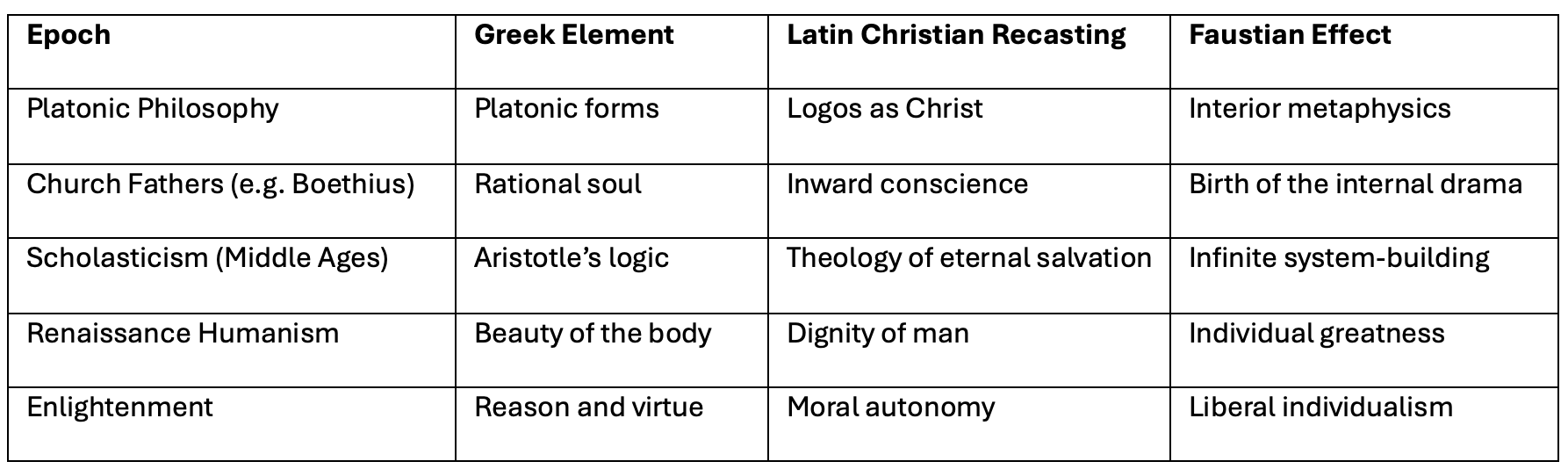
The Faustian (Latin Christian) West begins to express itself through new and distinctive forms. In St. Ignatius of Loyola’s Spiritual Exercises, we see the emergence of a uniquely Western interior metaphysics: a disciplined inward journey of the soul toward divine truth. Shakespeare’s Hamlet dramatizes the birth of the internal drama, revealing the deep conflict and conscience within the individual. The birth of the scholastic, monastic university as an institution gave rise to infinite system-building, crafting comprehensive intellectual frameworks that sought to explain all of existence. The Renaissance ideal of individual greatness is powerfully embodied in Michelangelo’s statue David, celebrating human dignity and creative potential. Finally, Immanuel Kant’s philosophy affirms liberal individualism, in which a modern, rational individual is free to choose and act according to moral autonomy.
“It is necessary that there be as many forms of human characters as there are forms of regimes.” — Plato, Republic, 544d. So, what are the traits of a Western soul in the West?
As Oswald Spengler writes, there are three dominant strands of Faustian DNA: “Only the Spanish, the English, and the Prussians have given European civilization universal ideas.”
Anglo-Liberalism expresses itself through bourgeois pragmatism, empirical inquiry, and expansionist energy. Rooted in Protestant individualism and a mercantile moral order, its society tends toward atomization, governed more by contracts than covenants. The civilizational archetypes it produces are the Merchant, the Engineer, and the Administrator; world-builders through commerce, industry, and bureaucratic infrastructure. Historically, this spirit animated the British Empire, driven by maritime trade, colonization, and structured governance. The Industrial Revolution exemplified technical innovation wedded to market logic, while the Protestant Reformation emphasized private conscience and individual interpretation of faith. America’s founding synthesized Enlightenment ideals into pragmatic governance. Thinkers such as Adam Smith and John Locke codified the ethical logic of property, liberty, and markets, while global financial centers like the City of London and Wall Street emerged as the symbols of Anglo civilization’s organizing principle: finance and flow.
Prussian-German Idealism expresses itself as philosophical, introspective, artistic, and systematic. Its civilizational roles are those of the Thinker, the Poet, and the Metaphysician; figures who seek truth not through accumulation, but contemplation. This tradition produced German Idealists like Kant, Fichte, and Hegel, who viewed reason as a path to spiritual self-realization. The Romantic poets like Goethe and Schiller channeling inner life into prophetic literature, while the Humboldtian model of the University of Berlin made soul-cultivation (Bildung) the telos of education. In music, Beethoven and Wagner transformed sound into metaphysical drama, elevating national consciousness. Politically, Bismarck's Realpolitik merged pragmatic governance with cultural warfare (Kulturkampf), conceiving the state as a moral organ which Spengler expands on. Finally, Nietzsche exposed the nihilistic nature of modernity and called forth the Zarathustra’s Übermensch as a response.
Spanish Catholicism, born in Spain and extended throughout the Spanish-speaking world, is defined by its religious fervor, sacrificial ethos, militant mindset, and mystical vision. It embodies the spirit of the Knight, the Crusader, the Conquistador, and the Martyr; those who give their lives for faith, glory, and eternal purpose. This ethos drove the Reconquista, an 800-year spiritual and military campaign to reclaim Iberia followed by the Inquisition to defend sacred order against any encroaching chaos. In the Age of Exploration, figures like Columbus, Cortés, and Pizarro sought not only conquest but conversion. Charles V aspired to a universal monarchy that could unite Christendom. The Jesuits, led by St. Ignatius of Loyola, became global agents of evangelization missions. Spanish Baroque mystics like St. Teresa of Ávila and St. John of the Cross mapped the soul’s inner trials in search of divine union. And in Cervantes’ Don Quixote, the Spanish soul appears in its most poignant form: the tragicomic last knight of a disenchanted world; a literary martyr for transcendent ideals.
Today, in 2025, these Faustian forms have morphed. Anglo-Liberalism has scaled into Global Neoliberalism, dominating commerce, governance, and digital life; but increasingly devoid of spiritual direction. It has substituted Protestantism with secularism and relativism. Its mercantile nature is represented by the arbitrary crypto-currency exchanges as well as obscured monetary transaction mechanisms such as blockchain. Its atomization of the individual is represented in social media application developing everyone into their own personal brand and “entrepreneur of the self” pressurizing all into self-optimization trends. Now, with the exhaustion of the market ethos, we are witnessing counter-impulses emerge. Prussian-German Idealism has slowly seen the rise of a diffident Neo-Romanticism stressing an awareness to Neoliberalism with an undertone of an aesthetic pessimism. Spanish Catholicism, long maligned, is forming as Reactionary Hispanidad; a metaphysical resistance rooted in a tradition, a spiritual hierarchy, and a resurrected hidalguía of the soul.
Now, Spengler’s core Faustian forms of the West have morphed into late-stage expressions:
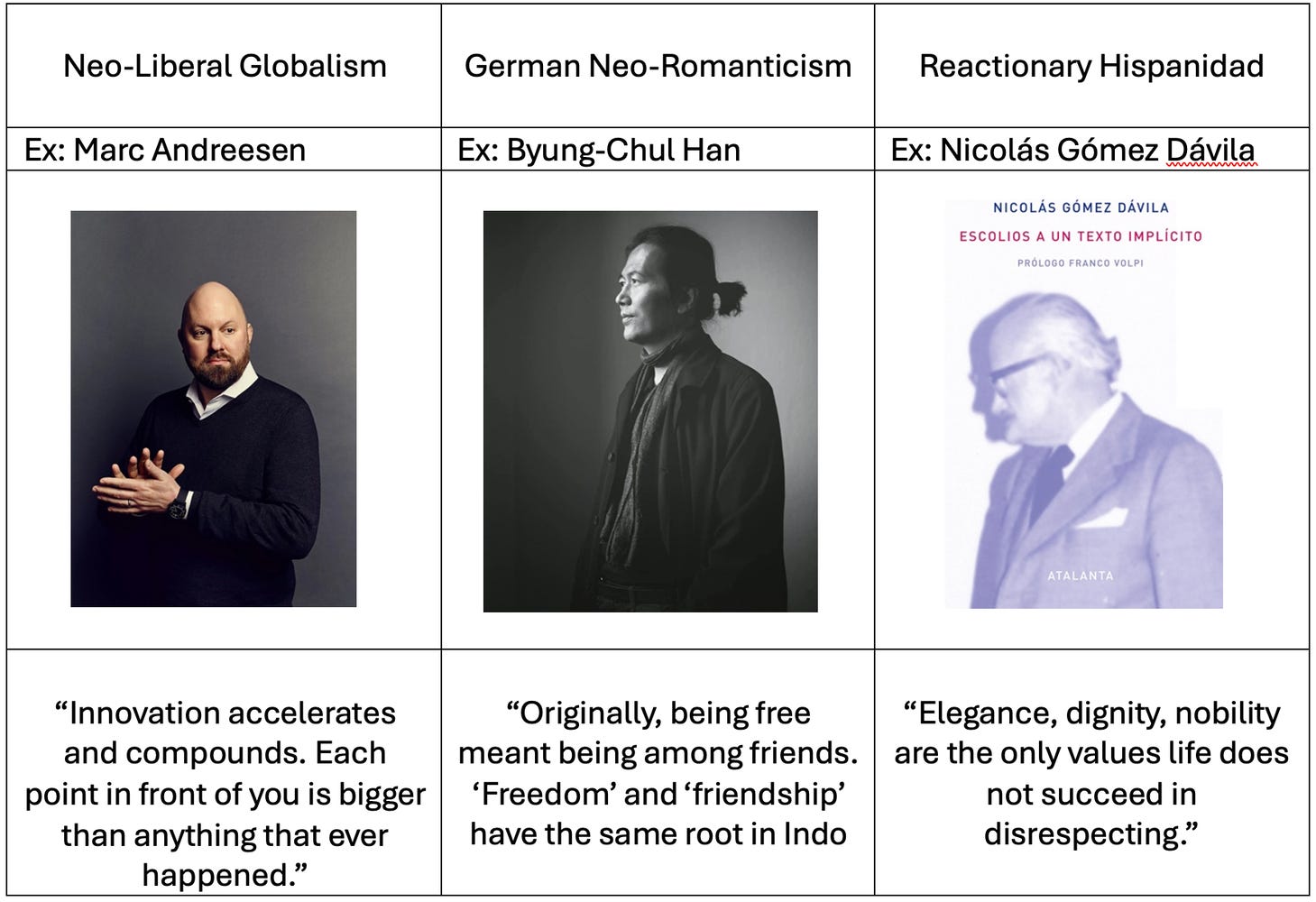
Oswald Spengler, who detested the Anglo-Liberal aka English Liberalism, predicated that the English Liberal strain, which is Protestant, mercantile, atomized; representing, in his schema, the bourgeois phase of Faustian civilization, would be spent, producing, What Peter Turchin refers to as, too many counter-elites. Now, we are witness to the exhaustion of the late stage-expression of the Anglo-Protestant strain, Neo-Liberalism, which is shallow, decadent, and fated to collapse under the weight of its own self-interest disguised as virtue.
Goethe’s 1827 poem “Amerika, du hast es besser” (“America, you are better off”) is often misread as a simple compliment to the New World. In truth, it's a subtle, even ironic reflection on America's lack of historical depth and civilizational rootedness compared to Europe. He intuits that a civilization without roots may struggle to endure, its trajectory governed by expansion, utility, and individual striving but lacking gravitas or metaphysical depth. In the Spenglerian sense, the United States embodies the Faustian will to power but it is unmoored from the sacred, a pure expression of the civilization’s final, dissolving stage.
Now, the Spanish are unique in this sense. They retain closer ties to the Greco-Latin heritage than either the English or Germans. In many ways, they are more Roman than the Italians themselves being heirs to Catholic imperialism. For Spengler, the Spanish strand represents a hybrid: the Faustian drive fused with eschatological yearning and honor-driven fatalism (e.g. Inquisition, Reconquista, Conquistadors, Holy Roman Empire, Jesuit Missionaries, etc.) The Spanish are the knights, crusaders and martyrs of the Western world with a passionate embrace of death, honor and the eternal. As Franco once called Spain “the spiritual reserve of the West,” we may now ask: Could it again become a source of counter-modern vitality? Spain, after all, led the Counter-Reformation and resisted the anti-Christian revolution of modernity in 1936. Its past (global, heroic, missionary) has long been defamed by Enlightenment critics and secular modernizers. But perhaps, precisely through its rejection, a new cultural and spiritual resurrection is rising. Perhaps, Hispanidad-infused reactionary metaphysics can form itself into the “mystical” counter-impulse to Neo-liberal globalism.
As we consider future reformation, I will conclude with a case study from a prior civilization:
In the Res Gestae of Ammianus Marcellinus, we see Emperor Julian undertake a bold mission: the Renovatio Imperii Morumque (translated as “Renewal of the Empire and its Morals.”) His policies for political reform in the fourth-century Classical Greco-Latin civilization represented a deliberate effort to restore and revitalize a weak society with a weakened immune system. Julian understood that the strength of a state lies in the character and virtue of its people. If Julian’s mission was to renew the inner soul of a decaying empire by returning to its origins, then our answer lies in reflecting for our own times what the Western soul is; where did it originate from and what direction is it going in?
Comments
Nothing yet. Say the first thing.
Sign in to join the conversation.