

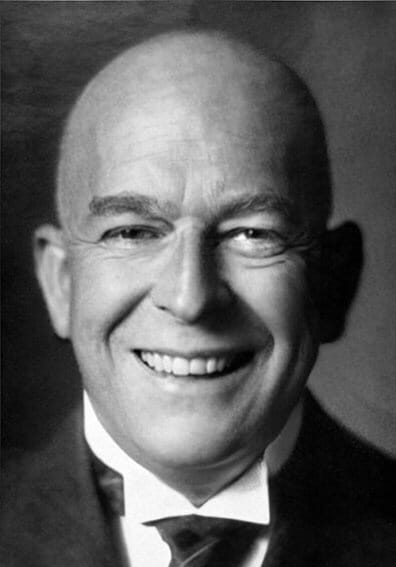
The longue durée nature of Oswald Spengler’s Decline of the West (1917) cannot be overstated, almost a century after his magnum opus has been published it still stands in the face of its critics, who can neither refute it, nor accept it. A refutation of Spengler is clearly a matter of incongruence of paradigms, the incongruity of paradigms is clearly a perennial constant when exploring the development of ideas across world history. The fear of accepting Spengler’s thesis despite the accuracy of his predictions and the fulfilment of his vision is not a paradigmatic one, rather, it is clearly shaped by a dread that fills all individuals when reading Spengler’s work and vision of the future of the West. It is a feeling of dread and hopelessness that one is faced with when confronting the impersonal forces – cultural superorganisms – Spengler designates as the primary driving forces of history. The sheer scale of Spenglerian high cultures dissolve the individual in history, the concept of agency in the liberal Western sense becomes almost irrelevant, which is a view of history that is clearly antithetical to the liberal Whiggish, Hegelian, and progressive notions of history that came to dominate the Western thought during the post-war international order. The individual is only relevant in specific cases where cultural archetypes emerge that essentially play a crucial role in the morphological development of the culture. Further, the individual is relevant only in relation to his participation in his own specific culture. Although the liberal order is intrinsically Western, it had eventually produced a notion of the individual agency that would eventually evolve into one that intentionally detaches the individual from participating as a productive member of his own higher culture. This is essentially why such speculative forms of philosophy of history, like Spengler’s own, where impersonal forces restrict individual agency, are anathema within the liberal world. But as we shall see later across the essay, Spengler’s higher cultures also produced harsh reactions from the political right as well.
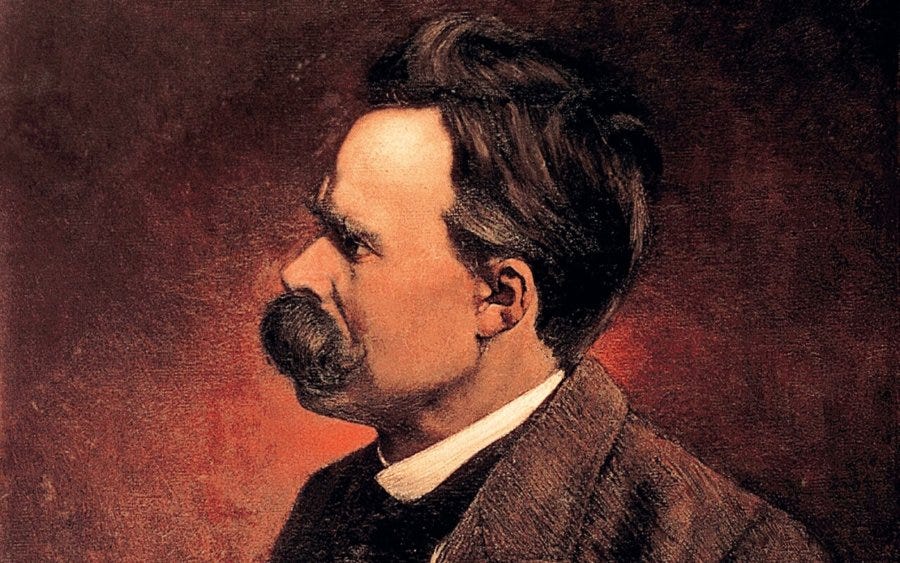
That all being said, Spengler was brave enough to face the abyss of decline, in a rather Nietzschean manner, when others were afraid to confront it, or admit to the clear crisis developing within Western civilization. When eventually confronting the criticism he had received of his work, Spengler reaffirmed his position and defended his pessimism describing his work as a form of “brave pessimism”. Spengler’s intellectual journey can be described as one of perpetually growing pessimism and determinism concerning the fate of Western civilization. The sociopolitical and geopolitical landscape of his own time, that is, the Europe of the First World War and Interwar periods, is one that had clearly strengthened these feelings within Spengler – The Decline of the West is clearly a product of its own zeitgeist. But it is not solely a product of its own zeitgeist, it is a philosophy of history that attempts to transcend its own zeitgeist and project itself unto the future where it remains relevant, it is in itself functioning within the longue durée. This is essentially what makes Spengler’s work unique, the fact that his own work lives on beyond the higher culture that had produced it, outlasting superorganisms. Like Braudel’s slow changing geographic landscapes, the rivers, cliffs, and mountains that have existed, and will continue to exist, beyond the individual and the cultural, Spengler’s timeless Decline as an idea will exist beyond the West. Moreover, Spengler’s philosophy of history was, again, not solely a product of its own zeitgeist, and a work that functions in the longue durée, but it was also much more. It was a product of the very high culture that it had emerged from, namely, the Western-European-Northern-American culture that Spengler had famously dubbed “Faustian”.
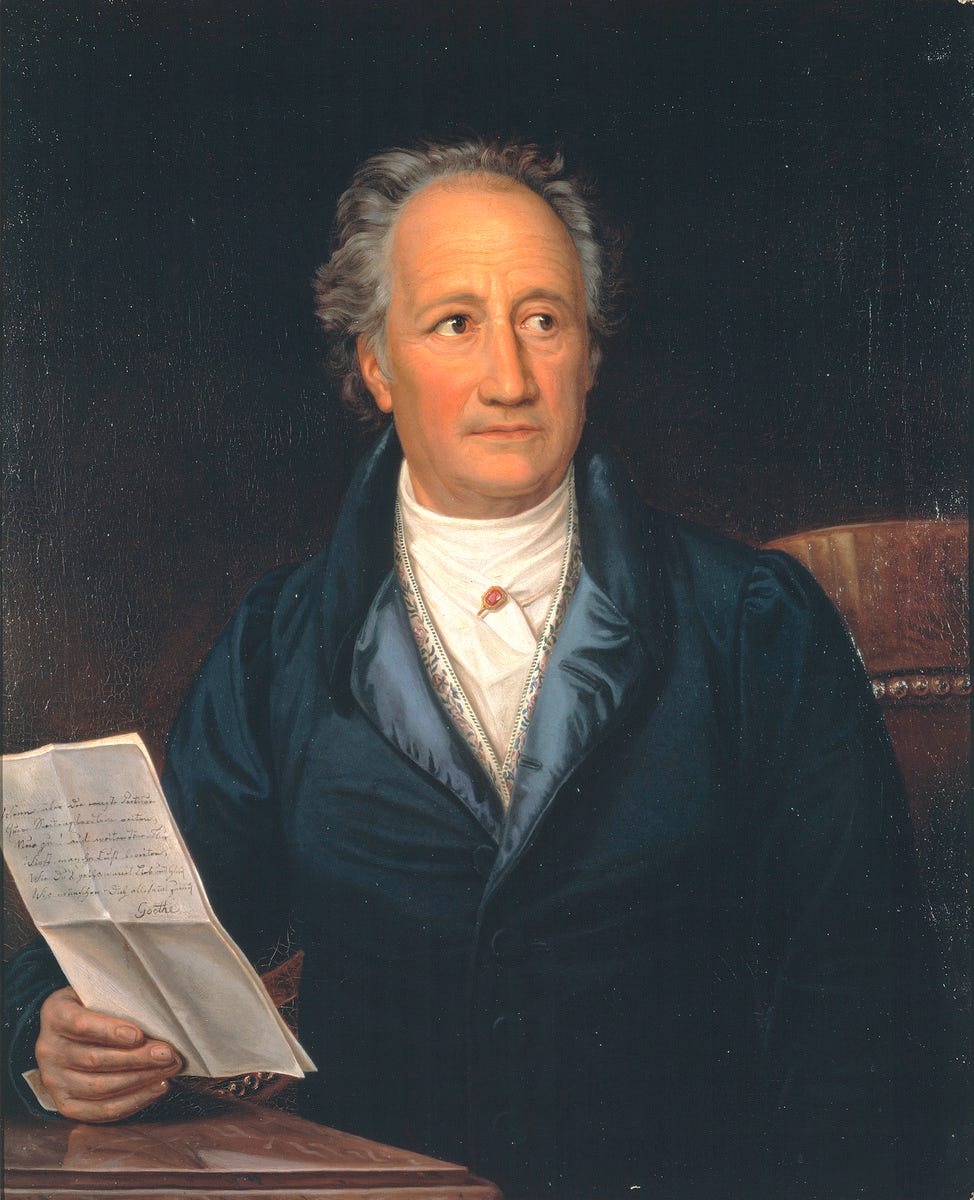
Alongside the Nietzschean Spengler that bravely confronted the abyss of decline, was the humble Goethean Spengler who possessed the poetic insight necessary to reveal the primary actors in the stage of world-history. The Goethean Spengler, who many had wrongly mistaken for a positivist, was a devout student of Goethe whom he was indebted to for his method – the morphology of cultures. The Goethean Spengler argued for a strict separation between the worlds of time and space, the historical and natural, the phenomenal and noumenal. The Kantian element in Spengler becomes very clear here, as many of my more experienced peers have always attempted to remind me. That said, while Kant viewed the phenomenal realm, the world as we experience it with our senses, as the only accessible realm to humans, he denied the possibility of accessing the noumenal world, the realm of “things-in-themselves”, that is the world beyond our senses. Spengler, like Schopenhauer, argued that it was possible to access this specific realm, but where the natural sciences are used to discover the phenomenal world-as-nature, poetry, art, and history are the means by which we can access the noumenal world-as-history, through instinct and feeling rather than intellect. This is the side of Spengler that had produced the most fruitful approach to world history, one that views world history as a drama of several might cultures, cultures guided by unique prime symbols – the driving force of their ontological being – allowing them to produce their unique political, religious, philosophical, scientific, and artistic forms. Spengler truly believed that cultures possessed souls, and once one discovers the soul of a specific culture they cannot help but see this specific soul manifesting itself across all facets of that culture. Cultures are therefore alive, and they are born unto history, grow and expand, bearing their scientific and philosophical fruits to the rest of the world, mature, decay, and eventually die after their destiny is fulfilled. Spengler’s approach is a Goethean one, that is not teleological in the Hegelian sense, nor causal in the progressive Darwinian sense, it is one where the notion of destiny is given primacy over teleology, progress, and causality.

As mentioned earlier, Spengler himself described his philosophy of history as a truly Faustian treatment of history, where the Faustian obsessive tendency to conquer space and time manifest themselves in the very scope and scale he adopted. Like other Western speculative philosophies of history, he had attempted to provide a historical narrative of history as a whole, a totality. Speculative philosophy of history in Western thought was inaugurated as a field by Kant, Herder, and Hegel who had all played different roles in either setting the objectives and subject matter of the field, introducing units of historical analysis, or popularizing the field in Western academic circles as Hegel had done. It is, in a sense, a reflection of a distinct German historical instinct, one that clearly overlaps with the German historicist tradition, which is a term that is difficult to define, but could be simply understood as a unique historiographical paradigm, intellectual culture, and disciplinary matrix. Spengler did describe his philosophy of history as a reflection of a purely German worldview, and philosophy. Here, the Faustian elements are evident, Spengler’s obsession with conquering the laws apparent within world history is quite clear, and in my judgement had profound implications on his personal life. Spengler is a thinker of the Faustian-stamp, one whose personal life is a reflection of a Faustian yearning for the infinite that was directed towards the conquest of world-history and expressed through his philosophy of history. This is the same spirit that had possessed, and is continuing to possess, many significant Faustian characters of world historical significance, all expressing the same spirit in their own specific realms. This is essentially why Spengler had called his treatment of history a purely Faustian one, that is, unique to a specific culture in space and time.
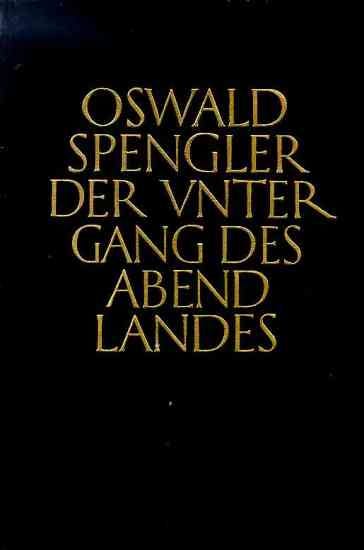
The relativity of Spengler’s own philosophy of history is one of the many points that reveal the paradoxes in Spenglerian thought. Greg Swer had argued that the relativity of Spengler’s philosophy of history, due to his radical stance of cultural relativism and cultural isolation theory, alongside the positivist elements of his work that aims to explore observable historical laws and patterns in history, almost contradict one another, leading him to describe this as a “comparative paradox”, one that makes it challenging to locate Spengler’s ideas within a definite philosophical position. This is a point that many of his critics had mentioned, Adorno, who despite rejecting his thesis continued to revisit Spengler due to the materialization of his predictions, had described Spengler’s work as possessing a totalitarian like power, stating:
He made positivism into metaphysics, subordination to the given into, amor fati, swimming with the stream into cosmic tact, meaninglessness into mystery, and the denial of truth into truth itself. This is the source of his power.
Likewise, other thinkers had described Spengler’s adoption of contradicting ideas as producing a “self-immunizing” effect that allows it to withstand any form of criticism. Spengler’s work, despite its rejection, had generated a considerable amount of criticism, love, respect, and hate, a tome written by a profound thinker working at the periphery of academia that had profound political, social, and philosophical implications, and continues to do so. The Spenglerian paradox, as I call it, the uniqueness of his philosophy of history and its predictive and retrodictive powers, the profound sociopolitical implications of his work when weaponized or practically applied, the infusion of cultural morphology and relativism alongside his position of Nietzschean total detachment, its ever-growing relevance and power when complemented with a position of hindsight, is indictive of the complexity and depth apparent in Spengler and his thought. One can go on for days discussing the thousands of unique ideas and philosophical rabbit holes that can be found in The Decline, let alone the rest of his unpublished and recently translated works. Spengler’s writings are hidden treasure troves of profound historicist insights, unique views on scientific paradigms, original ideas on the links between funerary practices and a culture’s perception of time and space, the existence of cultural-specific mathematical mentalities, art theory, critique of the notion of spacetime, simple history, futurism, philosophy of technology, comparative anatomy and its use in cultural analogy, the borrowing of insights from minerology to discuss the interaction between cultures, and much more. Many often ask me which of Spengler’s works are useful to begin with, and the answer is quite clear when looking at the disparity in scale and size when comparing his works, with The Decline dwarfing most of his other works. The size of the book coupled with the complex subject matter usually intimidates many, naturally of course. That said, I would usually advise many who cannot find the time to read Spengler to simply view his book as a type of encyclopedia, that beyond the initial critical 30 pages, one can jump through different parts of book at will, depending on what specific topic one is interested in. Like other speculative philosophies of history, and perhaps even more, Spengler’s work is a multidisciplinary one, and I have met engineers, poets, businessmen, scientists, and priests who regularly read his work, its appeal becomes apparent once one simply gathers the courage necessary to seriously wrestle and embrace some of his ideas – not surrender to his ideas, bur rather, giving them a chance while leaving space for criticism.
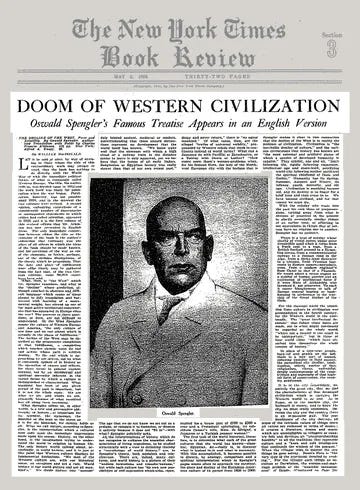
There are a number of stages one necessarily goes through when reading Spengler’s work, or at least, this has been my own journey with his writings. Initially, one is confronted with the complexity and seriousness of the subject matter, a similar feeling that I had developed when reading Hegel’s work but in a more subtle manner, perhaps this is a perennial trait within specific German philosophies. Beyond this brief shock, one continues to read his work, which almost always manages to immediately fascinate any reader, first, because he openly argued to have deciphered the secret to historical laws through a paradigm shifting approach to history, and second, because he oddly begins his book with a conclusion in a rather non-conventional manner. At this state, the reader is perplexed, and continues to read the opening chapter to his magnum opus, and almost unknowingly, begins to gradually lower their philosophical guard. Reading beyond this point, not realizing that the allure of Spengler’s work, his poetic tone, profound insights, and bizarre claims, paves the reader’s path towards an ontological shock, this is the turning point that many serious readers of Spengler have gone through. Subsequently, if one possesses a weak world-view or philosophical standpoint, it is immediately either shattered or challenged at this point. The philosophically stubborn and bright few thinkers who are challenged by Spengler, but continue to face him rather than run away are caught within endless discourse of Spenglerian paradoxes, and produce works that reveal a clear fascination with Spengler despite rejecting his thesis. These types find themselves stuck in a philosophical ouroboros almost always without noticing, it is a useless attempt at explaining the philosophical paradoxes and consistencies in Spengler’s philosophy of history. These attempts at explaining away Spengler are futile, and any serious Spenglerian thinker knows this primarily because they understand that Spengler’s philosophy of history belongs to a completely different paradigm that is incongruent with ones adopted by these persistent thinkers, such as Theodor Adorno, Stuart Hughes, John Farrenkopf, and more recently, Greg Swer. These specific thinkers that have bravely confronted Spengler despite rejecting his work deserve intellectual respect because many thinkers tend to usually ignore his work altogether, and an in depth exploration of Spengler without changing one’s philosophical standpoint reflects resilience on their part. Yet, reading their works, one can clearly see the Spenglerian effect, and more, one occasionally feels the enchantment of Spengler’s work in the words of critics. This is quite obvious with Adorno’s case, in fact, elements of Adorno’s work eventually overlapped with Spengler’s own, specifically in his critique of the enlightenment and its implications. That said, as opposed to Adorno and Horkheimer’s Marxian critique of the enlightenment, the power of Spengler’s work on the other hand led to its anathematization within the anglophone world, and eventually, the rest of Europe during the post-war period. Thus, one can see the hesitance of implicit Spenglerians in professing their acceptance of Spengler’s work, Frye, although clearly inspired by Spengler, had to occasionally defend his sympathetic view of Spengler through claiming that one can adopt Spengler’s method without necessarily believing in everything he said. Spengler’s method is beneficial even when viewing his notion of cultural superorganisms metaphorically, argued Frye, and reading his writings on Spengler, I could not help but feel he had to refrain from fully supporting his ideas for the sake of career progression. Wittgenstein is also similar in this sense, the Spenglerian elements are quite clear, that said, he does not allow Spengler’s idea to fully impose themselves upon his own world-view and philosophical standpoint. Paradigms, however, are mortal as Thomas Kuhn had argued, and are eventually confronted by anomalies that challenge their very existence, paving the way for newer paradigms that replace them.
The historicity of Spengler’s own philosophy of history, combined with our historical vantage point, due to hindsight, allows us to both reaffirm his own ideas, and more importantly, to develop them beyond where he stopped. My argument here is linked to Stephen Clark’s concept of Spenglerian Optimism, which is a creative attempt at projecting Spengler’s own philosophy of history beyond the decline of Western civilization, one shaped by an optimism for the historicity of cultures, and the potential for the human spirit to produce a new high culture. Clark’s paper on this specific topic had inspired me to begin the Spenglerian Optimism series which explores the potential for new future cultures, hidden cultures that might exist around us today, and past forgotten cultures (we should not forget that Spengler’s method was both predictive, and retrodictive). This position is not a departure from Spengler’s philosophy of history, rather, it is an affirmation of Spengler’s own optimism that was expressed in his writings during his younger years, and one could argue, briefly manifested itself in Spengler’s late years when he had moved beyond the cyclicality of his first philosophy of history, infusing it with an extra dose of directionality, to produce an upward spiraling world history in his second philosophy of history. That being said, Spengler’s upward spiral, as a result of modernity’s destructiveness, and the West’s own state of demise, had made him conclude that the next stop for humanity in the spiral of world history is a natural cataclysm, and not a new high culture. The war between nature and man had reached its apex with the advent of Faustian Western culture, Spengler concluded, and thus, it is only natural that nature, and the cosmos – the macrocosm, delivers a final blow due to the existential threat Faustian man had become with his total war against nature. Yet, if one were to revisit the paradoxes in Spengler’s work, namely, the relativity and historicity of his own position, emerging as a byproduct of Western civilization itself, and unique to a specific time and place, combined with the deterministic historical laws apparent in the decline and birth of cultures, one can essentially arrive at a position which affirms a spiral shape to world history, and the necessary birth of a new culture beyond the West’s decline, specifically if that culture is born beyond the Western realms. This, however, is not an absolute departure from Spengler’s critique of modernity as a possible force that could either, transition humanity into a new post-human mode of collective existence, or pave the way for the end of man, and the world as a whole through a real “end of history” – historico-terminus. Spengler’s approach is truly eschatological, and even a position of Spenglerian optimism acknowledges the eschatological dimension of such a subject matter, and thus, Spenglerian Optimism can be described as a katechon philosophy of history, one that attempts to envision a future where organic cultures proliferate in a post-modern future in order to avoid, or postpone, the eschaton – apocalypse. This, to me, is a moral imperative, in a world where Spengler’s own predictions seem to be materializing in front of our very eyes, from the rise of Caesarism in the West as a result of the crisis of parliamentary crisis, to the exponential growth of technological progress and the ever-increasing meaninglessness of hypermodern reality, and the intensification of the ecological crisis as a result of Faustian man’s war with nature. Chris Rojek once described Spengler’s work as possessing vampiric qualities, dubbing it the nosferatu of theories of social change, sucking the blood out of crises in order to renew itself again despite being constantly buried and neglected. Spengler is the prophet of our own age, and a realization of this almost instantly leads to a scarier awareness of the seriousness of this statement, since Spengler’s final prophecies are literally ones of pure eschatological dimension, losing faith in Western man, and humanity as a whole, he had not only predicted the Second World War, the destruction of Germany beyond this war, but also a global cataclysm once the episode of Western civilization terminates the saga of higher cultures in world history. As mentioned previously, Spengler was profoundly controversial to a degree that he was not only anathematized in the liberal spheres, but his works were also banned by the Nazis at one point after they had realized they themselves were viewed as symptoms of decline in Spengler’s historically totalitarian thesis, where even the Nazis themselves felt threatened when he had imposed his bleak pessimism on their shortly lived megalomania-driven optimism. “A prophet is not honored in his own country”, and their relevance and value only become realized centuries after their anathematization and crucifixion, such was the case of Spengler with his own Western civilization. Yet, with our unique historical vantage point, observing Spengler’s spiral of world history extend itself into the remote past, and make its away to our present moment, we can predict and manifest a new future:
There we are sounding the last necessities of life itself. We are learning out of another life-course to know ourselves what we are, what we must be, what we shall be. It is the great school of our future. We who have history still, are making history still, find here on the extreme frontiers of historical humanity what history is. -Oswald Spengler
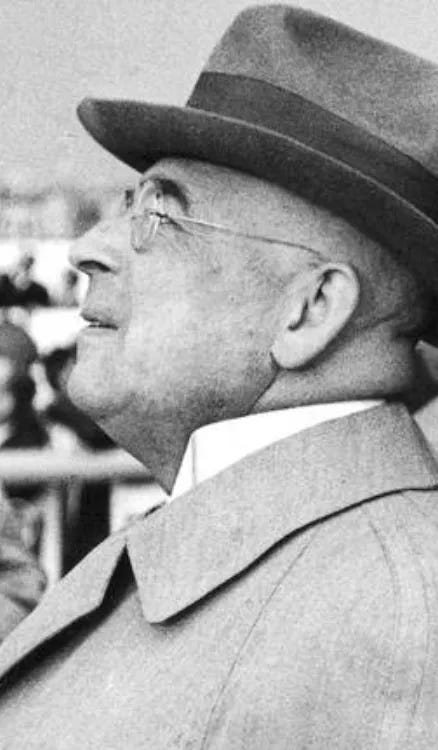
With a position of Spenglarian optimism many possible futures emerge, multiple temporalities, and new possible cultures that might as well already be functioning around us today without us realizing their existence. The optimist within Spengler himself, like Herder before him, had spoken of a new potential high culture emerging “between the Vistula and Amur” signifying not only the uniqueness of the Russian-Slavic world, arguing for a clear distinction between the West and Russia, but also the possibility of this culture growing into a fully-fledged high culture producing its own unique forms in the future. The last phase one arrives at when reading Spengler, which I had not mentioned earlier, is the stage of adopting a Spenglerian paradigm and world view, this is essentially when the individual affirms Spengler’s approach to all phenomena, to a degree that the individual cannot unsee Spengler’s work in everything they experience or observe. Spenglerians cannot help but view morphological connections between all facets of a culture, whereby the West’s conquest of space is not a surprise when observing Gothic architecture’s unique use of space; or the clear morphological connections between the emergence of bells within the West and their current modern obsession with time and the end of time perfectly embodied with the Doomsday Clock; it is the clear connection between the oneness of God, Arabesque, and domed structures in Magian (Middle Eastern) culture; and the obvious link between Indian mathematical conceptions, the Hindu concept of maya, and the practice of cremation in their funerary rituals. A Spenglerian position is thus a pre-requisite for Spenglerian optimism, since the latter is merely an attempt to extend the former beyond its temporal and spatial limitations, that is, limitations based on the theories cultural-specific position in the West, and Spengler’s own extreme pessimism as a result of living through the metaphysical decline of the West (these ideas are explored further in my previous writings, and will be expanded on properly across the series). Ever since Clark published his paper introducing the concept, many Spenglerians have attempted to project their own visions of new possible cultures that could exist beyond the West’s decline, from the concept of an “Aenean” civilization emerging from within the West itself (which I introduced and critiqued previously), to the notion of an Aridoamerican culture emerging as a result of the synthesis between the West and indigenous American cultures, and the possibility of a new high culture emerging within the ASEAN sphere in Asia. Some have also projected this approach into the deep human past, in what could be described as retrodictions of past hidden, or dead, cultures, such as the idea of a unique Celtic culture that was distinct from the Germanic and thus guided by a different principle and unique prime symbol, or soul, with the symbol of the trinity knot as its designated prime symbol. A lost, or extinct, Polynesian culture that possessed a unique conception of space that Spengler described as one that could have developed a peculiar mathematical instinct that would evolve into a non-static higher geometry, hence their discovery of the boomerang. Both the retrodictive and predictive elements in Spenglerian optimism makes it necessary to borrow ideas shared by other speculative philosophers of history that complement the Spenglerian paradigm, such as Arnold Toynbee, William Irwin Thompson, Carroll Quigley, and Jean Gebser, to name a few. Of course, this can only be done if specific ideas are borrowed and not their overarching theses that conflict with Spengler’s own. More recently, Eric A. Castro, whose efforts in inaugurating a new reconsideration of Spengler’s work had inspired me to write this specific piece, had provided his own unique view of the West’s future, one that I describe as a form of Spenglerian optimism, but also one that is clearly adhering to the Faustian spirit and form. This “Faustian Optimism” as I call it, is not only controversial (for many reasons I shall expand on soon), but also a new brave and daring attempt to extend the life of the West beyond its own Spenglerian timeline. These traits are precisely why his idea of a Faustian future guided solely by the “Spanish spirit” should be taken into consideration. I will not say much about this here and now but will provide my own critique and examination of his argument in a different post. But prior to publishing my critique, I will post Castro’s argument, alongside a new contribution to the series that presents the idea of Aridoamerican culture that clashes with the concept of Western “Hispanidad”. Despite the clash of these two future Spenglerian visions however, there are also clearly a lot of areas where these two ideas overlap, which could possibly present a middle ground where these two ideas possibly converge. Castro’s initiative to revive the discussion on Spengler’s timeline is not only timely, but crucial when considering the most recent world developments. It is also a reminder that Spengler’s work should be presented within alternative platforms beyond the academic world where his work had been denied the intellectual respectability it deserved for almost a century now
Links:
Substack -
Eric Aaron Castro - Society, Soul, and Style: Spengler and the Question of the West in the 21st Century: https://substack.com/home/post/p-164903163
Aksinya Staar , Eric Aaron Castro, and myself, will be initiating a dialogue on Spengler's work in the 21st century, and the recurring relevance of Spenglerian concepts. Stay tuned!
Comments
Nothing yet. Say the first thing.
Sign in to join the conversation.