
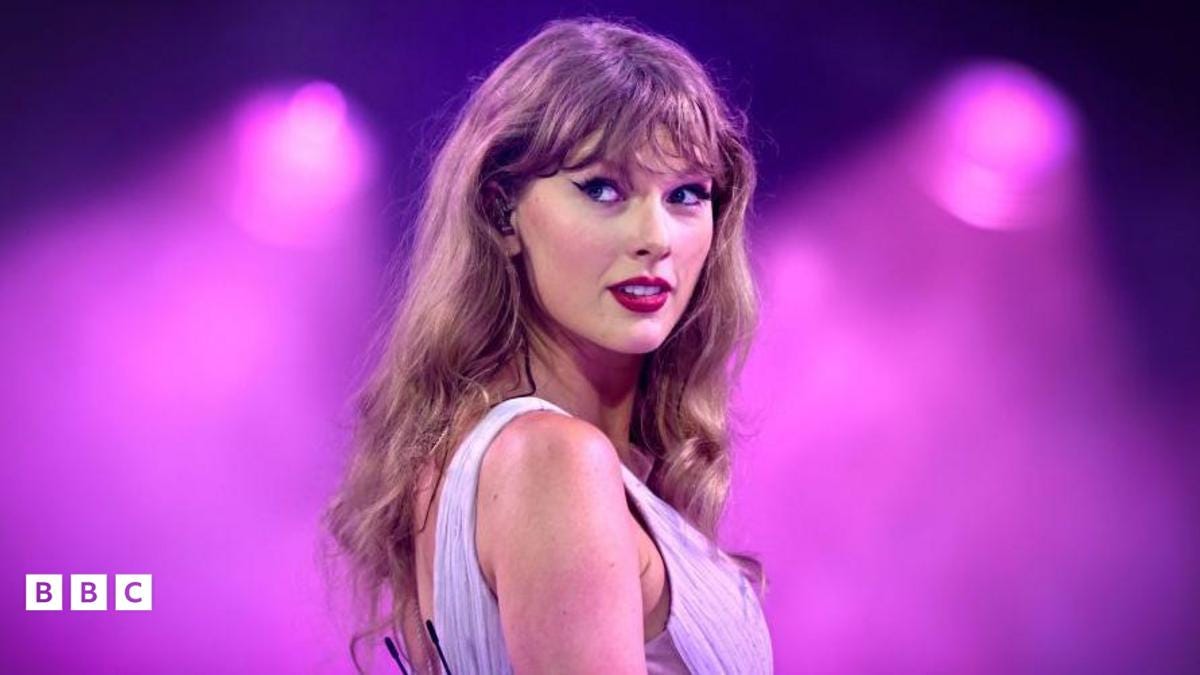
Back in the noughties, people would ask me what my guilty pleasure was, and hesitantly, I’d mumble out “Taylor Swift.” Twenty years on, I can actively say I’m proud to call myself a Swiftie. I’ve been hypnotised by the diversity of her catalogue, but just as much by the community she’s built around her. As we celebrate an artist who has weathered every storm thrown at her and come out the other side as one of our generation’s greatest living songwriters and performers - still breaking records 20 years in - I realised how often I’ve used Taylor’s tactics as a blueprint, not just for my work, but for my life.
Looking back, here are the best life lessons she’s taught me.
Taylor Swift is many things. Cool, in the traditional sense, has never been one of them. She wasn’t the artist held up for impeccable style, and writing songs that ached for boys was never the territory of the certified edgy. That’s exactly why she landed on my guilty-pleasure list for so long. But across every era, she’s refused to perform detachment, and in that refusal, she handed her fanbase something rarer than hit singles: proof that you don’t have to fit the mould to win.
She’s said it herself: “being yourself is the bravest thing you can do.” With Taylor, that isn’t a generic statement - it’s the core of who she is. In an industry built on mystery, effortless cool, and branded personas, she has done the opposite at every turn. Earnest when irony was fashionable. Emotional when detachment was considered cool. Unapologetically enthusiastic about the things she loves - her cats, her bridges, her own tendency to overthink a text for forty minutes. Her real legacy was never just the songs. It was permission for millions of people to stop auditioning for a version of themselves the world supposedly wanted, and just be the person already standing there.
In a culture addicted to nonchalance, she made it acceptable to be weird, soft, and quirky. And that’s the quiet magic of the fandom she built: it says you’re allowed to be exactly who you are, because underneath the differences, we’re all running on the same treadmill , moving through the same heartbreaks, the same confusion, the same growing pains. It doesn’t matter if you were smoking behind the bike sheds or rolling dice over Dungeons & Dragons - we’re all going through the motions of life.
That’s why millions see themselves in her. She never auditioned for “coolest person in the room” , she bet on authenticity beating image, every time, and that’s likely the reason she’s been able to withstand 20 years in the limelight.
As she told NYU’s graduating class: “Never be ashamed of trying. Effortlessness is a myth.”
The geeky pop culture nerd in me still loses it over the moves Taylor Swift has pulled throughout her career. She’s a strategic genius, full stop, and every move she makes just cements the army she’s built around her.
Case in point: reclaiming her music and rewriting the rules of the entire industry. Quick recap - her original master recordings got sold without her having any say in it. She wasn’t having it. Instead of just fighting it out in court or hoping public opinion would do the work, she re-recorded her first six albums as “Taylor’s Version” - brand new masters, owned by her, on her terms.
Fans didn’t just show up, they turned the whole thing into a cultural moment. What could’ve been a career setback became a landmark win for artist ownership. This was never just about getting the songs back. It was about proving you can take your work back on your own terms, no permission needed.
And the ripple effect was massive. For decades, losing your masters was just the cost of doing business - the unfortunate trade-off every emerging artist swallowed to get signed. Taylor blew that assumption up in public. She proved fans would actively choose her new versions over the originals, and suddenly ownership wasn’t some niche contractual footnote anymore - it was a mainstream conversation. Artists started talking openly about owning their work. Labels got put under a microscope. Fans started asking real questions about where their streaming money actually goes.
But honestly? For me, this smashed a belief I’d been carrying around forever. Follow the rules. Work the system. Stick to the blueprint and you’ll make it. I now say fuck that. I’m doing things my way, on my terms, and just because a system exists doesn’t mean it’s the right one. You have the power to rewrite your own story — nobody’s handing you permission for that. You take it.
Which brings me nicely to my next lesson from the class of Swift. I always wanted to change the world but assumed I’d need an army behind me to do it. Turns out Taylor’s the one who taught me that’s backwards - everyone already has the power. Passion alone builds the momentum. You don’t need permission to start.
For most of her career, Taylor stayed firmly out of politics. She’d watched other female celebrities get torn apart for speaking up, and she was scared of alienating half her audience. As a talent manager, it’s something I fear a lot too, and it’s often why I advise my own clients to stay clear of talking politics.
That tension finally cracked open on camera in Miss Americana, where we watched her wrestle with it in real time before deciding to publicly endorse Democratic candidates in Tennessee. At one point in the doc, she says it outright: “I need to be on the right side of history.” That’s not a PR line. That’s someone realising silence was never neutral , it was a choice too, and not the one she wanted to keep making.
That moment kicked off what’s now called the “Taylor Effect,” and the ripple went way past music. In 2018, after her very first political endorsement, over 169,000 people registered to vote in 48 hours, per Vote.org. Then in 2023, one single Instagram Story telling fans to register led to 35,252 new registrations in a single day - Vote.org clocked a 1,226% spike in participation in the hour right after she posted. One story. One hour. That’s insane.
Politicians talk about her influence like it’s a real electoral force. Universities study it. Campaigns either chase her endorsement or quietly dread it. She never ran for anything. She didn’t need to. She just proved that in this century, cultural influence can hit just as hard as political office - and that you don’t need a title to move millions of people. You just need to actually mean it.
In 2016, Taylor Swift experienced one of the biggest public backlashes of the social media era. Following a highly publicised feud with Kanye West and Kim Kardashian over the lyrics to “Famous,” edited footage of a phone call was released that appeared to paint Taylor as dishonest. Within hours, the internet turned on her. Her social media was flooded with snake emojis, #TaylorSwiftIsOverParty trended worldwide, and she became one of the first celebrities to experience what we now recognise as modern cancellation.
Rather than fight every headline, Taylor disappeared from public life for almost a year. When she eventually returned in 2017, she did something unexpected: instead of rejecting the snake symbol that had been weaponised against her, she reclaimed it. Reputation opened with giant inflatable cobras, snake imagery dominated the album’s artwork and stage production, and she transformed an insult into a badge of resilience.
It was more than a comeback album - it was a lesson in narrative control. Rather than allowing the internet to define her story, Taylor rewrote it herself, demonstrating that the most powerful response to public shaming isn’t always denial or retaliation, but reclaiming the narrative on your own terms.
The instinct when life knocks us down is often to hide, defend ourselves, or try to erase what happened. Taylor did the opposite. She accepted that she couldn’t change the past, but she could change what it meant. The very thing that was intended to destroy her reputation became the foundation of one of the biggest creative and commercial triumphs of her career. It’s a reminder that our greatest setbacks don’t have to be the end of our story - they can become the beginning of a better one.
Long before the sold-out stadiums and the billion-dollar tour, Taylor Swift was a teenager pitching songs on Music Row in Nashville, getting rejected far more often than she got a yes. She wrote “Tim McGraw” at sixteen, alone in a room with a guitar, with zero guarantee anyone outside her bedroom would ever hear it. That’s the part of the story that’s easy to skip past once someone becomes this big , but it’s the actual engine behind everything that came after.
It’s easy to look at Taylor Swift and see the records, the stadiums, the business empire, the cultural influence. But those things are the outcome, not the cause. At the heart of everything she has achieved is an almost obsessive commitment to her craft. She understood something that many of us forget in a world fixated on followers, personal brands, and algorithms: if you create work that genuinely means something to people, everything else tends to follow.
That’s perhaps the greatest life lesson of all. Focus less on chasing success and more on becoming exceptional at something you truly care about. Be curious. Put in the hours when nobody is watching. Keep refining your craft even after you’ve “made it.” Success built purely on image is fragile, but success built on substance has a habit of lasting.
Taylor’s career has been filled with reinventions, controversies, victories, and setbacks, but every chapter has been held together by one constant: an unwavering love for storytelling. It’s why people don’t just consume her music , they see themselves in it. And perhaps that’s the real secret behind one of the most remarkable careers of our generation.
The greatest achievements rarely come from chasing fame or validation. They come from caring so deeply about your craft that the world can’t help but pay attention.
Twenty years in, I’m still taking notes. Maybe that’s the real lesson underneath all the others: the artists - and the people- worth paying attention to aren’t the ones performing certainty.
They’re the ones still showing up, still trying, still rewriting the story on their own terms. Here’s to the next twenty Miss Swift - it’s been a privledge being part of your community.
No posts
Comments
Nothing yet. Say the first thing.
Sign in to join the conversation.