

Ariana Grande, who has cemented herself with legendary status, is one of the biggest pop stars in the world. She hasn’t toured in seven years, just came off an Oscar nominated role as Glinda in Wicked, and returned to the charts with an absolute banger. Yet the loudest conversation surrounding her comeback isn’t about her voice, her awards, or her music. It’s about her body.
Doom-scrolling through footage from her latest tour one night in bed, I found myself deep in the comments section dominated not by fans (or trolls) talking about that incredible vocal range, but by people obsessing over how skinny she looked. “She looks worryingly thin.” “I’m concerned about her health.” “She looked so much better a few years ago.” The usual abuse targeted at another women, disguised as care.
Ariana has pushed back on this before. In a 2023 , after losing weight for her role in Wicked, she was forced to put out a video on her socials. She pointed out that the body people were calling “healthy” from years previous was the unhealthiest she’d ever been - a period defined by antidepressants, private pain, and depression. She said, plainly, that there are many ways to look healthy and beautiful and said we should become less comfortable with commenting on people’s bodies. The internet’s response? To discuss her body even more. A woman says stop - and the request becomes ammunition.
This isn’t about health. It never was. It’s about a cultural belief, now so deeply embedded it barely registers, that public figures owe us access to their bodies. That appearance is public property. That scrutiny is care. And we should all still be judged by the way we look.
So how did we get here? And have we ever been shallower?

 Tiktok failed to load.
Enable 3rd party cookies or use another browser
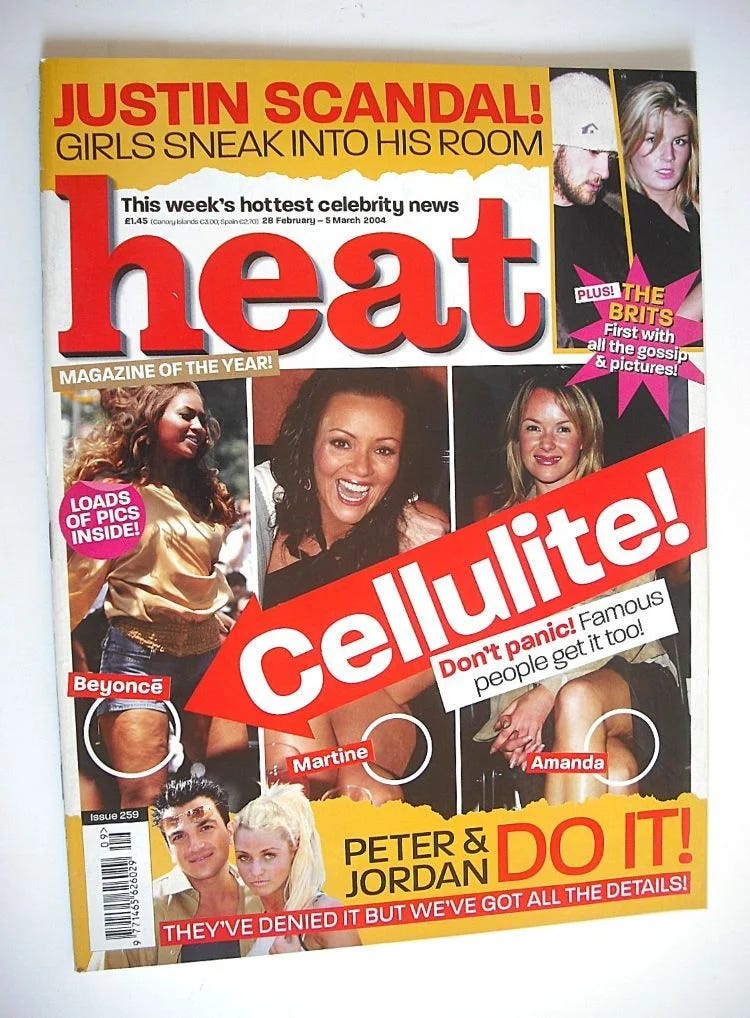
It’s tempting to think we’ve come a long way from those dreaded circles in Heat magazine, zooming in on a woman’s cellulite on a beach holiday. And in some ways, we have. Overt body-shaming has become socially unacceptable. Magazines don’t run those circles anymore. Brands talk about inclusivity.
But something more insidious has taken its place. The nastiness didn’t disappear. It got a rebrand. Now it arrives wrapped in wellness language, in concern, in the language of health advocacy. And crucially, it scaled. The red circle in a magazine reached a few million readers. A viral TikTok comment reaches the world. Just that video Ariana released , got over 17 million likes.
A 2023 report by the Centre for Countering Digital Hate found that Instagram and TikTok were algorithmically pushing body image content to teenage girls within minutes of them interacting with it - trapping them in a loop of comparison. The old media was a one-way broadcast. The new media is a mirror and it’s nearly impossible to look away.
Ariana’s scrutiny wasn’t random though. It’s the cultural output of a society that has never been more obsessed with appearance, and increasingly unable to admit it.
Take “looksmaxxing” - the practice of systematically optimising your physical appearance using science, routine, and often extreme measures. What started as a niche corner of Reddit has become mainstream. The hashtag #looksmaxxing has accumulated over 600 million views on TikTok. Jawline chewing exercises, mewing tutorials, skin routines for 12-year-olds, and cosmetic surgery “wishlists” have become a genre of their own. People are uploaded images of their faces and being asked to rated, and what they should change about their appearance.
Even I have become susceptible to the effects of trying to become the most attractive version of myself, all brought on by TikTok videos. I’m getting my eyebrows waxed (something I would have never done out of fear of being judges, and the pain of waxing), but TikTok told me to do it, and who wouldn’t want to be the most attractive version of myself. I even found myself uploaded a picture of my face to Chat GPT and asking how I could be the most attractive version of myself.
The global beauty and personal care market is now worth over $600 billion, projected to hit $800 billion by 2025. Cosmetic procedures in the UK rose by 40% between 2021 and 2023. We are spending more money, time, and psychological energy on our appearance than any previous generation, and we’ve convinced ourselves it’s self-care.
The message is subtle but relentless: your face is a project. Your body is a before photo. There is always a better version of you waiting on the other side of more discipline, more products, more procedures. And when we are conditioned to analyse our own reflection obsessively, it becomes instinct to analyse everyone else’s too.
Here is the trick the culture pulled off brilliantly: it made vanity sound virtuous.
Cold plunges are sold as longevity. Fasting is rebranded as biohacking. Salmon sperm facials are discussed as medical breakthroughs. All these promises selling us the same destination, which has always been, here is how you become thinner, younger, more attractive. Just with a different branding over it.
Take the social “IT Girl” aesthetic. On paper it’s about health: 5am workouts, green juices, supplements, sleep tracking, morning walks. In practice, it is diet culture with a productivity overlay. The goal hasn’t changed. The justification has.
This is exactly why the commentary around Ariana Grande’s weight has felt so normalised. When society frames appearance as a health metric, commenting on someone’s body starts to feel like concern. The line between judgement and care has been deliberately blurred, and it’s working.
And this isn’t only limited to women. Take Zac Efron who appeared with a noticeably different jawline in 2021, the internet immediately launched into forensic analysis. Plastic surgery rumors spread across social media, reaction videos racked up millions of views and his became the key talking point. Efron later revealed he’d suffered a serious injury that shattered his jaw, requiring extensive rehabilitation. Yet even after an explanation was provided, the speculation continued and people thought they had earnt the right to comment on his appearance.
And then Ozempic arrived and changed everything.
GLP-1 prescriptions in the UK tripled between 2021 and 2023. We have watched, in real time, a wave of celebrities and public figures visibly shrink. The conversation around thinness, which had briefly felt like it might be losing cultural ground, snapped back with a vengeance.
Ozempic didn’t just change bodies. It changed what felt impossible to talk about. Just as we had moved away from commenting on appearance, the topic skyrocketed. Now, we’re actively asking for the conversation to take center point again, disguised as medical care.
I don’t know if we are uniquely shallow, compared to previous generations. Think about it - every era has had its obsessions with appearance. The Greeks had beauty as virtue. The Victorians had tight-laced corsets as discipline. The noughties had the red circle.
But I do think we are uniquely dishonest about our obsession. Kris Jenner’s face lift was the most searched for new story last year for a reason. We are obsessed and we refuse to admit it.
Ariana Grande is one of the most talented entertainers of her generation. She gave us a decade of music, a sold-out movie run, a voice that could silence a stadium. And the loudest thing being said about her return is that she looks thin. It’s made me really sad.
That’s not a statement about Ariana. It’s a statement about us.
We have never had more access to information and more real tools for genuine self-improvement. And yet a significant portion of our collective cultural energy is still being poured into the same thing it always has been: how women look, and whether it’s good enough?
I’m tired of waking up, looking in the mirror, and fixating on the way my hair falls to one side. I don’t need strangers telling me the bags under my eyes could use filler. These conversations push us away from self-acceptance and toward chasing something unattainable.
When did we decide that how we look was more interesting than who we are? And why haven’t we changed our minds yet?
No posts
Comments
Nothing yet. Say the first thing.
Sign in to join the conversation.