
If you strip away the bright colors and the networking, character design and animation are essentially just complex psychological landscapes. It’s not about what software you use; it’s about how you manage your anxiety, how you build your reality, and how you eventually force yourself to hit “publish.”
Bought a subscription to Pictoplasma and watched 22 hours of the festival translation to note down their creative decisions, transitions between mediums, and the ways artists survive the industry.
Let the narrative entirely dictate the character.
A character is a vehicle engineered to communicate a specific concept or short story.
If the scene requires a cozy, relaxed baseline, use a mouse.
If you need to broadcast the frantic, relentless exhaustion of the modern worker, use a shrimp, and intentionally speed up the frame rate in post-production to maximize the neurosis.
Mechanics precede aesthetics.
Build the functional skeleton first, understand exactly how the character needs to move, and only then sculpt the skin to fit that movement.
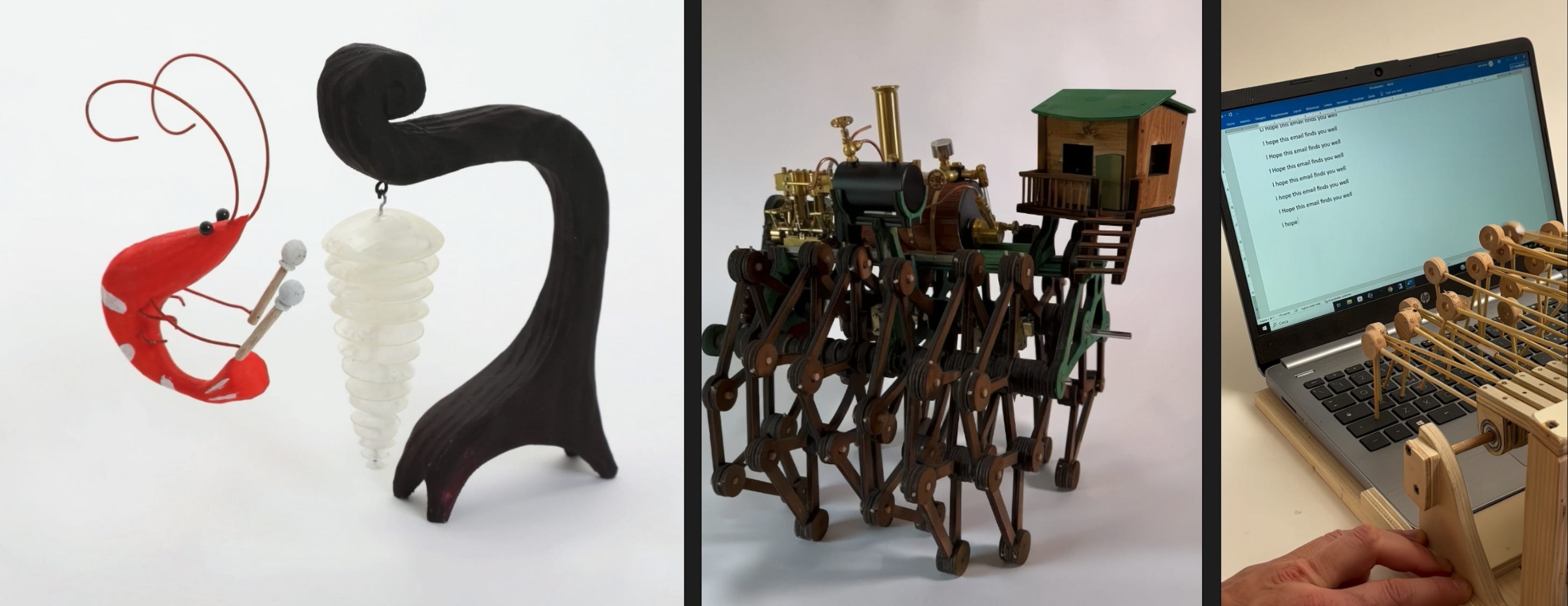
Embrace Chindogu — the art of inventing for the pure pleasure of uselessness.
There is profound value in engineering a massive, overly complicated physical machine solely to deliver a single, fleeting punchline.
The sheer disproportionate effort makes the joke hit infinitely harder. It’s the tactile equivalent of using a multi-billion-dollar AI cluster just to generate a standard “Thanks, sounds good” email reply.
Step out of the weekly content grind.
Slow your production down to a trickle to build manuals so your audience can physically interact with your work.
If the ideas temporarily dry up, don’t panic — just raid your old sketchbooks.
You don’t need to reinvent the wheel every week; sometimes you just need to carve it out of wood.
If you grew up in sunny California playing video games, your work will naturally exude bubbly, rounded joy.
Pitch your own specific madness. Forced joy does not attract - align with your visual frequency.
Weaponize corporate discipline for personal gain. Impose a strict 9-to-5 schedule on yourself not to serve a client, but to relentlessly study a new tool (like 3D) and build an expansive ecosystem for your characters.
Move digital assets off the screen into physical avenues — fabrics, packaging, or massive inflatables.
When scaling up to physical installations, leave zero room for manufacturing guesswork. A meticulously executed 360-degree 3D model is your remote control. It allows you to direct an entire international production line and installation process without ever leaving your desk.
The gatekeepers are an illusion; massive commissions are often secured by simply sliding into the right DMs. Even if they decline now, the worst they can do is say no. Reaching out acts as a memory hook—they might remember you and return later. It’s always worth going for it.
You can sit on all chairs at once — provided the chairs are tiny and the projects are self-sufficient.
In the absence of a strict color palette, a specific lightness of tone of voice becomes your brand’s connective tissue.
“A flower is simply weed with an advertising budget.”
Structure these micro-narratives ruthlessly: setup, journey, resolve, and surprise.
Stripping away unnecessary details isn’t just an aesthetic choice; simplicity is a relief.
Stop answering the useless client question, “How much for a 30-second animation?” Instead, force them to fill out a brief template that asks what actual business problem they are trying to solve.
Consider the micro-format as a part of modular system - it can either be compiled together for a TV commercial or broken down into separate posts for social media.
Clients don’t operate with stranger’s imagination; you must show them the fully realized possibility before they will buy it.
Treat bizarre, lightweight personal experiments with the same clinical reverence as paid client work.
A forced limitation may be the start of a new medium for you. If you physically can’t draw, transition to 3D.
To constantly feed your visual language, create extensive “character flashes.” Whenever you haven’t drawn in a while or don’t know what to do, just draw heaps of characters. This builds a visual library you can reference for later projects. A face drawn on a whim today might be exactly what a 3D model needs months later.
Never underestimate the power of bringing the real world into your digital space. Using an open-source 3D scanner to capture physical objects you’ve sculpted or painted, and then importing them into your software, opens up entirely new aesthetic avenues.
Establish a strict boundary to prevent burnout: completely separate personal and professional practices. This allows uninhibited experimentation without client anxiety.
Keep these experimental pipelines open; you might not know why you’re doing it now, but these seemingly disconnected threads will inevitably link up and pay for themselves later in your commercial work.
Business — especially when you do everything yourself and combine media — is 20% actual work and 80% BTS: showing the mesh, the drawing process, and yourself. If not on Instagram, then definitely in your blog or portfolio.
Declare cross-media skills loudly. Waiting for validation in an isolated local market while an oversaturated global market fills with those who dare is a tragic waste of time.
Use pop culture as a Trojan horse, where familiar icons act as visual clickbait to give the audience a comfortable point of entry into complex narratives.
Filtering heavy current events (like political protests) through a flat, medieval aesthetic is an exercise in cognitive distancing — to process an overwhelming reality without drowning in it.
Stop agonizing over the “deep meaning” of your stylistic choices. Practice radical acceptance: “I just love it” is a complete sentence. You don’t owe the market a profound thesis for your aesthetic preferences.
Remember that historical aesthetic constraints often stem from practical limitations, not a lack of skill. Let your own limitations dictate your style.
Use the resources you have, don’t fight against lack: traditional miniatures lack perspective because paper was a luxurious material back then. Artists couldn’t afford to waste it, leading them to cram multiple stories into a single, flat composition.
Refresh the message by shifting in time: “What would a medieval Ottoman artist do if they lived today?”
Consider a camera angle for a story that resists censorship or taking sides: Islamic miniatures originally bypassed the religious ban on drawing figures by claiming the artwork simply shows the world through the eyes of God.
Inspiration for a specific medium may come from unexpected, seemingly unrelated sources - an easily come from spending hours playing strategy video games.
Relinquishing total solo control is painful but may be necessary.
Recognize the “anxious avoidance loop” in your creative practice. Evading a difficult project or a terrifying medium provides immediate relief, but systematically destroys your confidence in your ability to cope. Confront the work directly.
When completely paralyzed by professional expectations, actively regress. Drawing deliberately in the style of a child is freeing. It bypasses the adult ego, strips away the crushing pressure of industry standards, and instantly resets your visual vocabulary.
Hit “publish” despite massive anxiety: “The stuff that I think is the absolute worst is usually the stuff that people like the most.” You cannot reverse-engineer audience affection. Therefore, publishing must be a conscious, mechanical reflex, completely divorced from your emotional evaluation. Just get it out of your system.
A careless pun doodled on a napkin can literally fund a real-life dog. The market is profoundly absurd. Your “throwaway” ideas hold as much potential as your heavily strategized masterworks, so treat them with equal respect.
Penciling is a safety net, and safety nets breed anxiety. Drawing straight in ink is the ultimate Gestalt move — accepting the “whole” raw image without the neurotic urge to Ctrl+Z it into perfection.
You do not need a noble, agonizing excuse like saving the world or educating the masses to validate your existence as a commercial artist. Accept your trivial desires. Draw the absurd things you want to draw without the guilt.
Comments
Nothing yet. Say the first thing.
Sign in to join the conversation.