
This is Part 2 of a two part series that is aimed at giving the gentlest possible introduction to string theory.
In Part 1 I explained some particle physics and the general problem of quantum gravity, and we learned that the basic issue is that there are simply too many gravity particles at short distances. Today we will learn how string theory solves this problem.
The basic idea is this: string theory states that everything you thought was a particle is actually secretly a very small loop of vibrating string.
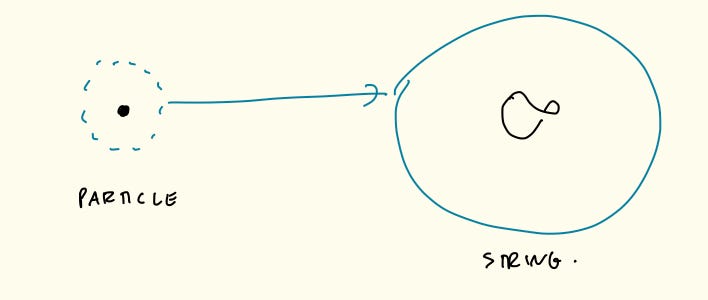
It is, at first, really not at all clear why this helps with anything.
After all, the loops of strings are very small, and if you look at any small object from a great distance, it always looks like a point-like object — a particle — anyway.
However one thing that immediately happens is that we obtain an even more powerful economy of description. Remember that in Part 1 I showed you that there are a wide variety of different kinds of particles — matter particles like electrons and quarks, and force particles like photons and gluons.
It turns out that in string theory, this whole dizzying zoo of particles can arise from just one type of string.
The idea is that a single tiny loop of strings can vibrate in a number of different ways. Because of the intrinsic fuzziness of quantum mechanics, a string never sits at rest — instead it is always somewhat fuzzy, and you can imagine that this fuzziness means that it is always vibrating.
Now remember that from a distance a small loop of string looks like a particle. It turns out that different ways of vibrating look like different kinds of particle. One vibrational pattern might look like a photon, and another vibrational pattern might look like an electron. So in principle — and I will come back to this below — we can get all of the different kinds of particles that we need from just one kind of vibrating string.
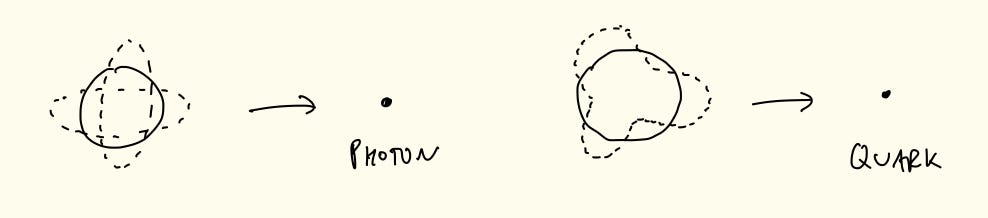
This is pretty nice. The whole zoo of particles — and their associated names and classifications etc. — just collapses to a single idea, the idea that secretly we have strings.
This is very appealing.
This new way of thinking about particles is something of a conceptual shift. In our old, provincial, pre-string-theory way of thinking, particles were thought of as elementary objects in their own right. In a string-theoretical universe this isn’t true any more — instead, they are excitations of strings, and that means that the set of particles is determined by the various ways that a string can vibrate. We are no longer free to think about what types of particles we have in our zoo: instead, the wigglings of the string dictate this.
Next, something miraculous happens.
If we examine all of the possible ways in which a string can wiggle, we see that there is a one vibrational pattern that is very familiar — there is a particular way in which a loop of string can wiggle that makes it look like a a particle that mediates the force of gravity, i.e. a graviton.
In other words, the gravity particle that so vexed us in Part 1 of this series literally just pops out for free. It is built into the framework from the very start. (In fact, there is no way to get rid of it).
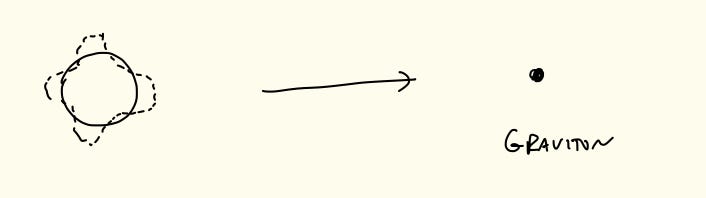
You might have worried that the quantum mechanics of the gravity particle would still be very confusing; after all, in Part 1 we learned that there is a serious problem with a naive quantum theory of gravity, i.e. it seems there are too many gravity particles at short distances. String theory actually also automatically solves this problem. As you might imagine, string theory comes with a natural length — the “string length” — which is basically just the typical size of a loop of string. (It turns out that it is terribly, obscenely, small, but more on this later).
It turns out that at scales that are smaller than this string length, strings become very “floppy”, and you can’t really resolve anything that is smaller than the size of the string1. There is no way to smash together two strings together very hard — they kind of just flop around instead of creating a dangerous explosion of gravitons. The worrying problem of the short-distance gravitons simply goes away once we look closely enough, being elegantly dealt with by the natural floppiness of the string.
In other words, string theory deals with the gravity particle perfectly. So it is precisely a quantum theory of gravity.
So are we done?
Not quite. I now need to tell you about the issues.
First: for reasons that are really rather complicated, string theory only works in ten dimensions.2
We, on the other hand, have four dimensions that we can see — three space, and one time. Thus there is seemingly an obvious elephant in the room, in that string theory seemingly has predicted the wrong number of spatial dimensions.
So to use string theory to describe our universe, it seems we need to get rid of six extra dimensions. One way to do this is to just curl them up. This is basically the same as curling up a two-dimensional piece of paper to make a tight one-dimensional tube, like in the figure below: a sufficiently large bug crawling around the tube will always think of the tube as one dimensional, and will never know that it was once a 2d sheet of paper.
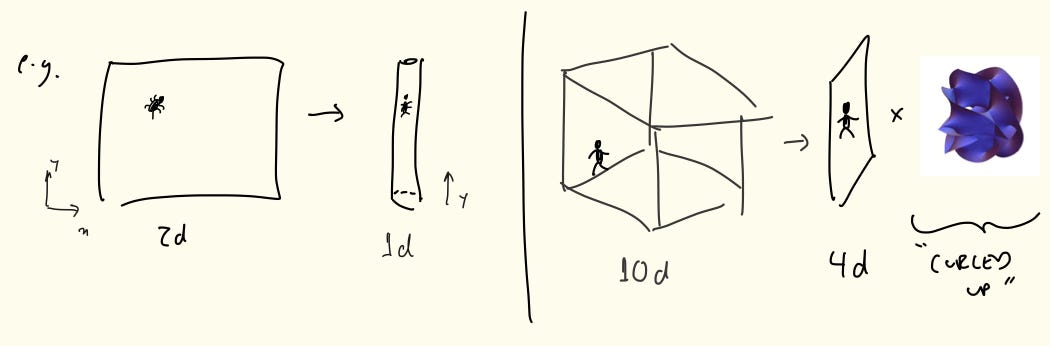
Similarly, you can curl up the six extra unwanted dimensions into a tight little bundle, and a sufficiently large human floating about will never know that their seemingly four-dimensional spacetime has six extra hidden dimensions.
Now, here is the fun part. In the example with the piece of paper and the ant, there was basically only one way to curl up my piece of paper. This is not true for the 10-dimensional spacetime: instead, it turns out that there are many, many ways to curl up these extra six dimensions. Remember that the set of particles we get out of this string theory is determined by how strings wiggle, and the strings can wiggle along these extra six dimensions. This means that depending on how you curl up the extra six dimensions, the physics — i.e. the types of particles you get — in the remaining four “ordinary” dimensions will look completely different. In some of them you might get an extra type of electron. In some of them you might get no electrons at all.
It turns out that it is very, very difficult to actually figure out how to curl up the extra dimensions in such a way that we can find precisely the features that we want — precisely the particle content and the expansion rate etc. etc. — for our own universe. No one has quite done this yet, and it is a field of extremely active research and debate.
So, we have a perfectly good theory of quantum gravity, but it is hard to use it to predict the particle content of our own universe.
So then we should ask ourselves: is it true? We have this brilliant mathematical framework that theoretically solves the problem of quantum gravity — but is it truly realized in nature?
It turns out that this is very hard to directly answer.
As I mentioned in Part 1, quantum gravity — no matter how you study it — is a question that is really only important at very small scales. This means that the strings in string theory are really absolutely miniscule. For example: if you take a hydrogen atom and blow it up to the size of the entire observable universe, one of the strings that hypothetically make up the atom will end up being about a centimetre in diameter. This is so absurdly small that it is basically impossible for me to imagine an experiment that directly probes this. It seems quite reasonable there never will be such an experiment, and that quantum gravity will always be a purely theoretical science. (Of course, we could get lucky — maybe the expansion of the universe will stretch a small-scale effect large enough that we can see it. Or maybe something else will happen that I can’t imagine).
But I should stress that I don’t study string theory because I believe that I will ever see a fundamental string under some kind of suitably sophisticated microscope.
Rather I study it because I am fascinated by the marriage of two of the fundamental principles of our universe, that of gravity and of quantum mechanics. It turns out that — contrary to what you might have heard — these two ideas really do live absolutely beautifully together, and string theory is perhaps the most tractable and concrete example of how they can do so.
And — happily — there is still much for us to understand.
If this interested you, there are many great resources. At a popular science level, I loved the Elegant Universe. And if you already have a physics background, then Barton Zwiebach’s book A First Course In String Theory is a great place to start.
Imagine a bowl of rubber bands. Now consider trying to use this bowl of rubber bands to pick up a grain of salt, which is something which is much smaller than the typical size of a rubber band. This will be difficult because the rubber bands are very floppy.
Now I should stress that this is actually a pretty useless analogy. It really has almost nothing to do with the reason why string theory is UV complete. It isn’t illuminating in any way whatsoever. But whenever I think about the true reason (involving thinking about string loops sweeping out torii in spacetime, and how different torii are secretly equivalent) this is what I’m imagining at the back of my mind. Now you are also cursed in this way.
I have never been able to think of a cute way to explain why this restriction to 10 dimensions is necessary. It follows from a rather technical calculation that enforces a kind of technical requirement. Sometimes I wonder if there is a better way to think about this that allows for a cute argument; if any reader of this blog knows of one, please let me know.
No posts
Comments
Nothing yet. Say the first thing.
Sign in to join the conversation.