
Hi everyone!
Before we jump into this week’s issue, we’re excited to welcome Sett as a partner! Sett is an agentic AI platform for mobile game marketing that creates and optimizes user acquisition creatives, helping mobile game teams find winning creatives faster and grow their games into global hits. To learn more, check out their podcast Unpredictable Hits.
Also, the Naavik team will attend Gamescom next month on August 26 and 27. Reach out if you’d like to meet, discuss the AI ecosystem, or explore consulting support from Naavik.

Industry leaders from Xbox, Sega, PlayStation Studios, and EPAM recently gathered to examine what happens when AI stops following scripts and starts shaping experiences. The conversation covered autonomous NPCs, adaptive world-building, AI safety, and the critical role that human creativity still plays when technology handles repetitive work.
Key themes explored:
From copilot to agent. AI has evolved from coding assistants to end-to-end agentic systems capable of autonomously delivering entire features.
Creativity amplified, not replaced. AI accelerates prototyping, while taste and craft remain irreplaceable — tools alone never reach a creator’s standard.
Living, infinite worlds. Games can now adapt in real time to a player’s personality, mood, and history — moving from static narratives to endlessly evolving content.
Safety first. Player-facing generative AI must be load-tested like live services; poor personalization is “toxic to the experience.”
New genres emerging. Agentic AI is enabling entirely new AI-native experiences while also reviving text-based adventures, giving player deeper agency through more dynamic interactions.
Read the full report here: Agentic AI in Gaming: Evolving Game Development and Player Experiences | EPAM
Written by Francois Courset, Lead Consultant at Naavik
From the moment generative AI entered gaming, QA has been viewed as one of the areas most ripe for disruption. Game professionals rank it among the most exciting AI trends, and 94% of developers believe AI will play a meaningful role in QA’s future, unlocking faster iteration and shorter dev cycles. We’re now seeing bold claims, from EA saying AI now shoulders 85% of its QA testing to Square Enix aiming to automate 70% of QA and debugging by 2027.
So, as usual, we wanted to parse through the noise and paint a full picture of AI for game QA today. Why is the need pressing? How mature is the technology? What will the next unlocks mean for the discipline?
Game QA is as relevant as ever. Studios allocate up to 10% of a game’s total budget to QA. And because testing needs swing wildly across the production timeline, QA has historically been heavily outsourced, turning Game Testing Services into a billion-dollar segment, growing at a healthy ~10% CAGR. High-profile games that faced backlash — like Mindseye, Borderlands 4, or Monster Hunter Wilds — are a reminder of how consequential proper QA execution still is.
Game QA is facing a math problem. Testing scales linearly, but games are exponentially more complex — open worlds, branching narrative, complex physics, multiplayer networking, live-service support, and a growing stack of platforms. 77% of developers admit their last release shipped with less QA than it deserved, and 50% of developers don’t think that QA budgets are growing fast enough to keep pace with growing QA requirements. More efficient QA workflows enable studios to test more of a game, leading to more polished releases, reducing the risk of backlash, and ultimately protecting sales. They also make QA faster and less expensive, addressing one of game development's largest cost centers. That’s the reasoning behind AI-enabled QA workflows: infrastructure that scales without linearly scaling cost, while running around the clock.
Automated QA is not new — scripting, bots, and rule-based test harnesses have been standard tooling for years. Ninety-four percent of developers already use some form of it. The challenge is not whether something can be automated, but rather how it can work cost-effectively and consistently.
Game QA process disruption has been slower than other verticals due to a highly bespoke nature tied to the game’s codebase, and a multiplicity of cases making one-size-fits-all approaches challenging. This has resulted in limited reusability across projects and complex integration processes within QA teams. As Christoffer Holmgård, Co-founder and CTO at Modl.ai, explained in an interview with Naavik: “From a maturity perspective, with very deep integration into the title, you can accomplish a lot for an individual game. But the price to pay is in maintaining this whole test harness. It is like having an extra project on top of building your game.”
This led QA solution providers to prioritize black-box testing. Rather than hard-coding every rule, developers can now deploy AI agents that engage with a game, reproduce human behavior, explore edge cases, and catch bugs. These agents can be run in the cloud and employ computer vision to recognize and interact with game elements. Holmgård added: “Having a solution able to cover any game and just play it is a harder problem in many ways. Black-box testing is the approach Modl.ai and most products are taking. It is completely integrationless, with no code going into the game.”
AI for game QA can be seen as a spectrum of tools, some requiring deep game-level integration and black-box approaches. Key testing technologies include:
Scripted Automation: Deterministic code that performs prescriptive actions in a limited scope
Symbolic AI: Explicit rules, logic, and structured models to reason about a game’s behavior and decide whether it matches expectations
Large Language Models: Models interpreting natural language requests and producing outputs based on these requests
Reinforcement Learning: Driving behavior by training a machine learning model through trial and error, and goal setting
Imitation Learning: Supervised reinforcement learning, where a model learns by using inputs from users simply playing the game
Computer Vision: A system using what’s shown on the screen to derive game behavior
The technical solution alone is not sufficient and needs to be paired with a comprehensive internal infrastructure. As explained by Modl.ai’s CTO: “You have to think through different layers: First is the interface/integration layer which ensures we can interact with all parts of the game. Second is the behavioral layer, which ensures we do actions that are valuable for the QA team. Lastly is the verification layer that checks QA process outcomes and ensures actionable data is collected about the game build.” AI for game QA needs to be approached as a complete overhaul of existing QA processes to establish proper governance, data collection, and feedback loops. This change management angle is key, as only 18% of developers feel their studios are fully prepared to implement AI tools.
Given the focus on cost-efficient and versatile black-box testing approaches, the QA stack currently isn’t entirely addressable. However, significant efficiencies can already be achieved. As Jan Schnyder, co-founder of Nunu.ai, shared with Naavik, “AI for QA is around a year behind other kinds of AI tools. We are approaching the 30% to 50% mark of automatable test cases. And these systems are getting better every month. We are now addressing 50% of the QA stack when at the start of the year it was around 30%.” Automation potential also varies across games: AAA 3D open-world environments remain harder to tackle compared to 2D mobile experiences.
The lowest-hanging fruit currently includes the most repetitive, pattern-based, low-judgment tasks such as test-case generation, bug triage, log analysis, regression checks, etc.
The foundations are in place for broad QA adoption, with use case sophistication expanding by the month. Studios can already achieve meaningful results across some of the easier tasks. The core challenge remains studio readiness to adopt.
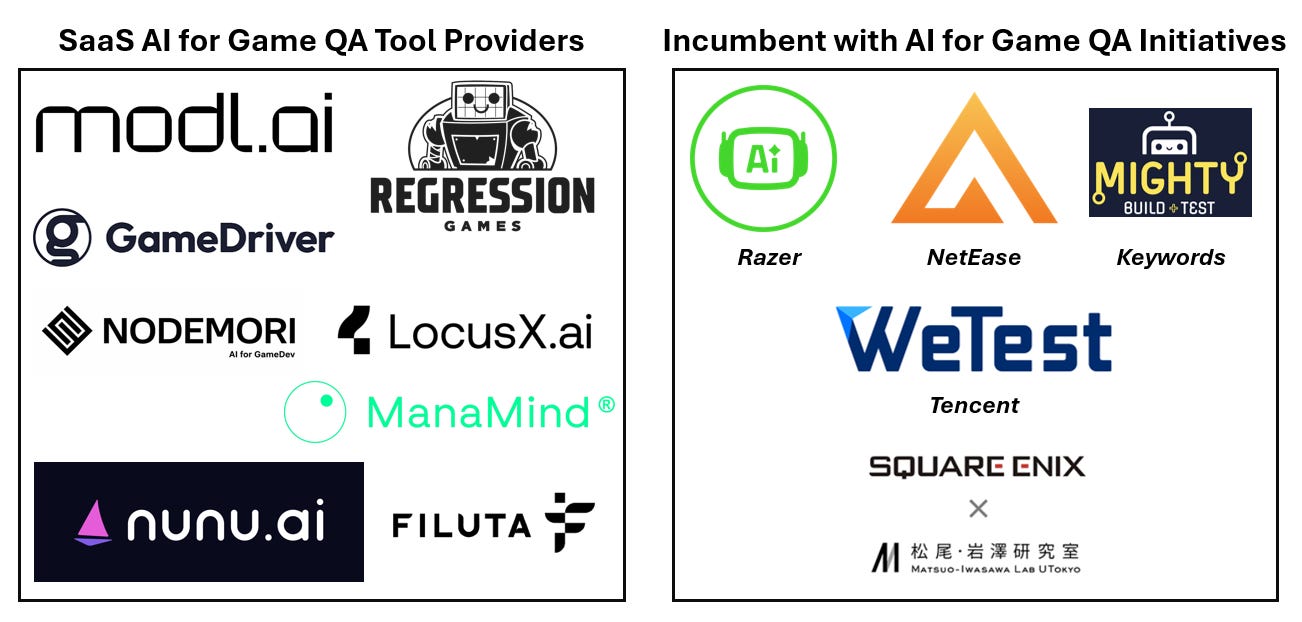
The AI for QA category is early, fragmented, and still waiting for its breakout moment. Startups in the space have raised a combined $35.8M to date, led by Modl.ai and Nunu.ai, but have yet to reach Series B scale. Rare incumbents such as Tencent’s WeTest have the scale to build AI QA infrastructure in-house. Meanwhile, engine makers are exploring the space with Unity Test Runner or Unreal Gauntlet, hinting at a future where they acquire their way into AI QA. While Keywords has some internal AI QA capability, the broader pattern is service providers leaning on startup-built SaaS tools to enhance their offerings, rather than building from the ground up.
Proper case studies are still hard to find, but all point to real cost savings, speed gains, and minimal setup. Nunu.ai got Stormforge to a 30% reduction in QA costs and 5x faster testing in a five-hour implementation. Nodemori is absorbing 40% of QA workload for clients and cutting build validation time in half. Schnyder added: “The biggest value add for our clients is speed, by running their entire QA plans in hours instead of days, which allows them to do much faster iteration cycles while also lowering costs by up to 30%.”
Looking ahead, AI for game QA is poised to benefit from multiple advances around perception, efficiency, and actions. As Christoffer Holmgård explains: “The next biggest unlock is around perception: Giving models the ability to accurately perceive what’s happening, locating objects and things that are going on in the game in a timely manner. For such use cases, you need an always-on system, which means you are entering computer vision robotics territory, and we are seeing month by month new models becoming available.” From an efficiency standpoint: “AI for QA systems are always on; as such, the costs of running are not neutral. Managing what kind of models to use for what part of the work is becoming key, especially as better models become available at cheaper rates or are able to run on smaller hardware.”
We drafted the emerging potential of World Models recently, and AI for game QA could be a key proving ground. As Schnyder put it: “World Models is the single biggest thing I’m excited about, which will address one of the biggest bottlenecks right now for game QA — the ability to do 3D real-time environments through new architectures that allow for much faster inference speed.”
AI for QA is also bound to have broad-ranging impacts inside and outside games. First, solving for game QA means solving one of the most complex software use cases; learnings and tools can then be applied and expanded to any sectors beyond games. Then, these tools will be more deeply integrated with the rest of a game’s production pipeline. As Christoffer Holmgård pointed out: “I’m also excited to see who cracks the workflow problem. Once we have an issue identified in a game, AI for QA shouldn’t stop there. It should then take action proactively to fix the issue and address it and help the developer.” Finally, these capabilities can also be extended to other areas of game production. Schnyder added: “What we’re building is an AI agent that can play your game and can perform tasks with it. We actually see customers adopting this across different sectors of a studio such as competitor analysis, design document generation, or updating internal knowledge bases.”
Editor’s note: We’re building an AI-powered, human-verified competitive intelligence platform that combines automated live gameplay with market and product data to reveal how your competitor games work and evolve. We’re currently in alpha and focused on serving mobile F2P teams. If this could help strengthen your product / competitive research function, we’d love to meet at Gamescom and showcase our prototype. Request a meeting here.
AI for game QA offers significant cost and efficiency gains, and with new black-box solutions paired with upcoming technical unlocks, it is nearing full maturity. As Christoffer Holmgård puts it: “We’re not at the point where the AI for QA can yet tell you whether a game is good. And that’s probably fine, because that’s what the human test team needs to figure out and communicate. But in the next year or so we’re going to see a lot of movement on the fundamental question of ‘does it work?’”
Unpredictable Hits is the podcast where Amit Carmi, Co-founder and CEO of Sett, sits down with the OGs of mobile gaming for the conversations they usually keep off the record. Real talk on the new world of UA and AI, and where the industry is really heading.
Each season is filmed in a different capital of mobile gaming: London, then Barcelona, and now Tel Aviv, home to some of the biggest games in the world and the teams behind them. Season 3 kicks off with Matt Veysberg, Director of Global Creative Marketing at Plarium.
Previous episodes have featured Jon Bellamy (CEO, Jagex), Akin Babayigit (co-founder, Tripledot), Yair Melamed (SVP Games, Zynga), Zeynep Tasoz Cataner (Senior Creative Director, Zynga), and many more. Worth hitting play if you haven’t.
Sett is building agentic AI that helps mobile game teams find winning creatives faster and grow their games into global hits.
Written by Devin Becker, Consultant at Naavik
Character.AI, the company behind the popular AI chatbot service, launched “c.ai Series,” a slate of original short-form vertical dramas produced by an in-house studio with credits spanning Nickelodeon, DreamWorks, Netflix, and Blumhouse. The first titles include a romance anime, a Gen Z paranormal horror, and a virtual-world survival thriller, all produced using AI. The hook is that after watching an episode, 18+ users can open a chat with the characters and continue the story interactively. It is a clever retention play in a booming market. Short drama apps generated significant IAP revenue in 2025, with some expecting it to more than double in 2026 (see our recent digest and podcast coverage on microdramas). Character.AI is betting that layering conversational AI on top of vertical video creates a stickier loop than passive autoplay, one where the character, not the episode, becomes the durable asset.
The question is whether this is primarily a content strategy or a platform strategy. Character.AI says it will eventually open production tools to creators, turning what is currently a studio-led slate into a broader ecosystem. Traditional microdrama economics are brutal, with as much as 90% of platform budgets reportedly going to marketing and user acquisition rather than content. If Character.AI can use its existing chat infrastructure and user base to bypass those acquisition costs, it could build a differentiated position. But first it needs to prove that chat-after-watch is a retention driver, not just a novelty. Fox, Peacock, and Disney are already circling the microdrama space with traditional IP. Character.AI’s potential advantage is that its characters can actually talk back.
Roblox announced “Build,” a mobile-first feature launching July 28th in New Zealand that lets any user turn a text prompt into a playable game directly within the Roblox app. Powered by a mix of open-source and proprietary Roblox AI models (including Cube, its 3D foundation model), Build handles gameplay mechanics, environments, characters, visual style, and sound. Users can iterate, playtest, and publish without ever opening Roblox Studio, though the two tools share a backend, so creators can start in Build and refine in Studio. This is a meaningful expansion of Roblox’s AI creation stack beyond the Studio-based agentic tools it shipped earlier this year. Published games will be available globally to age-verified users 16 and older and will be subject to Roblox’s existing retention-based discovery ranking, the same system that surfaces all other experiences on the platform.
The slop question is unavoidable with one-shot development. Roblox is betting its existing discovery algorithm provides a natural quality filter: if nobody plays it, nobody finds it. That logic held when supply was constrained by the difficulty of building in Studio. Whether it holds when potentially millions of casual users can generate and publish games from their phones is a genuinely open question. The deeper strategic play is clear, though. Roblox wants every one of its 132M DAU to see themselves as a potential creator, not just a player. If even a small fraction converts, this helps discourage creators from considering using other creation platforms, especially those leveraging AI that are starting to emerge. Roblox will certainly be counting on social sharing when everyone can create something they can at least convince a friend to play.
Meta soft-launched Pocket, a standalone mobile app that lets users generate and share small interactive games and experiences using text prompts. The app appeared on iOS and Android on June 29th with no formal announcement, and it is not yet available in the US. Pocket is built on the bones of Gizmo, a vibe-coded gaming platform whose team Meta acquired earlier in 2026. Users can create mini-games from prompts and browse a scrollable feed of others’ creations. Gizmo had generated 635K installs with 98% positive sentiment before the acquisition, and Meta is looking to scale that concept with its distribution muscle.
This is the latest in a string of experimental AI content apps from Meta (following AI-generated images via Meta AI, AI video via Vibes, and AI editing tools in Edits), but Pocket is the first one that sits squarely in interactive entertainment. The quiet launch suggests Meta is still testing product-market fit, and there is no indication yet of integration with Instagram, Facebook, or WhatsApp. But the potential distribution advantage is enormous. If Pocket’s gizmos eventually surface inside Meta’s social feeds, it could reach billions of users overnight. For the gaming industry, Meta entering the vibe-coded games space is noteworthy. This means the largest social media company views AI-generated interactive content as a product category worth investing in.
Yield Guild Games (YGG), once a standard-bearer of blockchain gaming, launched vibecode.game, a discovery and publishing platform for vibe-coded browser games. To kick things off, YGG is partnering with Minds by Animoca Brands for a four-week game jam running through August 10, which includes a “Game Designer Mind” AI agent that helps creators with design decisions, mechanics, and balancing. The pivot is notable: YGG and Animoca were among the loudest voices in the play-to-earn era, and this move signals a pragmatic migration from blockchain infrastructure to AI-powered creation tools. The platform features curated rankings, reviews, and community-driven discovery, positioning itself as a permissionless launchpad where anyone can publish and find an audience.
The timing is interesting, as the bottleneck has shifted from production to distribution. Making a game is easier than ever, but getting anyone to play it is harder. vibecode.game is a direct attempt to build a discovery layer for the emerging wave of AI-built games. Whether YGG’s community, which was built around token-incentivized gaming guilds, translates effectively into a vibe-coded game audience is uncertain. YGG is trying to leverage its Web3 start to improve discoverability for AI-built games, but with such a small audience in comparison to a mature platform in the space like Roblox, this feels more like a last-ditch pivot as Web3 gaming has mostly died out.
MIRA Multiplayer Interactive world models with Representation Autoencoders
Grok’s programming tool was uploading its users’ entire codebase to cloud storage
Moonshot’s Kimi K3 pushes Chinese AI into Fable-level territory
FL Studio 2026 turns its AI chatbot into your assistant engineer
Apple’s failed self-driving car program left a legacy of powerful AI chips
Reverse Engineering a Commercial AI Cheat: How AI Agents Changed the Way We Work (Armada): “While my findings on the cheat are obviously an important part of this engagement, this methodology turned out to be just as interesting. Agentic AI tooling applied to reverse engineering is not a marginal improvement. The economies of large-codebase analysis have shifted. A piece of commercial software that might have required weeks of manual static analysis to map structurally can be characterized in days when you’re asking questions rather than reading files.”
The State of AI in UA Creative (Sett): “Across the pipeline, AI now does the work that used to eat a creative team’s week with many creative tools that make it easier or faster to produce creatives - be it assets, optimization, editing, and more. It is also able to spin up variations of the same concept at a lower and lower cost - similar to templates. But creative tools have the same ceiling. They run on a concept you already have.”
What do Steam fans really think about AI in games? (GameDiscoverCo): “Conditional acceptance is the order of the day: ~51% of the 2,100 analyzable answers accepted AI for some uses but not others, for example: ‘I’m fine with limited AI use for support tasks, not for replacing human creativity.’ On the ‘acceptable’ side, the clear winner is coding/programming: code helper tools like Claude Code had ~239 mentions as acceptable. This was way more than other categories like prototyping & and placeholder assets (119 mentions), and/or tedious or repetitive tasks (101 mentions).”
Building an AI game testing agent with Amazon Bedrock (AWS): “Automated game testing isn’t new, but previous approaches have always struggled to keep up. Can an AI agent on Amazon Bedrock deliver autonomous QA that actually works?”
Naavik’s team of experts has helped over 300 companies — publishers, studios, tech companies, and investors — succeed across the video game industry. We’d love to work with you too! Here’s how we can help, spanning all platforms, genres, and regions:
Strategy Consulting: Market research, corporate strategy, game and economy design, gamification, live-ops strategy, AI strategy, product management, brand and performance marketing, and more.
M&A and Investment Advisory: Expert commercial due diligence for buyers, fundraising support for sellers, and fractional CFO/CSO services.
Fractional Talent: The one-stop shop for top-tier fractional talent covering dozens of game industry roles — analytics, design, marketing, art, QA, and more.
Check out the links above to learn more. If you'd like to discuss how Naavik can support your team, click the box below or send us a note at consulting@naavik.co.
No posts
Comments
Nothing yet. Say the first thing.
Sign in to join the conversation.